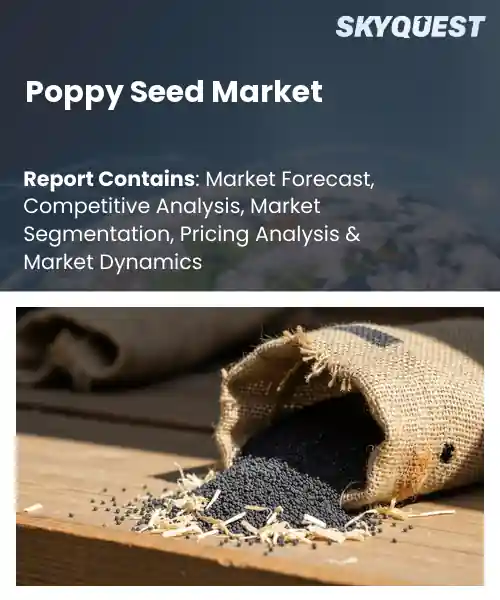
Poppy Seed Market
Report ID: SQMIG30H2468
Report ID: SQMIG30H2468
[email protected]
USA +1 351-333-4748
Report ID:
SQMIG30H2468 |
Region:
Global |
Published Date: July, 2026
Pages:
157
|Tables:
118
|Figures:
77


Global Poppy Seed Market size was valued at USD 1.22 Billion in 2024 and is poised to grow from USD 1.28 Billion in 2025 to USD 1.92 Billion by 2033, growing at a CAGR of 5.21% during the forecast period (2026-2033).
Global poppy seed market growth is driven by an increased consumer demand for modern culinary and specialty products manufactured using seeds. This drives production and trade. The global market includes raw seeds and their derived products (e.g., cold-pressed oil and processed ingredients) used by bakers, candy makers and food manufacturers. The creation of these goods serves as a connection between the farmers who grow the seeds and the various premium food and personal-care value chains. Historically, the global poppy seed market has transitioned from localized production throughout Central and Eastern Europe as well as parts of Asia to a network of international suppliers. This shift has taken place due to the supply chain's regulatory pressures resulting from increasing alkaloid testing for imports, thereby forcing the industry to invest in cleaning techniques that altered how they source and price their goods.
The poppy seed industry primary growth opportunity is based on the advancement of technology and the resulting upgrades in the processing and traceability areas of the business. As a distributor processes its goods in compliance with regulatory standards and as a distributor maintains high-quality products, it is able to expand its ability to enter into various markets as well as charge a premium for its product and thus create revenue. The increased compliance and quality, as well as the increased availability, results in merchandisers within the EU and North America providing larger orders from exporters and in turn financing growth in the capacity of the exporter by lowering the levels of alkaloid contaminants present in the seeds. That causal chain creates opportunities for product diversification as cold-pressed poppy oil enters specialty foods and cosmetics, and for contract farming models that stabilize supply, while higher margins incentivize downstream branding and vertical integration.
How is Blockchain Improving Traceability in the Poppy Seed Market?
Due to the development of immutable records to follow each lot of poppy seed from the farmer's field through to final processing, Blockchain is significantly increasing the ability to trace the product in the poppy seed supply chain. Much of this will be accomplished through tamper-proof provenance and the connection of laboratory test results through timestamps on all handling events identifying when cleaning was accomplished and when the lot was tested for alkaloids. Due to the increasing pressure from purchasers and regulatory authorities for pure source and cleaning histories because of strict food safety laws, the current method seems to be using digital identification (ID) for growers, processors recording washing and testing events and retailing verifications of the chains of custody being recorded on a shared ledger.
Each covers a major reduction in audit time required and provides verified sourcing for premium bakery and specialty food customers. KoRo June 2026, acquired Seedtrace to introduce blockchain verified supply chain tracing across its product range, demonstrating how immutable lot histories enable faster audit resolution, targeted recall handling and smoother supplier onboarding, all of which help unlock premium channels and improve efficiency for poppy seed sourcing.
Market snapshot - (2026-2033)
Global Market Size
USD 1.22 Billion
Largest Segment
Blue/Black Poppy Seeds
Fastest Growth
Poppy Seed Oil
Growth Rate
5.21% CAGR
To get more insights on this market click here to Request a Free Sample Report
Global poppy seed market is segmented by type, application, distribution, end-use and region. Based on type, the market is segmented into Blue/Black Poppy Seeds, White Poppy Seeds and Poppy Seed Oil. Based on application, the market is segmented into Bakery & Confectionery, Culinary (Spice), Pharmaceutical and Poppy Seed Oil (Cosmetic/Edible). Based on distribution, the market is segmented into B2B Food Manufacturers, Online Retail and Supermarkets. Based on end-use, the market is segmented into Food Industry, Pharmaceutical Industry and Personal Care. Based on region, the market is segmented into North America, Europe, Asia Pacific, Latin America and Middle East & Africa.
The Blue/Black Poppy Seeds segment leads the way because of their greater flavor and eye-catching appearance which are why they are usually used as mainstay ingredients in baked goods and savory items which create a constant demand for large food manufacturing companies. The fact that they are commonly used in traditional recipes and have established quality specifications allows for good procurement practices. Therefore, many manufacturers develop formulations based on this variety and generate continuity for this segment by repeatedly using it within their entire product range.
In contrast, the White Poppy Seeds segment is experiencing the most rapid growth as manufacturers seek milder-flavored, lighter inclusions that meet changing consumer preferences and clean label requirements. Innovations in value added processing and expanded uses as ingredients in high-end candy and gluten-free formulations will expand the demand, create many new product introductions, and provide ideas for specialized suppliers and brands focused on niche marketing.
The leading segment of the poppy seeds market is Bakery/Confectionery because they form the majority of everyday consumption in the general population leading to a constant/continuous demand for the level of quality/consistency to be supplied by manufacturers. The trend toward providing variations in texture and appearance in bread, baked products, and candy, has led formulators to specify particular grades of poppy seeds resulting in larger demand at-scale for raw ingredients, standardised manufacturing processes and long-term contracts.
While Bakery/Confectionery is currently the dominant segment for poppy seed, Pharmaceutical is experiencing the fastest growth. The increased research into active compounds derived from poppy, coupled with stricter regulatory requirements/quality management systems has resulted in higher demand for both pharmacopoeial grades and traceable supply chains. In addition, the development of therapeutic-based applications, as well collaborations between ingredient suppliers and drug developers, continue to create more high-value opportunity for both parties which will result in further investment and increased levels of compliant production practices and certified processing technology being applied to growers and manufacturers.
To get detailed segments analysis, Request a Free Sample Report
Europe has the leading position in the global poppy seed market owing to an already established production base, integrated supply chains, and continuously high culinary and industrial demand from multiple markets. The regulatory framework in Europe, in conjunction with the quality control systems that ensure the consistency of the products sold throughout the EU, have made Europe attractive to international buyers because they know their products will be of high quality. The long-standing experience of producers and processors has produced specialized producers of different types of poppy seeds which have led to greater differentiation of the food and confectionery products that utilize these seeds, while being centrally located to both major markets (in terms of consumers) and processors in the large consumer markets of Europe. Extensive R&D and breeding programs have all contributed to bolstering the stability of poppy seed and trait performances, while applications in food, confectionery, and oil extraction have continued to grow. Further, the partnership between different segments of academia (universities) and industry has enabled accelerated innovation and the development of new market opportunities for poppy seeds.
Advancements in processors, a deep-rooted baking tradition, strong quality management programs, and an established traceability system have played an integral role in the growth of the German Poppy Seed Market. Integrated farm to factory systems, along with highly knowledgeable agronomy practitioners, ensure consistent availability and differentiated products are created. Traceability and certification are both heavily emphasized in the German Poppy Seed Market, thus providing strong confidence to buyers whose products use poppy seed. Finally, partnerships between cooperatives, processors, and research agencies are facilitating innovation and adaptation to both changing consumer demands and industrial applications across the many distribution and manufacturing channels around the Germany.
The Poppy Seed market in the UK is thriving, with a growing demand for artisanal baking and health-related items. This trend is also evident by a growing number of high-quality and easily traceable products on the market. Several specialties bakers are pushing the envelope and coming up with new ways to sell their products using innovative techniques, which is beneficial to everyone in the supply chain. Additionally, the increased emphasis placed on food safety, labeling, and the traceability of the product will inspire the trust of future buyers that will eventually lead to an increased level of sales.
The poppy seed market in French tends to mirror the needs of the industry by drawing on the rich culinary traditions associated with French food as well as a business environment that supports the artisanal bakeries that exist throughout France. Because the French culture has a long tradition of being highly discriminating regarding the flavor and origin of the ingredients they use in their cooking, they continue to support a large number of producers and processors through their ongoing pursuit of both oil and seed extraction and processing. The strong emphasis on the labeling of ingredients and the gastronomic reputation of the products will have a dramatic effect on the potential for products to be premium positioned. The ability of producers, processors, and chefs to collaborate effectively allows for the continued development of new products, as well as the retention of the relevance of these products to each of the various distribution channels.
Asia Pacific expansion is driven by shifting consumer preferences toward diverse culinary experiences, increasing incorporation of poppy seed ingredients in bakery, confectionery, and modern fusion cuisines, and growing interest in functional and specialty oils. Rising urbanization and expanding retail networks enable broader market access and product visibility. Domestic processors are improving quality and adopting international standards to meet sophisticated buyer expectations, while regional trade linkages facilitate supply diversification. Investment in supply chain infrastructure, cold chain logistics, and processing technologies enhances product shelf life and safety. Cultural adaptation of traditional recipes alongside innovation in ready to eat and premium product formats has elevated demand and positioned the region as a fast evolving market for poppy seed applications. Collaboration among industry stakeholders and research centers supports quality improvement and tailored cultivar selection for regional climates.
Poppy Seed Market in Japan is shaped by sophisticated consumer tastes, a strong culture of confectionery craftsmanship, and high standards for ingredient traceability and presentation. Retail channels and specialty bakeries favor premium, fine textured seeds and refined oil for culinary and pastry use. Domestic processors focus on precision milling and quality control to meet exacting chef and consumer expectations. Collaborative efforts among suppliers and culinary professionals drive tailored product introductions
Poppy Seed Market in South Korea benefits from dynamic food innovation, strong snack segments, and growing interest in premium and functional ingredients among trend focused consumers. Retail innovation and cafe culture support novel product formats integrating poppy seed inclusions and oil blends. Domestic manufacturers emphasize quality, purity, and appealing sensory profiles to attract discerning buyers. Cooperation between culinary innovators, ingredient suppliers, and retail channels accelerates product trial and adoption nationally
North America is reinforcing its role through a combination of innovation in processing, emphasis on food safety and quality assurance, and diversification of product offerings to meet evolving consumer preferences. Strong research and development efforts support advances in milling, oil extraction, and value added formulations, while industry consolidation enhances distribution efficiency. Retail and foodservice channels are introducing upscale and functional products that raise category visibility. Investment in supply chain transparency and sustainable sourcing practices improves market credibility. Cross border trade relationships and collaboration among growers, processors, and academic institutions support continuous improvement, enabling the region to play an increasingly influential role in global poppy seed value chains. Focus on product differentiation, private label innovation, and partnerships with culinary professionals is expanding application use across bakery, confectionery, and niche industrial segments.
Poppy Seed Market in United States is shaped by strong innovation in processing and product development, broad retail and foodservice channels, and demand for clean label and functional ingredient attributes. Large scale processors and specialty manufacturers offer diversified product formats for bakery, snack, and industrial applications. Emphasis on quality assurance, traceability, and sustainable sourcing supports buyer confidence. Collaboration among growers, ingredient suppliers, and culinary developers drives product concepts and expansion
Poppy Seed Market in Canada is influenced by emphasis on sustainable agriculture, niche crop development, with focus on high quality standards that appeal to premium buyers. Processors concentrate on purity, gentle milling, and oil extraction adapted to specialty requirements. Strong collaboration among growers, cooperatives, and research organizations supports cultivar selection and best practices. Retail and foodservice channels highlight traceable, responsibly sourced ingredients, fostering consumer trust and uptake across culinary applications
To know more about the market opportunities by region and country, click here to
Buy The Complete Report
Rising Demand In Food Applications
Growing Preference For Natural Ingredients
Regulatory Restrictions on Opium
Supply Chain Vulnerabilities and Harvesting Challenges
Request Free Customization of this report to help us to meet your business objectives.
Competitive intensity in the global poppy seed market is driven by tighter opiate residue rules and concentrated supply from the Czech Republic, Turkey and Tasmania, forcing processors and traders to pursue processing tech and partner deals to secure compliant supply. Examples include Semix’s thermo-stabilisation for low-alkaloid supply, AGRA GROUP’s stabilized-milled processing, Cognizant’s infrastructure deal with McCormick and Olam Agri’s sustainability alliances.
SkyQuest’s ABIRAW (Advanced Business Intelligence, Research & Analysis Wing) is our Business Information Services team that Collects, Collates, Correlates, and Analyses the Data collected by means of Primary Exploratory Research backed by robust Secondary Desk research.
As per SkyQuest analysis, rising consumer demand for seed-based culinary and specialty products is a key driver shaping the global poppy seed market, supported by a growing preference for natural ingredients as a second driver that boosts clean label and health positioning. A significant restraint remains regulatory restrictions on opium which raise compliance costs and complicate cultivation, processing and trade. Europe is the dominating region thanks to established production bases, integrated supply chains and rigorous quality frameworks. The Blue/Black poppy seed segment dominates the market due to its intense flavor and entrenched use across bakery and savory formulations. Investment in processing and traceability will determine near term access to premium channels.
| Report Metric | Details |
|---|---|
| Market size value in 2024 | USD 1.22 Billion |
| Market size value in 2033 | USD 1.92 Billion |
| Growth Rate | 5.21% |
| Base year | 2024 |
| Forecast period | (2026-2033) |
| Forecast Unit (Value) | USD Billion |
| Segments covered |
|
| Regions covered | North America (US, Canada), Europe (Germany, France, United Kingdom, Italy, Spain, Rest of Europe), Asia Pacific (China, India, Japan, Rest of Asia-Pacific), Latin America (Brazil, Rest of Latin America), Middle East & Africa (South Africa, GCC Countries, Rest of MEA) |
| Companies covered |
|
| Customization scope | Free report customization with purchase. Customization includes:-
|
To get a free trial access to our platform which is a one stop solution for all your data requirements for quicker decision making. This platform allows you to compare markets, competitors who are prominent in the market, and mega trends that are influencing the dynamics in the market. Also, get access to detailed SkyQuest exclusive matrix.
Table Of Content
Executive Summary
Market overview
Parent Market Analysis
Market overview
Market size
KEY MARKET INSIGHTS
COVID IMPACT
MARKET DYNAMICS & OUTLOOK
Market Size by Region
KEY COMPANY PROFILES
Methodology
For the Poppy Seed Market, our research methodology involved a mixture of primary and secondary data sources. Key steps involved in the research process are listed below:
1. Information Procurement: This stage involved the procurement of Market data or related information via primary and secondary sources. The various secondary sources used included various company websites, annual reports, trade databases, and paid databases such as Hoover's, Bloomberg Business, Factiva, and Avention. Our team did 45 primary interactions Globally which included several stakeholders such as manufacturers, customers, key opinion leaders, etc. Overall, information procurement was one of the most extensive stages in our research process.
2. Information Analysis: This step involved triangulation of data through bottom-up and top-down approaches to estimate and validate the total size and future estimate of the Poppy Seed Market.
3. Report Formulation: The final step entailed the placement of data points in appropriate Market spaces in an attempt to deduce viable conclusions.
4. Validation & Publishing: Validation is the most important step in the process. Validation & re-validation via an intricately designed process helped us finalize data points to be used for final calculations. The final Market estimates and forecasts were then aligned and sent to our panel of industry experts for validation of data. Once the validation was done the report was sent to our Quality Assurance team to ensure adherence to style guides, consistency & design.
Analyst Support
Customization Options
With the given market data, our dedicated team of analysts can offer you the following customization options are available for the Poppy Seed Market:
Product Analysis: Product matrix, which offers a detailed comparison of the product portfolio of companies.
Regional Analysis: Further analysis of the Poppy Seed Market for additional countries.
Competitive Analysis: Detailed analysis and profiling of additional Market players & comparative analysis of competitive products.
Go to Market Strategy: Find the high-growth channels to invest your marketing efforts and increase your customer base.
Innovation Mapping: Identify racial solutions and innovation, connected to deep ecosystems of innovators, start-ups, academics, and strategic partners.
Category Intelligence: Customized intelligence that is relevant to their supply Markets will enable them to make smarter sourcing decisions and improve their category management.
Public Company Transcript Analysis: To improve the investment performance by generating new alpha and making better-informed decisions.
Social Media Listening: To analyze the conversations and trends happening not just around your brand, but around your industry as a whole, and use those insights to make better Marketing decisions.
REQUEST FOR SAMPLE
 REQUEST FREE CUSTOMIZATION
Global Poppy Seed Market size was valued at USD 1.22 Billion in 2024 and is poised to grow from USD 1.28 Billion in 2025 to USD 1.92 Billion by 2033, growing at a CAGR of 5.21% during the forecast period (2026-2033).
Competitive intensity in the global poppy seed market is driven by tighter opiate residue rules and concentrated supply from the Czech Republic, Turkey and Tasmania, forcing processors and traders to pursue processing tech and partner deals to secure compliant supply. Examples include Semix’s thermo-stabilisation for low-alkaloid supply, AGRA GROUP’s stabilized-milled processing, Cognizant’s infrastructure deal with McCormick and Olam Agri’s sustainability alliances. 'McCormick & Company', 'Frontier Co-op', 'Penzeys Spices', 'Adams Foods', 'Olam International', 'Eurasian Natural Resources Corporation', 'ETG Group', 'Agora Spice Company', 'Badia Spices Inc.', 'Simply Organic (Frontier)', 'Starwest Botanicals', 'Pacific Botanicals', 'Mountain Rose Herbs', 'Morton & Bassett Spices', 'Deep Foods India', 'Bolner's Fiesta Brand', 'Vikki Brand (Turkey)', 'Natco Foods (UK)', 'East End Foods', 'Spar (various retail brands)'
Expanded culinary and bakery applications have increased the incorporation of poppy seeds as flavoring, texture, and visual garnish, encouraging producers to scale cultivation and processing capacities. As food manufacturers reformulate products for diversity and authenticity, they turn to poppy seeds for sensory contribution and shelf stability, which creates steadier procurement patterns. This steady demand motivates investment in supply chains, quality control, and marketing that in turn lowers barriers for new market entrants and supports product innovation across ready to eat, bakery, and condiment segments.
Health And Functional Positioning: Growing consumer focus on natural, functional ingredients is elevating poppy seeds beyond traditional bakery use into health-oriented portfolios. Their perceived nutritional attributes and versatility in oil, flour, and whole-seed formats attract formulators seeking clean-label, plant-based alternatives. Product developers leverage poppy seeds for texture, omega-rich messaging, and fiber content while emphasizing provenance and traceability to meet wellness-conscious expectations. Partnerships between suppliers and health brands foster innovation in supplements, snacks, and fortified foods, positioning poppy seeds as premium ingredient with storytelling potential.
Why does Europe Dominate the Global Poppy Seed Market? |@12


Want to customize this report? This report can be personalized according to your needs. Our analysts and industry experts will work directly with you to understand your requirements and provide you with customized data in a short amount of time. We offer $1000 worth of FREE customization at the time of purchase.
Feedback From Our Clients


 USA (+1) 351-333-4748

