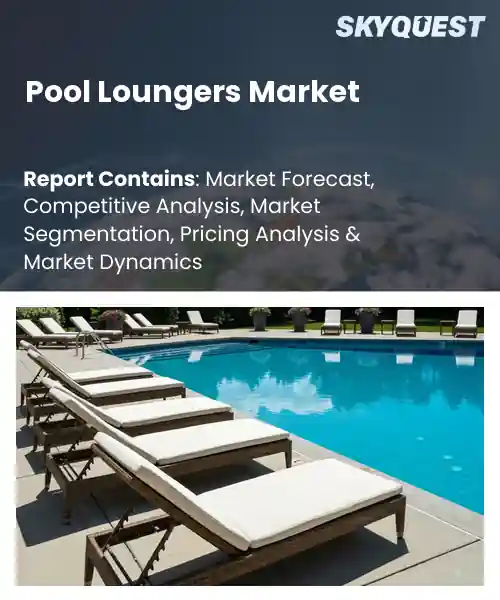
Pool Loungers Market
Report ID: SQMIG25J2227
Report ID: SQMIG25J2227
[email protected]
USA +1 351-333-4748
Report ID:
SQMIG25J2227 |
Region:
Global |
Published Date: June, 2026
Pages:
157
|Tables:
144
|Figures:
78


Global Pool Loungers Market size was valued at USD 1.52 Billion in 2024 and is poised to grow from USD 1.61 Billion in 2025 to USD 2.52 Billion by 2033, growing at a CAGR of 5.81% during the forecast period (2026-2033).
The global pool loungers market consists of seating options designed for outdoor use at pools, both residential and commercial, ranging from basic aluminum-frame loungers to ergonomic loungers with weather resistance and integrated storage. The global pool loungers market growth is driven by factors including growing disposable income, increasing home improvement budgets, and the growing popularity of outdoor leisure time as a direct consequence of home renovations that occurred after the pandemic. Up until recently, the market was primarily filled with inexpensive plastic chairs, but beginning in 2015 manufacturers have embraced premium designs that feature powder-coated finishes, recyclable fabric, and multiple options for adjustable recline. This expansion of the target audience for loungers has led to the hotel chains throughout Europe and North America expanding their pool side offerings, thus, contributing to the overall growth of the market.
The current state of the market is such that sustainable materials are being adopted quickly, giving the manufacturer an immediate advantage. It appears that consumers prefer loungers made from recycled aluminum, reclaimed wood, or bio-based polymers and as a result, retailers throughout Asia are stocking premium "green" lines of loungers. This new demand has created higher profit margins to fund the continued development of ergonomic loungers, which allow users to experience less fatigue while sitting and to be comfortable on cooler night, both of which appeal to hotels that want to separate their guest experience from the competition. As a result, the blend of eco‑friendly credentials with enhanced functionality expands the market’s addressable base and opens fresh distribution avenues through dedicated green e‑commerce platforms and drives long‑term profitability for manufacturers globally.
How is IoT Integration Shaping Design Trends In The Pool Loungers Market?
Loungers will soon transform into smart, comfortable spaces thanks to IoT technology. Sensors installed in each lounger can track temperature, light levels, and posture while providing real-time feedback through an app. In doing so, the app is able to automatically adjust the built-in heating, cooling, and LED lights within the lounger. This new design incorporates low-profile electronics within a sleek design that doesn't interfere with the overall appeal of the lounger. Additionally, these loungers connect to the internet and can be programmed ahead of time, allowing users to arrive at a comfortable lounger after swimming, thus extending the time they spend using the pool. Because of the emphasis on creating a sleek look, manufacturers are moving toward creating a minimalist silhouette so that they can hide smart modules.
The increase in demand for personalized outdoor living will make IoT features a significant way to differentiate between products that combine technology with relaxation in the market. Stump & Company launched an IoT-based sensor enabled lounger in January of 2025, which automatically adjusts temperature and light through a mobile device, demonstrating the effect of IoT on design innovation and the resultant growth of the market.
Market snapshot - (2026-2033)
Global Market Size
USD 1.52 Billion
Largest Segment
Chaise Lounge Chairs (Poolside)
Fastest Growth
Floating Pool Loungers
Growth Rate
5.81% CAGR
To get more insights on this market click here to Request a Free Sample Report
Global pool loungers market is segmented by type, material, end-user, distribution, price and region. Based on type, the market is segmented into Floating Pool Loungers, Chaise Lounge Chairs (Poolside) and Inflatable Pool Rafts. Based on material, the market is segmented into Foam/EVA, PVC Inflatable and Resin/Plastic. Based on end-user, the market is segmented into Residential and Commercial (Hotels, Resorts). Based on distribution, the market is segmented into Online Retail, Sporting Goods Stores and Pool Supply Stores. Based on price, the market is segmented into Budget, Mid-Range and Premium. Based on region, the market is segmented into North America, Europe, Asia Pacific, Latin America and Middle East & Africa.
The Floating Pool Lounger segment continues to dominate, since consumers want to experience sitting on a floating item that provides easy comfort and mobility on the water’s surface. This has led to product innovations that are based on ergonomic designs and buoyant materials being developed and further exacerbates brand loyalty. Because floating pool loungers offer a direct connection to the pool, they do not create the need for extra accessories and correspond with consumers’ lifestyle aspirations for luxury in their products, providing continued leadership in the market.
On the other hand, the Chaise Lounge Chair segment is experiencing the most tremendous growth because designers are delivering weather resistant frames with interchangeable accessories that provide consumers with an option for versatility in seating surrounding pools (i.e., on both the pool’s edge as well as the surrounding patio), and allow for innovative use opportunities. Retailers are allocating additional shelves for chaise lounges, which is contributing to the overall market growth of chaise lounges and will continue to do so at an accelerated pace.
The most popular inflatable segment is the PVC inflatables. They provide a cost-effective solution with a good balance of portability and water resistance that appeals to many who want convenience but don't want to sacrifice longevity. The flexibility of the material gives manufacturers the ability to create vibrant designs using a chlorine resistant material, which increases consumer confidence in the product. The easy storage and rapid inflating features of an inflatable also add to its overall appeal, making it the top inflatable product choice in the residential and commercial market segments.
The resin/plastics segment is a new key high growth area for inflatable products. The new eco polymer blends used in this segment have a lower impact on the environment and supply a stronger product than traditional materials; these benefits appeal to environmentally conscious buyers who are looking for a durable product and to high-end establishments looking for strong products. As a result, the manufacturers of resin/plastic products are expanding their products and retailers are marketing their green features, driving market growth.
To get detailed segments analysis, Request a Free Sample Report
The North American region is in a dominant position for the following reasons; affluent lifestyle consumers, extensive private and commercial swimming facilities and an established retail infrastructure that adopts new styles quickly. Additionally, there is a significant seasonal demand based on warm climatic conditions and a cultural emphasis on outdoor activities. Brands that are positioned in the high end and use premium raw materials align with the level of consumer expectations for comfort and durability, while sophisticated distribution networks provide broad coverage throughout the marketplace. Also, the hospitality industry focuses on creating upscale experiences near their pools which helps to further fuel demand for high-end pool loungers throughout hotels, resorts and residential communities.
The pool loungers market in the United States will continue to rely on the breadth of backyard recreation and the large segment of the hospitality industry that also utilizes high-end pool environments. This has provided consumers with preferences for custom designed and ergonomically designed loungers thereby helping to create a robust product pipeline, while significant distribution channels have enabled rapid entry into the market place. The continued focus on outdoor living spaces and the integration of pool areas into the design of homes will increase demand, which in turn will continue to enrich the relationship between manufacturers and retailers.
In Canada, the Pool Loungers Market continues its development through seasonal leisure activity practices as well as a trend of increasing residential pool installations in warmer climates. Retail environments emphasize lifestyle branding which promotes buying premium loungers, while the hospitality industry in tourist areas looks for opportunities to provide guests with a comfortable design at the poolside. The market also continues to see emphasis on sustainable materials due to increased environmental awareness among consumers, thereby giving brands another opportunity to differentiate themselves.
In Europe, the market is seeing exponential growth mainly due to increased customer focus on wellness and outdoor living, coupled with a strong design culture that values beauty and functionality. The need for compact (or smaller-than-usual) residential spaces also supports the development of new space-efficient loungers. At the same time, premium poolside products are being offered by luxury hotel chains to create a unique guest experience. A greater awareness of the need for eco-friendly materials leads to continued growth in demand for eco-friendliness, while e-commerce channels have resulted in greater accessibility to all segments of the population for these types of products. These elements create a strong case for Europe as having the possibility of being an innovative marketplace for product(s) and market share.
Pool Loungers Market in Germany benefits from a strong tradition of engineering excellence and a consumer base that values high‑quality craftsmanship. Retail channels emphasize design sophistication and durability, aligning with a preference for long‑lasting products. Hospitality venues in upscale resort areas prioritize premium loungers to complement refined poolside settings, while residential trends highlight outdoor leisure spaces, further stimulating demand across the country.
Pool Loungers Market in the United Kingdom is distinguished by a rapid uptake of contemporary designs that merge comfort with stylistic flair. Urban dwellers are increasingly incorporating private pool installations into modern homes, prompting a surge in demand for adaptable and space‑efficient loungers. The hospitality sector, particularly boutique hotels, seeks distinctive poolside furniture to enhance guest appeal, while retail environments promote premium offerings that resonate with a style‑conscious consumer base.
Pool Loungers Market in France is emerging as a noteworthy segment driven by a growing enthusiasm for outdoor lifestyle experiences. Consumers are gravitating toward elegant yet functional loungers that complement Mediterranean‑inspired architectural aesthetics. Boutique resorts and upscale residential projects prioritize sophisticated poolside furnishings, creating opportunities for brands that blend design innovation with comfort. The market also reflects an increasing awareness of sustainable production practices, influencing purchasing decisions.
Asia Pacific is solidifying its influence through a combination of rising disposable incomes, expanding middle‑class populations, and a cultural shift toward leisure‑centric lifestyles. Increased investment in resort development and private pool construction fuels demand for versatile loungers that suit varied space constraints. Market players are capitalising on local design sensibilities, integrating ergonomic features with contemporary aesthetics. Rapid urbanisation and a burgeoning e‑commerce ecosystem enhance product accessibility, while an emphasis on lightweight, durable materials caters to diverse climatic conditions across the region.
Pool Loungers Market in Japan reflects a keen appreciation for refined design and meticulous craftsmanship. Consumers favour sleek, space‑efficient loungers that harmonise with compact residential layouts, while luxury hotels seek elegant poolside solutions to elevate guest experiences. Retail outlets highlight high‑quality materials and ergonomic comfort, aligning with a discerning customer base that values both form and function. Sustainable manufacturing practices also resonate strongly within the market.
Pool Loungers Market in South Korea is driven by a burgeoning interest in upscale outdoor recreation and a growing number of private pool installations in affluent neighborhoods. The market embraces innovative designs that combine modern aesthetics with ergonomic support, appealing to both residential buyers and hospitality operators. Digital retail platforms accelerate product exposure, while an emphasis on lightweight, weather‑resistant materials addresses the region’s varied climatic demands.
To know more about the market opportunities by region and country, click here to
Buy The Complete Report
Increasing Outdoor Living Trends
Rise In Sustainable Material Adoption
High Seasonal Demand Fluctuations
Rising Material Cost Pressures
Request Free Customization of this report to help us to meet your business objectives.
The competitive landscape is shaped by firms leveraging strategic M&A to broaden product lines, forming distribution partnerships with resort chains, and investing in material‑science innovations that enhance durability and UV resistance, exemplified by Ledge Lounger’s recent collaboration with a marine‑grade polymer supplier and Outer’s acquisition of a niche waterproof cushion manufacturer.
SkyQuest’s ABIRAW (Advanced Business Intelligence, Research & Analysis Wing) is our Business Information Services team that Collects, Collates, Correlates, and Analyses the Data collected by means of Primary Exploratory Research backed by robust Secondary Desk research.
As per SkyQuest analysis, the global pool loungers market is propelled chiefly by the surge in outdoor‑living trends as consumers expand garden and patio spaces, while a second strong catalyst comes from the growing adoption of sustainable materials such as recycled plastics and bio‑based fabrics that differentiate premium offerings. The market’s main restraint is the pronounced seasonal demand swing, which forces retailers to manage inventory and margins carefully during off‑peak months. North America remains the dominant region, driven by affluent homeowners and a robust hospitality sector. The floating pool loungers segment leads the market because users value effortless comfort and water‑borne mobility.
| Report Metric | Details |
|---|---|
| Market size value in 2024 | USD 1.52 Billion |
| Market size value in 2033 | USD 2.52 Billion |
| Growth Rate | 5.81% |
| Base year | 2024 |
| Forecast period | (2026-2033) |
| Forecast Unit (Value) | USD Billion |
| Segments covered |
|
| Regions covered | North America (US, Canada), Europe (Germany, France, United Kingdom, Italy, Spain, Rest of Europe), Asia Pacific (China, India, Japan, Rest of Asia-Pacific), Latin America (Brazil, Rest of Latin America), Middle East & Africa (South Africa, GCC Countries, Rest of MEA) |
| Companies covered |
|
| Customization scope | Free report customization with purchase. Customization includes:-
|
To get a free trial access to our platform which is a one stop solution for all your data requirements for quicker decision making. This platform allows you to compare markets, competitors who are prominent in the market, and mega trends that are influencing the dynamics in the market. Also, get access to detailed SkyQuest exclusive matrix.
Table Of Content
Executive Summary
Market overview
Parent Market Analysis
Market overview
Market size
KEY MARKET INSIGHTS
COVID IMPACT
MARKET DYNAMICS & OUTLOOK
Market Size by Region
KEY COMPANY PROFILES
Methodology
For the Pool Loungers Market, our research methodology involved a mixture of primary and secondary data sources. Key steps involved in the research process are listed below:
1. Information Procurement: This stage involved the procurement of Market data or related information via primary and secondary sources. The various secondary sources used included various company websites, annual reports, trade databases, and paid databases such as Hoover's, Bloomberg Business, Factiva, and Avention. Our team did 45 primary interactions Globally which included several stakeholders such as manufacturers, customers, key opinion leaders, etc. Overall, information procurement was one of the most extensive stages in our research process.
2. Information Analysis: This step involved triangulation of data through bottom-up and top-down approaches to estimate and validate the total size and future estimate of the Pool Loungers Market.
3. Report Formulation: The final step entailed the placement of data points in appropriate Market spaces in an attempt to deduce viable conclusions.
4. Validation & Publishing: Validation is the most important step in the process. Validation & re-validation via an intricately designed process helped us finalize data points to be used for final calculations. The final Market estimates and forecasts were then aligned and sent to our panel of industry experts for validation of data. Once the validation was done the report was sent to our Quality Assurance team to ensure adherence to style guides, consistency & design.
Analyst Support
Customization Options
With the given market data, our dedicated team of analysts can offer you the following customization options are available for the Pool Loungers Market:
Product Analysis: Product matrix, which offers a detailed comparison of the product portfolio of companies.
Regional Analysis: Further analysis of the Pool Loungers Market for additional countries.
Competitive Analysis: Detailed analysis and profiling of additional Market players & comparative analysis of competitive products.
Go to Market Strategy: Find the high-growth channels to invest your marketing efforts and increase your customer base.
Innovation Mapping: Identify racial solutions and innovation, connected to deep ecosystems of innovators, start-ups, academics, and strategic partners.
Category Intelligence: Customized intelligence that is relevant to their supply Markets will enable them to make smarter sourcing decisions and improve their category management.
Public Company Transcript Analysis: To improve the investment performance by generating new alpha and making better-informed decisions.
Social Media Listening: To analyze the conversations and trends happening not just around your brand, but around your industry as a whole, and use those insights to make better Marketing decisions.
REQUEST FOR SAMPLE
 REQUEST FREE CUSTOMIZATION
Global Pool Loungers Market size was valued at USD 1.52 Billion in 2024 and is poised to grow from USD 1.61 Billion in 2025 to USD 2.52 Billion by 2033, growing at a CAGR of 5.81% during the forecast period (2026-2033).
The competitive landscape is shaped by firms leveraging strategic M&A to broaden product lines, forming distribution partnerships with resort chains, and investing in material‑science innovations that enhance durability and UV resistance, exemplified by Ledge Lounger’s recent collaboration with a marine‑grade polymer supplier and Outer’s acquisition of a niche waterproof cushion manufacturer. 'Frontgate (Cornerstone Brands)', 'Restoration Hardware (RH)', 'Pottery Barn (Williams-Sonoma)', 'Tommy Bahama (Oxford Industries)', 'Intex Recreation Corp.', 'SwimWays (SPIN Master)', 'Sun Pleasure (Aqua Cell)', 'Lagoon (LNG-Raft)', 'Swimline Poolmaster', 'Aqua Leisure', 'Kelsyus (Swimways)', 'AIRHEAD Sports Group', 'Poolmaster Inc.', 'Chill Leaf', 'Gaiam Inc.', 'WISE International', 'ZiaBella Pool Floats', 'Island Dogs', 'Float-Eh', 'Aqua Float'
Consumers are spending more time in gardens, patios, and poolside areas, seeking comfortable seating that blends relaxation with style. This shift toward outdoor leisure creates a steady demand for versatile pool loungers that offer ergonomic support, weather resistance, and aesthetic appeal. Manufacturers respond by expanding product lines with innovative materials and designs, further stimulating market growth as retailers showcase these options in home improvement and specialty stores. Customers also appreciate the durability and low maintenance requirements, which encourage repeat purchases and brand loyalty.
Sustainable Materials Integration: Consumers increasingly prioritize eco‑friendly products, prompting manufacturers to source recycled plastics, responsibly harvested wood, and bio‑based fabrics for pool loungers. This shift drives design teams to balance durability with low environmental impact, while marketing emphasizes green credentials. The supply chains adapt by collaborating with certified recyclers and adopting closed‑loop processes, reducing waste and carbon footprints. The emerging sustainability narrative not only strengthens brand loyalty but also opens access to green‑focused retail channels and premium price points for discerning buyers worldwide.
Why does North America Dominate the Global Pool Loungers Market? |@12


Want to customize this report? This report can be personalized according to your needs. Our analysts and industry experts will work directly with you to understand your requirements and provide you with customized data in a short amount of time. We offer $1000 worth of FREE customization at the time of purchase.
Feedback From Our Clients


 USA (+1) 351-333-4748

