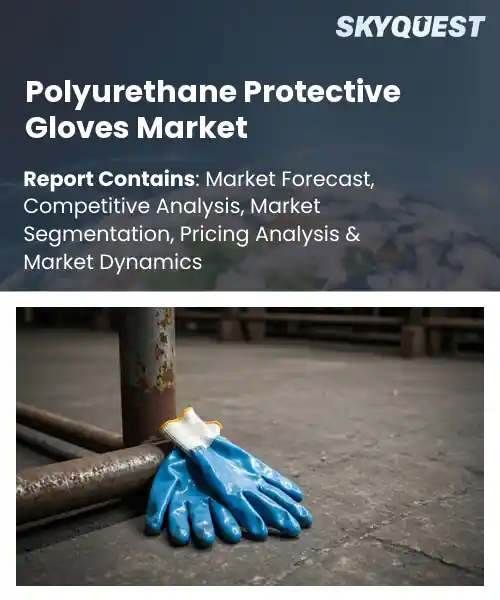
Polyurethane Protective Gloves Market
Report ID: SQMIG15E3408
Report ID: SQMIG15E3408
[email protected]
USA +1 351-333-4748
Report ID:
SQMIG15E3408 |
Region:
Global |
Published Date: April, 2026
Pages:
157
|Tables:
90
|Figures:
76


Global Polyurethane Protective Gloves Market size was valued at USD 2.14 Billion in 2024 and is poised to grow from USD 2.27 Billion in 2025 to USD 2.1 Billion by 2033, growing at a CAGR of 6.2% during the forecast period (2026-2033).
Polyurethane protective gloves are coated handwear combining a polyurethane film with backings to provide dexterity, abrasion resistance, and chemical splash protection, and this market matters because it directly links workplace safety to productivity and regulatory compliance. Primary driver is rising demand from manufacturing and logistics sectors where fine tactile grip and cut resistance reduce handling errors; as industries automate, operators require gloves that preserve touch sensitivity while protecting against oil and particulate hazards. Historically the market evolved from rubber and nitrile options toward engineered PU blends in the 2000s, exemplified by electronics and automotive assemblers adopting thin film coated gloves.Building on increased industrial adoption, a key factor propelling global growth is material innovation that improves durability while lowering production costs, which encourages procurement by large distribution centers and contract manufacturers alike. When manufacturers develop breathable PU coatings and reinforce seams, glove lifespan extends and replacement frequency drops, so total cost of ownership falls and procurement volumes rise. This effect is visible in ecommerce fulfillment, where pick and pack workers wear polyurethane coated gloves for prolonged shifts and demonstrate fewer dropped items and faster throughput. Consequently suppliers can expand into healthcare and electronics assembly through certification and targeted formulations that unlock revenue streams.
How is AI improving quality control in the polyurethane protective gloves market?
Quality control in the polyurethane protective gloves market focuses on detecting coating defects, ensuring process consistency, and maintaining traceability across production. AI is being used for automated visual inspection with deep learning to find surface blemishes and uneven coatings, for sensor based monitoring of dipping and curing to keep coating uniform, and for predictive maintenance that reduces line downtime. These capabilities reduce repetitive manual checks and speed corrective action. That improves tactile performance where precision matters in electronics assembly and automotive work and makes quality more defensible to buyers who demand reliable, repeatable products.Medtecs Group January 2026, highlighted AI deployments that strengthen inspection and traceability, enabling faster detection of coating faults and more reliable delivery which supports market efficiency and scalable growth.
Market snapshot - (2026-2033)
Global Market Size
USD 2.14 Billion
Largest Segment
Cell Therapy (Stem Cell, T-Cell/CAR-T)
Fastest Growth
Cell Therapy (Stem Cell, T-Cell/CAR-T)
Growth Rate
6.2% CAGR
To get more insights on this market click here to Request a Free Sample Report
Global polyurethane protective gloves market is segmented by therapy type (strategic breakout), therapeutic application, end-user and region. Based on therapy type (strategic breakout), the market is segmented into Cell Therapy (Stem Cell, T-Cell/CAR-T) and Acellular Therapy (Exosomes, Microvesicles). Based on therapeutic application, the market is segmented into Oncology (Primary Revenue Driver), Regenerative Medicine & Wound Healing and Cardiovascular & Neurological Disorders. Based on end-user, the market is segmented into Specialized Hospitals & Cancer Centers and Biotechnology & Pharmaceutical Companies. Based on region, the market is segmented into North America, Europe, Asia Pacific, Latin America and Middle East & Africa.
Cell Therapy segment dominates because the handling demands of live cells require gloves that combine exceptional tactile sensitivity with robust barrier integrity, driving preference for polyurethane formulations. High sterility expectations and compatibility with cell culture reagents compel facilities to choose gloves that minimize particulate shedding and chemical leaching, so research and manufacturing environments standardize on polyurethane protective gloves to reduce contamination risk and improve procedural precision and reproducibility.
However, exosomes in acellular therapy are emerging as the fastest growing area because isolation and handling require gloves that prevent adsorption and preserve vesicle integrity. Advances in polyurethane formulations offering low particulate generation and enhanced surface compatibility are driving adoption in research and manufacturing, opening new application niches and procurement demand for specialized gloves.
Oncology segment dominates because oncology workflows involve frequent exposure to cytotoxic agents and invasive procedures that prioritize reliable barrier protection combined with fine tactile control, making polyurethane gloves a preferred choice. Sustained procurement from treatment and diagnostic settings pressures suppliers to deliver gloves engineered for chemical resistance, comfort, and longevity, prompting material optimization to support clinician dexterity and improve patient safety while reducing contamination and procedural interruptions.
Meanwhile, regenerative medicine and wound healing are the most rapidly expanding application areas because growing outpatient procedures and biologic therapies require gloves balancing sterility with tactile sensitivity for grafting and dressing tasks. Innovation in polyurethane textures and enhanced grip features is increasing adoption across clinics and specialized care providers, creating new demand channels for tailored glove solutions.
To get detailed segments analysis, Request a Free Sample Report
Asia Pacific dominates the global polyurethane protective gloves market due to a combination of concentrated manufacturing capacity, integrated supply chains, and deep end use demand across electronics, automotive components, and industrial maintenance sectors. Regional manufacturers benefit from close proximity to raw material suppliers and coating technology developers, which accelerates product refinement and cost efficient production. Strong adoption in healthcare and light industrial applications is supported by regulatory frameworks that emphasize workplace safety, while continuous investment in material science and production automation enhances product quality and variety. These strengths drive extensive product customization, rapid response to market needs, and robust export orientation that collectively reinforce the region role as the primary source of innovation, volume, and specialized offerings for global markets.
Polyurethane Protective Gloves Market in Japan reflects a mature industrial ecosystem supported by advanced manufacturing, stringent safety standards, and widespread adoption across electronics, automotive component assembly, and precision manufacturing. Strong supplier networks and emphasis on material innovation foster high-quality product development and consistent demand from industrial and healthcare segments. Collaboration between manufacturers and end users promotes customized solutions and drives incremental improvements in durability, fit, and tactile sensitivity and performance.
Polyurethane Protective Gloves Market in South Korea combines robust industrial demand with emphasis on electronics, automotive components, and chemical handling applications, creating a diverse end use base. Investments in specialty coatings and thin film technologies support high dexterity and improved abrasion resistance. Close cooperation between manufacturers and suppliers accelerates adoption of novel formulations and efficiencies, enabling tailored offerings that meet occupational safety norms while addressing ergonomic preferences and operational workflows.
Europe is experiencing rapid expansion in polyurethane protective gloves driven by stringent occupational safety standards, increasing healthcare and industrial demand, and coordinated procurement policies that prioritize certified, high performance products. A strong focus on material innovation and environmental responsibility encourages development of more durable, recyclable, and user comfortable glove solutions. Close collaboration between manufacturers, testing bodies, and end users supports rapid refinement of coating technologies and ergonomic designs to meet sector specific requirements. Market growth is also underpinned by diversified application areas from medical and laboratory settings to complex manufacturing processes, while evolving supply chain strategies aim to ensure traceability and resilience. Investment in specialized manufacturing capacity and harmonized regulatory frameworks across member states further facilitate cross border collaboration, enabling suppliers to scale niche innovations and support procurement programs.
Polyurethane Protective Gloves Market in Germany is driven by a strong industrial base and high occupational safety standards that demand certified, high performance products. Key end uses include automotive manufacturing and mechanical engineering where precision glove design and robust coating technologies are prioritized. Close collaboration between engineering firms and material suppliers supports application specific development. Growing emphasis on sustainability encourages longer lasting and more recyclable solutions aligned with procurement requirements.
Polyurethane Protective Gloves Market in United Kingdom is propelled by expanding healthcare and service sectors alongside heightened regulatory focus on worker safety. Demand centers on lightweight, high dexterity gloves for medical, laboratory, and precision assembly use. Advances in thin polyurethane coatings and ergonomic designs are fostered by collaboration among designers, manufacturers, and procurement bodies. Greater emphasis on supply chain resilience and product traceability supports adoption of quality controls and sourcing.
Polyurethane Protective Gloves Market in France shows increasing demand for specialty coatings in hygiene sensitive industries and a diversified end use including medical, food processing, and light manufacturing. Collaboration between material scientists and glove producers drives softer, breathable formulations that enhance wearer comfort while preserving protective performance. Procurement practices in public and private institutions favor certified products, supporting broader adoption of ergonomic glove designs suited to varied occupational needs specifically.
North America is strengthening its position in the polyurethane protective gloves market through a blend of innovation, regulatory oversight, and strategic supply chain development. Market participants emphasize material research, ergonomic design, and performance certification to meet demanding requirements across construction, industrial maintenance, healthcare, and resource sectors. Investments in domestic manufacturing capacity and partnerships with technology providers reduce reliance on distant sourcing while enhancing quality control. Procurement policies focused on resilience and compliance encourage diversified supplier networks. Together, these dynamics promote gradual reshoring of specialized production, accelerated product qualification processes, and broader availability of tailored glove solutions that meet both safety and operational needs across regional markets. Active engagement with certification bodies and industry consortia supports harmonized testing protocols and faster market access for innovative formulations. Growing emphasis on sustainable materials and advanced coating techniques encourages manufacturers to balance protective performance with environmental considerations.
Polyurethane Protective Gloves Market in United States reflects diverse industrial demand and strong emphasis on workplace safety, with buyers focusing on performance and certification. Sectors such as construction, manufacturing, and healthcare prioritize durability, chemical resistance, and tactile sensitivity. Partnerships between research institutions and manufacturers promote innovations in coating chemistries and ergonomic form factors. Procurement favors supply continuity and compliance, driving suppliers to provide validated solutions suited to varied operational environments.
Polyurethane Protective Gloves Market in Canada reflects a mix of industrial, resource, and healthcare demand that prioritizes protective performance and wearer comfort. Requirements for cold weather durability and multi hazard protection influence material and coating choices. Partnerships between manufacturers and providers enable customization for sector specific needs while procurement increasingly favors certified, ethically sourced products. Suppliers improve supply chain transparency and offer versatile glove ranges adaptable to varied working conditions.
To know more about the market opportunities by region and country, click here to
Buy The Complete Report
Rising Healthcare Safety Standards
Expansion In Industrial Applications
Raw Material Price Volatility
Environmental And Disposal Concerns
Request Free Customization of this report to help us to meet your business objectives.
Competitive dynamics center on differentiation through ultra thin tactile PU coatings and sustainable formulations, driving consolidation and targeted acquisitions by capacity seeking firms and regional buyouts by established OEMs. Companies pursue partnerships and product innovation, exemplified by recent capacity and portfolio deals and new disposable PU ranges and biodegradable or touchscreen compatible coatings aimed at industrial and electronics customers.
Top Player’s Company Profile
Recent Developments
SkyQuest’s ABIRAW (Advanced Business Intelligence, Research & Analysis Wing) is our Business Information Services team that Collects, Collates, Correlates, and Analyses the Data collected by means of Primary Exploratory Research backed by robust Secondary Desk research. As per SkyQuest analysis, the global polyurethane protective gloves market is being driven primarily by expanding industrial applications, where demand for high dexterity and abrasion resistance in manufacturing and logistics boosts procurement, and further supported by material innovation that improves durability and lowers total cost of ownership. However, raw material price volatility remains a key restraint, creating procurement uncertainty and pressuring margins. Asia Pacific remains the dominating region due to concentrated manufacturing capacity, integrated supply chains and strong end-use demand, while the cell therapy segment is the dominant application area as facilities demand low particulate, high-sensitivity gloves for handling live cells. Overall, innovation and cost pressures will shape near-term growth.
| Report Metric | Details |
|---|---|
| Market size value in 2024 | USD 2.14 Billion |
| Market size value in 2033 | USD 2.1 Billion |
| Growth Rate | 6.2% |
| Base year | 2024 |
| Forecast period | (2026-2033) |
| Forecast Unit (Value) | USD Billion |
| Segments covered |
|
| Regions covered | North America (US, Canada), Europe (Germany, France, United Kingdom, Italy, Spain, Rest of Europe), Asia Pacific (China, India, Japan, Rest of Asia-Pacific), Latin America (Brazil, Rest of Latin America), Middle East & Africa (South Africa, GCC Countries, Rest of MEA) |
| Companies covered |
|
| Customization scope | Free report customization with purchase. Customization includes:-
|
To get a free trial access to our platform which is a one stop solution for all your data requirements for quicker decision making. This platform allows you to compare markets, competitors who are prominent in the market, and mega trends that are influencing the dynamics in the market. Also, get access to detailed SkyQuest exclusive matrix.
Table Of Content
Executive Summary
Market overview
Parent Market Analysis
Market overview
Market size
KEY MARKET INSIGHTS
COVID IMPACT
MARKET DYNAMICS & OUTLOOK
Market Size by Region
KEY COMPANY PROFILES
Methodology
For the Polyurethane Protective Gloves Market, our research methodology involved a mixture of primary and secondary data sources. Key steps involved in the research process are listed below:
1. Information Procurement: This stage involved the procurement of Market data or related information via primary and secondary sources. The various secondary sources used included various company websites, annual reports, trade databases, and paid databases such as Hoover's, Bloomberg Business, Factiva, and Avention. Our team did 45 primary interactions Globally which included several stakeholders such as manufacturers, customers, key opinion leaders, etc. Overall, information procurement was one of the most extensive stages in our research process.
2. Information Analysis: This step involved triangulation of data through bottom-up and top-down approaches to estimate and validate the total size and future estimate of the Polyurethane Protective Gloves Market.
3. Report Formulation: The final step entailed the placement of data points in appropriate Market spaces in an attempt to deduce viable conclusions.
4. Validation & Publishing: Validation is the most important step in the process. Validation & re-validation via an intricately designed process helped us finalize data points to be used for final calculations. The final Market estimates and forecasts were then aligned and sent to our panel of industry experts for validation of data. Once the validation was done the report was sent to our Quality Assurance team to ensure adherence to style guides, consistency & design.
Analyst Support
Customization Options
With the given market data, our dedicated team of analysts can offer you the following customization options are available for the Polyurethane Protective Gloves Market:
Product Analysis: Product matrix, which offers a detailed comparison of the product portfolio of companies.
Regional Analysis: Further analysis of the Polyurethane Protective Gloves Market for additional countries.
Competitive Analysis: Detailed analysis and profiling of additional Market players & comparative analysis of competitive products.
Go to Market Strategy: Find the high-growth channels to invest your marketing efforts and increase your customer base.
Innovation Mapping: Identify racial solutions and innovation, connected to deep ecosystems of innovators, start-ups, academics, and strategic partners.
Category Intelligence: Customized intelligence that is relevant to their supply Markets will enable them to make smarter sourcing decisions and improve their category management.
Public Company Transcript Analysis: To improve the investment performance by generating new alpha and making better-informed decisions.
Social Media Listening: To analyze the conversations and trends happening not just around your brand, but around your industry as a whole, and use those insights to make better Marketing decisions.
REQUEST FOR SAMPLE
 REQUEST FREE CUSTOMIZATION


Want to customize this report? This report can be personalized according to your needs. Our analysts and industry experts will work directly with you to understand your requirements and provide you with customized data in a short amount of time. We offer $1000 worth of FREE customization at the time of purchase.
Feedback From Our Clients


 USA (+1) 351-333-4748

