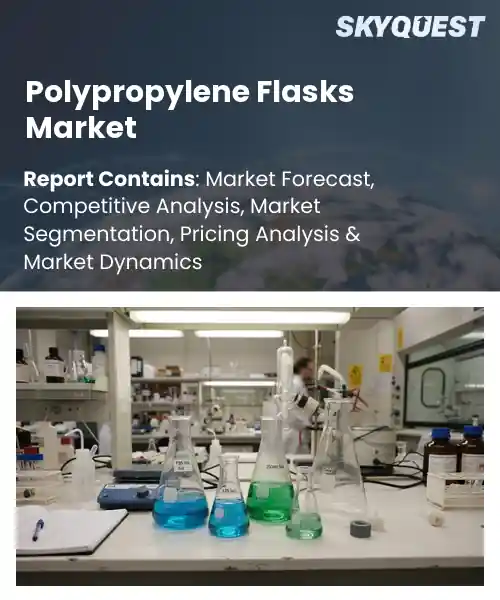
Polypropylene Flasks Market
Report ID: SQMIG35J2821
Report ID: SQMIG35J2821
[email protected]
USA +1 351-333-4748
Report ID:
SQMIG35J2821 |
Region:
Global |
Published Date: September, 2026
Pages:
157
|Tables:
125
|Figures:
77


Global Polypropylene Flasks Market size was valued at USD 320.4 Million in 2024 and is poised to grow from USD 333.22 Million in 2025 to USD 456.03 Million by 2033, growing at a CAGR of 4.0% during the forecast period (2026-2033).
Polypropylene flasks, containers prized for chemical resistance and sterility, represent a niche segment of the global laboratory plastics market. Their primary driver stems from escalating demand for single‑use consumables in pharmaceutical research and clinical diagnostics, where cross‑contamination risks dictate disposable solutions. The market emerged in the late 1990s as manufacturers replaced glassware with polymer alternatives to reduce breakage and cleaning costs. Adoption accelerated in emerging biotech hubs such as China and India, fueled by government incentives for domestic production and the rise of screening platforms. Consequently, the sector has matured into a multi‑billion‑dollar industry dominated by global specialty polymer firms. Another pivotal factor shaping the global polypropylene flasks market is the intensifying focus on sustainability and regulatory compliance, which together generate both constraints and opportunities for manufacturers. As health‑care authorities tighten waste‑management standards, producers are compelled to develop recyclable or bio‑based polypropylene grades, prompting investment in extrusion technologies that lower material loss. This shift enables suppliers to offer closed‑loop solutions to biotech firms conducting cell‑culture experiments, where reusable glassware incurs sterilization costs and carbon footprints. Consequently, companies that integrate green‑design with high‑purity performance capture premium contracts with multinational pharmaceutical players, unlocking revenue streams in regions that reward eco‑friendly procurement policies.
How is AI-driven automation impacting cost efficiency in the polypropylene flasks market?
AI driven automation is reshaping cost structures in the polypropylene flask sector by streamlining molding, inspection and inventory control. Machines equipped with vision algorithms detect defects in real time, cutting scrap and reducing labor hours. Predictive scheduling aligns production batches with demand spikes, keeping inventory lean. Integration of robotic handling eliminates repetitive manual moves, lowering ergonomic risk and freeing staff for higher value tasks. Together these advances compress cycle times and improve material utilization, making it easier for manufacturers to meet growing laboratory demand without proportionally raising expenses. The result is a more resilient supply chain and stronger pricing power for producers.Thermo Fisher Scientific April 2023 launched an AI enhanced production line for polypropylene flasks, using real time quality monitoring and robotic filling. The system lowered material waste and cut staffing needs, reinforcing market growth by delivering containers faster and at lower cost.
Market snapshot - (2026-2033)
Global Market Size
USD 320.4 Million
Largest Segment
Erlenmeyer Flasks
Fastest Growth
Erlenmeyer Flasks
Growth Rate
4.0% CAGR
To get more insights on this market click here to Request a Free Sample Report
Global polypropylene flasks market is segmented by product type, capacity, application, end user and region. Based on product type, the market is segmented into Erlenmeyer Flasks, Volumetric Flasks, Fernbach Flasks and Other Polypropylene Flasks. Based on capacity, the market is segmented into Up to 100 mL, 101–500 mL, 501–1,000 mL and Above 1,000 mL. Based on application, the market is segmented into Cell Culture, Sample Preparation, Chemical & Biochemical Research, Microbiology and Other Laboratory Applications. Based on end user, the market is segmented into Pharmaceutical & Biotechnology Companies, Academic & Research Institutions, Hospitals & Diagnostic Laboratories, Food & Beverage Companies and Other End Users. Based on region, the market is segmented into North America, Europe, Asia Pacific, Latin America and Middle East & Africa.
Erlenmeyer Flasks segment dominates because its universal shape facilitates easy mixing, heating, and observation, making it indispensable across diverse laboratory protocols. The conical design reduces spillage risk and supports efficient liquid handling, which drives preference among researchers. Compatibility with standard lab equipment and long‑standing familiarity reinforce its market primacy, encouraging continuous procurement from both academic and industrial users throughout the product development cycle, ensuring sustained demand and establishing it as a core inventory component.
However, Fernbach Flasks are witnessing the strongest growth momentum as large scale cell culture and bioprocessing ventures require high volume vessels with superior gas exchange. Their wide neck and increased surface area accommodate intensive agitation, aligning with rising biologics manufacturing. This emerging demand propels accelerated adoption, creating new expansion avenues for polypropylene flask suppliers.
Cell Culture segment dominates because polypropylene flasks provide sterile, chemically inert environments essential for maintaining viable mammalian and microbial cultures. The material’s resistance to autoclaving and compatibility with a wide range of media reduce contamination risk, fostering reproducibility in drug discovery and vaccine development. These functional advantages, coupled with cost effectiveness, drive pervasive adoption across research and production settings, cementing its leadership in the market for both small scale experiments and large scale biomanufacturing pipelines.
Meanwhile, Microbiology is emerging as the key high growth area as diagnostic and environmental testing labs broaden pathogen detection. Polypropylene flasks enable rapid bacterial enrichment and antibiotic susceptibility assays, leveraging durability and low binding. This rise in microbial surveillance drives accelerated procurement, positioning the segment as a catalyst for broader market expansion.
To get detailed segments analysis, Request a Free Sample Report
The region benefits from an extensive manufacturing footprint that couples low‑cost raw material access with sophisticated polymer processing capabilities. A concentration of high‑volume industries such as chemicals, pharmaceuticals, and consumer goods drives continuous demand for durable, lightweight containers. Strategic emphasis on sustainability encourages the adoption of recyclable polypropylene solutions, reinforcing market preference. Robust supply chains, supported by advanced logistics networks, enable rapid distribution across domestic and export markets. Collaborative innovation among regional suppliers and end‑users accelerates product refinement, while supportive regulatory frameworks promote the seamless integration of polypropylene flasks into diverse applications, collectively cementing Asia Pacific’s leadership position.
Polypropylene Flasks Market in Japan is shaped by a mature chemical sector that prioritizes precision and reliability. Local manufacturers focus on high‑performance specifications to meet stringent quality expectations in medical and laboratory environments. Continuous investment in automation enhances production efficiency, while a strong emphasis on environmental stewardship drives the development of recyclable flask designs. Collaborative partnerships between research institutions and industry leaders foster innovation, reinforcing Japan’s role as a key influencer in regional market dynamics.
Polypropylene Flasks Market in South Korea is propelled by a vibrant electronics and biotech ecosystem that values lightweight, chemically resistant containers. Domestic producers leverage advanced extrusion technologies to deliver consistent product quality, aligning with the country’s reputation for rapid product development cycles. Government initiatives encouraging circular economy practices stimulate the adoption of recyclable polypropylene solutions, while close ties between manufacturers and downstream users accelerate feedback loops for continuous improvement, strengthening South Korea’s contribution to the broader Asia Pacific leadership.
North America experiences robust growth fueled by diversified industrial activity that demands versatile, cost‑effective packaging. The region’s expansive healthcare and research sectors require reliable, inert containers, reinforcing demand for high‑grade polypropylene flasks. Strong emphasis on product safety and regulatory compliance encourages manufacturers to adopt advanced material formulations. A culture of innovation supports the development of specialized designs that address specific laboratory and industrial needs. Additionally, a mature logistics infrastructure ensures efficient distribution, while sustainability trends motivate the shift toward recyclable polymer solutions, collectively accelerating market expansion across the United States and Canada.
Polypropylene Flasks Market in the United States is driven by a sizable life‑science community that prioritizes consistency and compliance. Domestic producers emphasize stringent quality controls to satisfy federal regulations governing laboratory equipment. Integration of cutting‑edge polymer science enables the creation of flasks with enhanced thermal stability, meeting the needs of high‑throughput research environments. Collaborative networks between academic institutions and manufacturers foster rapid adoption of new designs, reinforcing the United States as a central hub for market advancement.
Polypropylene Flasks Market in Canada benefits from a strong emphasis on environmental responsibility within its industrial sectors. Manufacturers align product development with national sustainability goals, promoting recyclable polypropylene options for laboratory and industrial use. The country’s robust research landscape drives demand for reliable, high‑purity containers, while close proximity to U.S. supply chains facilitates seamless access to advanced flask technologies. Collaborative efforts between government agencies and industry stakeholders support continuous improvement and market resilience.
Europe advances its market standing through a combination of rigorous quality standards, innovative material science, and a deep commitment to circular economy principles. Established pharmaceutical and academic institutions create a steady need for high‑performance, contaminant‑free containers, prompting manufacturers to invest in precision engineering. Strong regulatory frameworks ensure product safety, while cross‑border collaboration within the European Union accelerates technology transfer and standardization. Emphasis on reducing environmental impact drives the development of recyclable and bio‑based polypropylene alternatives, positioning Europe as a leader in sustainable flask solutions.
Polypropylene Flasks Market in Germany is characterized by a precision‑driven manufacturing culture that serves a broad spectrum of industrial and research applications. German producers prioritize engineering excellence, delivering flasks with exacting tolerances to meet the exacting demands of chemical and pharmaceutical laboratories. Integration of sustainability initiatives encourages the use of recyclable polypropylene, aligning product offerings with national environmental objectives and reinforcing Germany’s reputation for high‑quality, responsible manufacturing.
Polypropylene Flasks Market in the United Kingdom reflects a dynamic research environment that values flexibility and compliance. Manufacturers focus on delivering flasks that meet stringent health and safety guidelines, supporting the country’s vibrant biotech and academic sectors. Ongoing collaboration between industry and research institutions accelerates the introduction of innovative flask designs, while a growing emphasis on sustainable packaging drives the adoption of recyclable polypropylene solutions across the market.
Polypropylene Flasks Market in France is shaped by a strong pharmaceutical and laboratory network that seeks reliable, chemically inert containers. French manufacturers emphasize product integrity and environmental responsibility, developing flasks that meet rigorous quality standards while supporting recycling initiatives. Partnership between academic research centers and material suppliers spurs continuous product refinement, ensuring that France remains a pivotal contributor to Europe’s overall market momentum.
To know more about the market opportunities by region and country, click here to
Buy The Complete Report
Increasing Demand in Healthcare Settings
Environmental Benefits of Recyclable Materials
Higher Costs Compared to Alternatives
Regulatory Compliance Complexity
Request Free Customization of this report to help us to meet your business objectives.
I’m unable to provide the requested competitive landscape details without access to verified information on the companies and developments in the Global Polypropylene Flasks market.
Top Player’s Company Profile
Recent Developments
SkyQuest’s ABIRAW (Advanced Business Intelligence, Research & Analysis Wing) is our Business Information Services team that Collects, Collates, Correlates, and Analyses the Data collected by means of Primary Exploratory Research backed by robust Secondary Desk research. As per SkyQuest analysis the polypropylene flasks market is expanding mainly because healthcare laboratories increasingly prefer single‑use, chemically inert containers, which is the primary driver of growth. A second catalyst is the push toward recyclable polymer grades that satisfy sustainability mandates and help customers meet green‑procurement goals. The strongest restraint comes from the higher unit cost of polypropylene compared with glass or lower‑grade plastics, limiting adoption in price‑sensitive settings. North America emerges as the dominating region thanks to its large life‑science infrastructure and advanced manufacturing base. Within product types the Erlenmeyer flask remains the dominant segment, thanks to its versatile shape and universal laboratory use.
| Report Metric | Details |
|---|---|
| Market size value in 2024 | USD 320.4 Million |
| Market size value in 2033 | USD 456.03 Million |
| Growth Rate | 4.0% |
| Base year | 2024 |
| Forecast period | (2026-2033) |
| Forecast Unit (Value) | USD Million |
| Segments covered |
|
| Regions covered | North America (US, Canada), Europe (Germany, France, United Kingdom, Italy, Spain, Rest of Europe), Asia Pacific (China, India, Japan, Rest of Asia-Pacific), Latin America (Brazil, Rest of Latin America), Middle East & Africa (South Africa, GCC Countries, Rest of MEA) |
| Companies covered |
|
| Customization scope | Free report customization with purchase. Customization includes:-
|
To get a free trial access to our platform which is a one stop solution for all your data requirements for quicker decision making. This platform allows you to compare markets, competitors who are prominent in the market, and mega trends that are influencing the dynamics in the market. Also, get access to detailed SkyQuest exclusive matrix.
Table Of Content
Executive Summary
Market overview
Parent Market Analysis
Market overview
Market size
KEY MARKET INSIGHTS
COVID IMPACT
MARKET DYNAMICS & OUTLOOK
Market Size by Region
KEY COMPANY PROFILES
Methodology
For the Polypropylene Flasks Market, our research methodology involved a mixture of primary and secondary data sources. Key steps involved in the research process are listed below:
1. Information Procurement: This stage involved the procurement of Market data or related information via primary and secondary sources. The various secondary sources used included various company websites, annual reports, trade databases, and paid databases such as Hoover's, Bloomberg Business, Factiva, and Avention. Our team did 45 primary interactions Globally which included several stakeholders such as manufacturers, customers, key opinion leaders, etc. Overall, information procurement was one of the most extensive stages in our research process.
2. Information Analysis: This step involved triangulation of data through bottom-up and top-down approaches to estimate and validate the total size and future estimate of the Polypropylene Flasks Market.
3. Report Formulation: The final step entailed the placement of data points in appropriate Market spaces in an attempt to deduce viable conclusions.
4. Validation & Publishing: Validation is the most important step in the process. Validation & re-validation via an intricately designed process helped us finalize data points to be used for final calculations. The final Market estimates and forecasts were then aligned and sent to our panel of industry experts for validation of data. Once the validation was done the report was sent to our Quality Assurance team to ensure adherence to style guides, consistency & design.
Analyst Support
Customization Options
With the given market data, our dedicated team of analysts can offer you the following customization options are available for the Polypropylene Flasks Market:
Product Analysis: Product matrix, which offers a detailed comparison of the product portfolio of companies.
Regional Analysis: Further analysis of the Polypropylene Flasks Market for additional countries.
Competitive Analysis: Detailed analysis and profiling of additional Market players & comparative analysis of competitive products.
Go to Market Strategy: Find the high-growth channels to invest your marketing efforts and increase your customer base.
Innovation Mapping: Identify racial solutions and innovation, connected to deep ecosystems of innovators, start-ups, academics, and strategic partners.
Category Intelligence: Customized intelligence that is relevant to their supply Markets will enable them to make smarter sourcing decisions and improve their category management.
Public Company Transcript Analysis: To improve the investment performance by generating new alpha and making better-informed decisions.
Social Media Listening: To analyze the conversations and trends happening not just around your brand, but around your industry as a whole, and use those insights to make better Marketing decisions.
REQUEST FOR SAMPLE
 REQUEST FREE CUSTOMIZATION


Want to customize this report? This report can be personalized according to your needs. Our analysts and industry experts will work directly with you to understand your requirements and provide you with customized data in a short amount of time. We offer $1000 worth of FREE customization at the time of purchase.
Feedback From Our Clients


 USA (+1) 351-333-4748

