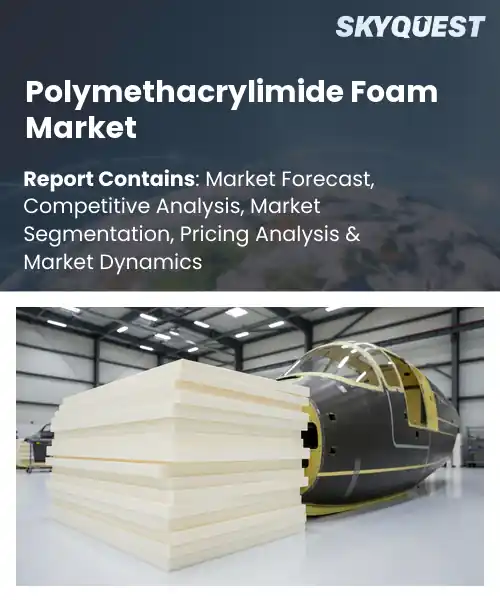
Polymethacrylimide Foam Market
Report ID: SQMIG15E3637
Report ID: SQMIG15E3637
[email protected]
USA +1 351-333-4748
Report ID:
SQMIG15E3637 |
Region:
Global |
Published Date: June, 2026
Pages:
157
|Tables:
93
|Figures:
76


Global Polymethacrylimide Foam Market size was valued at USD 110.2 Million in 2024 and is poised to grow from USD 115.38 Million in 2025 to USD 166.61 Million by 2033, growing at a CAGR of 4.7% during the forecast period (2026-2033).
Polymethacrylimide foam is a rigid closed-cell engineering foam serving as a structural core and thermal insulator in sandwich composites, important because its low density combined with high shear strength and thermal stability enables lighter, more efficient systems in aerospace, transportation and refrigeration. The market evolved from niche aerospace and defense programs where high performance justified premium cost to broader industrial use as manufacturing improved and material compatibility increased; stricter fuel-efficiency and emissions regulations accelerated adoption into wind blades, rail interiors and building insulation. The primary driver is pressure to reduce mass and energy use, which increases PMI selection for savings.
Building on weight and energy pressures, a decisive market factor is cost and manufacturing scalability since lower production costs lead OEMs to specify PMI for more applications, producing scale-driven price reductions. Advances in molding, automated trimming and sandwich-panel integration enable PMI cores for electric vehicle battery enclosures and LNG cryogenic panels, which increase vehicle range and storage efficiency. At the same time, stricter fire and smoke regulations push rail and marine designers toward fire-rated PMI, prompting supplier investment, capacity expansion and R&D partnerships, and these cause immediate commercial opportunities, notably in retrofit insulation, offshore wind blades and lightweight mass-transit components.
How is AI improving manufacturing efficiency in the Polymethacrylimide foam market?
Polymethacrylimide foam is a rigid, high temperature resistant core material used in sandwich structures for aerospace and other high performance applications. The market is driven by demand for lighter weight and reliable core performance as new grades scale to industrial volumes. AI improves manufacturing efficiency by enabling real time process control during polymerization and foaming using sensor fusion and machine learning. Computer vision detects surface and internal defects early and robotics keeps fabrication consistent. Predictive maintenance reduces unplanned downtime and digital twins help tune cure cycles and recipes. These capabilities shorten development cycles, reduce waste and make PMI production more repeatable for demanding end uses.
Evonik April 2026, showcased ROHACELL PMI at CHINAPLAS while highlighting smart manufacturing and digital process initiatives. That development signals how AI enabled monitoring and analytics can boost throughput and stabilize product quality, supporting faster qualification and broader market adoption.
Market snapshot - (2026-2033)
Global Market Size
USD 110.2 Million
Largest Segment
High-Density Foam
Fastest Growth
High-Density Foam
Growth Rate
4.7% CAGR
To get more insights on this market click here to Request a Free Sample Report
Global polymethacrylimide foam market is segmented by type, application, end-use industry and region. Based on type, the market is segmented into High-Density Foam and Low-Density Foam. Based on application, the market is segmented into Composite Sandwich Structures, Radio-Transparent Components, Insulation and Others. Based on end-use industry, the market is segmented into Aerospace and Defense, Automotive and Transportation, Wind Energy, Medical and Imaging, Electronics and Others. Based on region, the market is segmented into North America, Europe, Asia Pacific, Latin America and Middle East & Africa.
High Density Foam segment dominates because its superior mechanical strength, stiffness, and impact resistance make it the default choice for load bearing and structural uses in polymethacrylimide foam applications. Designers and OEMs favor it for demanding environments, which drives specification standards and investment in production capacity. This preference feeds back into supply chain prioritization, enabling scale economies and continuous material optimization that reinforce its leadership in performance critical markets.
However, Low Density Foam is emerging as the fastest growing area because its extreme light weighting, superior thermal insulation, and formability suit radio transparent and insulation uses. Advances in processing and tailored formulations are enabling novel lightweight designs, stimulating adoption across transport and thermal management applications and creating new product opportunities.
Composite Sandwich Structures segment leads because polymethacrylimide foam core delivers an exceptional stiffness to weight profile and reliable bonding with composite skins, making it a preferred core material for performance critical panels and assemblies. Designers prioritize its dimensional stability, fatigue resistance, and damage tolerance for long life structural applications, which shapes material specifications, encourages supplier investments, and propels integration into new platform designs.
Meanwhile, Radio Transparent Components are witnessing the strongest growth as demand for sensors, antennas, and stealth friendly enclosures pushes development of low dielectric polymethacrylimide formulations. Material innovations and tailored processing enable precise dielectric control and conformal parts, expanding applications in communications and surveillance equipment and unlocking new design opportunities for OEMs.
To get detailed segments analysis, Request a Free Sample Report
Asia Pacific holds a commanding position in the global polymethacrylimide foam market due to a convergence of manufacturing scale, integrated supply chains and concentrated demand from high growth end use sectors. Regional manufacturers leverage cost competitive production, deep supplier networks and proximity to major electronics and automotive original equipment manufacturers to accelerate adoption. Strong public and private investment into materials research, coupled with applied engineering expertise, supports rapid product development and customised solutions. Regulatory frameworks and export oriented industrial strategies further enable market penetration beyond regional borders, while collaborative ecosystems linking universities, research centres and industry players foster innovation in foam formulations and processing techniques. Market participants benefit from efficient logistics and competitive supplier clustering that reduce time to market.
Polymethacrylimide Foam Market Japan is characterised by high performance applications, advanced materials research and close alignment with precision manufacturing sectors. Demand from aerospace, electronics and specialty insulation markets drives development of tailored formulations. Domestic manufacturers prioritise quality, certification and collaboration with system integrators, while research institutions support continuous innovation. The ecosystem emphasises reliability, traceability and engineering excellence, enabling premium positioning and technology led exports to adjacent markets and strategic partnerships.
Polymethacrylimide Foam Market South Korea benefits from close integration with electronics and automotive supply chains, fostering demand for lightweight thermal solutions and high performance components. Local producers collaborate with tier one manufacturers to develop application specific systems and scalable production methods. Emphasis on rapid prototyping, material innovation and export oriented manufacturing supports competitive positioning. Policy support for advanced materials and strong logistics infrastructure further facilitate technology transfer and market expansion.
Expansion in Europe is driven by a convergence of regulatory emphasis on energy efficiency, a strong engineering heritage and growing demand across building, transport and industrial sectors. Manufacturers are responding with high performance formulations that meet stringent safety and thermal requirements while addressing design and sustainability priorities. A dense network of material research centres, specialist converters and tiered supply chains enables rapid application development and localised production. Cross border collaboration and investment in retrofit and new build projects stimulate adoption, while premium OEMs and system designers prefer tailored foam solutions. The region's focus on lifecycle performance and recyclability reinforces a shift toward advanced insulating materials and niche high value applications. Supportive cluster dynamics and specialist manufacturing capabilities accelerate product customisation for complex systems and cross sector transfers.
Polymethacrylimide Foam Market Germany benefits from a deep industrial base and engineering focus that support adoption for transportation, industrial insulation and specialised applications. Strong links between material producers and automotive and rail OEMs enable application specific development and rigorous qualification processes. A mature supply chain of converters and testing facilities underpins quality production, while emphasis on standards compliance and performance reliability secures Germany leading role in foam innovation and deployment.
Polymethacrylimide Foam Market United Kingdom is marked by growth driven by innovation in lightweight design, retrofit initiatives and a vibrant cluster of materials startups and specialist converters. Demand from maritime, rail and building refurbishment projects encourages uptake of advanced foam solutions. Collaboration between universities, design houses and manufacturers accelerates commercialisation of novel formulations. Flexible procurement practices and growing interest in lifecycle performance support an expanding role for tailored foam systems.
Polymethacrylimide Foam Market France shows emerging momentum through focused applications in aerospace, automotive and high end construction where design and material performance are critical. Niche manufacturers and research centres collaborate to develop bespoke foam solutions emphasising sustainability and lifecycle considerations. The market favours quality, customised supply and close technical support for complex assemblies. Supplier networks and targeted innovation initiatives signal further expansion of specialised polymethacrylimide foam use across premium segments.
North America is reinforcing its role through concentrated investment in applied research, advanced manufacturing and strategic partnerships that bring materials innovation closer to end users. Demand from aerospace, defence, automotive and building sectors drives development of certified foam solutions and bespoke component integration. Manufacturers and converters are emphasising scalable production, quality management and supply chain resilience to support near market delivery. Collaboration between industry, research institutions and component suppliers accelerates prototyping and commercialisation. A focus on lifecycle performance, recyclability and tailored technical support positions the region to capture specialised applications and meet customer requirements for engineered insulation and structural foam systems. Increasing collaboration with OEMs and supply chain partners enables rapid adoption of validated materials in complex assemblies, while domestic production capability reduces logistical friction and supports customer service excellence.
Polymethacrylimide Foam Market United States is anchored by demand from aerospace, defence and mobility sectors that require certified, high performance materials. A robust innovation ecosystem of materials research, prototyping facilities and specialty converters enables rapid scale up of novel formulations. Emphasis on qualification, supplier diversification and after market support enhances market readiness. Manufacturers prioritise custom engineering, quality assurance and integrated supply to serve complex assemblies and stringent end user requirements.
Polymethacrylimide Foam Market Canada is shaped by demand for robust insulation in cold climate applications, as well as opportunities in rail, marine and industrial sectors. Local manufacturers focus on customised solutions, technical support and integration with regional supply chains. Collaboration with research institutions and industry partners supports material adaptation for specific performance requirements. Emphasis on sustainability, lifecycle considerations and logistics enhances Canada position for niche, performance oriented polymethacrylimide foam deployments.
To know more about the market opportunities by region and country, click here to
Buy The Complete Report
Lightweighting In Transportation Applications
Enhanced Thermal Insulation Performance
High Production And Processing Costs
Recycling And End Of Life
Request Free Customization of this report to help us to meet your business objectives.
Competition in the global polymethacrylimide foam market is intensifying as incumbents defend aerospace and high temperature niches through capacity expansion and selective divestitures, while new material entrants push sustainability as a procurement differentiator. Real tactics include Evonik ramping ROHACELL capacity and targeted product upgrades, and asset sales such as Evonik’s CALOSTAT divestiture to Kingspan, which reflect M&A and portfolio sharpening across the value chain.
SkyQuest’s ABIRAW (Advanced Business Intelligence, Research & Analysis Wing) is our Business Information Services team that Collects, Collates, Correlates, and Analyses the Data collected by means of Primary Exploratory Research backed by robust Secondary Desk research.
As per SkyQuest analysis, the global polymethacrylimide foam market is driven primarily by lightweighting pressures that push designers to reduce mass and improve energy efficiency, while a second strong driver is the material's superior thermal insulation performance across transport and building applications. Growth is concentrated in Asia Pacific where manufacturing scale, integrated supply chains and demand from electronics and transport OEMs dominate regional adoption, and the high density foam segment leads global specifications for load bearing and structural uses. Market expansion is tempered by high production and processing costs which limit uptake in price sensitive sectors, keeping adoption focused on premium, performance critical applications.
| Report Metric | Details |
|---|---|
| Market size value in 2024 | USD 110.2 Million |
| Market size value in 2033 | USD 166.61 Million |
| Growth Rate | 4.7% |
| Base year | 2024 |
| Forecast period | (2026-2033) |
| Forecast Unit (Value) | USD Million |
| Segments covered |
|
| Regions covered | North America (US, Canada), Europe (Germany, France, United Kingdom, Italy, Spain, Rest of Europe), Asia Pacific (China, India, Japan, Rest of Asia-Pacific), Latin America (Brazil, Rest of Latin America), Middle East & Africa (South Africa, GCC Countries, Rest of MEA) |
| Companies covered |
|
| Customization scope | Free report customization with purchase. Customization includes:-
|
To get a free trial access to our platform which is a one stop solution for all your data requirements for quicker decision making. This platform allows you to compare markets, competitors who are prominent in the market, and mega trends that are influencing the dynamics in the market. Also, get access to detailed SkyQuest exclusive matrix.
Table Of Content
Executive Summary
Market overview
Parent Market Analysis
Market overview
Market size
KEY MARKET INSIGHTS
COVID IMPACT
MARKET DYNAMICS & OUTLOOK
Market Size by Region
KEY COMPANY PROFILES
Methodology
For the Polymethacrylimide Foam Market, our research methodology involved a mixture of primary and secondary data sources. Key steps involved in the research process are listed below:
1. Information Procurement: This stage involved the procurement of Market data or related information via primary and secondary sources. The various secondary sources used included various company websites, annual reports, trade databases, and paid databases such as Hoover's, Bloomberg Business, Factiva, and Avention. Our team did 45 primary interactions Globally which included several stakeholders such as manufacturers, customers, key opinion leaders, etc. Overall, information procurement was one of the most extensive stages in our research process.
2. Information Analysis: This step involved triangulation of data through bottom-up and top-down approaches to estimate and validate the total size and future estimate of the Polymethacrylimide Foam Market.
3. Report Formulation: The final step entailed the placement of data points in appropriate Market spaces in an attempt to deduce viable conclusions.
4. Validation & Publishing: Validation is the most important step in the process. Validation & re-validation via an intricately designed process helped us finalize data points to be used for final calculations. The final Market estimates and forecasts were then aligned and sent to our panel of industry experts for validation of data. Once the validation was done the report was sent to our Quality Assurance team to ensure adherence to style guides, consistency & design.
Analyst Support
Customization Options
With the given market data, our dedicated team of analysts can offer you the following customization options are available for the Polymethacrylimide Foam Market:
Product Analysis: Product matrix, which offers a detailed comparison of the product portfolio of companies.
Regional Analysis: Further analysis of the Polymethacrylimide Foam Market for additional countries.
Competitive Analysis: Detailed analysis and profiling of additional Market players & comparative analysis of competitive products.
Go to Market Strategy: Find the high-growth channels to invest your marketing efforts and increase your customer base.
Innovation Mapping: Identify racial solutions and innovation, connected to deep ecosystems of innovators, start-ups, academics, and strategic partners.
Category Intelligence: Customized intelligence that is relevant to their supply Markets will enable them to make smarter sourcing decisions and improve their category management.
Public Company Transcript Analysis: To improve the investment performance by generating new alpha and making better-informed decisions.
Social Media Listening: To analyze the conversations and trends happening not just around your brand, but around your industry as a whole, and use those insights to make better Marketing decisions.
REQUEST FOR SAMPLE
 REQUEST FREE CUSTOMIZATION
Global Polymethacrylimide Foam Market size was valued at USD 110.2 Million in 2024 and is poised to grow from USD 115.38 Million in 2025 to USD 166.61 Million by 2033, growing at a CAGR of 4.7% during the forecast period (2026-2033).
Competition in the global polymethacrylimide foam market is intensifying as incumbents defend aerospace and high temperature niches through capacity expansion and selective divestitures, while new material entrants push sustainability as a procurement differentiator. Real tactics include Evonik ramping ROHACELL capacity and targeted product upgrades, and asset sales such as Evonik’s CALOSTAT divestiture to Kingspan, which reflect M&A and portfolio sharpening across the value chain. 'Evonik Industries', 'Cashem Advanced Materials', 'Hunan Rifeng Composite', 'Jiaxing Sky Composites', 'Diab Group', 'SABIC', 'BASF', 'Schweiter Technologies', 'Solvay', 'Zotefoams', 'Gurit Holding', 'Armacell', 'Corecell', 'Degussa', 'Rohm GmbH', 'Composite Essential Materials', 'Evonik Foam', 'Advanced Composite Structures', 'Performance Composites', 'Zhejiang Tiansheng'
Lightweighting driven by fuel efficiency goals and the need to reduce structural mass in vehicles encourages adoption of polymethacrylimide foam because it offers a high stiffness-to-weight ratio and favorable energy absorption characteristics. Manufacturers seek materials that enable design flexibility while meeting performance targets, and polymethacrylimide foam supports component integration and weight reduction without compromising strength. This alignment between material attributes and transportation sector priorities fosters specification by designers and engineers, thereby expanding demand across automotive, aerospace, and rail applications where weight savings translate to operational benefits.
Aerospace Structural Integration: Demand for polymethacrylimide foam is growing as manufacturers integrate it into sandwich cores and composite assemblies to deliver superior stiffness-to-weight and long-term dimensional stability. OEMs and tier suppliers value its reliable mechanical behavior across operational temperatures, resistance to moisture and fatigue, and compatibility with resin infusion processes. The trend reflects priorities for lifecycle efficiency, lower maintenance, and tighter engineering tolerances, driving collaborative development of custom foam grades, tailored geometries, and validated processing protocols to satisfy aerospace safety and performance requirements.
Why does Asia Pacific Dominate the Global Polymethacrylimide Foam Market? |@12


Want to customize this report? This report can be personalized according to your needs. Our analysts and industry experts will work directly with you to understand your requirements and provide you with customized data in a short amount of time. We offer $1000 worth of FREE customization at the time of purchase.
Feedback From Our Clients


 USA (+1) 351-333-4748

