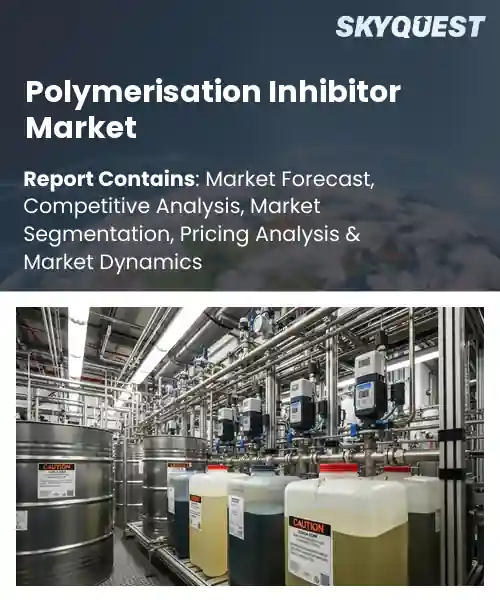
Polymerisation Inhibitor Market
Report ID: SQMIG15E4196
Report ID: SQMIG15E4196
[email protected]
USA +1 351-333-4748
Report ID:
SQMIG15E4196 |
Region:
Global |
Published Date: August, 2026
Pages:
157
|Tables:
144
|Figures:
78


Global Polymerisation Inhibitor Market size was valued at USD 348.6 Million in 2024 and is poised to grow from USD 369.86 Million in 2025 to USD 593.98 Million by 2033, growing at a CAGR of 6.1% during the forecast period (2026-2033).
The polymerisation inhibitor market trends relates to chemicals which are used to prevent unwanted chain reactions during the storage and processing of monomers such as styrene, methyl methacrylate and vinyl acetate. This is important because uncontrolled polymerization can lead to expensive losses and safety hazards in petrochemical plants, paint manufacturers and adhesive producers. The market goes back to the 1970s when the petrochemical boom exposed frequent reactor run-aways, allowing early adopters like hydroquinone to get a foothold. Over the last decade the sector has become strategically important worldwide, with the introduction of more stringent environmental regulations and the shift to high-performance polymers, which have raised the demand for more efficient and low-toxicity inhibitors.
One of the main drivers of the global polymerisation inhibitor market share is the rapid development of renewable-based polymer production, which increases the demand for inhibitors that are effective under milder, water-rich conditions. Traditional inhibitors are losing their effectiveness as manufacturers turn more to bio-derived monomers such as lactic acid or itaconic acid, forcing companies to invest in new phenolic or phosphite additives. The change creates a growth opportunity. For example, a major resin supplier introduced a low temperature inhibitor that cut batch failures by 30%, directly boosting profit margins. Hence R&D spending is rising and strategic alliances between chemical companies and biotech startups are being formed opening up market horizons
How is AI-driven Automation Influencing the Development of Polymerisation Inhibitor Formulations?
Automation of polymerisation inhibitor market growth formulation development is transformed by artificial intelligence. It combines machine learning and high throughput experimentation to predict molecular frameworks that can halt unwanted chain reactions. Researchers can now test thousands of candidate compounds in silico before even one lab test, dramatically shortening development cycles. The algorithms receive real-time data from the reactors, so the dosage levels can be continually refined and are compatible with different monomers. It attracts both established chemical groups and niche innovators, promising a quicker time-to-market and lower R&D costs. Therefore, the market will be flooded with performance based inhibitors designed to meet more stringent safety and sustainability requirements.
In March 2024 BASF launched an AI-optimised polymerization inhibitor which reduces batch cycle time and improves the stability of the resin. This is an example of how automation can accelerate the launch of formulations and help market growth through more efficient and reliable products. The solution applies model prediction to fine tune additive concentrations, reducing waste and energy use in production lines.
Market snapshot - (2026-2033)
Global Market Size
USD 348.6 Million
Largest Segment
MEHQ
Fastest Growth
TBC
Growth Rate
6.1% CAGR
To get more insights on this market click here to Request a Free Sample Report
Global polymerisation inhibitor market is segmented by product type, application, end user, form, distribution channel and region. Based on product type, the market is segmented into hydroquinone, MEHQ, TBC and phenothiazine. Based on application, the market is segmented into petrochemicals, monomer production, resin manufacturing and chemical processing. Based on end user, the market is segmented into chemical manufacturers, petrochemical companies and polymer producers. Based on form, the market is segmented into liquid and powder. Based on distribution channel, the market is segmented into direct sales and distributors. Based on region, the market is segmented into North America, Europe, Asia Pacific, Latin America and Middle East & Africa.
Hydroquinone segment dominates because it offers superior radical scavenging efficiency that aligns with the stringent stability requirements of modern polymerisation processes. Its well established performance profile builds confidence among manufacturers, encouraging widespread adoption across diverse production lines. The chemical’s compatibility with common monomers and ease of integration into existing formulations further reinforce its preferred status, cementing its leadership in the polymerisation inhibitor market. It also simplifies logistics due to its stable liquid form.
However, MEHQ segment emerges as the most rapidly expanding area because its lower toxicity profile meets increasing regulatory scrutiny and sustainability goals. Producers favor it for high purity polymerisation control, especially in specialty monomer streams. This growing preference fuels new formulation development and opens avenues for broader market penetration, accelerating market expansion.
Resin manufacturing segment leads because the production of high performance resins demands precise control of polymerisation to avoid premature gelation and ensure product consistency. Inhibitors are integral to maintaining reaction stability, allowing manufacturers to achieve tighter tolerances and superior mechanical properties. The critical nature of these applications motivates extensive inhibitor procurement, positioning resin manufacturing as the primary consumption engine within the polymerisation inhibitor market across both bulk and specialty segments worldwide.
Meanwhile, monomer production segment is witnessing the strongest growth momentum because feedstock diversification and expanded monomer portfolios require tighter polymerisation control. Advanced inhibitors enable producers to process novel monomers with reduced side reactions, unlocking new market opportunities. This acceleration promotes broader adoption of inhibitors, fueling expansion of the polymerisation inhibitor market.
To get detailed segments analysis, Request a Free Sample Report
Asia Pacific is confluence of large scale industrial activity, advanced chemical manufacturing ecosystems, and aggressive innovation agendas which together elevate its leadership in polymerization inhibitors. The region’s automotive, electronics and construction sectors are deeply integrated, which has translated into persistent demand for high‑performance resin stabilization. Strong government support for advanced materials and a dense network of research institutions and multinational chemical companies speed up the development and adoption of products. Furthermore, cost-effective production capacities and strong supply chains contribute to competitiveness. Increasing awareness toward responsibility for the environment is creating paths for developing greener inhibition solutions. These synergistic factors make Asia Pacific the number one hub for volume and technological advancement in polymerization inhibitors.
Polymerisation inhibitor market outlook in Japan is characterized by a legacy of precision engineering and a focus on high‑value specialty chemicals. Local producers leverage extensive R&D investments to tailor inhibitors for electronics, automotive coatings, and high‑performance plastics, addressing stringent quality standards. Collaboration between academia and industry nurtures innovative formulations that meet both performance and environmental criteria, reinforcing Japan’s reputation for reliability and technical excellence in the global supply chain.
Polymerisation inhibitor market forecast in South Korea is driven by rapid growth in petrochemical complexes and a strong orientation toward export‑oriented manufacturing. The country’s proactive policy framework encourages the development of advanced inhibitor chemistries for use in display technologies, battery materials, and automotive applications. Strategic partnerships with global chemical leaders facilitate technology transfer, while a skilled workforce supports high‑precision production, positioning South Korea as a pivotal contributor to regional market dynamics.
The North American landscape is powered by a mix of advanced downstream industries and an enhanced emphasis on product durability and sustainability. Strong demand exists for reliable polymerization control to extend material life and reduce waste in the automotive, aerospace and consumer goods sectors. Regulatory incentives for safer chemical practices encourage the use of advanced inhibitors that meet stringent health and environmental standards. Moreover, significant investments made toward research centers and partnerships between chemical producers and end-users are speeding up the introduction of next-gen inhibition technologies, presenting a strong growth trajectory across the continent.
Polymerisation inhibitor market regional outlook in the United States benefits from a broad base of petrochemical infrastructure and a culture of innovation. Leading chemical corporations prioritize the development of high‑efficiency inhibitors for applications ranging from high‑strength composites to medical devices. Close ties with academic research centers foster rapid prototyping and scaling of novel chemistries, while industry consortia promote best practices for safety and environmental compliance, reinforcing the United States’ role as a primary driver of market growth.
Polymerisation inhibitor market regional forecast in Canada reflects the country’s commitment to sustainable industrial development and resource‑rich feedstock availability. Emphasis on green chemistry drives the formulation of inhibitors that align with strict environmental guidelines, particularly for the forestry‑derived polymer sector. Collaborative initiatives between government agencies and private manufacturers encourage technology adoption that enhances product stability while minimizing ecological impact, positioning Canada as a niche yet influential participant in the North American market.
Europe is cementing its position with a mix of strong regulatory regimes, a legacy of high-quality chemical manufacturing and a strategic focus on circular economy principles. With a varied industrial base from automotive to packaging to renewable energy, the region requires sophisticated inhibition solutions that combine performance and compliance. Robust research networks across universities and multinational firms speed up the development of innovative low-toxicity inhibitors. Policy incentives promote the adoption of sustainable methods across the value chain. Such a concerted approach promotes leadership in environmentally responsible polymer technologies and keeps Europe competitive.
Polymerisation inhibitor market analysis in Germany is anchored by a strong engineering culture and a dense concentration of specialty chemical manufacturers. The industry focuses on delivering high‑precision inhibitors for automotive coatings, building materials, and high‑performance plastics, aligning with Germany’s reputation for durability and efficiency. Collaborative research programs and a well‑established standards framework ensure that products meet rigorous quality and environmental criteria, reinforcing the country’s influential role within the European market.
Polymerisation inhibitor market penetration in the United Kingdom thrives on a vibrant ecosystem of innovation hubs and a legacy of advanced materials research. Emphasis on sustainable product development drives the creation of inhibitors suited for aerospace, renewable energy, and high‑value consumer goods. Partnerships between leading universities and chemical firms accelerate the translation of cutting‑edge science into commercial solutions, while regulatory alignment supports market confidence and adoption across multiple sectors.
Polymerisation inhibitor industry in France benefits from a deep tradition of chemical expertise and a strategic focus on eco‑friendly solutions. The sector prioritizes the development of inhibitors for automotive paints, packaging films, and biomedical devices, driven by strong industry‑academia collaborations. Government initiatives promoting green chemistry reinforce the pursuit of low‑impact formulations, positioning France as a key contributor to Europe’s broader goals of sustainability and technological advancement.
To know more about the market opportunities by region and country, click here to
Buy The Complete Report
Sustainable Plastic Production Growth
Regulatory Incentives Driving Adoption
High Cost of Specialized Inhibitors
Limited Availability of Raw Materials
Request Free Customization of this report to help us to meet your business objectives.
The global polymerisation inhibitor market is characterized by competition among established specialty-chemical manufacturers, additive suppliers and process-chemistry companies, with differentiation increasingly centered on inhibition efficiency, thermal stability, compatibility with different monomers and polymers, regulatory compliance and sustainability. Leading participants such as BASF SE, Evonik Industries AG, Solvay S.A., Arkema S.A., LANXESS AG, Clariant AG and Songwon Industrial Co., Ltd. compete through broad additive portfolios, application-specific formulations, technical support and manufacturing scale. BASF, for example, offers antioxidant and processing-stabilizer technologies that help control radical-driven degradation and maintain polymer stability during processing, while its March 2025 investment to expand aminic-antioxidant capacity in Mexico demonstrates continued emphasis on strengthening additive supply capabilities.
Evonik similarly maintains polymerisation-inhibition solutions for hydrocarbon processing, while other specialty-chemical suppliers are focusing on improved processing stability, lower emissions, compatibility with bio-based feedstocks and higher-performance formulations. As manufacturers face tighter environmental requirements and increasing demand for efficient polymer processing, competition is shifting toward higher-performance, application-specific inhibitor systems and more sustainable additive technologies.
Top Player’s Company Profile
Recent Developments in the Polymerisation Inhibitor Market
SkyQuest’s ABIRAW (Advanced Business Intelligence, Research & Analysis Wing) is our Business Information Services team that Collects, Collates, Correlates, and Analyses the Data collected by means of Primary Exploratory Research backed by robust Secondary Desk research. As per SkyQuest analysis, the global polymerisation inhibitor market is being pulled forward primarily by the surge in sustainable plastic production, as manufacturers seek additives that safeguard high‑performance resins while cutting energy use and waste. A second strong driver is tightening environmental regulations that compel firms to adopt low‑toxicity inhibitors to stay compliant. The market is led by the hydroquinone product segment, valued for its reliable radical‑scavenging and easy integration, and by the Asia‑Pacific region, which benefits from dense chemical clusters, cost‑effective manufacturing and aggressive R&D investment. Growth, however, is tempered by the high cost of specialised inhibitors, which can limit adoption among price‑sensitive producers.
| Report Metric | Details |
|---|---|
| Market size value in 2024 | USD 348.6 Million |
| Market size value in 2033 | USD 593.98 Million |
| Growth Rate | 6.1% |
| Base year | 2024 |
| Forecast period | (2026-2033) |
| Forecast Unit (Value) | USD Million |
| Segments covered |
|
| Regions covered | North America (US, Canada), Europe (Germany, France, United Kingdom, Italy, Spain, Rest of Europe), Asia Pacific (China, India, Japan, Rest of Asia-Pacific), Latin America (Brazil, Rest of Latin America), Middle East & Africa (South Africa, GCC Countries, Rest of MEA) |
| Companies covered |
|
| Customization scope | Free report customization with purchase. Customization includes:-
|
To get a free trial access to our platform which is a one stop solution for all your data requirements for quicker decision making. This platform allows you to compare markets, competitors who are prominent in the market, and mega trends that are influencing the dynamics in the market. Also, get access to detailed SkyQuest exclusive matrix.
Table Of Content
Executive Summary
Market overview
Parent Market Analysis
Market overview
Market size
KEY MARKET INSIGHTS
COVID IMPACT
MARKET DYNAMICS & OUTLOOK
Market Size by Region
KEY COMPANY PROFILES
Methodology
For the Polymerisation Inhibitor Market, our research methodology involved a mixture of primary and secondary data sources. Key steps involved in the research process are listed below:
1. Information Procurement: This stage involved the procurement of Market data or related information via primary and secondary sources. The various secondary sources used included various company websites, annual reports, trade databases, and paid databases such as Hoover's, Bloomberg Business, Factiva, and Avention. Our team did 45 primary interactions Globally which included several stakeholders such as manufacturers, customers, key opinion leaders, etc. Overall, information procurement was one of the most extensive stages in our research process.
2. Information Analysis: This step involved triangulation of data through bottom-up and top-down approaches to estimate and validate the total size and future estimate of the Polymerisation Inhibitor Market.
3. Report Formulation: The final step entailed the placement of data points in appropriate Market spaces in an attempt to deduce viable conclusions.
4. Validation & Publishing: Validation is the most important step in the process. Validation & re-validation via an intricately designed process helped us finalize data points to be used for final calculations. The final Market estimates and forecasts were then aligned and sent to our panel of industry experts for validation of data. Once the validation was done the report was sent to our Quality Assurance team to ensure adherence to style guides, consistency & design.
Analyst Support
Customization Options
With the given market data, our dedicated team of analysts can offer you the following customization options are available for the Polymerisation Inhibitor Market:
Product Analysis: Product matrix, which offers a detailed comparison of the product portfolio of companies.
Regional Analysis: Further analysis of the Polymerisation Inhibitor Market for additional countries.
Competitive Analysis: Detailed analysis and profiling of additional Market players & comparative analysis of competitive products.
Go to Market Strategy: Find the high-growth channels to invest your marketing efforts and increase your customer base.
Innovation Mapping: Identify racial solutions and innovation, connected to deep ecosystems of innovators, start-ups, academics, and strategic partners.
Category Intelligence: Customized intelligence that is relevant to their supply Markets will enable them to make smarter sourcing decisions and improve their category management.
Public Company Transcript Analysis: To improve the investment performance by generating new alpha and making better-informed decisions.
Social Media Listening: To analyze the conversations and trends happening not just around your brand, but around your industry as a whole, and use those insights to make better Marketing decisions.
REQUEST FOR SAMPLE
 REQUEST FREE CUSTOMIZATION
Global Polymerisation Inhibitor Market size was valued at USD 348.6 Million in 2024 and is poised to grow from USD 369.86 Million in 2025 to USD 593.98 Million by 2033, growing at a CAGR of 6.1% during the forecast period (2026-2033).
I’m unable to provide the requested Competitive Landscape section because I don’t have sufficient verified information about recent companies, developments, or funding details in the polymerisation inhibitor market. 'BASF SE', 'Eastman Chemical Company', 'Solvay S.A.', 'Arkema S.A.', 'LANXESS AG', 'Clariant AG', 'SI Group, Inc.', 'Dorf Ketal Chemicals', 'Evonik Industries AG', 'Songwon Industrial Co., Ltd.', 'ADEKA Corporation', 'Sartomer (Arkema)', 'Nouryon', 'Mitsubishi Gas Chemical Company, Inc.', 'Merck KGaA', 'Thermo Fisher Scientific Inc.', 'Kemin Industries, Inc.', 'Shandong Taihe Water Treatment Technologies Co., Ltd.', 'Jiangsu Dynamic Chemical Co., Ltd.', 'Kao Corporation'
Manufacturers are increasingly seeking polymerisation inhibitors that enable the production of high‑performance plastics while minimizing environmental impact. This demand is driven by corporate sustainability commitments and consumer preference for greener materials. The ability of advanced inhibitors to preserve polymer integrity under milder conditions reduces energy consumption and waste generation. Consequently, producers adopt these additives to meet eco‑friendly product specifications, thereby expanding the market as more sectors integrate sustainable practices into their manufacturing processes. These trends also encourage research investments aimed at creating inhibitor chemistries that enhance performance and sustainability.
Sustainable Feedstock Integration: Growing consumer and regulatory pressure for greener products is prompting polymer manufacturers to adopt bio‑based and recycled feedstocks. This shift reduces the propensity for uncontrolled polymerisation, creating demand for inhibitors that are compatible with renewable monomers and can function under varied processing conditions. Suppliers are developing multifunctional additives that maintain performance while supporting circular economy goals, positioning polymerisation inhibitors as essential enablers of sustainable resin formulations across packaging, automotive and construction sectors throughout the global supply chain.
Why does Asia Pacific Dominate the Global Polymerisation Inhibitor Market? |@12


Want to customize this report? This report can be personalized according to your needs. Our analysts and industry experts will work directly with you to understand your requirements and provide you with customized data in a short amount of time. We offer $1000 worth of FREE customization at the time of purchase.
Feedback From Our Clients


 USA (+1) 351-333-4748

