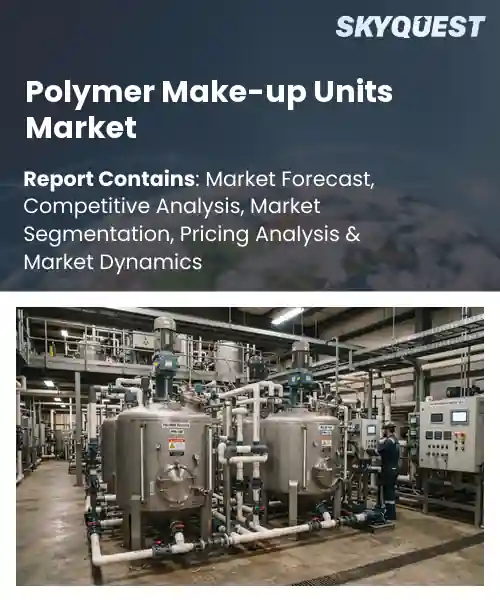
Polymer Make-up Units Market
Report ID: SQMIG20I3793
Report ID: SQMIG20I3793
[email protected]
USA +1 351-333-4748
Report ID:
SQMIG20I3793 |
Region:
Global |
Published Date: August, 2026
Pages:
157
|Tables:
143
|Figures:
78


Global Polymer Make-Up Units Market size was valued at USD 2.86 Billion in 2024 and is poised to grow from USD 3.04 Billion in 2025 to USD 5.0 Billion by 2033, growing at a CAGR of 6.4% during the forecast period (2026-2033).
The global polymer make‑up units market covers the production and supply of modular polymer components for automotive, packaging, and consumer electronics, where the material’s lightweight, corrosion‑resistant and customizable nature drives demand. Its significance lies in replacing heavier metal parts, improving fuel efficiency and cutting emissions. The market originated in the late 1990s as manufacturers pursued alternatives to steel and gained momentum in the 2010s under sustainability mandates and advances in extrusion technology. For instance, leading automotive OEMs introduced polymer‑based intake manifolds, showing how the sector moved from niche uses to mainstream adoption across global supply chains worldwide, driving substantial investment. One of the catalysts for market expansion is the rising emphasis on lightweight construction in electric‑vehicle (EV) platforms, which forces manufacturers to replace metal parts with polymers to preserve range as battery capacity grows. Reducing vehicle mass improves energy efficiency, and polymer modules, which can be molded with brackets, also streamline assembly processes. This benefit has prompted suppliers to broaden production in Southeast Asia, where lower labor costs and proximity to EV factories lower expenditures. A case involves European battery‑module maker collaborating with a polymer extruder to create a housing, cutting component count by thirty percent and accelerating product launch.
How is AI-driven automation impacting pricing strategies in the polymer make‑up units market?
AI‑driven automation is reshaping pricing strategies in the polymer make‑up units market by enabling real‑time cost analysis, demand forecasting and dynamic price adjustments. Machine‑learning models ingest raw material prices, production yields and customer order patterns to predict optimal price points, reducing reliance on static spreadsheets. This capability shortens the pricing cycle, improves margin protection and allows manufacturers to respond swiftly to supply chain fluctuations. Companies are integrating these tools with enterprise resource planning systems, creating a feedback loop where pricing decisions inform production planning and inventory management, making the overall operation more agile and customer‑focused.As of March 2024, BASF launched an AI‑powered pricing platform, illustrating how automation can streamline price setting and support growth in the polymer make‑up units market.
Market snapshot - (2026-2033)
Global Market Size
USD 2.86 Billion
Largest Segment
Continuous Polymer Make-up Units
Fastest Growth
Batch Polymer Make-up Units
Growth Rate
6.4% CAGR
To get more insights on this market click here to Request a Free Sample Report
Global polymer make-up units market is segmented by unit type, automation, application, end user, installation and region. Based on unit type, the market is segmented into Batch Polymer Make-up Units and Continuous Polymer Make-up Units. Based on automation, the market is segmented into Manual, Semi-Automatic and Fully Automatic. Based on application, the market is segmented into Water Treatment, Wastewater Treatment, Mining and Pulp & Paper. Based on end user, the market is segmented into Municipal Utilities, Industrial Facilities and EPC Contractors. Based on installation, the market is segmented into Skid Mounted and Stationary. Based on region, the market is segmented into North America, Europe, Asia Pacific, Latin America and Middle East & Africa.
Fully Automatic segment dominates because it delivers consistent dosing precision, reduces human error, and enables continuous operation that aligns with high throughput production demands. Its integration with advanced control systems simplifies monitoring, lowers labor costs, and meets stringent quality standards, making it the preferred choice for operators seeking reliability and scalability. Additionally, the ability to interface with digital twins and predictive maintenance tools enhances uptime, while compliance with environmental regulations drives adoption across water and wastewater sectors.
Meanwhile, Semi Automatic segment emerges as the most rapidly expanding area because modular upgrades allow legacy plants to improve dosing accuracy without full system replacement. This approach appeals to cost conscious operators, fostering incremental automation adoption and creating new retrofit opportunities that broaden market reach. It also supports flexible scaling as production volumes fluctuate, reinforcing its growth momentum.
Water Treatment segment dominates because it addresses critical contaminant removal needs, requiring precise polymer dosing to achieve regulatory compliance and operational efficiency. The high volume of municipal and industrial water streams drives continuous demand for reliable make up units, while the push for sustainable treatment processes encourages integration of advanced polymer technologies that enhance flocculation performance and reduce chemical waste. Rapid response to seasonal load spikes also drives flexible dosing adoption.
Conversely, Pulp & Paper segment emerges as the most rapidly expanding area because the industry is intensifying its focus on water recycling, which relies on precise polymer dosing to maximize fiber recovery and minimize effluent discharge. Emerging eco label requirements and cost pressures incentivize investment in modern make up units, creating a growth engine that broadens market opportunities.
To get detailed segments analysis, Request a Free Sample Report
Asia Pacific dominates the global Polymer Make-up Units market because of its deep integration of advanced manufacturing capabilities with a robust supply chain for high‑performance polymers. The region benefits from a large concentration of technology‑driven automotive and electronics manufacturers that demand precision‑engineered make‑up units for polymer blending and compounding. Strong research institutions and a culture of continuous innovation accelerate the development of tailored polymer formulations, while supportive trade policies facilitate cross‑border component sourcing. In addition, a skilled engineering workforce coupled with strategic investments in automation and digitalization enhances production efficiency, reinforcing the region’s leadership position. Moreover, the proximity of key raw‑material producers reduces logistics complexity and costs, enabling rapid response to market demand fluctuations. Collaborative ecosystems linking OEMs, polymer suppliers and equipment makers foster co‑development of next‑generation make‑up units that meet stringent environmental and performance criteria, further solidifying the region’s competitive edge.
Polymer Make-up Units Market in Japan is propelled by longstanding expertise in precision engineering and a strong focus on high‑value automotive and electronics applications. Leading manufacturers collaborate closely with polymer producers to create highly specialized blend solutions that address stringent performance and sustainability requirements. Continuous investment in automation and AI‑driven process control enhances throughput while maintaining exacting quality standards, positioning Japan as a benchmark for technological excellence in the sector.
Polymer Make-up Units Market in South Korea benefits from a dynamic blend of advanced materials research and a responsive manufacturing base that serves both domestic and regional automotive sectors. Close cooperation between universities, research institutes and equipment suppliers accelerates the introduction of innovative polymer formulations designed for lightweighting and energy efficiency. Emphasis on digital integration and smart factory concepts improves operational flexibility, allowing rapid adaptation to evolving customer specifications globally.
Europe’s rapid expansion of the Polymer Make-up Units market is fueled by a confluence of stringent regulatory frameworks, a strong emphasis on circular economy principles, and sophisticated downstream industries that demand high‑performance polymer blends. Leading automotive manufacturers and consumer‑goods producers are investing in lightweight and recyclable polymer solutions, prompting equipment makers to develop more flexible and efficient make‑up units. Collaborative research networks across the continent, supported by public‑private partnerships, accelerate innovation in bio‑based and recycled polymers. Furthermore, an established infrastructure for high‑precision machining and a skilled engineering workforce enable rapid scaling of production while adhering to rigorous environmental and safety standards, thereby reinforcing Europe’s position as a hub for sustainable polymer processing technologies. These dynamics also encourage cross‑border collaborations that leverage complementary expertise, further strengthening the continent’s competitive advantage in polymer make‑up technology.
Polymer Make-up Units Market in Germany is anchored by a mature automotive industry that prioritizes precision engineering and sustainability. Domestic equipment manufacturers collaborate closely with chemical firms to deliver highly specialized polymer blending solutions that meet rigorous performance and emissions standards. Strong governmental incentives for green manufacturing and a dense network of research institutes further drive innovation, ensuring Germany remains a leading producer of advanced make‑up units for polymer applications.
Polymer Make-up Units Market in United Kingdom is experiencing the fastest growth across Europe, driven by decarbonization targets and a vibrant aerospace sector. Collaborative initiatives between leading universities and industrial partners accelerate development of lightweight polymer blends that fulfill stringent safety and performance criteria. The presence of financing mechanisms and an emphasis on transformation enables deployment of smart make‑up units, positioning United Kingdom as a hub for polymer processing solutions.
Polymer Make-up Units Market in France is emerging as a notable contributor, benefitting from governmental support for sustainable manufacturing and a growing demand for biodegradable polymer applications. Partnerships between chemical firms and automotive suppliers foster the creation of innovative make‑up units capable of handling bio‑based feedstocks with precision. Investment in digital twins and simulation tools enhances process optimisation, allowing French producers to deliver tailored polymer solutions that meet market expectations.
North America is strengthening its position in the Polymer Make-up Units market through a blend of extensive R&D investment, a deep talent pool in materials science, and a flexible manufacturing ecosystem that supports rapid prototyping and scale‑up. The region’s leading consumer‑goods and automotive manufacturers are actively seeking polymer blend solutions that improve performance while reducing weight and environmental impact, prompting equipment suppliers to innovate more versatile and intelligent make‑up units. Close collaboration between universities, research consortia and industry accelerates technology transfer, while a robust venture capital environment fuels start‑ups focused on advanced polymer processing. In addition, a regulatory framework that encourages sustainability and a strong emphasis on digital integration further enhance the competitiveness of North American producers on the global stage.
Polymer Make-up Units Market in United States is driven by a manufacturing base and a culture of innovation in polymer science. Equipment manufacturers partner with automotive and consumer‑goods firms to develop adaptable make‑up units that handle diverse feedstock streams and advanced polymer formulations. Funding for bio‑based and high‑performance polymer research, together with testing facilities, enables rapid validation of new technologies, cementing United States as a global leader in polymer processing.
Polymer Make-up Units Market in Canada focuses on sustainability and an ecosystem linking resource extraction, polymer production and equipment manufacturing. Canadian firms leverage natural gas and renewable feedstocks to develop polymer blends, driving demand for make‑up units optimized for low‑emission processing. Government incentives for green technology and ties between research universities and industry accelerate adoption of digital monitoring and control systems, positioning Canada as a progressive player in polymer make‑up.
To know more about the market opportunities by region and country, click here to
Buy The Complete Report
Rising Demand for Sustainable Packaging
Growth of Electric Vehicle Batteries
Stringent Environmental Regulation
High Raw Material Prices
Request Free Customization of this report to help us to meet your business objectives.
I’m unable to provide the requested Competitive Landscape section because I don’t have verified information on real companies, their strategies, or recent developments in the Global Polymer Make‑up Units market.
Top Player’s Company Profile
Recent Developments
SkyQuest’s ABIRAW (Advanced Business Intelligence, Research & Analysis Wing) is our Business Information Services team that Collects, Collates, Correlates, and Analyses the Data collected by means of Primary Exploratory Research backed by robust Secondary Desk research. As per SkyQuest analysis the global polymer make‑up units market is projected to rise from $3.04 billion in 2025 to $5.0 billion by 2033, driven first by the surging demand for sustainable packaging that pushes manufacturers toward lighter, high‑performance polymer blends, and second by the rapid expansion of electric‑vehicle battery production which requires specialized polymer components for casings and thermal management. A key restraint is stringent environmental regulation that forces costly reformulation and slows new product launches. Asia Pacific remains the dominating region thanks to its advanced manufacturing base and integrated supply chain, while the fully automatic automation segment leads the market by delivering precise dosing, continuous operation and lower labor costs.
| Report Metric | Details |
|---|---|
| Market size value in 2024 | USD 2.86 Billion |
| Market size value in 2033 | USD 5.0 Billion |
| Growth Rate | 6.4% |
| Base year | 2024 |
| Forecast period | (2026-2033) |
| Forecast Unit (Value) | USD Billion |
| Segments covered |
|
| Regions covered | North America (US, Canada), Europe (Germany, France, United Kingdom, Italy, Spain, Rest of Europe), Asia Pacific (China, India, Japan, Rest of Asia-Pacific), Latin America (Brazil, Rest of Latin America), Middle East & Africa (South Africa, GCC Countries, Rest of MEA) |
| Companies covered |
|
| Customization scope | Free report customization with purchase. Customization includes:-
|
To get a free trial access to our platform which is a one stop solution for all your data requirements for quicker decision making. This platform allows you to compare markets, competitors who are prominent in the market, and mega trends that are influencing the dynamics in the market. Also, get access to detailed SkyQuest exclusive matrix.
Table Of Content
Executive Summary
Market overview
Parent Market Analysis
Market overview
Market size
KEY MARKET INSIGHTS
COVID IMPACT
MARKET DYNAMICS & OUTLOOK
Market Size by Region
KEY COMPANY PROFILES
Methodology
For the Polymer Make-up Units Market, our research methodology involved a mixture of primary and secondary data sources. Key steps involved in the research process are listed below:
1. Information Procurement: This stage involved the procurement of Market data or related information via primary and secondary sources. The various secondary sources used included various company websites, annual reports, trade databases, and paid databases such as Hoover's, Bloomberg Business, Factiva, and Avention. Our team did 45 primary interactions Globally which included several stakeholders such as manufacturers, customers, key opinion leaders, etc. Overall, information procurement was one of the most extensive stages in our research process.
2. Information Analysis: This step involved triangulation of data through bottom-up and top-down approaches to estimate and validate the total size and future estimate of the Polymer Make-up Units Market.
3. Report Formulation: The final step entailed the placement of data points in appropriate Market spaces in an attempt to deduce viable conclusions.
4. Validation & Publishing: Validation is the most important step in the process. Validation & re-validation via an intricately designed process helped us finalize data points to be used for final calculations. The final Market estimates and forecasts were then aligned and sent to our panel of industry experts for validation of data. Once the validation was done the report was sent to our Quality Assurance team to ensure adherence to style guides, consistency & design.
Analyst Support
Customization Options
With the given market data, our dedicated team of analysts can offer you the following customization options are available for the Polymer Make-up Units Market:
Product Analysis: Product matrix, which offers a detailed comparison of the product portfolio of companies.
Regional Analysis: Further analysis of the Polymer Make-up Units Market for additional countries.
Competitive Analysis: Detailed analysis and profiling of additional Market players & comparative analysis of competitive products.
Go to Market Strategy: Find the high-growth channels to invest your marketing efforts and increase your customer base.
Innovation Mapping: Identify racial solutions and innovation, connected to deep ecosystems of innovators, start-ups, academics, and strategic partners.
Category Intelligence: Customized intelligence that is relevant to their supply Markets will enable them to make smarter sourcing decisions and improve their category management.
Public Company Transcript Analysis: To improve the investment performance by generating new alpha and making better-informed decisions.
Social Media Listening: To analyze the conversations and trends happening not just around your brand, but around your industry as a whole, and use those insights to make better Marketing decisions.
REQUEST FOR SAMPLE
 REQUEST FREE CUSTOMIZATION


Want to customize this report? This report can be personalized according to your needs. Our analysts and industry experts will work directly with you to understand your requirements and provide you with customized data in a short amount of time. We offer $1000 worth of FREE customization at the time of purchase.
Feedback From Our Clients


 USA (+1) 351-333-4748

