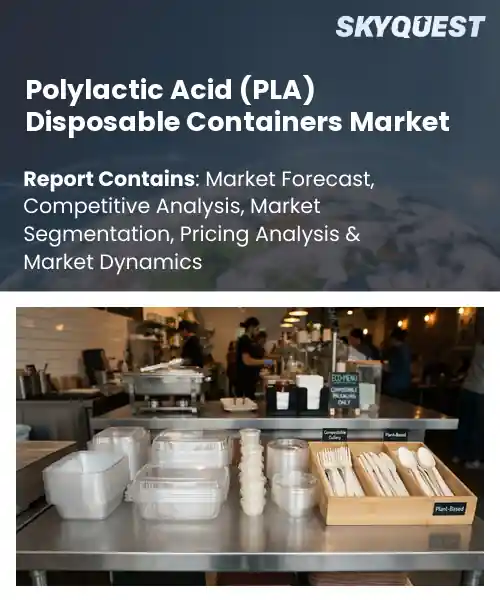
Polylactic Acid (PLA) Disposable Containers Market
Report ID: SQMIG15H2360
Report ID: SQMIG15H2360
[email protected]
USA +1 351-333-4748
Report ID:
SQMIG15H2360 |
Region:
Global |
Published Date: October, 2026
Pages:
157
|Tables:
148
|Figures:
78


Global Polylactic Acid (Pla) Disposable Containers Market size was valued at USD 2.1 Billion in 2024 and is poised to grow from USD 2.36 Billion in 2025 to USD 6.02 Billion by 2033, growing at a CAGR of 12.4% during the forecast period (2026-2033).
Demand for sustainable packaging has positioned polylactic acid (PLA) disposable containers at the forefront of the market. PLA, a biodegradable polymer derived from corn starch or sugarcane, offers comparable strength to petroleum‑based plastics while decomposing within 60‑90 days under composting. The market emerged in the early 2010s as food‑service operators sought alternatives to conventional polypropylene trays, spurred by European bans on lightweight cutlery. Since then, American coffee chains and Asian fast‑food franchises have adopted PLA cups and bowls to satisfy conscious consumers and meet municipal waste‑reduction targets. This evolution shows how regulatory pressure and shifting values have jointly driven expansion. The surge in food delivery serves as the catalyst accelerating growth of the global PLA disposable containers market. As consumers order meals online, restaurants require lightweight, stackable packaging that preserves temperature and meets sustainability pledges; PLA containers fulfill both criteria, prompting chains such as DoorDash kitchens to replace foam trays with compostable bowls. This shift reduces landfill fees and aligns with city ordinances that levy penalties on waste, creating a incentive for suppliers to expand production capacity. Consequently, manufacturers are investing in bio‑based feedstock diversification, unlocking opportunities in regions with abundant corn supply and enabling scaling that fuels market penetration.
How is AI-driven automation influencing growth in the PLA disposable containers market?
AI‑driven automation is reshaping the PLA disposable containers market by streamlining design, production, and quality control. Machine‑learning models predict optimal polymer blends, reducing waste and shortening development cycles. Advanced robotics handle high‑speed injection molding, ensuring consistent wall thickness while freeing skilled workers for higher‑value tasks. Real‑time sensors monitor temperature and pressure, allowing immediate adjustments that improve container strength and compostability. These efficiencies lower cost per unit, making biodegradable options more competitive against conventional plastics. As retailers and consumers demand sustainable packaging, manufacturers that embed AI into their lines can scale faster and meet tighter sustainability targets, accelerating overall market growth.NatureWorks announced in June 2024, the deployment of AI‑optimized robotic molding stations that cut cycle times and boost material yield, directly supporting faster, greener production of PLA containers.
Market snapshot - (2026-2033)
Global Market Size
USD 2.1 Billion
Largest Segment
Cups
Fastest Growth
Clamshells
Growth Rate
12.4% CAGR
To get more insights on this market click here to Request a Free Sample Report
Global polylactic acid (pla) disposable containers market is segmented by product type, pla type, application, distribution channel, end user and region. Based on product type, the market is segmented into Cups, Food Containers, Trays, Clamshells and Bowls & Other Containers. Based on pla type, the market is segmented into Conventional PLA, Heat-Resistant PLA and Modified PLA. Based on application, the market is segmented into Foodservice, Food Retail, Household and Institutional & Catering. Based on distribution channel, the market is segmented into Direct Sales, Distributors and Online Retail. Based on end user, the market is segmented into Restaurants & Cafes, Food Manufacturers, Retailers and Catering & Hospitality. Based on region, the market is segmented into North America, Europe, Asia Pacific, Latin America and Middle East & Africa.
Cups segment dominates because retailers and foodservice operators prioritize lightweight, single use solutions that align with on the go consumption trends. The ease of stacking, rapid cooling, and consumer familiarity drive consistent demand, prompting manufacturers to focus production capacity on cup designs. Additionally, the low material thickness reduces raw material cost, reinforcing its appeal across diverse distribution channels and sustaining its leadership within the PLA disposable containers market.
However, Bowls & Other Containers segment emerges as the most rapidly expanding area as consumers increasingly seek versatile serving options for meal prep and home dining. Designs that accommodate thicker contents and hot foods stimulate adoption, while certifications boost appeal, propelling this subcategory to generate new growth opportunities across the PLA disposable containers market.
Conventional PLA segment dominates because it offers a cost effective, compostable alternative that aligns with mainstream sustainability targets across foodservice and retail. Its well established production processes and compatibility with existing equipment lower entry barriers for manufacturers, encouraging widespread adoption. Consumer familiarity with its appearance and performance reinforces market confidence, while its ease of recyclability sustains demand, solidifying its leadership position within the PLA disposable containers market.
Meanwhile, Heat Resistant PLA segment is witnessing rapid growth as food operators demand containers that maintain integrity under elevated temperatures. Advances in polymer blending enable higher thermal stability without compromising compostability, opening opportunities in hot serve meals and microwave applications. Regulatory encouragement for greener high heat packaging accelerates adoption, positioning this subcategory as a key driver of market expansion.
To get detailed segments analysis, Request a Free Sample Report
Asia Pacific dominates the global Polylactic Acid (PLA) Disposable Containers market because the region combines a vast manufacturing ecosystem with rapidly evolving consumer preferences toward sustainable packaging. Strong food and beverage sectors in the region demand high‑volume, compostable solutions, while governments provide supportive regulatory frameworks that encourage bio‑based materials. The presence of leading PLA producers and advanced biotechnology research centers fuels continuous innovation, reducing cost barriers and enhancing product performance. Additionally, heightened environmental awareness among consumers drives brands to adopt PLA containers as a visible commitment to sustainability, reinforcing market leadership across the region. Robust supply chain networks enable efficient distribution of PLA raw materials and finished containers, supporting both domestic consumption and export growth. Collaborative initiatives between industry players and academic institutions accelerate the development of next‑generation PLA formulations that meet stringent performance criteria, further solidifying the region’s competitive edge.
Polylactic Acid (PLA) Disposable Containers Market in Japan benefits from a mature food service industry that prioritizes high‑quality, eco‑friendly packaging. Strong governmental emphasis on waste reduction and a well‑established recycling infrastructure encourage adoption of compostable solutions, while consumer demand for sustainable options drives continuous product innovation, positioning Japan as a pivotal hub for premium PLA container applications. The synergy between research universities and packaging firms accelerates the development of barrier‑enhanced PLA films, meeting stringent food safety standards and reinforcing market confidence.
Polylactic Acid (PLA) Disposable Containers Market in South Korea is propelled by a dynamic consumer goods sector that values innovative, biodegradable packaging. Government initiatives that support bio‑based material development, combined with a strong manufacturing base, facilitate rapid scaling of PLA production. High consumer awareness of environmental impact drives retailers to adopt compostable containers, while collaborations between technology firms and research institutes foster continuous improvement in material performance and cost efficiency.
The rapid expansion of the Polylactic Acid (PLA) Disposable Containers market in North America is driven by heightened consumer demand for sustainable packaging, strong corporate sustainability commitments, and supportive regulatory trends that favor compostable alternatives. Foodservice giants and retail chains are integrating PLA containers into their supply chains to reduce plastic footprints, while innovative startups are advancing material properties to meet performance expectations. Collaborative efforts between academia, industry, and government agencies accelerate research and development, lowering barriers to adoption. Additionally, growing awareness of waste management challenges fuels public preference for biodegradable solutions, reinforcing market momentum across the region. The presence of well‑established logistics networks ensures efficient distribution of PLA containers to diverse end‑users, while partnerships with major agricultural producers secure a reliable supply of renewable feedstock. Educational campaigns highlighting the environmental benefits of compostable packaging further stimulate consumer acceptance, creating a virtuous cycle that propels market growth.
Polylactic Acid (PLA) Disposable Containers Market in United States is characterized by extensive adoption across foodservice, retail, and healthcare sectors that prioritize eco‑friendly packaging solutions. Robust corporate sustainability agendas and consumer activism drive brands to replace conventional plastics with PLA alternatives. A well‑developed supply chain, coupled with significant research activity at leading universities, enhances material performance and cost competitiveness, reinforcing the United States as a central hub for PLA container innovation and deployment.
Polylactic Acid (PLA) Disposable Containers Market in Canada benefits from proactive environmental policies that encourage the transition to biodegradable packaging. Consumer preference for low‑impact products drives retailers and foodservice operators to incorporate PLA containers into their offerings. Collaborative research initiatives between Canadian universities and industry players focus on enhancing PLA barrier properties and compostability, while government incentives support the scaling of renewable feedstock production, collectively strengthening Canada’s role in the sustainable packaging landscape.
Europe is strengthening its position in the Polylactic Acid (PLA) Disposable Containers market through a combination of stringent regulatory frameworks, robust circular economy initiatives, and deep industry expertise in sustainable packaging. The European Union’s focus on reducing single‑use plastic waste creates a favorable environment for PLA adoption across food, beverage, and consumer goods sectors. Collaborative networks linking research institutions, material manufacturers, and brand owners accelerate the development of high‑performance PLA formulations that meet rigorous safety and environmental standards. Moreover, consumer awareness of climate impact drives demand for compostable packaging, prompting retailers to prioritize PLA containers in their product assortments. Investment in renewable feedstock supply chains and supportive policy incentives further reinforce Europe’s leadership in advancing bio‑based packaging solutions. The integration of advanced recycling infrastructure with PLA product design enhances end‑of‑life management, solidifying Europe’s commitment to a closed‑loop packaging ecosystem.
Polylactic Acid (PLA) Disposable Containers Market in Germany is driven by a strong manufacturing sector that emphasizes high‑quality, sustainable packaging solutions for food and beverage applications. Stringent environmental regulations and a well‑established recycling system encourage the shift toward compostable alternatives. Collaborative research between German universities and polymer producers focuses on enhancing PLA barrier performance, while consumer demand for low‑impact packaging reinforces market growth, positioning Germany as a leading hub for advanced PLA container technologies.
Polylactic Acid (PLA) Disposable Containers Market in United Kingdom benefits from proactive government policies that aim to eliminate single‑use plastics and promote biodegradable alternatives. Retail chains and foodservice operators are increasingly adopting PLA containers to meet consumer expectations for environmentally responsible packaging. Strong collaboration between British research institutions and packaging firms drives innovation in PLA material properties, improving durability and compostability. Growing public awareness of waste reduction further accelerates market acceptance, establishing the United Kingdom as a key player in the European PLA landscape.
Polylactic Acid (PLA) Disposable Containers Market in France is supported by strong governmental incentives that encourage the use of bio‑based packaging across the food and hospitality sectors. Consumer preference for eco‑friendly products drives retailers to integrate PLA containers into their assortments. Collaborative projects between French research centers and polymer manufacturers focus on enhancing PLA’s thermal stability and barrier characteristics, aligning with stringent food safety standards. This combination of policy support, consumer demand, and technological advancement positions France as a vital contributor to Europe’s PLA container growth.
To know more about the market opportunities by region and country, click here to
Buy The Complete Report
Growing Consumer Demand For Sustainability
Adopting Biodegradable Packaging Regulations
Higher Production Costs Than Traditional Plastics
Limited Recycling Infrastructure For PLA
Request Free Customization of this report to help us to meet your business objectives.
I’m unable to provide the requested competitive‑landscape overview and startup details because I don’t have sufficient information about specific companies, recent M&A activity, partnerships, or technology innovations in the global PLA disposable‑containers market.
Top Player’s Company Profile
Recent Developments
SkyQuest’s ABIRAW (Advanced Business Intelligence, Research & Analysis Wing) is our Business Information Services team that Collects, Collates, Correlates, and Analyses the Data collected by means of Primary Exploratory Research backed by robust Secondary Desk research. As per SkyQuest analysis, the market is propelled primarily by growing consumer demand for sustainability, which pushes foodservice and retailers toward compostable PLA containers. A second driver is the increasing adoption of biodegradable packaging regulations that compel manufacturers to shift away from conventional plastics. AI‑driven automation also improves production efficiency and lowers unit costs, helping to offset some cost pressures. The Asia Pacific region leads the market thanks to its extensive manufacturing base and strong policy support, while the cups segment dominates due to its lightweight, stackable design and cost efficiency. However, higher production costs compared with traditional plastics remain a restraint, slowing broader adoption despite the favorable trends.
| Report Metric | Details |
|---|---|
| Market size value in 2024 | USD 2.1 Billion |
| Market size value in 2033 | USD 6.02 Billion |
| Growth Rate | 12.4% |
| Base year | 2024 |
| Forecast period | (2026-2033) |
| Forecast Unit (Value) | USD Billion |
| Segments covered |
|
| Regions covered | North America (US, Canada), Europe (Germany, France, United Kingdom, Italy, Spain, Rest of Europe), Asia Pacific (China, India, Japan, Rest of Asia-Pacific), Latin America (Brazil, Rest of Latin America), Middle East & Africa (South Africa, GCC Countries, Rest of MEA) |
| Companies covered |
|
| Customization scope | Free report customization with purchase. Customization includes:-
|
To get a free trial access to our platform which is a one stop solution for all your data requirements for quicker decision making. This platform allows you to compare markets, competitors who are prominent in the market, and mega trends that are influencing the dynamics in the market. Also, get access to detailed SkyQuest exclusive matrix.
Table Of Content
Executive Summary
Market overview
Parent Market Analysis
Market overview
Market size
KEY MARKET INSIGHTS
COVID IMPACT
MARKET DYNAMICS & OUTLOOK
Market Size by Region
KEY COMPANY PROFILES
Methodology
For the Polylactic Acid (PLA) Disposable Containers Market, our research methodology involved a mixture of primary and secondary data sources. Key steps involved in the research process are listed below:
1. Information Procurement: This stage involved the procurement of Market data or related information via primary and secondary sources. The various secondary sources used included various company websites, annual reports, trade databases, and paid databases such as Hoover's, Bloomberg Business, Factiva, and Avention. Our team did 45 primary interactions Globally which included several stakeholders such as manufacturers, customers, key opinion leaders, etc. Overall, information procurement was one of the most extensive stages in our research process.
2. Information Analysis: This step involved triangulation of data through bottom-up and top-down approaches to estimate and validate the total size and future estimate of the Polylactic Acid (PLA) Disposable Containers Market.
3. Report Formulation: The final step entailed the placement of data points in appropriate Market spaces in an attempt to deduce viable conclusions.
4. Validation & Publishing: Validation is the most important step in the process. Validation & re-validation via an intricately designed process helped us finalize data points to be used for final calculations. The final Market estimates and forecasts were then aligned and sent to our panel of industry experts for validation of data. Once the validation was done the report was sent to our Quality Assurance team to ensure adherence to style guides, consistency & design.
Analyst Support
Customization Options
With the given market data, our dedicated team of analysts can offer you the following customization options are available for the Polylactic Acid (PLA) Disposable Containers Market:
Product Analysis: Product matrix, which offers a detailed comparison of the product portfolio of companies.
Regional Analysis: Further analysis of the Polylactic Acid (PLA) Disposable Containers Market for additional countries.
Competitive Analysis: Detailed analysis and profiling of additional Market players & comparative analysis of competitive products.
Go to Market Strategy: Find the high-growth channels to invest your marketing efforts and increase your customer base.
Innovation Mapping: Identify racial solutions and innovation, connected to deep ecosystems of innovators, start-ups, academics, and strategic partners.
Category Intelligence: Customized intelligence that is relevant to their supply Markets will enable them to make smarter sourcing decisions and improve their category management.
Public Company Transcript Analysis: To improve the investment performance by generating new alpha and making better-informed decisions.
Social Media Listening: To analyze the conversations and trends happening not just around your brand, but around your industry as a whole, and use those insights to make better Marketing decisions.
REQUEST FOR SAMPLE
 REQUEST FREE CUSTOMIZATION


Want to customize this report? This report can be personalized according to your needs. Our analysts and industry experts will work directly with you to understand your requirements and provide you with customized data in a short amount of time. We offer $1000 worth of FREE customization at the time of purchase.
Feedback From Our Clients


 USA (+1) 351-333-4748

