Polyethylene Terephthalate (PET) Cups Market
Report ID: SQMIG15B2198
Report ID: SQMIG15B2198
[email protected]
USA +1 351-333-4748
Report ID:
SQMIG15B2198 |
Region:
Global |
Published Date: March, 2026
Pages:
157
|Tables:
115
|Figures:
77


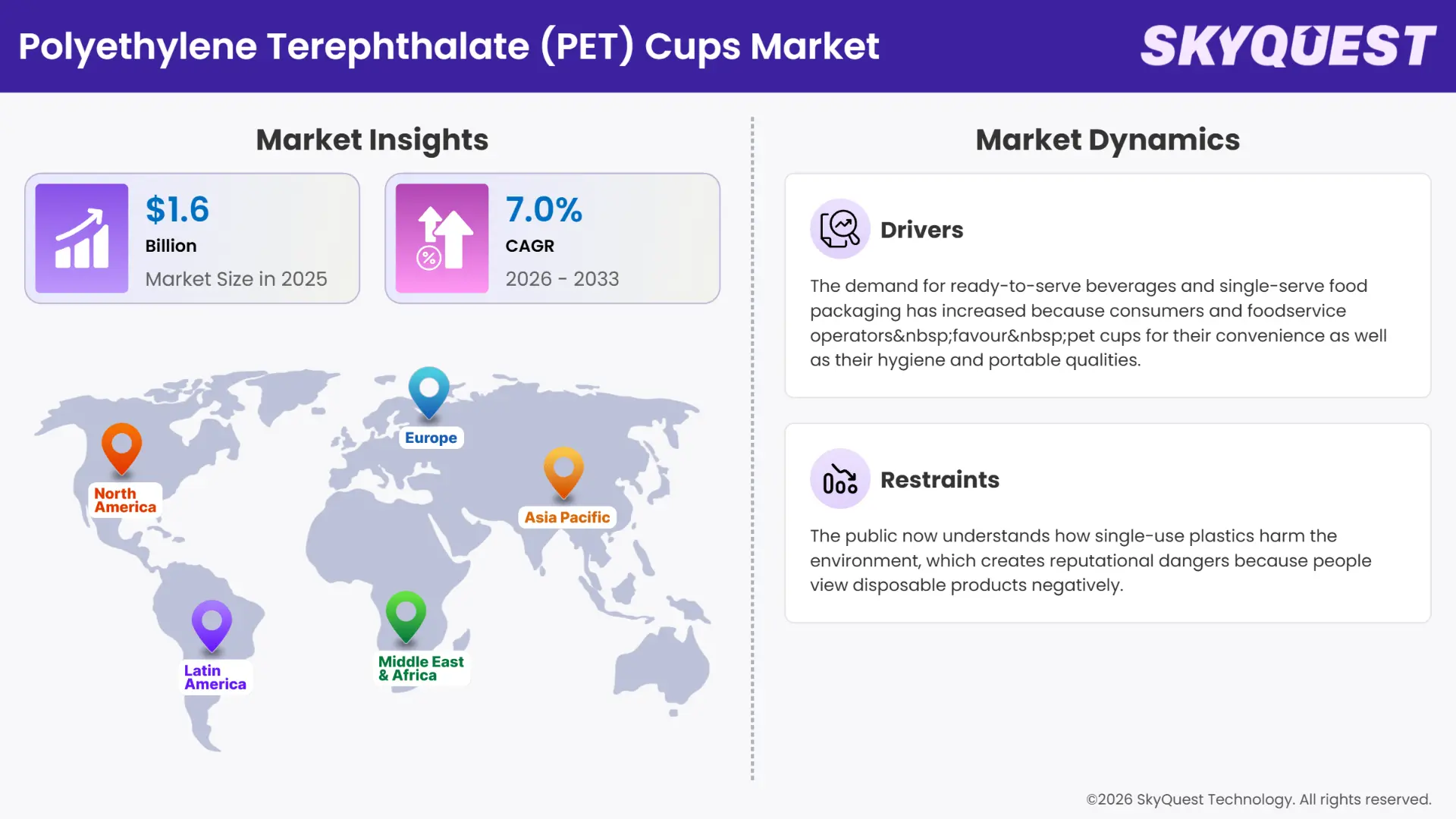
Global Polyethylene Terephthalate (Pet) Cups Market size was valued at USD 1.5 Billion in 2024 and is poised to grow from USD 1.6 Billion in 2025 to USD 2.76 Billion by 2033, growing at a CAGR of 7.0% during the forecast period (2026-2033).
Key Takeaways: Market Trends & Insights
The global polyethylene terephthalate (PET) cups market growth is driven because consumers prefer lightweight transparent and hygienic single use products which result in reduced distribution expenses over their growing need for on-the-go beverage options. The market consists of injection molded PET cups supplied to quick service restaurants, cold beverage chains, supermarkets, and event organizers. The combination of food safe performance and recyclability potential in PET materials enables brands to meet consumer expectations while complying with regulatory requirements. The segment developed from its 1970s introduction because of resin advancements and production cost reductions and supply chain improvements which enabled bottled water and takeaway beverage growth in Asia Pacific and other regions.
Moreover, the global demand for PET cups depends on two primary factors, which include rising sustainability packaging requirements and increasing consumer demand for sustainable packaging solutions, which force producers to change their product design and supply chain operations to meet recycling requirements and extended producer responsibility regulations. The production process now uses recycled PET and lightweighting technologies and barrier coatings so producers can meet performance standards while they sustain product visibility and protection capabilities, which creates new business prospects for recycling infrastructure operators and rPET pellet manufacturing companies. Coffee chains that adopt certified rPET cups together with municipal deposit return systems which improve recovery rates, create substantial reductions in carbon emissions through their decreased use of raw resin materials.
How is AI Transforming the Polyethylene Terephthalate (PET) Cups Market?
Artificial intelligence transforms the entire polyethylene terephthalate (PET) cups market outlook through its impact on product development and production techniques and waste management operations. AI-driven computer vision improves in line quality inspection and waste reduction while machine learning optimizes material recipes to meet clarity and barrier expectations. The system operates efficiently because predictive maintenance and process control systems prevent high speed lines from experiencing operational pauses. AI technology helps brand teams create trend forecasts that develop lightweight designs which achieve efficient product performance while maintaining recyclable properties. AI technology enables PET cup identification through automated sorting and robotic systems which establish links between product use and recycling, thus returning high quality recycled resin to manufacturing processes, which leads to a more sustainable and circular product market. AMP Robotics demonstrated its AI-powered sorting technology which improves PET cup identification and recovery to deliver recycled PET for manufacturing while reducing waste handling costs that enhance operational productivity and support market expansion.
To get more insights on this market click here to Request a Free Sample Report
The global polyethylene terephthalate (PET) cups market is segmented based on cup design and utility, material source, manufacturing technology, end-use sector, and region. In terms of cup design and utility, the market includes cold drink cups, dessert/parfait cups, and portion or deli cups. Based on material source, it is divided into virgin PET and recycled PET (rPET). By manufacturing technology, the market is categorized into thermoforming and injection molding processes. In terms of end-use sector, the segmentation covers quick service restaurants (QSRs) and cafés, event and catering services, as well as household and retail consumption. Geographically, the market is segmented into North America, Europe, Asia Pacific, Latin America, and the Middle East & Africa.
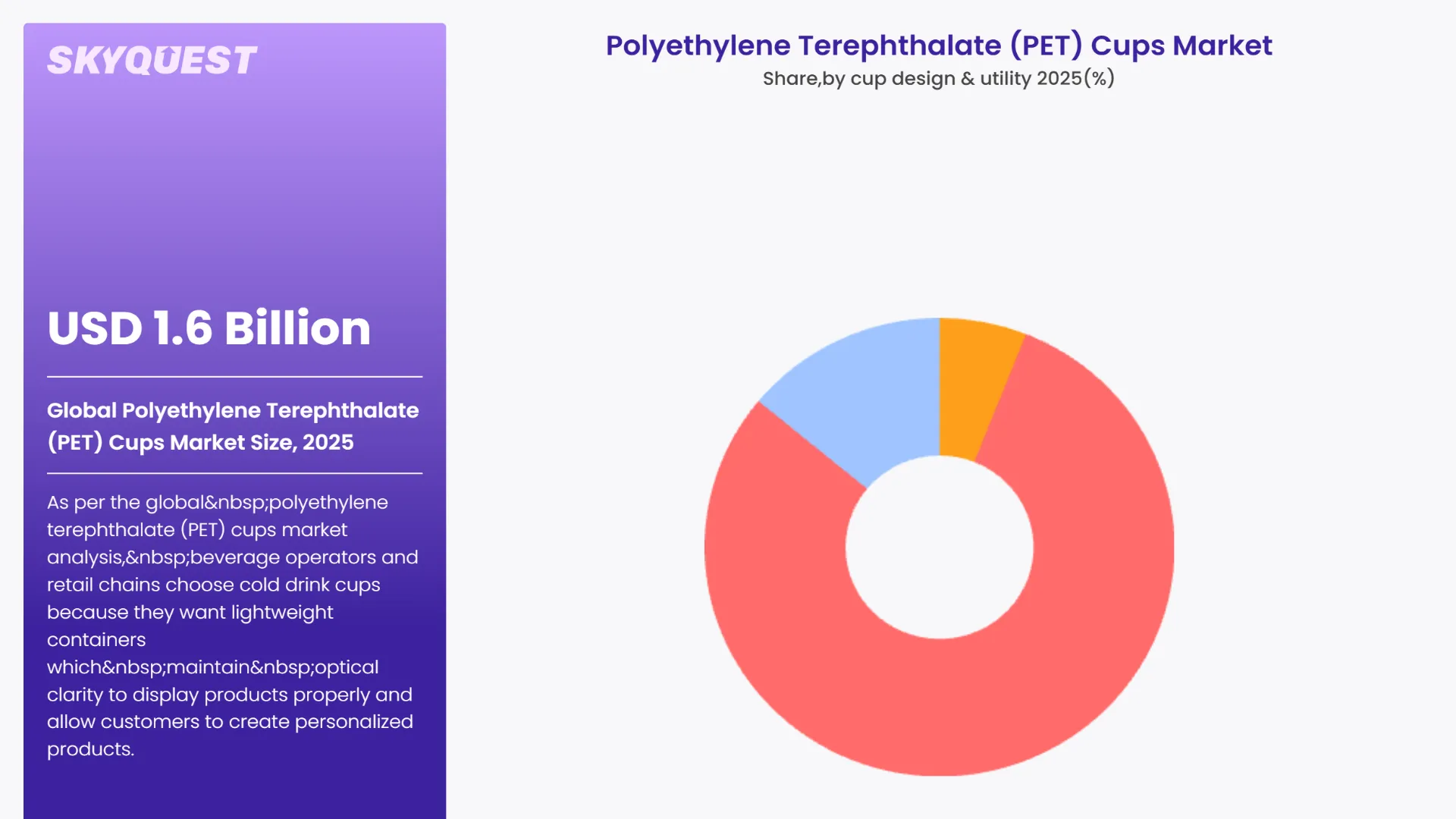
As per the global polyethylene terephthalate (PET) cups market analysis, beverage operators and retail chains choose cold drink cups because they want lightweight containers which maintain optical clarity to display products properly and allow customers to create personalized products. The combination of functional lid and straw compatibility with cost-effective production and distribution capabilities drives buyers to choose these elements. Single-serve cold beverage designers and packagers select this format for their products because it creates steady demand which supports tooling development and supply chain operations in the PET cups market.
However, the Dessert/Parfait Cup market has substantial growth because people want visually appealing desserts which come in controlled portions. The premiumization trend which drives social media presentation demands, together with restaurant industry specialty desserts and bakery shops, leads to new premium dessert products which allow customers to create their own desserts.
According to the global polyethylene terephthalate (PET) cups market forecast, the virgin PET segment leads the market because it provides food contact applications with necessary optical quality and meltsbehavior and it delivers stable production results while meeting food safety rules. Producers use virgin resin because it produces consistent high-quality results for critical packaging operations, while customers want the material to provide standard barrier performance together with multiple converting process compatibility. The PET cups market has widespread acceptance because its products deliver reliable performance throughout the manufacturing and distribution processes.
However, demand for recycled PET is increasing because circularity requirements become more common, and brands make sustainability commitments. Collection and purification technologies have improved feedstock consistency so food-contact standards can be met which enables companies to develop eco-friendly products that attract environmentally conscious customers while they create new business opportunities in the market.
To get detailed segments analysis, Request a Free Sample Report
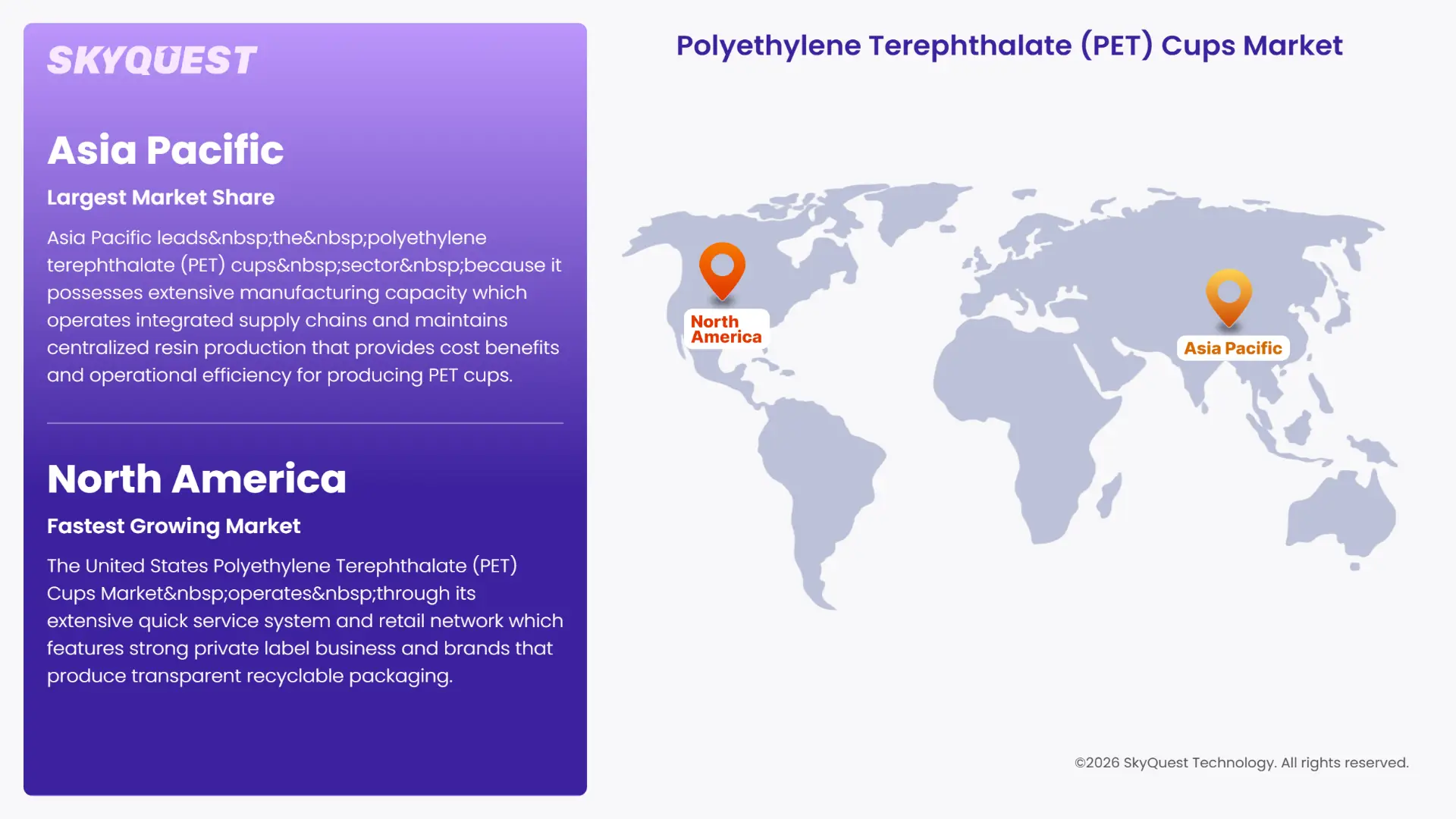
Asia Pacific leads the polyethylene terephthalate (PET) cups sector because it possesses extensive manufacturing capacity which operates integrated supply chains and maintains centralized resin production that provides cost benefits and operational efficiency for producing PET cups. The growing urban population in combination with various foodservice channels maintains high demand which supports large scale operations while regional converters allocate funds towards advanced processing technology and lightweight materials development. Companies can swiftly adapt and send their products because they operateclose to important consumer markets. The food contact compliance and recycling programs receive support through policy frameworks and industry partnerships meanwhile brand owners and converters and material suppliers work together to promote recyclable PET formats through various market channels.
The Japan Polyethylene Terephthalate (PET) Cups industry features advanced manufacturing capabilities which companies use to achieve food safety standards while consumers prefer packaging that offers high clarity. The premium beverage market together with retail businesses that offer convenience products drives demand. Local converters specialize in producing precise molds which optimize material use through lightweight designs. Companies work with brand owners and recyclers to develop circularity programs which help them achieve incremental packaging improvements that match customer expectations.
The South Korean Polyethylene Terephthalate (PET) Cups Market benefits from its advanced plastics processing competencies which enable multiple research areas to integrate electronics and materials science while its foodservice industry demands user-friendly packing solutions. Companies develop packaging solutions through their local production operations, which focus on producing and developing barrier materials. Recycling program enhancements together with waste management partnerships to assist resource recovery efforts. Seasonal promotions and premium packaging solutions can be quickly customized through flexible manufacturing.
The North American Polyethylene Terephthalate (PET) Cups market penetration because modern consumers demand products which offer them convenience while they are away from home. The market for PET cups expands through brand investments in single use of clear packaging and the rising popularity of private label products. PET has become the material of choice because companies are actively pursuing sustainability goals through material optimization, and their recycling methods have better performance. Processing technology improvements together with efficient supply chain operations enable businesses to produce products at higher volumes while differentiating their offerings. The market moves forward because converters and resin suppliers and retailers work together to create lightweight solutions which meet food safety standards and regional logistics needs. Businesses use automation together with packaging design skills to create unique products for their premium and value markets which comply with food contact requirements needed for their products to obtain market acceptance.
The United States Polyethylene Terephthalate (PET) Cups Market operates through its extensive quick service system and retail network which features strong private label business and brands that produce transparent recyclable packaging. Producers use scalable production methods together with advanced automation systems to fulfill both retailer and foodservice requirements. The industry's recycling initiatives together with material recovery programs create a framework for achieving circularity goals. Companies ensure food contact compliance through their regulatory approach while it works with supply chain partners to maintain product safety throughout the entire market distribution process.
The Polyethylene Terephthalate (PET) Cups Market in Canada demonstrates a strong dedication to environmental protection which matches the regional sustainability programs. The local converters use their material efficiency and recyclability and lightweighting capabilities to meet the requirements of retailers and consumers. Beverage brands work with packaging suppliers to create products which enable consumers to take their drinks with them while eating out at restaurants. Companies strengthen citywide convenience store acceptance of its product through its design of products for collection and recycling partnerships.
The European Union strengthens its role through three elements which include strict regulatory standards and brand and retail environmental commitments and its packaging circularity of investments. The design for the recycling process receives encouragement through the dual focus on recyclability and material traceability which promotes the use of recycled materials in PET cup production. The advanced recycling technology and unified collection system operations in the region enhance feedstock supply to converters. To achieve performance goals while meeting environmental requirements, converters and suppliers select mono material solutions and develop barrier innovations and design lightweight products. The three groups of packaging manufacturers and waste management operators and policy makers work together to create the needed standards which will help them establish their products in the market. The design standards and commercial scale trials receive funding to maintain product flow between countries while helping retailers choose materials with assurance.
The Polyethylene Terephthalate (PET) Cups Market in Germany demonstrates a strong engineering and manufacturing foundation which exists because of its strong recycling system and strict regulatory framework. The converters need to establish material traceability through their high-quality standards because food contact requirements demand their customers meet stringent standards. The market activities take shape through the joint efforts of packaging suppliers and waste management operators and brand owners to develop products which can be recycled from mono materials. The market gains acceptance through production processes which show efficient results during actual disposal activities.
The United Kingdom Polyethylene Terephthalate (PET) Cups Market exists because retailers and food service providers need convenient and presentable packaging while sustainability discussions maintain active operations. The manufacturers use design innovation and mono material formats and product clarity to fulfill their premium beverage requirements. The organizations work together to improve their collection system through their partnerships between brands and converters and waste management services. The combination of food contact standards compliance and clear recyclability information establishesconsumer trust which leads to market acceptance.
The French Polyethylene Terephthalate (PET) Cups Market develops through the strong cafe and beverage culture, which prioritizes attractive packaging designs. The converters and brands collaborate to produce high-quality product lids which deliver both product preservation and functional capabilities. The recycling PET formats receive support through the recycling standard use and participation in local collection systems. Organizations make investments in design for recycling while it establishes recycling partnerships to create circular systems which follow both regulatory standards and retailer demands.
To know more about the market opportunities by region and country, click here to
Buy The Complete Report
Rising Preference for Disposable Cups
The demand for ready-to-serve beverages and single-serve food packaging has increased because consumers and foodservice operators favour pet cups for their convenience as well as their hygiene and portable qualities. Manufacturers and retailers increase PET cup offerings because they need to meet consumer demand for ready-to-eat food items through single-use packaging solutions. The retailers increase product visibility through display units and checkout counters while food service operations choose PET materials for their price advantages and supply chain efficiency, which extends the market reach by making more products available and driving category development.
Enhanced Brand Sustainability Initiatives
The corporate sustainability commitments and voluntary industry programs, which prioritize recyclability and post-consumer resin usage, make PET cups an attractive packaging option for brands who want to demonstrate their environmental commitment through visible green packaging. The procurement teams become more likely to choose PET cups as their packaging option when manufacturers use clear labeling and recycling partnerships and recycled PET content in their products. The connection between sustainability goals and material characteristics results in better brand perception which drives product specification of PET products thus enabling the market to expand through increased corporate use and positive public views of PET packaging.
Environmental Concerns Over Single Use Plastics
The public now understands how single-use plastics harm the environment, which creates reputational dangers because people view disposable products negatively. This leads to decreased retailer interest in PET cup products. The policy discussions and consumer campaigns steer people toward using materials that create less environmental damage or toward using reusable systems, which makes procurement teams and food service operators want to test new options. The market faces challenges because of the changes in public attitude which increase resistance against sustainability messaging in specific sectors while manufacturers need to develop new products and disclose end-of-life information before they can continue expanding their operations.
Concerns Regarding Recycled Resin Quality
The presence of different visual characteristics and performance features between recycled PET materials leads buyers to distrust their suitability for cup applications that require both visual clarity and barrier protection and consistent shape ability thus brand and specification managers choose to use virgin materials. Recycled content solutions, which suppliers provide, face increased challenges because their customers need to demonstrate that recycled material can be processed without producing contamination or odors. The product development teams and procurement staff maintain a cautious approach, which prevents them from adopting PET cup variants that run on recycled materials until they achieve consistent quality standards.
Request Free Customization of this report to help us to meet your business objectives.
The global PET cups market shows competitive behavior through three major trends which include consolidation, formation of partnerships and ongoing material innovation battles that focus on creating circular systems and increasing rPET usage. The major buyers and converters have executed strategic acquisitions while launching rPET cup lines, which investors support to spur the development of recyclable and bio-based alternatives through circular-material startups.
Shift Toward Lightweight Designs: Manufacturers and brand owners prioritize lightweight cup profiles to reduce material use and enhance transport efficiency while preserving structural integrity and consumer convenience. Design innovation focuses on design innovation which uses thinner walls and optimized geometry and material blends to achieve maximum clarity while maintaining heat resistance. This trend supports lower production costs and aligns with sustainability messaging without relying on recycled content claims. The companies modernize their operations through tooling and process improvements which help them deliver reliable product quality at increased production volumes while achieving widespread market acceptance in retail and foodservice sectors.
Digital Decoration and Customization: To enhance their brand identity, companies now utilize high-resolution printing for their PET packaging design which results in unique visual products that boost their store presence and customer interaction. Marketing campaigns and promotions benefit from custom graphics and limited editions and tailored designs which also allow companies to quickly adjust their operations according to emerging market trends. Low-temperature ink technology and inline decoration processes now enable various substrates to maintain their original clarity and tactile properties. Packaging converters work together with brand teams to deliver brand experiences which create premium value through fast service and smaller package size delivery that enables brands to deliver value through their products across all sales areas.
SkyQuest’s ABIRAW (Advanced Business Intelligence, Research & Analysis Wing) is our Business Information Services team that Collects, Collates, Correlates, and Analyses the Data collected by means ofPrimary Exploratory Research backed by robust Secondary Desk research.
As per SkyQuest analysis, the global PET cups market is being driven primarily by rising on-the-go beverage consumption, while regulatory mandates and growing brand sustainability commitments act as a second driver encouraging rPET use and lightweighting. The public has grown increasingly concerned about single-use plastics which creates a major obstacle for brands and retailers to discover sustainable alternatives to their existing plastic products or better methods for disposing of their plastic waste. Asia Pacific maintains its status as the leading area for production because it possesses extensive manufacturing facilities and complete supply chain networks and strong local market requirements, while cold drink cups remain the most popular type of cup because they offer optimal clarity and lid compatibility and affordability to all foodservice and retail customers.
| Report Metric | Details |
|---|---|
| Market size value in 2024 | USD 1.5 Billion |
| Market size value in 2033 | USD 2.76 Billion |
| Growth Rate | 7.0% |
| Base year | 2024 |
| Forecast period | 2026-2033 |
| Forecast Unit (Value) | USD Billion |
| Segments covered |
|
| Regions covered | North America (US, Canada), Europe (Germany, France, United Kingdom, Italy, Spain, Rest of Europe), Asia Pacific (China, India, Japan, Rest of Asia-Pacific), Latin America (Brazil, Rest of Latin America), Middle East & Africa (South Africa, GCC Countries, Rest of MEA) |
| Companies covered | |
| Customization scope | Free report customization with purchase. Customization includes:-
|
To get a free trial access to our platform which is a one stop solution for all your data requirements for quicker decision making. This platform allows you to compare markets, competitors who are prominent in the market, and mega trends that are influencing the dynamics in the market. Also, get access to detailed SkyQuest exclusive matrix.
Table Of Content
Executive Summary
Market overview
Parent Market Analysis
Market overview
Market size
KEY MARKET INSIGHTS
COVID IMPACT
MARKET DYNAMICS & OUTLOOK
Market Size by Region
KEY COMPANY PROFILES
Methodology
For the Polyethylene Terephthalate (PET) Cups Market, our research methodology involved a mixture of primary and secondary data sources. Key steps involved in the research process are listed below:
1. Information Procurement: This stage involved the procurement of Market data or related information via primary and secondary sources. The various secondary sources used included various company websites, annual reports, trade databases, and paid databases such as Hoover's, Bloomberg Business, Factiva, and Avention. Our team did 45 primary interactions Globally which included several stakeholders such as manufacturers, customers, key opinion leaders, etc. Overall, information procurement was one of the most extensive stages in our research process.
2. Information Analysis: This step involved triangulation of data through bottom-up and top-down approaches to estimate and validate the total size and future estimate of the Polyethylene Terephthalate (PET) Cups Market.
3. Report Formulation: The final step entailed the placement of data points in appropriate Market spaces in an attempt to deduce viable conclusions.
4. Validation & Publishing: Validation is the most important step in the process. Validation & re-validation via an intricately designed process helped us finalize data points to be used for final calculations. The final Market estimates and forecasts were then aligned and sent to our panel of industry experts for validation of data. Once the validation was done the report was sent to our Quality Assurance team to ensure adherence to style guides, consistency & design.
Analyst Support
Customization Options
With the given market data, our dedicated team of analysts can offer you the following customization options are available for the Polyethylene Terephthalate (PET) Cups Market:
Product Analysis: Product matrix, which offers a detailed comparison of the product portfolio of companies.
Regional Analysis: Further analysis of the Polyethylene Terephthalate (PET) Cups Market for additional countries.
Competitive Analysis: Detailed analysis and profiling of additional Market players & comparative analysis of competitive products.
Go to Market Strategy: Find the high-growth channels to invest your marketing efforts and increase your customer base.
Innovation Mapping: Identify racial solutions and innovation, connected to deep ecosystems of innovators, start-ups, academics, and strategic partners.
Category Intelligence: Customized intelligence that is relevant to their supply Markets will enable them to make smarter sourcing decisions and improve their category management.
Public Company Transcript Analysis: To improve the investment performance by generating new alpha and making better-informed decisions.
Social Media Listening: To analyze the conversations and trends happening not just around your brand, but around your industry as a whole, and use those insights to make better Marketing decisions.
REQUEST FOR SAMPLE
 REQUEST FREE CUSTOMIZATION
Global Polyethylene Terephthalate (Pet) Cups Market size was valued at USD 1.5 Billion in 2024 and is poised to grow from USD 1.6 Billion in 2025 to USD 2.76 Billion by 2033, growing at a CAGR of 7.0% during the forecast period (2026-2033).
Competitive dynamics in the global PET cups market reflect rapid consolidation, partnerships and material-innovation arms races that prioritize circularity and rPET adoption, driving suppliers to pursue acquisitions, joint ventures and recycling-to-product technology. For example, major buyers and converters have completed strategic acquisitions and launched rPET cup lines while investors back circular-material startups to accelerate recyclable and bio-based alternatives. 'Amcor plc', 'Huhtamaki', 'Berry Global', 'Sonoco', 'Dart Container', 'Pactiv Evergreen', 'Genpak LLC', 'Solo Cup Company', 'Fabri-Kal', 'Placon', 'Silgan Plastics', 'Printpack', 'Anchor Packaging', 'Pretium Packaging', 'Macpac', 'Ningbo Yi Sheng', 'Sabert Corporation', 'Eco-Products', 'D&W Fine Pack', 'Visy'
Pet cups are increasingly favored by consumers and foodservice operators for convenience, hygiene and portability, which drives demand for ready-to-serve beverages and single-serve food packaging. This preference encourages manufacturers and retailers to stock and promote PET cup formats, expand SKU offerings and invest in optimized designs that meet handling and performance expectations. Retailers respond with prominent shelving and point-of-sale promotion, while foodservice procurement shifts toward PET for consistency and cost-effective logistics, collectively supporting market expansion through broader availability and category growth.
Shift Toward Lightweight Designs: Manufacturers and brand owners prioritize lightweight cup profiles to reduce material use and enhance transport efficiency while preserving structural integrity and consumer convenience. Design innovation focuses on thinner walls, optimized geometry and material blends that maintain clarity and heat resistance. This trend supports lower production costs and aligns with sustainability messaging without relying on recycled content claims. Suppliers invest in tooling and process refinements to enable consistent quality at scale, driving broader adoption across retail and foodservice channels and markets.
Asia Pacific Dominate the Global Polyethylene Terephthalate (PET) Cups Market.
Based on material source, the market is categorized into Virgin PET and rPET (Recycled PET). Growing sustainability initiatives are accelerating the adoption of rPET-based cups across multiple industries.
Demand for rPET cups is increasing because companies and consumers are prioritizing sustainable packaging solutions that reduce plastic waste, support circular economy goals, and comply with environmental regulations.
The market faces challenges such as fluctuating raw material prices, stringent regulations on single-use plastics, and increasing competition from biodegradable and alternative packaging materials.


Want to customize this report? This report can be personalized according to your needs. Our analysts and industry experts will work directly with you to understand your requirements and provide you with customized data in a short amount of time. We offer $1000 worth of FREE customization at the time of purchase.
Feedback From Our Clients


 USA (+1) 351-333-4748

