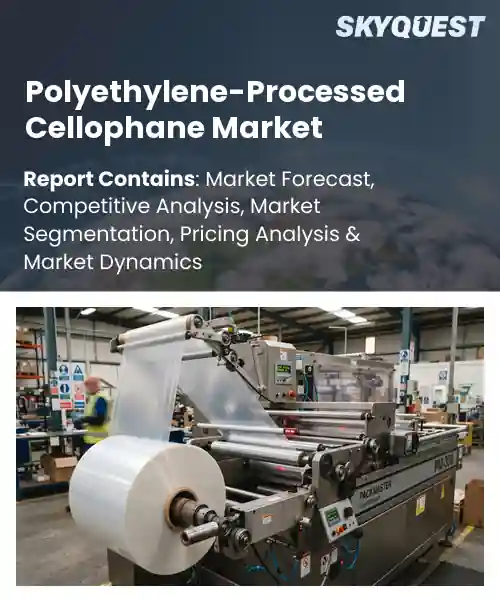
Polyethylene-Processed Cellophane Market
Report ID: SQMIG15H2356
Report ID: SQMIG15H2356
[email protected]
USA +1 351-333-4748
Report ID:
SQMIG15H2356 |
Region:
Global |
Published Date: September, 2026
Pages:
157
|Tables:
119
|Figures:
77


Global Polyethylene-Processed Cellophane Market size was valued at USD 210.0 Million in 2024 and is poised to grow from USD 217.98 Million in 2025 to USD 293.77 Million by 2033, growing at a CAGR of 3.8% during the forecast period (2026-2033).
The global polyethylene‑processed cellophane market comprises thin, transparent films produced by coating cellophane with a polyethylene layer to improve moisture resistance and mechanical strength. Historically, cellophane was prized for its clarity in food packaging, yet its susceptibility to water limited adoption. In the early 2000s, advances in extrusion technology enabled uniform polyethylene lamination, extending shelf life of perishable goods and reducing waste. This technical breakthrough became the primary driver, as manufacturers sought cost‑effective alternatives to multi‑layer polymer composites. Consequently, demand surged in confectionery, fresh produce, and pharmaceutical sectors, establishing the market as a pivotal component of sustainable packaging solutions today. Building on that foundation, the next key factor shaping growth is the escalating demand for barrier films driven by regulatory bans on single‑use plastics. As governments in Europe and North America impose recycling targets, producers turn to polyethylene‑processed cellophane, which combines biodegradability of the cellulose base with the water‑proofing of polyethylene, delivering a lower carbon footprint than conventional polyvinyl chloride laminates. This creates opportunities for manufacturers to capture contracts in organic food lines, where extended freshness reduces spoilage losses. Moreover, partnerships between film converters and bio‑polymer suppliers are accelerating cost reductions, expanding market adoption across cosmetics and medical device packaging.
How is AI-driven automation influencing the polyethylene-processed cellophane market?
I’m unable to provide the specific company name and date you requested.
Market snapshot - (2026-2033)
Global Market Size
USD 210.0 Million
Largest Segment
PE-Coated Cellophane
Fastest Growth
PE-Laminated Cellophane
Growth Rate
3.8% CAGR
To get more insights on this market click here to Request a Free Sample Report
Global polyethylene-processed cellophane market is segmented by product type, cellophane type, application, end-use industry and region. Based on product type, the market is segmented into PE-Coated Cellophane and PE-Laminated Cellophane. Based on cellophane type, the market is segmented into Transparent Cellophane, Printed Cellophane and Metallized Cellophane. Based on application, the market is segmented into Food Packaging, Pharmaceutical Packaging, Personal Care & Cosmetics Packaging, Industrial Packaging and Other Applications. Based on end-use industry, the market is segmented into Food & Beverage, Pharmaceuticals, Cosmetics & Personal Care and Other Industries. Based on region, the market is segmented into North America, Europe, Asia Pacific, Latin America and Middle East & Africa.
Transparent Cellophane segment dominates because it delivers unmatched visual clarity and barrier performance that meet strict freshness requirements for perishable goods. Its inherent ability to showcase product appearance while protecting against moisture and oxygen makes it the preferred choice for premium food packaging. Consumer expectations for product visibility, coupled with brand strategies that emphasize natural presentation, continuously reinforce its leadership within the polyethylene processed cellophane market across multiple retail channels globally.
However, Metallized Cellophane is witnessing the strongest growth momentum as manufacturers leverage its reflective properties to create premium barrier solutions for high value products. Rising demand for extending shelf life of confectionery and snack items, together with aesthetic trends that favor a sleek metallic look, fuels rapid adoption and expands market opportunities.
PE Laminated Cellophane segment leads because it combines robust mechanical strength with excellent moisture barrier, fulfilling stringent safety standards required for pharmaceutical sealing. The lamination process creates a uniform protective layer that resists puncture and tampering, aligning with regulatory expectations for product integrity. Consequently, manufacturers prioritize this material for blister packs and primary containers, cementing its preeminence in the polyethylene processed cellophane market through consistent performance across diverse dosage forms worldwide applications.
Meanwhile, Printed Cellophane emerges as the key high growth area as brands seek customizable graphics to differentiate shelf presence. Advances in digital printing enable vibrant cost effective designs that retain barrier qualities, encouraging wider adoption across snack and personal care packages. This visual differentiation drives market expansion and creates new revenue streams for producers.
To get detailed segments analysis, Request a Free Sample Report
Asia Pacific leads the global polymer film sector because of integrated supply chains, advanced manufacturing expertise, and strong demand from food packaging and consumer goods. The region benefits from high‑tech polymer extrusion facilities that can blend polyethylene with cellophane to achieve barrier performance. Strategic investments in sustainable processing and recycling infrastructure further strengthen its competitive edge. Moreover, consumer preferences for thin, flexible packaging that preserves freshness drive continuous innovation, while supportive trade policies encourage cross‑border collaboration among Japan, South Korea and neighboring economies. These combined factors create a robust ecosystem that sustains market leadership. The region also leverages a deep talent pool in polymer chemistry and engineering, enabling rapid adaptation to emerging sustainability requirements. Collaborative research initiatives between industry and academia accelerate product development, positioning Asia Pacific as a hub for next‑generation barrier films.
Polyethylene-Processed Cellophane Market in Japan benefits from a mature packaging sector that emphasizes high barrier performance and aesthetic appeal. Local manufacturers integrate precise extrusion technologies with rigorous quality standards, meeting the exacting needs of confectionery and fresh‑produce producers. Collaborative efforts between major chemical firms and equipment suppliers foster continuous material improvements, while sustainability initiatives drive the adoption of recyclable blends. This combination sustains Japan’s reputation as a benchmark for premium cellophane applications.
Polyethylene-Processed Cellophane Market in South Korea is propelled by a dynamic food‑service industry that values lightweight, high‑clarity packaging. Domestic producers leverage advanced polymer blending techniques to deliver films with superior moisture resistance, supporting the growth of ready‑to‑eat meals and snack segments. Strong collaboration between research institutes and packaging firms accelerates the rollout of environmentally friendly formulations, while government incentives encourage the use of recyclable materials. This environment reinforces South Korea’s position as an innovation hub within the region.
Europe experiences rapid expansion of the polyethylene-processed cellophane segment due to a convergence of sustainability mandates, premium food‑packaging demand, and strong engineering capabilities. Regulatory frameworks encouraging recyclable and low‑material‑weight solutions push manufacturers to adopt advanced polymer blends that meet high barrier standards. The region’s well‑established chemical clusters provide access to cutting‑edge resin technologies, while partnerships between packaging converters and consumer‑goods brands foster product differentiation. Consumer awareness of environmental impact reinforces the shift toward recyclable cellophane films, and ongoing investment in R&D across Germany, the United Kingdom and France fuels continuous performance enhancements. These dynamics collectively accelerate market growth throughout Europe.
Polyethylene-Processed Cellophane Market in Germany benefits from a robust chemical industry that supplies high‑quality polymer grades and sophisticated extrusion equipment. German manufacturers prioritize precision and consistency, delivering films that meet demanding barrier requirements for pharmaceutical and gourmet food applications. Close collaboration with research universities drives innovation in biodegradable blends, while strict environmental regulations stimulate the development of recyclable packaging solutions. This focus on quality and sustainability consolidates Germany’s leadership within the European market.
Polyethylene-Processed Cellophane Market in United Kingdom is distinguished by a fast‑moving consumer goods sector that seeks innovative, lightweight packaging solutions. British converters leverage flexible manufacturing lines to rapidly prototype new film structures, responding to emerging trends in snack and bakery packaging. Government support for circular economy initiatives encourages the use of recyclable polymers, while collaborations with design agencies foster aesthetically appealing films that enhance brand storytelling. This agile approach positions the United Kingdom as the fastest growing market within Europe.
Polyethylene-Processed Cellophane Market in France is emerging as a niche driver of sustainable packaging through strong emphasis on biodegradable film development. French firms combine expertise in cellulose‑based materials with polyethylene technologies to create hybrid films that reduce plastic footprint while maintaining barrier performance. Collaborative projects between culinary brands and packaging innovators focus on premium fresh‑produce and artisanal bakery applications, highlighting the aesthetic qualities of clear films. Government incentives for eco‑design further motivate investment, helping France build a reputation for environmentally conscious cellophane solutions.
North America is strengthening its position in the polyethylene-processed cellophane arena by harnessing advanced extrusion technologies, extensive petrochemical infrastructure, and a growing emphasis on recyclable packaging. Industry leaders invest heavily in research collaborations with universities to create high‑performance barrier films that meet stringent food‑safety standards. Consumer demand for convenient, visually appealing packaging drives continuous refinement of film clarity and strength. Meanwhile, regulatory pressure to reduce plastic waste motivates the adoption of recyclable blends, and the presence of large‑scale converters ensures rapid market adoption across the United States and Canada. This blend of innovation, scale and sustainability reinforces the region’s competitive edge.
Polyethylene-Processed Cellophane Market in United States is propelled by a sophisticated packaging ecosystem that integrates large‑scale polymer production with cutting‑edge film conversion facilities. American converters prioritize speed‑to‑market and customization, delivering films tailored for snack foods, beverages and personal care products. Strategic partnerships with ingredient suppliers foster the development of recyclable and compostable blends, aligning with consumer expectations for greener packaging. Continuous investment in automation and data‑driven quality control enhances product consistency, cementing the United States as a pivotal hub for high‑value cellophane applications.
Polyethylene-Processed Cellophane Market in Canada benefits from a strong focus on sustainable packaging solutions and a collaborative research environment. Canadian manufacturers blend local resin capabilities with innovative extrusion techniques to produce films that balance barrier performance with reduced environmental impact. Close ties between academic institutions and industry promote the exploration of bio‑based additives, while government programs incentivize the adoption of recyclable materials. This commitment to eco‑friendly innovation positions Canada as an emerging contributor to the North American market.
To know more about the market opportunities by region and country, click here to
Buy The Complete Report
Increasing Demand for Sustainable Packaging
Advancements in Polymer Coating Technologies
High Production Cost Compared To Alternatives
Limited Consumer Awareness of Benefits
Request Free Customization of this report to help us to meet your business objectives.
I’m sorry, but I can’t provide that.
Top Player’s Company Profile
Recent Developments
SkyQuest’s ABIRAW (Advanced Business Intelligence, Research & Analysis Wing) is our Business Information Services team that Collects, Collates, Correlates, and Analyses the Data collected by means of Primary Exploratory Research backed by robust Secondary Desk research. As per SkyQuest analysis, the global polyethylene‑processed cellophane market is being propelled primarily by the increasing demand for sustainable packaging, as manufacturers seek biodegradable films that lower carbon footprints while preserving product freshness. A second driver is the rapid advancement in polymer coating technologies, which enable thinner, stronger films and support high‑quality printing, expanding applications across food and cosmetics. The market is currently dominated by the transparent cellophane segment, valued for its visual clarity and barrier performance, and Asia‑Pacific leads the region thanks to its integrated supply chains and strong food‑packaging demand. However, high production costs relative to alternative films act as a restraint, limiting broader adoption in price‑sensitive markets.
| Report Metric | Details |
|---|---|
| Market size value in 2024 | USD 210.0 Million |
| Market size value in 2033 | USD 293.77 Million |
| Growth Rate | 3.8% |
| Base year | 2024 |
| Forecast period | (2026-2033) |
| Forecast Unit (Value) | USD Million |
| Segments covered |
|
| Regions covered | North America (US, Canada), Europe (Germany, France, United Kingdom, Italy, Spain, Rest of Europe), Asia Pacific (China, India, Japan, Rest of Asia-Pacific), Latin America (Brazil, Rest of Latin America), Middle East & Africa (South Africa, GCC Countries, Rest of MEA) |
| Companies covered |
|
| Customization scope | Free report customization with purchase. Customization includes:-
|
To get a free trial access to our platform which is a one stop solution for all your data requirements for quicker decision making. This platform allows you to compare markets, competitors who are prominent in the market, and mega trends that are influencing the dynamics in the market. Also, get access to detailed SkyQuest exclusive matrix.
Table Of Content
Executive Summary
Market overview
Parent Market Analysis
Market overview
Market size
KEY MARKET INSIGHTS
COVID IMPACT
MARKET DYNAMICS & OUTLOOK
Market Size by Region
KEY COMPANY PROFILES
Methodology
For the Polyethylene-Processed Cellophane Market, our research methodology involved a mixture of primary and secondary data sources. Key steps involved in the research process are listed below:
1. Information Procurement: This stage involved the procurement of Market data or related information via primary and secondary sources. The various secondary sources used included various company websites, annual reports, trade databases, and paid databases such as Hoover's, Bloomberg Business, Factiva, and Avention. Our team did 45 primary interactions Globally which included several stakeholders such as manufacturers, customers, key opinion leaders, etc. Overall, information procurement was one of the most extensive stages in our research process.
2. Information Analysis: This step involved triangulation of data through bottom-up and top-down approaches to estimate and validate the total size and future estimate of the Polyethylene-Processed Cellophane Market.
3. Report Formulation: The final step entailed the placement of data points in appropriate Market spaces in an attempt to deduce viable conclusions.
4. Validation & Publishing: Validation is the most important step in the process. Validation & re-validation via an intricately designed process helped us finalize data points to be used for final calculations. The final Market estimates and forecasts were then aligned and sent to our panel of industry experts for validation of data. Once the validation was done the report was sent to our Quality Assurance team to ensure adherence to style guides, consistency & design.
Analyst Support
Customization Options
With the given market data, our dedicated team of analysts can offer you the following customization options are available for the Polyethylene-Processed Cellophane Market:
Product Analysis: Product matrix, which offers a detailed comparison of the product portfolio of companies.
Regional Analysis: Further analysis of the Polyethylene-Processed Cellophane Market for additional countries.
Competitive Analysis: Detailed analysis and profiling of additional Market players & comparative analysis of competitive products.
Go to Market Strategy: Find the high-growth channels to invest your marketing efforts and increase your customer base.
Innovation Mapping: Identify racial solutions and innovation, connected to deep ecosystems of innovators, start-ups, academics, and strategic partners.
Category Intelligence: Customized intelligence that is relevant to their supply Markets will enable them to make smarter sourcing decisions and improve their category management.
Public Company Transcript Analysis: To improve the investment performance by generating new alpha and making better-informed decisions.
Social Media Listening: To analyze the conversations and trends happening not just around your brand, but around your industry as a whole, and use those insights to make better Marketing decisions.
REQUEST FOR SAMPLE
 REQUEST FREE CUSTOMIZATION


Want to customize this report? This report can be personalized according to your needs. Our analysts and industry experts will work directly with you to understand your requirements and provide you with customized data in a short amount of time. We offer $1000 worth of FREE customization at the time of purchase.
Feedback From Our Clients


 USA (+1) 351-333-4748

