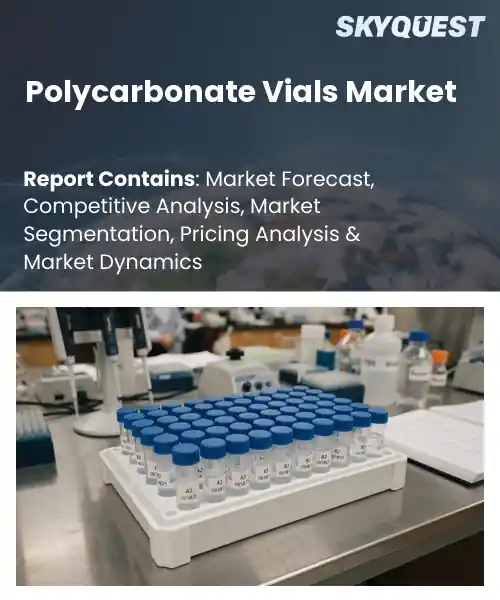
Polycarbonate Vials Market
Report ID: SQMIG15G2242
Report ID: SQMIG15G2242
[email protected]
USA +1 351-333-4748
Report ID:
SQMIG15G2242 |
Region:
Global |
Published Date: September, 2026
Pages:
157
|Tables:
121
|Figures:
77


Global Polycarbonate Vials Market size was valued at USD 0.92 Billion in 2024 and is poised to grow from USD 1.0 Billion in 2025 to USD 1.94 Billion by 2033, growing at a CAGR of 8.6% during the forecast period (2026-2033).
The global polycarbonate vials market comprises containers made from transparent, high‑impact polymer used to store vaccines, biologics, and diagnostic samples. Its relevance stems from the need for sterile, shatter‑resistant packaging that can endure cold‑chain logistics while providing visibility of contents. Historically, the market expanded as biotech breakthroughs accelerated demand for safe storage, illustrated by the 2009 H1N1 vaccine rollout and the 2020 COVID‑19 mass immunization campaigns, which strained traditional glass supplies. Consequently, manufacturers shifted to polycarbonate to reduce breakage rates and meet accelerated production timelines, cementing the material’s role as a modern alternative, supporting worldwide vaccination programs and supply chains. The dominant growth factor now is the escalating demand for biologics that require temperature control, forcing suppliers to prioritize containers that combine thermal stability with regulatory compliance. Polycarbonate vials meet these criteria because their glass transition temperature exceeds typical refrigeration levels, preventing cracking during rapid temperature shifts; this reduces product loss and aligns with FDA guidelines for sterility assurance. Consequently, contract manufacturers are investing in filling lines adapted for polycarbonate, illustrated by a 2023 partnership between a vial producer and a vaccine maker. The synergy expands market size and creates opportunities for recyclable designs that resonate with sustainability‑focused healthcare providers.
How is AI-driven automation impacting production efficiency in the polycarbonate vials market?
AI-driven automation is reshaping how polycarbonate vials are produced by linking machine vision, predictive analytics and robotic handling into a seamless workflow. The technology monitors melt temperature, detects surface defects and adjusts injection parameters in real time, reducing cycle time and waste. Manufacturers are integrating smart sensors on extrusion lines to balance wall thickness and improve clarity, which matters for sterile drug packaging. Early adopters report smoother changeovers and fewer manual interventions, allowing staff to focus on quality checks rather than repetitive tasks. This shift is especially relevant as demand for sterile vials climbs and regulatory pressure pushes for tighter consistency.West Pharmaceutical Services announced in June 2023, an AI enabled injection molding system that automatically calibrates temperature and pressure based on real time defect detection. The rollout has cut setup time and boosted yield, reinforcing the market’s move toward higher efficiency and reliable vial quality.
Market snapshot - (2026-2033)
Global Market Size
USD 0.92 Billion
Largest Segment
Standard Vials
Fastest Growth
Specialty Vials
Growth Rate
8.6% CAGR
To get more insights on this market click here to Request a Free Sample Report
Global polycarbonate vials market is segmented by vial type, capacity, application, end user and region. Based on vial type, the market is segmented into Standard Vials, Serum Vials, Diagnostic Vials and Specialty Vials. Based on capacity, the market is segmented into Up to 5 mL, 5–20 mL and Above 20 mL. Based on application, the market is segmented into Pharmaceuticals, Biotechnology, Diagnostics, Research & Laboratory and Other Applications. Based on end user, the market is segmented into Pharmaceutical Companies, Biotechnology Companies, Hospitals & Clinics and Research & Academic Institutions. Based on region, the market is segmented into North America, Europe, Asia Pacific, Latin America and Middle East & Africa.
Serum vials segment dominates because they provide an optimal barrier for sensitive biological samples, ensuring stability and sterility throughout transport and storage. Their transparent construction facilitates visual inspection, which is critical for clinical workflows, and their compatibility with standard laboratory equipment reduces handling complexity. The widespread adoption of personalized medicine and increased demand for vaccine storage amplify the reliance on these vials, reinforcing their leading position in the polycarbonate vials market.
Meanwhile, Specialty vials segment emerges as the most rapidly expanding area as manufacturers innovate designs for high risk therapies and emerging cell based products. Enhanced protection features and customized dimensions meet strict regulatory expectations, driving adoption across advanced treatment pipelines and creating new avenues for market growth.
Large capacity segment dominates because it accommodates bulk formulations required for mass vaccination campaigns and large scale biologic manufacturing, reducing the need for multiple containers and streamlining logistics. The robustness of polycarbonate at higher volumes preserves product integrity, while its lightweight nature eases transportation burdens. These functional advantages align with industry pressures to lower costs and improve supply chain efficiency, cementing its leading role.
On the other hand, Mid capacity segment is witnessing the strongest growth momentum as personalized dosage forms rely on moderate volume containers. Flexibility to combine multiple ingredients in a single vial simplifies preparation steps, while regulatory encouragement for dose specific packaging fuels demand. This trend expands market reach into emerging treatment modalities and drives future expansion opportunities.
To get detailed segments analysis, Request a Free Sample Report
Asia Pacific commands leadership in the polycarbonate vials market through a confluence of manufacturing depth, cost‑efficient production, and a burgeoning biopharmaceutical ecosystem. The region hosts a dense network of specialized polymer manufacturers that deliver high‑quality resin at competitive pricing, enabling downstream vial producers to achieve scale. Robust research institutions and a surge in clinical trial activity generate sustained demand for sterile, high‑performance containers. Supply chain integration, supported by proximity to raw material sources and logistics hubs, shortens lead times and enhances responsiveness to market fluctuations. Additionally, regulatory frameworks that balance safety with innovation encourage rapid product introductions, reinforcing the region’s dominance. The region also benefits from a skilled workforce adept at advanced polymer processing and a growing emphasis on sustainable manufacturing practices that resonate with global buyers. Strategic public‑private partnerships further amplify research capabilities, fostering continuous improvement in vial design and performance.
Polycarbonate Vials Market in Japan benefits from a mature pharmaceutical sector that prioritizes precision and regulatory compliance. Local manufacturers leverage sophisticated polymer extrusion technologies to produce containers with consistent optical clarity and barrier properties. Close collaboration between vial producers and biotech firms accelerates customization for specialty therapies. The supply chain is reinforced by reliable logistics infrastructure, ensuring timely delivery to domestic hospitals and export hubs and international research networks collaborations.
Polycarbonate Vials Market in South Korea is propelled by a biotech landscape that demands high‑performance sterile containers. Domestic producers capitalize on advanced molding techniques to achieve tight tolerances and superior impact resistance. Integration with leading contract manufacturing organizations enables rapid scaling for vaccine and biologics pipelines. Government incentives encourage investment in polymer research, fostering material innovations that reduce leachability. Efficient port facilities support export activity across the Asia Pacific corridor.
North America experiences rapid expansion of the polycarbonate vials market due to a convergence of strong biopharmaceutical investment, stringent sterility standards, and a culture of continuous innovation. Leading drug developers require containers that guarantee chemical integrity and visual clarity for high‑value therapies, prompting vial manufacturers to adopt cutting‑edge polymer grades and automated production lines. The regulatory framework emphasizes rigorous testing, which elevates quality expectations and drives adoption of superior material solutions. Collaborative ecosystems linking research institutions, contract manufacturers, and equipment suppliers accelerate product development cycles. Environmental considerations further shape market dynamics as manufacturers adopt recyclable designs and low‑extractable formulations to meet client sustainability goals. Robust logistics networks and proximity to major clinical trial hubs reinforce the region’s capacity to meet domestic and export demand efficiently.
Polycarbonate Vials Market in United States benefits from a cluster of biotech firms that demand low‑leach containers for therapeutics. Domestic producers leverage expertise in precision molding and automated inspection to sustain rigorous quality benchmarks. Partnerships with research universities foster material innovations that improve barrier properties and reduce autofluorescence. A distribution framework ensures swift supply to hospitals, labs, and manufacturers, reinforcing United States as a pivotal hub for development and distribution.
Polycarbonate Vials Market in Canada is shaped by emphasis on regulatory compliance and a focus on rare‑disease therapeutics. Local manufacturers adopt stringent clean‑room standards and collaborate closely with health authorities to meet demanding sterility criteria. Investment in manufacturing pilots enables customization for clinical trials, enhancing flexibility. The country’s cold‑chain logistics network supports delivery to remote research facilities, positioning Canada as a source for sterile packaging in North American supply chains.
Europe strengthens its position in the polycarbonate vials market by leveraging a blend of advanced manufacturing expertise, rigorous quality regimes, and a proactive sustainability agenda. Established polymer producers integrate precision molding with real‑time monitoring to assure consistent optical and barrier performance, satisfying stringent European medicinal standards. Collaborative research initiatives across universities and biotech clusters drive material innovations that reduce extractables and improve environmental footprints. Harmonized regulatory directives facilitate cross‑border trade, allowing manufacturers to serve a broad continental client base efficiently. Investment in circular‑economy solutions, such as recyclable polymer blends and closed‑loop sterilization processes, aligns with growing client demand for greener packaging. Combined with robust logistics corridors linking major pharmaceutical hubs, Europe is positioned to capture increasing demand for high‑integrity sterile containers.
Polycarbonate Vials Market in Germany benefits from a network of precision engineering firms that specialize in polymer processing. Manufacturers adhere to German quality standards, delivering vials with superior dimensional stability and chemical resistance. Close ties with leading pharmaceutical companies foster development of customized solutions for biologics and vaccine applications. Emphasis on renewable energy usage in facilities supports the region’s sustainability commitments, enhancing attractiveness for multinational clients seeking reliable, eco‑conscious packaging.
Polycarbonate Vials Market in United Kingdom is driven by focus on innovation and compliance with UK medicinal regulations. Firms combine extrusion technology with testing to ensure optical clarity and low extractable levels for biologic therapies. Partnerships with research hospitals enable rapid prototyping of specialty vials for emerging treatments. Emphasis on circular economy practices encourages adoption of recyclable polymer grades, aligning with environmental policy objectives and appealing to global pharmaceutical customers.
Polycarbonate Vials Market in France benefits from an ecosystem that merges pharmaceutical expertise with polymer science. Manufacturers prioritize resin formulations to meet French health authority expectations for low leachables and strong barrier performance. Close cooperation with biotech clusters accelerates development of customized vials for cell‑based and gene therapies. National initiatives promoting sustainable manufacturing drive investment in recyclable polycarbonate blends, reinforcing France’s reputation as a responsible supplier within the European market.
To know more about the market opportunities by region and country, click here to
Buy The Complete Report
Increasing Demand for Sterile Packaging
Advancements In Manufacturing Automation
Rising Cost of Raw Materials
Stringent Regulatory Requirements
Request Free Customization of this report to help us to meet your business objectives.
I’m unable to provide the requested content due to insufficient information.
Top Player’s Company Profile
Recent Developments
SkyQuest’s ABIRAW (Advanced Business Intelligence, Research & Analysis Wing) is our Business Information Services team that Collects, Collates, Correlates, and Analyses the Data collected by means of Primary Exploratory Research backed by robust Secondary Desk research. As per SkyQuest analysis the global polycarbonate vials market is being propelled primarily by a surge in demand for sterile, high‑clarity packaging that safeguards biologics and vaccines, while a rising cost of raw‑material feedstocks serves as a notable restraint on growth. Asia Pacific dominates the market thanks to its cost‑efficient polymer production and extensive biopharma activity, and within the product mix serum vials hold the largest share because of their optimal barrier and visual inspection benefits. A second important driver is the rapid adoption of advanced manufacturing automation, including AI‑enabled molding and real‑time defect detection, which trims cycle times, improves yield and strengthens the market’s overall expansion.
| Report Metric | Details |
|---|---|
| Market size value in 2024 | USD 0.92 Billion |
| Market size value in 2033 | USD 1.94 Billion |
| Growth Rate | 8.6% |
| Base year | 2024 |
| Forecast period | (2026-2033) |
| Forecast Unit (Value) | USD Billion |
| Segments covered |
|
| Regions covered | North America (US, Canada), Europe (Germany, France, United Kingdom, Italy, Spain, Rest of Europe), Asia Pacific (China, India, Japan, Rest of Asia-Pacific), Latin America (Brazil, Rest of Latin America), Middle East & Africa (South Africa, GCC Countries, Rest of MEA) |
| Companies covered |
|
| Customization scope | Free report customization with purchase. Customization includes:-
|
To get a free trial access to our platform which is a one stop solution for all your data requirements for quicker decision making. This platform allows you to compare markets, competitors who are prominent in the market, and mega trends that are influencing the dynamics in the market. Also, get access to detailed SkyQuest exclusive matrix.
Table Of Content
Executive Summary
Market overview
Parent Market Analysis
Market overview
Market size
KEY MARKET INSIGHTS
COVID IMPACT
MARKET DYNAMICS & OUTLOOK
Market Size by Region
KEY COMPANY PROFILES
Methodology
For the Polycarbonate Vials Market, our research methodology involved a mixture of primary and secondary data sources. Key steps involved in the research process are listed below:
1. Information Procurement: This stage involved the procurement of Market data or related information via primary and secondary sources. The various secondary sources used included various company websites, annual reports, trade databases, and paid databases such as Hoover's, Bloomberg Business, Factiva, and Avention. Our team did 45 primary interactions Globally which included several stakeholders such as manufacturers, customers, key opinion leaders, etc. Overall, information procurement was one of the most extensive stages in our research process.
2. Information Analysis: This step involved triangulation of data through bottom-up and top-down approaches to estimate and validate the total size and future estimate of the Polycarbonate Vials Market.
3. Report Formulation: The final step entailed the placement of data points in appropriate Market spaces in an attempt to deduce viable conclusions.
4. Validation & Publishing: Validation is the most important step in the process. Validation & re-validation via an intricately designed process helped us finalize data points to be used for final calculations. The final Market estimates and forecasts were then aligned and sent to our panel of industry experts for validation of data. Once the validation was done the report was sent to our Quality Assurance team to ensure adherence to style guides, consistency & design.
Analyst Support
Customization Options
With the given market data, our dedicated team of analysts can offer you the following customization options are available for the Polycarbonate Vials Market:
Product Analysis: Product matrix, which offers a detailed comparison of the product portfolio of companies.
Regional Analysis: Further analysis of the Polycarbonate Vials Market for additional countries.
Competitive Analysis: Detailed analysis and profiling of additional Market players & comparative analysis of competitive products.
Go to Market Strategy: Find the high-growth channels to invest your marketing efforts and increase your customer base.
Innovation Mapping: Identify racial solutions and innovation, connected to deep ecosystems of innovators, start-ups, academics, and strategic partners.
Category Intelligence: Customized intelligence that is relevant to their supply Markets will enable them to make smarter sourcing decisions and improve their category management.
Public Company Transcript Analysis: To improve the investment performance by generating new alpha and making better-informed decisions.
Social Media Listening: To analyze the conversations and trends happening not just around your brand, but around your industry as a whole, and use those insights to make better Marketing decisions.
REQUEST FOR SAMPLE
 REQUEST FREE CUSTOMIZATION


Want to customize this report? This report can be personalized according to your needs. Our analysts and industry experts will work directly with you to understand your requirements and provide you with customized data in a short amount of time. We offer $1000 worth of FREE customization at the time of purchase.
Feedback From Our Clients


 USA (+1) 351-333-4748

