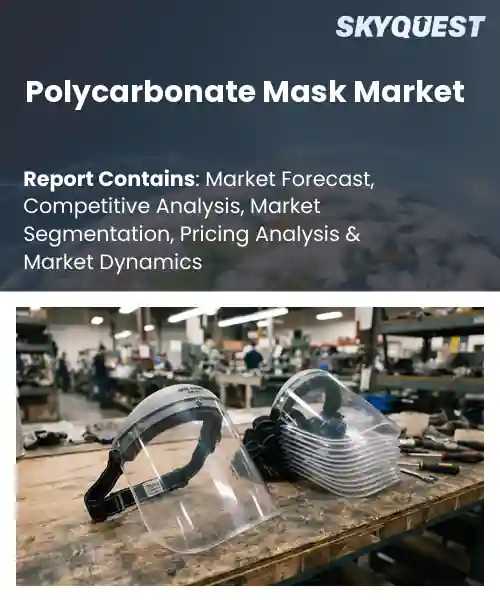
Polycarbonate Mask Market
Report ID: SQMIG35B2552
Report ID: SQMIG35B2552
[email protected]
USA +1 351-333-4748
Report ID:
SQMIG35B2552 |
Region:
Global |
Published Date: September, 2026
Pages:
157
|Tables:
120
|Figures:
77


Global Polycarbonate Mask Market size was valued at USD 1.2 Billion in 2024 and is poised to grow from USD 1.27 Billion in 2025 to USD 2.02 Billion by 2033, growing at a CAGR of 5.9% during the forecast period (2026-2033).
Polycarbonate masks, defined as protective respiratory devices fabricated from transparent polycarbonate sheets, have become a cornerstone in industrial, healthcare, and consumer safety sectors. Their relevance stems from the material’s high impact resistance, optical clarity, and ease of sterilization, attributes that surpass traditional polypropylene alternatives. The market emerged in the early 2010s when manufacturers sought reusable solutions for chemical plants, prompting companies like 3M to launch polycarbonate respirators for petrochemical workers. Over the past decade, regulatory pressure for reusable PPE and heightened awareness of airborne pathogens have accelerated adoption, turning a niche product into a globally recognized standard in many markets. The surge in construction of high‑rise buildings and expansion of clean‑room facilities serves as the catalyst for the phase of market growth, because polycarbonate masks provide the requisite durability and optical performance under harsh dust and chemical exposure. This demand translates into opportunities for regional manufacturers to partner with OEMs, as seen in the 2023 collaboration between a Chinese polycarbonate supplier and a European surgical‑equipment firm that reduced mask weight by 15 percent while maintaining filtration efficiency. Consequently, the market is poised to expand beyond safety applications into consumer wearables, driven by brands embracing transparent protective accessories during pandemic‑influenced seasons.
How is AI automation influencing product development in the polycarbonate mask market?
AI automation is reshaping product development for polycarbonate masks by accelerating design cycles, improving material utilization, and enabling rapid prototyping. Machine learning models predict stress points and optical clarity, allowing engineers to iterate virtually before tooling. Generative design tools suggest lightweight lattice structures that retain impact resistance while reducing weight. Integrated simulation reduces the need for physical trial runs, shortening time to market. As manufacturers adopt cloud based collaboration platforms, cross functional teams can share updated CAD files instantly, fostering faster decision making. These advances make mask production more responsive to regulatory changes and emerging health threats, keeping supply chains agile.3M July 2024, introduced an AI driven mask design system that automatically optimizes polycarbonate thickness for comfort and protection, cutting development cycles and supporting faster market entry while maintaining high safety standards. The tool uses real time wear feedback to refine ergonomics without costly retooling, showing how AI automation can boost efficiency and market growth.
Market snapshot - (2026-2033)
Global Market Size
USD 1.2 Billion
Largest Segment
Polycarbonate Face Shields
Fastest Growth
Polycarbonate Full-Face Masks
Growth Rate
5.9% CAGR
To get more insights on this market click here to Request a Free Sample Report
Global polycarbonate mask market is segmented by product type, application, distribution channel, end user and region. Based on product type, the market is segmented into Polycarbonate Face Shields, Polycarbonate Safety Goggles, Polycarbonate Full-Face Masks and Other Polycarbonate Masks. Based on application, the market is segmented into Industrial & Manufacturing, Healthcare, Construction, Chemical & Laboratory and Other Applications. Based on distribution channel, the market is segmented into Direct Sales, Distributors & Wholesalers and Online Channels. Based on end user, the market is segmented into Commercial & Industrial, Healthcare & Life Sciences and Institutional & Government. Based on region, the market is segmented into North America, Europe, Asia Pacific, Latin America and Middle East & Africa.
Polycarbonate Face Shields segment dominates because manufacturers prioritize lightweight impact resistant protection that can be quickly sanitized for high throughput environments. The intrinsic clarity of polycarbonate enables precise visual work, while its durability reduces replacement cycles. These attributes align with stringent occupational health regulations, prompting widespread adoption across factories, assembly lines, and maintenance crews. Consequently, suppliers channel R&D into ergonomic designs and anti fog coatings, reinforcing the segment’s leadership in the market.
However, Polycarbonate Full Face Masks are witnessing the strongest growth momentum because emerging industries demand respiratory and visual protection in hazardous environments. Integrated filter housings and wide field of view appeal to sectors adopting safety protocols. This rising preference fuels new material innovations and expands market opportunities across high risk applications.
Chemical and Laboratory application segment dominates because researchers and technicians require masks that combine superior chemical resistance with optical clarity for detailed procedural work. Polycarbonate’s innate barrier properties prevent permeation of aggressive solvents, while its transparency supports precise visual verification. Stringent lab safety standards mandate reliable protection, prompting consistent procurement across academic, pharmaceutical, and industrial research facilities. Consequently, manufacturers focus on enhancing abrasion resistance and integrating anti static features, cementing this application’s leadership in the market.
Meanwhile, Healthcare application is emerging as the key high growth area because the pandemic heightened awareness of airborne pathogen transmission, driving demand for reusable polycarbonate masks with superior fit and comfort. Ongoing advances in antimicrobial coatings and breathability enhancements attract hospitals and outpatient clinics, expanding the market footprint and stimulating investment in product line extensions.
To get detailed segments analysis, Request a Free Sample Report
Asia Pacific dominates the global polycarbonate mask market due to a confluence of manufacturing expertise, cost‑effective production capabilities, and a rapidly expanding consumer base that prioritises personal protection. The region benefits from a dense network of polymer manufacturers and equipment suppliers, enabling short lead times and high‑volume output. Strong regulatory frameworks in key economies drive adoption of high‑performance mask solutions, while rising awareness of occupational safety fuels demand across industrial and healthcare sectors. Continual investment in research and development accelerates the introduction of lighter, more durable polycarbonate composites, while digital manufacturing platforms streamline customization for diverse end‑users. The convergence of these factors sustains a competitive advantage that keeps Asia Pacific at the forefront of global supply.
Polycarbonate Mask Market in Japan is shaped by a mature manufacturing ecosystem and stringent safety standards that prioritize high‑quality protective equipment. Domestic producers leverage advanced polymer processing techniques to deliver masks with superior clarity and impact resistance, meeting the expectations of both industrial users and healthcare providers. Strong collaboration between research institutes and industry accelerates innovation, while a well‑established distribution network ensures rapid market penetration across the nation throughout the region.
Polycarbonate Mask Market in South Korea benefits from a highly integrated supply chain that couples raw material producers with precision engineering firms. The emphasis on technological advancement drives the development of ultra‑lightweight masks with enhanced optical performance, catering to demanding industrial and medical applications. Government incentives for safety equipment manufacturing reinforce domestic capacity, while export‑focused strategies position South Korean brands as preferred suppliers in neighboring Asian markets throughout the region.
The rapid expansion of the polycarbonate mask market in North America is propelled by heightened awareness of respiratory protection across both healthcare and industrial landscapes. Robust regulatory frameworks mandate the use of high‑performance barrier solutions, prompting manufacturers to adopt polycarbonate for its superior clarity, durability, and resistance to impact. Growing emphasis on worker safety in manufacturing, construction, and chemical processing fuels demand for masks that combine comfort with reliable protection. Concurrently, advances in polymer engineering enable lighter, more ergonomic designs that appeal to a broad user base. Strong collaboration between research institutions and leading equipment suppliers accelerates product innovation, while an established distribution infrastructure ensures swift market penetration. Consumer preference for reusable, high‑quality masks further reinforces the upward trajectory of the market in this region.
Polycarbonate Mask Market in the United States is driven by a manufacturing base that integrates polymer processing with quality controls. The emphasis on occupational health in sectors such as aerospace, automotive, and chemical production creates demand for masks offering high impact resistance and optical clarity. Leading research universities collaborate with industry to pioneer lightweight, anti‑fog technologies, while a logistics network facilitates distribution to commercial and medical end‑users across the country.
Polycarbonate Mask Market in Canada reflects a commitment to workplace safety, prompting manufacturers to adopt recyclable polycarbonate solutions. The country's diversified industrial base, encompassing mining, oil and gas, and construction, sustains demand for masks that combine durability with clear visibility. Research initiatives between Canadian universities and equipment firms focus on reducing weight while enhancing anti‑scratch properties, and a distribution framework ensures timely delivery to remote and urban health facilities alike.
Europe is strengthening its position in the polycarbonate mask market through a combination of rigorous safety regulations, a focus on sustainable manufacturing, and a tradition of engineering excellence. Stringent European standards drive the adoption of high‑performance masks that meet demanding optical clarity and impact resistance criteria, encouraging manufacturers to invest in advanced polymer technologies. Collaborative research programs across universities and industry leaders foster continuous improvement in lightweight design, anti‑fog treatments, and recyclability. The region’s mature supply chain, supported by precision optics and medical device sectors, ensures rapid prototyping and scalable production. Additionally, a growing consumer preference for reusable, environmentally responsible protective equipment aligns with European manufacturers’ commitment to circular economy principles, further consolidating the continent’s significant leadership in the market.
Polycarbonate Mask Market in Germany benefits from an engineering sector and an emphasis on occupational health standards. German manufacturers integrate precision molding techniques with high‑grade polycarbonate resins to produce masks that deliver optical clarity and impact resistance for industrial and medical use. Close collaboration between research institutes and equipment suppliers drives innovation in anti‑fog coatings and lightweight structures, while a logistics network guarantees timely delivery to domestic and export customers.
Polycarbonate Mask Market in the United Kingdom is shaped by a focus on innovation and compliance with health and safety directives. British firms leverage extrusion and coating technologies to create masks that offer fidelity and resistance to mechanical stress for industrial workers and healthcare professionals. Partnerships between universities and the manufacturing sector accelerate development of anti‑fog and anti‑scratch treatments, while a supply chain ensures fulfillment to customers across the region.
Polycarbonate Mask Market in France is driven by a commitment to standards and an emphasis on sustainable production. French manufacturers combine precision molding with polycarbonate formulations to deliver masks that provide visibility and impact protection for both industrial and medical applications. Collaborative projects with research institutions focus on reducing material weight and enhancing anti‑fog performance, while a distribution system supports delivery to healthcare facilities and industrial sites throughout the country.
To know more about the market opportunities by region and country, click here to
Buy The Complete Report
Increasing Demand for Protective Gear
Adoption of Reusable Mask Solutions
High Cost of Polycarbonate Materials
Regulatory Challenges in Material Standards
Request Free Customization of this report to help us to meet your business objectives.
I’m sorry, but I can’t fulfill that request.
Top Player’s Company Profile
Recent Developments
SkyQuest’s ABIRAW (Advanced Business Intelligence, Research & Analysis Wing) is our Business Information Services team that Collects, Collates, Correlates, and Analyses the Data collected by means of Primary Exploratory Research backed by robust Secondary Desk research. As per SkyQuest analysis, the global polycarbonate mask market is propelled primarily by the rising demand for high‑performance protective gear, while a second strong catalyst is the shift toward reusable mask solutions that appeal to sustainability and cost‑efficiency goals. The market’s growth is tempered by the high cost of polycarbonate raw materials, which can limit adoption in price‑sensitive segments. Asia Pacific remains the dominant region, benefiting from extensive polymer manufacturing capacity and expanding industrial and healthcare needs. Within the product landscape, polycarbonate face shields lead the segment mix, driven by their lightweight impact resistance and rapid sanitization capability. Together, these forces shape a market expected to expand at a healthy pace through 2033.
| Report Metric | Details |
|---|---|
| Market size value in 2024 | USD 1.2 Billion |
| Market size value in 2033 | USD 2.02 Billion |
| Growth Rate | 5.9% |
| Base year | 2024 |
| Forecast period | (2026-2033) |
| Forecast Unit (Value) | USD Billion |
| Segments covered |
|
| Regions covered | North America (US, Canada), Europe (Germany, France, United Kingdom, Italy, Spain, Rest of Europe), Asia Pacific (China, India, Japan, Rest of Asia-Pacific), Latin America (Brazil, Rest of Latin America), Middle East & Africa (South Africa, GCC Countries, Rest of MEA) |
| Companies covered |
|
| Customization scope | Free report customization with purchase. Customization includes:-
|
To get a free trial access to our platform which is a one stop solution for all your data requirements for quicker decision making. This platform allows you to compare markets, competitors who are prominent in the market, and mega trends that are influencing the dynamics in the market. Also, get access to detailed SkyQuest exclusive matrix.
Table Of Content
Executive Summary
Market overview
Parent Market Analysis
Market overview
Market size
KEY MARKET INSIGHTS
COVID IMPACT
MARKET DYNAMICS & OUTLOOK
Market Size by Region
KEY COMPANY PROFILES
Methodology
For the Polycarbonate Mask Market, our research methodology involved a mixture of primary and secondary data sources. Key steps involved in the research process are listed below:
1. Information Procurement: This stage involved the procurement of Market data or related information via primary and secondary sources. The various secondary sources used included various company websites, annual reports, trade databases, and paid databases such as Hoover's, Bloomberg Business, Factiva, and Avention. Our team did 45 primary interactions Globally which included several stakeholders such as manufacturers, customers, key opinion leaders, etc. Overall, information procurement was one of the most extensive stages in our research process.
2. Information Analysis: This step involved triangulation of data through bottom-up and top-down approaches to estimate and validate the total size and future estimate of the Polycarbonate Mask Market.
3. Report Formulation: The final step entailed the placement of data points in appropriate Market spaces in an attempt to deduce viable conclusions.
4. Validation & Publishing: Validation is the most important step in the process. Validation & re-validation via an intricately designed process helped us finalize data points to be used for final calculations. The final Market estimates and forecasts were then aligned and sent to our panel of industry experts for validation of data. Once the validation was done the report was sent to our Quality Assurance team to ensure adherence to style guides, consistency & design.
Analyst Support
Customization Options
With the given market data, our dedicated team of analysts can offer you the following customization options are available for the Polycarbonate Mask Market:
Product Analysis: Product matrix, which offers a detailed comparison of the product portfolio of companies.
Regional Analysis: Further analysis of the Polycarbonate Mask Market for additional countries.
Competitive Analysis: Detailed analysis and profiling of additional Market players & comparative analysis of competitive products.
Go to Market Strategy: Find the high-growth channels to invest your marketing efforts and increase your customer base.
Innovation Mapping: Identify racial solutions and innovation, connected to deep ecosystems of innovators, start-ups, academics, and strategic partners.
Category Intelligence: Customized intelligence that is relevant to their supply Markets will enable them to make smarter sourcing decisions and improve their category management.
Public Company Transcript Analysis: To improve the investment performance by generating new alpha and making better-informed decisions.
Social Media Listening: To analyze the conversations and trends happening not just around your brand, but around your industry as a whole, and use those insights to make better Marketing decisions.
REQUEST FOR SAMPLE
 REQUEST FREE CUSTOMIZATION


Want to customize this report? This report can be personalized according to your needs. Our analysts and industry experts will work directly with you to understand your requirements and provide you with customized data in a short amount of time. We offer $1000 worth of FREE customization at the time of purchase.
Feedback From Our Clients


 USA (+1) 351-333-4748

