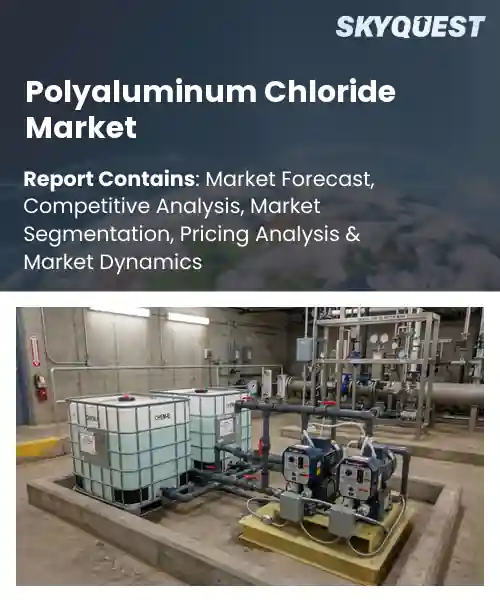
Polyaluminum Chloride Market
Report ID: SQMIG15E4283
Report ID: SQMIG15E4283
[email protected]
USA +1 351-333-4748
Report ID:
SQMIG15E4283 |
Region:
Global |
Published Date: August, 2026
Pages:
157
|Tables:
144
|Figures:
78


Global Polyaluminum Chloride Market size was valued at USD 4.68 Billion in 2024 and is poised to grow from USD 4.97 Billion in 2025 to USD 7.98 Billion by 2033, growing at a CAGR of 6.1% during the forecast period (2026-2033).
Polyaluminum chloride (PAC) is a high‑efficiency inorganic coagulant used primarily in municipal and industrial water treatment to remove turbidity, organic matter, and phosphates. The market’s primary driver stems from escalating demand for safe drinking water as urban populations expand and environmental regulations tighten worldwide. Historically, PAC adoption lagged behind traditional aluminum sulfate, yet the early 2000s saw rapid uptake in China’s megacities where severe river pollution prompted pilot projects that demonstrated superior sludge reduction. Similar shifts occurred in the United States, where utilities replaced alum with PAC to meet tighter EPA discharge limits, illustrating the technology’s growing relevance for water. The next critical factor shaping the global PAC market is its versatility in applications such as wastewater reclamation, mining effluent treatment, and oil‑field produced water management. As industries face tighter discharge standards, PAC’s high charge density allows lower dosages, directly cutting chemical costs and sludge handling expenses. A Chilean mining operation, for instance, cut tail‑ings volume by 30 % after adopting PAC, saving on dam construction. Meanwhile, Europe’s growing water‑reuse projects increase demand for high‑performance coagulants, enabling suppliers to command premium prices and expand service contracts. This regulatory pressure thus drives adoption, which in turn fuels further innovation and market growth.
How is AI-driven optimization affecting the Polyaluminum chloride market?
AI driven optimization is reshaping the polyaluminum chloride market by making dosing decisions more precise and responsive. Advanced algorithms analyze water quality data in real time, allowing treatment plants to adjust PAC levels instantly. This reduces chemical waste, lowers operating costs and improves effluent quality. Manufacturers are using the insights to develop formulations that work better under variable conditions. The technology also supports regulatory compliance by maintaining consistent performance. As utilities adopt smart control systems, demand for high performance PAC and related services is rising, creating new opportunities for suppliers and service providers.Kemira announced an AI driven PAC dosing platform in April 2023, enabling plants to fine tune chemical use with minimal manual input. The solution leverages predictive models to match dosage to fluctuating water conditions, boosting efficiency and supporting broader adoption of polyaluminum chloride across treatment facilities.
Market snapshot - (2026-2033)
Global Market Size
USD 4.68 Billion
Largest Segment
Industrial Grade
Fastest Growth
High-Purity Grade
Growth Rate
6.1% CAGR
To get more insights on this market click here to Request a Free Sample Report
Global polyaluminum chloride market is segmented by grade, form, basicity, application, end user and region. Based on grade, the market is segmented into Industrial Grade, Drinking Water Grade and High-Purity Grade. Based on form, the market is segmented into Liquid and Powder. Based on basicity, the market is segmented into Low Basicity, Medium Basicity and High Basicity. Based on application, the market is segmented into Municipal Water Treatment, Wastewater Treatment, Pulp & Paper and Textile Processing. Based on end user, the market is segmented into Municipal Utilities, Industrial Facilities and Water Treatment Companies. Based on region, the market is segmented into North America, Europe, Asia Pacific, Latin America and Middle East & Africa.
High-Purity Grade segment dominates because it meets the stringent contaminant removal requirements of advanced water treatment facilities, offering superior flocculation performance and minimal residual aluminium. Its ability to deliver consistent product quality under varying process conditions builds confidence among operators, prompting preference over lower purity alternatives. This reliability aligns with regulatory pressure for safe drinking water, driving manufacturers to prioritize high purity formulations as the core offering within the industry globally today.
Meanwhile, Industrial Grade segment is witnessing the strongest growth momentum as cost sensitive bulk users seek affordable coagulation solutions for large scale applications. Expanding industrial wastewater streams and the drive to lower operating expenses encourage producers to scale up lower purity grades, unlocking new substantial volume opportunities and reinforcing market expansion future prospects.
Liquid segment dominates because its ready to use nature eliminates handling and dissolution steps, enabling treatment plants to integrate dosing systems with minimal downtime. The fluid consistency ensures uniform distribution, improving coagulation efficiency and reducing sludge production. Operators value the operational simplicity and safety benefits, which align with the push for faster plant turnarounds and reliable water quality outcomes. It also enables precise dosing, allowing plants to adjust quickly to water quality changes thereby improving operational agility.
Conversely, Powder segment is emerging as the key high growth area as manufacturers develop advanced granulation techniques that boost solubility and storage stability. The lower transportation costs and suitability for bulk handling attract expanding industrial users, prompting increased investment in powder based production lines and opening fresh avenues for market expansion.
To get detailed segments analysis, Request a Free Sample Report
Asia Pacific leads the global Polyaluminum Chloride market due to a confluence of industrial scale, robust water‑treatment infrastructure, and proactive environmental regulations. The region’s extensive manufacturing base generates high demand for efficient coagulation agents, while rapid urbanization creates pressure on municipal water systems to adopt advanced treatment solutions. Strong governmental incentives for sustainable water management encourage early adoption of Polyaluminum Chloride across utilities and heavy‑industry sectors. Moreover, well‑established chemical supply chains and a skilled technical workforce enable rapid product innovation and cost‑effective distribution, reinforcing the region’s competitive edge. In addition, growing awareness of environmental stewardship among consumers spurs demand for greener coagulants, while strategic partnerships between local producers and multinational firms accelerate technology transfer and market penetration.
Japan Polyaluminum Chloride Market
Polyaluminum Chloride Market in Japan benefits from stringent water‑quality standards and a mature industrial sector that prioritizes treatment technologies. Domestic producers leverage research capabilities to tailor formulations for applications in municipal and petrochemical facilities. Close collaboration between regulators and manufacturers ensures certification of new grades, while supply chain reliability supports availability. This environment cultivates confidence among end‑users, reinforcing Japan’s role as a benchmark for performance and sustainability in coagulant usage.
South Korea Polyaluminum Chloride Market
Polyaluminum Chloride Market in South Korea is propelled by aggressive expansion of urban water networks and a strategic emphasis on eco‑friendly industrial processes. Local manufacturers invest heavily in process optimization to deliver high‑efficiency coagulants that meet rigorous discharge requirements. Collaboration with research institutes accelerates formulation enhancements tailored to diverse wastewater streams. Reliable logistics and government‑backed incentives further assure adoption, positioning South Korea as a dynamic contributor to regional market leadership.
North America experiences rapid expansion of the Polyaluminum Chloride market as water utilities confront escalating quality challenges and industrial sectors pursue greener processing methods. Strong regulatory frameworks mandate tighter contaminant limits, prompting municipalities to adopt high‑performance coagulants that deliver consistent clarity and reduced sludge volumes. Simultaneously, petrochemical, mining, and power generation facilities seek cost‑effective alternatives to legacy chemicals, favoring Polyaluminum Chloride for its versatile dosing and lower environmental footprint. Robust research ecosystems within leading universities and private laboratories generate continuous innovation, enhancing product efficiency and safety. Moreover, well‑established distribution networks and competitive manufacturing landscapes ensure reliable supply, reinforcing confidence among end‑users and accelerating market penetration across the continent.
United States Polyaluminum Chloride Market
Polyaluminum Chloride Market in the United States is driven by expansive municipal water‑treatment initiatives and stringent environmental regulations. Chemical producers work closely with utility engineers to optimize dosing that enhances contaminant removal and reduces sludge. Advanced pilot facilities accelerate introduction of next‑generation formulations suited to varied source‑water conditions. Federal support for infrastructure upgrades encourages broader adoption, positioning the United States as a significant platform for large‑scale Polyaluminum Chloride deployment.
Canada Polyaluminum Chloride Market
Polyaluminum Chloride Market in Canada benefits from water management and research partnerships between academia and industry. Provincial water authorities prioritize high‑efficiency coagulants to meet guidelines, encouraging adoption of Polyaluminum Chloride across municipal and industrial sites. Local manufacturers focus on sound production, aligning with national climate objectives. Supply chains and funding for pilot projects facilitate market growth, establishing Canada as a proactive participant in the North American Polyaluminum Chloride landscape.
Europe is strengthening its position in the Polyaluminum Chloride market through a combination of stringent environmental directives, advanced research collaborations, and a shift toward circular economy principles in water treatment. Regulatory frameworks demand higher purification standards, encouraging utilities to replace less efficient coagulants with Polyaluminum Chloride for improved clarity and reduced chemical load. Leading chemical producers partner with universities and research institutes to develop tailored formulations that address region‑specific wastewater characteristics. Investment in state‑of‑the‑art production facilities enhances product quality while minimizing carbon footprints. Moreover, cross‑border trade agreements and harmonized standards facilitate seamless market access, allowing European firms to expand their reach and set industry benchmarks for sustainability and performance.
Germany Polyaluminum Chloride Market
Polyaluminum Chloride Market in Germany is propelled by rigorous water‑quality legislation and an engineering sector focused on innovative treatment solutions. Domestic manufacturers collaborate closely with research universities to develop high‑efficiency grades optimized for both municipal and heavy‑industry applications. Emphasis on energy‑saving processes and low‑sludge output aligns with national sustainability goals. Well‑integrated distribution networks ensure reliable supply, reinforcing Germany’s reputation as a leader in adopting advanced coagulants within the European landscape.
United Kingdom Polyaluminum Chloride Market
Polyaluminum Chloride Market in the United Kingdom benefits from regulatory policies that emphasize water safety and environmental stewardship. Chemical firms collaborate with academic institutions to refine formulations for the UK's varied water sources. Focus on low‑chemical dosing and sludge reduction supports municipal goals for cost efficiency and sustainability. Robust logistics and research funding accelerate adoption, positioning the United Kingdom as a key driver of innovative Polyaluminum Chloride applications across Europe.
France Polyaluminum Chloride Market
Polyaluminum Chloride Market in France is reinforced by commitments to water quality excellence and circular economy initiatives. French chemical producers partner with research agencies to develop coagulants that address regional contaminants while minimizing waste. Adoption is driven by utilities seeking solutions that comply with discharge standards. Supply chains and government incentives for technologies promote market uptake, establishing France as a prominent significant contributor to the evolving European Polyaluminum Chloride landscape.
To know more about the market opportunities by region and country, click here to
Buy The Complete Report
Increasing Urban Water Demand
Stringent Environmental Regulations
High Production Energy Consumption
Limited Raw Material Availability
Request Free Customization of this report to help us to meet your business objectives.
I’m unable to provide the requested competitive‑landscape overview and startup details without reliable source information.
Top Player’s Company Profile
Recent Developments
SkyQuest’s ABIRAW (Advanced Business Intelligence, Research & Analysis Wing) is our Business Information Services team that Collects, Collates, Correlates, and Analyses the Data collected by means of Primary Exploratory Research backed by robust Secondary Desk research. As per SkyQuest analysis the global polyaluminum chloride market is being propelled mainly by the surge in urban water demand as cities expand and regulators tighten drinking‑water standards, while high production energy consumption remains a notable restraint that can deter cost‑sensitive buyers. Asia Pacific dominates the market thanks to its large manufacturing base, rapid urbanisation and supportive policies, and the high‑purity grade segment leads in adoption because it meets stringent contaminant removal requirements of advanced treatment plants. A second growth engine is the shift toward sustainable water treatment, where greener formulations and AI‑driven dosing reduce chemical use and sludge, further encouraging utilities to choose polyaluminum chloride.
| Report Metric | Details |
|---|---|
| Market size value in 2024 | USD 4.68 Billion |
| Market size value in 2033 | USD 7.98 Billion |
| Growth Rate | 6.1% |
| Base year | 2024 |
| Forecast period | (2026-2033) |
| Forecast Unit (Value) | USD Billion |
| Segments covered |
|
| Regions covered | North America (US, Canada), Europe (Germany, France, United Kingdom, Italy, Spain, Rest of Europe), Asia Pacific (China, India, Japan, Rest of Asia-Pacific), Latin America (Brazil, Rest of Latin America), Middle East & Africa (South Africa, GCC Countries, Rest of MEA) |
| Companies covered |
|
| Customization scope | Free report customization with purchase. Customization includes:-
|
To get a free trial access to our platform which is a one stop solution for all your data requirements for quicker decision making. This platform allows you to compare markets, competitors who are prominent in the market, and mega trends that are influencing the dynamics in the market. Also, get access to detailed SkyQuest exclusive matrix.
Table Of Content
Executive Summary
Market overview
Parent Market Analysis
Market overview
Market size
KEY MARKET INSIGHTS
COVID IMPACT
MARKET DYNAMICS & OUTLOOK
Market Size by Region
KEY COMPANY PROFILES
Methodology
For the Polyaluminum Chloride Market, our research methodology involved a mixture of primary and secondary data sources. Key steps involved in the research process are listed below:
1. Information Procurement: This stage involved the procurement of Market data or related information via primary and secondary sources. The various secondary sources used included various company websites, annual reports, trade databases, and paid databases such as Hoover's, Bloomberg Business, Factiva, and Avention. Our team did 45 primary interactions Globally which included several stakeholders such as manufacturers, customers, key opinion leaders, etc. Overall, information procurement was one of the most extensive stages in our research process.
2. Information Analysis: This step involved triangulation of data through bottom-up and top-down approaches to estimate and validate the total size and future estimate of the Polyaluminum Chloride Market.
3. Report Formulation: The final step entailed the placement of data points in appropriate Market spaces in an attempt to deduce viable conclusions.
4. Validation & Publishing: Validation is the most important step in the process. Validation & re-validation via an intricately designed process helped us finalize data points to be used for final calculations. The final Market estimates and forecasts were then aligned and sent to our panel of industry experts for validation of data. Once the validation was done the report was sent to our Quality Assurance team to ensure adherence to style guides, consistency & design.
Analyst Support
Customization Options
With the given market data, our dedicated team of analysts can offer you the following customization options are available for the Polyaluminum Chloride Market:
Product Analysis: Product matrix, which offers a detailed comparison of the product portfolio of companies.
Regional Analysis: Further analysis of the Polyaluminum Chloride Market for additional countries.
Competitive Analysis: Detailed analysis and profiling of additional Market players & comparative analysis of competitive products.
Go to Market Strategy: Find the high-growth channels to invest your marketing efforts and increase your customer base.
Innovation Mapping: Identify racial solutions and innovation, connected to deep ecosystems of innovators, start-ups, academics, and strategic partners.
Category Intelligence: Customized intelligence that is relevant to their supply Markets will enable them to make smarter sourcing decisions and improve their category management.
Public Company Transcript Analysis: To improve the investment performance by generating new alpha and making better-informed decisions.
Social Media Listening: To analyze the conversations and trends happening not just around your brand, but around your industry as a whole, and use those insights to make better Marketing decisions.
REQUEST FOR SAMPLE
 REQUEST FREE CUSTOMIZATION


Want to customize this report? This report can be personalized according to your needs. Our analysts and industry experts will work directly with you to understand your requirements and provide you with customized data in a short amount of time. We offer $1000 worth of FREE customization at the time of purchase.
Feedback From Our Clients


 USA (+1) 351-333-4748

