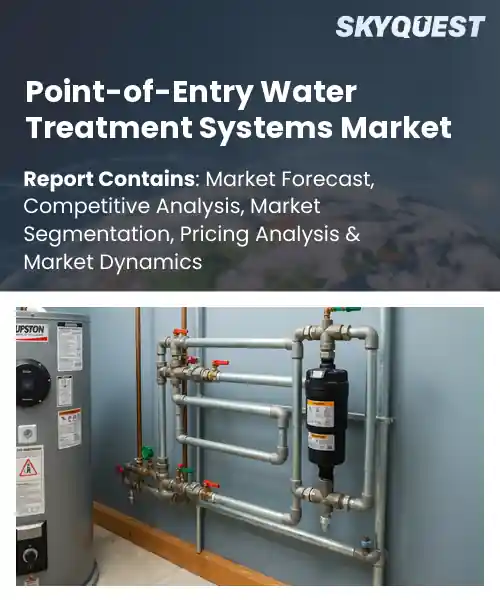
Point-of-Entry Water Treatment Systems Market
Report ID: SQMIG55D2037
Report ID: SQMIG55D2037
[email protected]
USA +1 351-333-4748
Report ID:
SQMIG55D2037 |
Region:
Global |
Published Date: May, 2026
Pages:
157
|Tables:
185
|Figures:
79


Global Point-Of-Entry Water Treatment Systems Market size was valued at USD 9.5 Billion in 2024 and is poised to grow from USD 9.95 Billion in 2025 to USD 14.36 Billion by 2033, growing at a CAGR of 4.7% during the forecast period (2026-2033).
Rising concerns regarding water contamination, increasing demand for whole-house water purification solutions, rising awareness about waterborne diseases, tightening water quality regulations, and advancements in filtration technologies are driving demand for point-of-entry water treatment systems.
Increasing needs for ongoing maintenance services, smart monitoring devices, and water safety solutions are opening up more avenues for manufacturers of point-of-entry water treatment systems. Furthermore, the increasing adoption of water treatment systems at a building level for houses, hospitals, hotels, commercial establishments, and the food processing industry has been boosting the sale of point-of-entry water treatment systems. Additionally, regulations being imposed on contaminants such as lead, nitrates, microorganisms, and other emerging contaminants will likely contribute towards the growing requirement of point-of-entry water treatment systems. There is increased spending by property owners, healthcare facilities, hospitality industry, and industrial sector in adopting advanced filtration solutions, membranes, and water monitoring systems. Growing concerns regarding drinking water quality and increasing emphasis on protecting residential and commercial water supplies from harmful contaminants are expected to primarily drive point-of-entry water treatment systems market growth.
On the contrary, high installation and maintenance costs, complexity associated with system integration and servicing, lack of consumer awareness in developing regions, and operational challenges related to filter replacement and wastewater generation are anticipated to slow down point-of-entry water treatment systems market penetration in the future.
How is IoT Enhancing Performance Monitoring Capabilities of Point-of-entry Water Treatment Systems?
IoT integration has led to improved management of performance in point-of-entry water treatment technologies owing to the use of sensors, internet connectivity, and analytics in the whole-house/building water treatment systems. The use of telemetry and filtration, and flow monitoring systems has led to the growth in the use of intelligent water treatment systems and service businesses. The use of IoT technology in point-of-entry water treatment systems has seen remote leak detection capability, automatic scheduling of backwashing activities, and the employment of edge computing systems that have enhanced the decision-making abilities of the devices by making them quick and more efficient.
Market snapshot - (2026-2033)
Global Market Size
USD 9.5 Billion
Largest Segment
Water Softeners
Fastest Growth
Reverse Osmosis Systems
Growth Rate
4.7% CAGR
To get more insights on this market click here to Request a Free Sample Report
Global point-of-entry water treatment systems market is segmented by product type, technology, application, contaminant type, end user, distribution channel, and region. Based on product type, the market is segmented into water softeners, sediment filtration systems, carbon filtration systems, reverse osmosis systems, UV disinfection systems, iron & manganese removal systems, whole-house filtration systems, and others. Based on technology, the market is segmented into reverse osmosis, activated carbon filtration, ion exchange, ultraviolet purification, ultrafiltration, and others. Based on application, the market is segmented into residential water treatment, commercial water treatment, and industrial water treatment. Based on by contaminant type, the market is segmented into chemical contaminants, biological contaminants, sediments & particulates, heavy metals, and others. Based on by end user, the market is segmented into households, hospitality industry, healthcare facilities, manufacturing facilities, educational institutions, and others. Based on distribution channel, the market is segmented into direct sales, specialty stores, online retail, and plumbing & hardware stores. Based on region, the market is segmented into North America, Europe, Asia Pacific, Latin America, and Middle East & Africa.
The reverse osmosis systems segment is projected to lead the global point-of-entry water treatment systems market revenue generation through 2033. The reverse osmosis technique can remove the greatest number of dissolved solids and contaminants of different types and origins upon entering the water purification system, meeting requirements for consistent quality and purity of supply. The success rate of RO technology in operation, reliability of the supplier and services market, flexibility, and professional satisfaction ensure its broad application.
Nonetheless, UV Disinfection Systems are being recognized as the fastest growing segment due to increased awareness of biological contaminants, compact modules that can be easily installed at point of entry, innovations in LEDs, and the need for chemical-free disinfection solutions. This is creating new opportunities for hybridization.
The online retail segment is anticipated to account for the highest global point-of-entry water treatment systems market share going forward. Digital platforms minimize purchasing friction, offer access to multiple entry point products, and support a direct-to-customer model, which bundles hardware along with its replacement parts and subscriptions. Product descriptions, user reviews, effective marketing, and efficient logistics make it easy to acquire and scale up inventory and aftersales products quickly.
Conversely, plumbing and hardware stores are the fastest-growing segment as per this point-of-entry water treatment systems market forecast. Increased demand for products at the point of entry, which require certification and local service, is opening up new business opportunities. Collaboration between manufacturers and trade retailers, coupled with demonstrations in store and the demand for installations, helps in retrofitting and new construction.
To get detailed segments analysis, Request a Free Sample Report
Regulatory attention, advanced technology development, and a well-established distribution and service infrastructure are helping this region maintain its dominant stance. The continuing push for compliance by regulators to ensure high-quality drinking water combined with consumer awareness surrounding water quality increases demand for treating all discharges from individual premises. Local producers and technology providers of systems that provide integrated smart capabilities play an important role in continuing innovation within this sector as well as the use of established installers and after-market services to drive reliability and provide consumers with confidence in their purchases. Collaboration between utilities, builders and finance companies allow for broader adoption of technology throughout both urban and rural communities while a competitive manufacturer base provides scalable production capabilities and rapid product innovation, strengthening the regional market and providing on-going regional dominance.
Point-of-entry water treatment systems market in the United States is characterized by a broad installed base, diverse water source challenges, and strong demand for whole-property solutions. Certification, performance, and service issues form the core of marketing strategies; educational programs grow more extensive. Private wells being owned by many people, and differences from town to town, present opportunities for point-of-entry systems installation, given an established service infrastructure, sophisticated manufacturing technology, and good connections with contractors and utilities.
Dispersed population centers, cold climate considerations, and emphasis on protecting rural and Indigenous water supplies support high sales of point-of-entry water treatment systems in Canada. Reliability, durability, and compatibility with decentralized infrastructure drive the procurement process. Demand focuses on resilient and maintenance-free whole-house systems capable of dealing with hardness and contamination by remote sources and reducing energy consumption. Effective cooperation among the provincial government, utility providers, and equipment manufacturers can facilitate customization and service delivery.
Rapid urbanization, heightened awareness of municipal water variability, and rising consumer expectations converge to favor whole-property water treatment solutions help create new opportunities in the region. Public-private partnerships and increased environmental awareness will drive the introduction of products to serve targeted markets. Partnerships for distribution and locally based service networks will facilitate the efficient deployment and continued support of products after sale. Regulatory focus on contaminants and the integration of products to smart home ecosystems will drive manufacturers’ introduction of connected, energy-saving products and will increase the provision of aftermarket support throughout urban and peri-urban cities across Asia Pacific. The local technology leadership in filtration and monitoring elements has enabled firms to create a variety of products.
Sales of point-of-entry water treatment systems in Japan are influenced by consumer expectations for high-performing, compact, and reliable home systems that integrate seamlessly with smart-home environments. Strong engineering expertise drives innovation in advanced filtration, sensor integration, and energy-efficient operation. Urban housing formats favor space-saving designs, while meticulous product certification and brand reputation shape purchasing decisions. Manufacturers emphasize longevity, low maintenance, and service networks that ensure rapid response, reinforcing trust with homeowners.
Technological innovations, consumer demand for connected household devices, and high population densities that make small-scale installation on the entire property suitable are some factors fueling increased installation of point-of-entry water filtration systems in South Korea. Industry and research collaborations enable product innovation as well as tailored services for consumers and businesses. Local manufacturers emphasize innovations such as membrane technology and sensors, along with their easy integration into the smart home system. Various channels such as online distribution and installers make this product popular.
Rigorous regulations, innovation driven by sustainability considerations, and an effective service infrastructure to assist in installation and ongoing maintenance are expected to play key roles in regulating the sale of point-of-entry water treatment systems in the region. Trust in point-of-entry water treatment systems can be developed through employing rigorous certification programs and protection from exploitative practices of unqualified installers. The increasing retrofitting of older residential and commercial buildings is creating a new marketplace for replacing or upgrading previously installed systems, with cooperation between utilities and POE water filtration suppliers to develop standardized sizing, performance, and post-installation services. Through R&D investments, utilization of circular economy principles, and improved cross-border supply chain opportunities, POE water filters will become more competitive globally while providing a wide variety of products that meet different national regulatory requirements.
Engineering-led product development, stringent performance standards, and a strong emphasis on energy efficiency helps shape sales of point-of-entry water treatment systems in Germany. Joint ventures with utility companies and universities help in developing new media and test methods for filtration. The demand is facilitated by an extensive network of certified installers and service companies that make sure that proper systems are selected and maintained. Industrial experience helps manufacturers create durable systems.
Point-of-entry water treatment systems market in the United Kingdom reflects a mature consumer focus on water quality, particularly addressing localized source variability and hardness-related issues. Both the manufacturer and the distributor place great emphasis on energy efficiency, low maintenance, and aftersales services. Market operations rely on efficient installer networks, performance testing, and a focus on product certification. The retrofitting of older buildings, as well as the needs of building owners, provides avenues for providing holistic property-based solutions.
Sales of point-of-entry water treatment systems in France are shaped by strong consumer interest in water quality and sustainable product attributes. A cooperative effort between the installer and the local authorities will help achieve proper implementation. The aftersales service is an important part in gaining acceptance from household and business customers. The market demand ranges from urban apartment buildings that need efficient design systems to rural areas that require rugged and maintenance-free technology.
To know more about the market opportunities by region and country, click here to
Buy The Complete Report
Rising Concern For Water Quality
Strengthened Regulatory Compliance Requirements
High Initial Capital Investment
Maintenance Complexity and Service Needs
Request Free Customization of this report to help us to meet your business objectives.
Competitive landscape in the global point-of-entry water treatment systems market is intensifying as regulatory scrutiny and consumer concerns about PFAS and aging infrastructure push incumbents and new entrants into targeted partnerships, technology launches, and selective acquisitions. Notable tactical moves include Clear integrating Atlantium UV modules for whole-home POE solutions, Navien launching an all-electric WEC deionization POE appliance, and regional rollouts by new entrants such as AmeriFree.
SkyQuest’s ABIRAW (Advanced Business Intelligence, Research & Analysis Wing) is our Business Information Services team that Collects, Collates, Correlates, and Analyses the Data collected by means of Primary Exploratory Research backed by robust Secondary Desk research.
As per SkyQuest analysis, increasing concerns regarding water contamination and increasing demand for whole-house water purification solutions are anticipated to drive the demand for point-of-entry water treatment systems going forward. However, high installation and maintenance costs and operational challenges related to system servicing are slated to slow down the adoption of point-of-entry water treatment systems in the future. North America is slated to spearhead the demand for point-of-entry water treatment systems owing to stringent water quality regulations, high consumer awareness regarding water safety, and widespread adoption of advanced filtration technologies. Development of IoT-enabled smart water monitoring systems and increasing integration of advanced filtration and predictive maintenance technologies are anticipated to be key trends driving the point-of-entry water treatment systems sector over the coming years.
| Report Metric | Details |
|---|---|
| Market size value in 2024 | USD 9.5 Billion |
| Market size value in 2033 | USD 14.36 Billion |
| Growth Rate | 4.7% |
| Base year | 2024 |
| Forecast period | (2026-2033) |
| Forecast Unit (Value) | USD Billion |
| Segments covered |
|
| Regions covered | North America (US, Canada), Europe (Germany, France, United Kingdom, Italy, Spain, Rest of Europe), Asia Pacific (China, India, Japan, Rest of Asia-Pacific), Latin America (Brazil, Rest of Latin America), Middle East & Africa (South Africa, GCC Countries, Rest of MEA) |
| Companies covered |
|
| Customization scope | Free report customization with purchase. Customization includes:-
|
To get a free trial access to our platform which is a one stop solution for all your data requirements for quicker decision making. This platform allows you to compare markets, competitors who are prominent in the market, and mega trends that are influencing the dynamics in the market. Also, get access to detailed SkyQuest exclusive matrix.
Table Of Content
Executive Summary
Market overview
Parent Market Analysis
Market overview
Market size
KEY MARKET INSIGHTS
COVID IMPACT
MARKET DYNAMICS & OUTLOOK
Market Size by Region
KEY COMPANY PROFILES
Methodology
For the Point-of-Entry Water Treatment Systems Market, our research methodology involved a mixture of primary and secondary data sources. Key steps involved in the research process are listed below:
1. Information Procurement: This stage involved the procurement of Market data or related information via primary and secondary sources. The various secondary sources used included various company websites, annual reports, trade databases, and paid databases such as Hoover's, Bloomberg Business, Factiva, and Avention. Our team did 45 primary interactions Globally which included several stakeholders such as manufacturers, customers, key opinion leaders, etc. Overall, information procurement was one of the most extensive stages in our research process.
2. Information Analysis: This step involved triangulation of data through bottom-up and top-down approaches to estimate and validate the total size and future estimate of the Point-of-Entry Water Treatment Systems Market.
3. Report Formulation: The final step entailed the placement of data points in appropriate Market spaces in an attempt to deduce viable conclusions.
4. Validation & Publishing: Validation is the most important step in the process. Validation & re-validation via an intricately designed process helped us finalize data points to be used for final calculations. The final Market estimates and forecasts were then aligned and sent to our panel of industry experts for validation of data. Once the validation was done the report was sent to our Quality Assurance team to ensure adherence to style guides, consistency & design.
Analyst Support
Customization Options
With the given market data, our dedicated team of analysts can offer you the following customization options are available for the Point-of-Entry Water Treatment Systems Market:
Product Analysis: Product matrix, which offers a detailed comparison of the product portfolio of companies.
Regional Analysis: Further analysis of the Point-of-Entry Water Treatment Systems Market for additional countries.
Competitive Analysis: Detailed analysis and profiling of additional Market players & comparative analysis of competitive products.
Go to Market Strategy: Find the high-growth channels to invest your marketing efforts and increase your customer base.
Innovation Mapping: Identify racial solutions and innovation, connected to deep ecosystems of innovators, start-ups, academics, and strategic partners.
Category Intelligence: Customized intelligence that is relevant to their supply Markets will enable them to make smarter sourcing decisions and improve their category management.
Public Company Transcript Analysis: To improve the investment performance by generating new alpha and making better-informed decisions.
Social Media Listening: To analyze the conversations and trends happening not just around your brand, but around your industry as a whole, and use those insights to make better Marketing decisions.
REQUEST FOR SAMPLE
 REQUEST FREE CUSTOMIZATION
Global Point-Of-Entry Water Treatment Systems Market size was valued at USD 9.5 Billion in 2024 and is poised to grow from USD 9.95 Billion in 2025 to USD 14.36 Billion by 2033, growing at a CAGR of 4.7% during the forecast period (2026-2033).
Competitive landscape in the global point-of-entry water treatment systems market is intensifying as regulatory scrutiny and consumer concerns about PFAS and aging infrastructure push incumbents and new entrants into targeted partnerships, technology launches, and selective acquisitions. Notable tactical moves include Clear integrating Atlantium UV modules for whole-home POE solutions, Navien launching an all-electric WEC deionization POE appliance, and regional rollouts by new entrants such as AmeriFree. 'A. O. Smith', 'Pentair', 'Culligan International', '3M', 'Ecolab', 'Veolia', 'DuPont', 'EcoWater Systems', 'Brita', 'Coway', 'Kent RO Systems', 'Eureka Forbes', 'Whirlpool Corporation', 'Honeywell', 'Canature Health Technology', 'Aquasana', 'GE Appliances', 'BWT', 'Watts Water Technologies', 'Toray Industries'
The growing public awareness of contaminants in municipal and private water supplies has led households and institutions to prioritize point-of-entry treatment solutions, as they seek whole-building protection against diverse impurities. This heightened concern motivates replacement and new installations, encourages adoption of certified systems, and expands demand across residential, commercial, and institutional segments. Suppliers benefit from willingness to invest in comprehensive treatment, while service providers are called to offer integrated maintenance and monitoring, reinforcing market expansion through customer education and solution differentiation.
Smart Integration With Iot: Adoption of connected sensors and control platforms is driving transformation, enabling remote monitoring, real time quality alerts, and adaptive operation tailored to household and commercial needs. Integration with building management systems and mobile applications supports servicing and simplified user interaction, while data driven performance insights facilitate regulatory adherence and resource optimization. Vendors are emphasizing interoperability, cybersecurity, and cloud based analytics to differentiate offerings, reduce complexity for end users, and enable subscription models that align maintenance with evolving water quality expectations.
Why does North America Dominate the Global Point-of-Entry Water Treatment Systems Market? |@12


Want to customize this report? This report can be personalized according to your needs. Our analysts and industry experts will work directly with you to understand your requirements and provide you with customized data in a short amount of time. We offer $1000 worth of FREE customization at the time of purchase.
Feedback From Our Clients


 USA (+1) 351-333-4748

