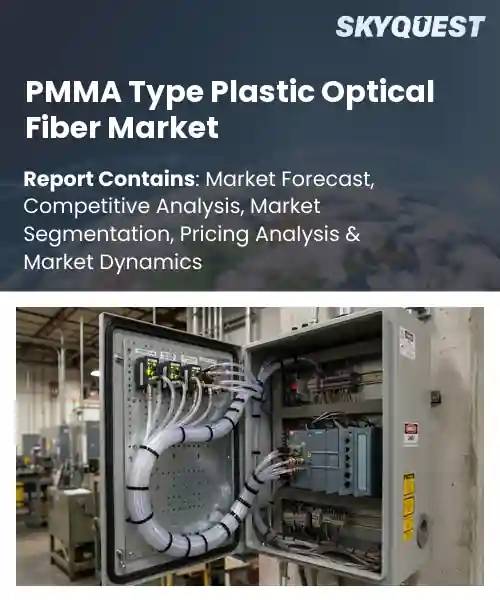
PMMA Type Plastic Optical Fiber Market
Report ID: SQMIG45H2375
Report ID: SQMIG45H2375
[email protected]
USA +1 351-333-4748
Report ID:
SQMIG45H2375 |
Region:
Global |
Published Date: August, 2026
Pages:
157
|Tables:
120
|Figures:
77


Global Pmma Type Plastic Optical Fiber Market size was valued at USD 864.0 Million in 2024 and is poised to grow from USD 936.58 Million in 2025 to USD 1785.58 Million by 2033, growing at a CAGR of 8.4% during the forecast period (2026-2033).
The PMMA type plastic optical fiber market centers on polymer waveguides that transmit light with lower attenuation than glass for short‑range links. Its primary driver is the surging demand for high‑speed data connectivity in automotive infotainment, consumer electronics, and IoT devices. Because PMMA fibers combine flexibility, lightweight construction, and easy installation, manufacturers can replace copper or bulky glass assemblies, cutting vehicle weight and assembly time. Since the early 2000s the technology moved from simple illumination to communication, exemplified by Tesla’s interior lighting networks and Samsung’s smart‑TV back‑plane designs.
The next wave of expansion in the PMMA type plastic optical fiber market is driven by its integration with automotive LED lighting and data‑bus architectures, turning regulatory pressure for lighter, more efficient vehicles into sales. When manufacturers replace copper harnesses with PMMA fibers, vehicle weight drops, fuel consumption improves, and emissions compliance becomes easier, prompting OEMs such as BMW to embed fiber‑based sensor networks in cabins. Simultaneously, data‑center operators seeking cost links and healthcare providers needing connections for patient monitoring broaden the market. These forces create economies of scale, lower prices, and open application niches, reinforcing a cycle of adoption.
How is AI driving design optimization in the PMMA plastic optical fiber market?
AI enhances design optimization in the PMMA plastic optical fiber market by automating geometry selection, material grading and performance simulation. Machine learning models analyze vast datasets of optical loss, bend radius and manufacturing tolerances, revealing patterns that human engineers would miss. These insights guide engineers toward fiber structures that balance flexibility with signal integrity, accelerating prototype iteration and reducing material waste. Real‑time feedback loops allow rapid adjustment of extrusion parameters, ensuring consistent quality across production runs. As manufacturers adopt AI‑enabled tools, product development becomes more agile, helping firms meet growing demand for high‑performance optical links while keeping costs competitive.
FiberTx in August 2025, launched an AI‑driven simulation platform that refines core‑cladding design of PMMA fibers, shortening development cycles and boosting production efficiency, thereby reinforcing market expansion.
Market snapshot - (2026-2033)
Global Market Size
USD 864.0 Million
Largest Segment
Step-Index PMMA Fiber
Fastest Growth
Graded-Index PMMA Fiber
Growth Rate
8.4% CAGR
To get more insights on this market click here to Request a Free Sample Report
Global pmma type plastic optical fiber market is segmented by product type, core diameter, application, end user and region. Based on product type, the market is segmented into Step-Index PMMA Fiber and Graded-Index PMMA Fiber. Based on core diameter, the market is segmented into Up to 0.5 mm, 0.5–1.0 mm and Above 1.0 mm. Based on application, the market is segmented into Automotive, Industrial Automation, Consumer Electronics, Medical Devices and Lighting & Decoration. Based on end user, the market is segmented into Automotive, Telecommunications, Healthcare, Industrial Manufacturing and Consumer Electronics. Based on region, the market is segmented into North America, Europe, Asia Pacific, Latin America and Middle East & Africa.
Graded Index PMMA Fiber segment dominates because it offers superior bandwidth and reduced modal dispersion which are critical for high speed optical links. Its refractive index profile smooths light propagation enabling longer runs without repeaters and supporting emerging high definition video and sensor networks. These technical advantages drive its preference across diverse applications reinforcing its market leadership in sectors such as automotive infotainment, industrial automation, and consumer entertainment where reliable data transfer is essential.
Meanwhile, Step Index PMMA Fiber is witnessing growth momentum as manufacturers target sensitive projects that prioritize ease of installation. Its simpler design reduces production expenses and aligns with rising demand for reach links in consumer electronics and lighting solutions. This affordability and deployment are accelerating market expansion and creating opportunities for low cost optical networking.
Automotive segment dominates because vehicle manufacturers increasingly rely on high speed optical links to support infotainment, advanced driver assistance systems, and interior lighting networks. The lightweight and flexible nature of PMMA fibers meets strict automotive weight and space constraints while delivering reliable data transmission. Integration with emerging electric and autonomous platforms amplifies demand, positioning automotive use as the primary driver of market adoption across multiple vehicle classes.
Conversely, Medical Devices application is emerging as the key high growth area as healthcare providers adopt optical fiber solutions for minimally invasive imaging and patient monitoring. The biocompatible and sterilizable properties of PMMA fibers enable safe integration into diagnostic equipment, while regulatory encouragement for non electrical data pathways fuels rapid uptake. This surge is expanding market horizons and unlocking new revenue streams.
To get detailed segments analysis, Request a Free Sample Report
The region benefits from a confluence of advanced manufacturing capabilities, extensive research and development ecosystems, and a deep integration of optical fiber solutions within high‑growth sectors such as telecommunications, automotive lighting, and consumer electronics. Strong collaboration between equipment suppliers, component manufacturers, and end‑user industries accelerates product innovation and drives cost efficiencies. Government initiatives that prioritize digital infrastructure and smart city projects further amplify demand, while a skilled workforce supports rapid scaling of production capacities. These combined strengths create a resilient supply chain and foster a competitive environment that positions Asia Pacific as the leading hub for PMMA type plastic optical fiber adoption worldwide.
PMMA Type Plastic Optical Fiber Market in Japan is propelled by a mature electronics sector that continuously seeks lightweight and flexible transmission solutions for high‑speed data links. The country’s emphasis on precision engineering and stringent quality standards enhances the reliability of fiber products, encouraging adoption across automotive and industrial automation applications. Collaborative research programs between universities and industry leaders drive incremental improvements in material performance, reinforcing Japan’s reputation as a technology pioneer in optical networking.
PMMA Type Plastic Optical Fiber Market in South Korea thrives on a dynamic telecommunications landscape that prioritizes rapid deployment of broadband and 5G infrastructure. The nation’s strong semiconductor and display manufacturing base creates a steady demand for high‑bandwidth, low‑loss fiber solutions in data centers and consumer devices. Aggressive investment in smart factory initiatives and IoT ecosystems further fuels the need for versatile optical connectivity, positioning South Korea as a critical growth engine within the broader Asia Pacific dominance.
Europe’s expansion is driven by a strategic focus on sustainable connectivity, stringent environmental regulations, and a robust industrial base that values high‑performance optical solutions. The region’s commitment to energy‑efficient data transmission aligns with the low‑loss characteristics of PMMA fibers, encouraging adoption in renewable energy grids and smart infrastructure projects. Strong collaboration among research institutions, standards bodies, and manufacturers accelerates innovation, while mature automotive and aerospace sectors integrate fiber optics for weight reduction and enhanced signal integrity. These factors collectively reinforce Europe’s position as a forward‑looking market for advanced plastic optical fiber technologies.
PMMA Type Plastic Optical Fiber Market in Germany is anchored by a powerful engineering tradition and a large automotive supply chain that prioritizes lightweight, high‑precision components. The country’s emphasis on Industry 4.0 and digital manufacturing drives demand for reliable, flexible fiber solutions in factory automation and high‑speed data exchange. Collaborative initiatives between research institutes and leading manufacturers foster continuous material enhancements, ensuring that German applications remain at the forefront of optical performance standards.
PMMA Type Plastic Optical Fiber Market in the United Kingdom experiences rapid growth through vigorous investment in broadband expansion and smart city projects. The nation’s vibrant technology ecosystem and strong emphasis on innovation encourage the integration of fiber optics in emerging sectors such as autonomous transport and health‑care monitoring. Policy support for digital infrastructure and a proactive approach to research funding accelerate the development of next‑generation fiber products, positioning the United Kingdom as a leading growth market within Europe.
PMMA Type Plastic Optical Fiber Market in France is emerging alongside a concerted push for digital transformation across public services and industrial sectors. The country’s focus on sustainable mobility and renewable energy networks creates new opportunities for fiber deployment in electric vehicle charging infrastructure and smart grid communication. Collaborative research programs between academic institutions and industry players nurture innovation in polymer fiber technology, supporting France’s gradual ascent as an influential participant in the European optical fiber landscape.
North America reinforces its role through a combination of extensive R&D investment, a diversified industrial base, and a proactive approach to integrating optical fiber solutions across multiple high‑tech domains. The region’s emphasis on high‑speed data centers, advanced automotive lighting, and consumer electronics drives continuous demand for flexible, cost‑effective PMMA fibers. Strong collaboration between leading manufacturers and technology innovators accelerates product development, while regulatory frameworks that promote energy efficiency and digital connectivity further stimulate market adoption. These dynamics collectively enhance North America’s strategic importance in the global landscape of plastic optical fiber technologies.
PMMA Type Plastic Optical Fiber Market in the United States benefits from a vast telecommunications infrastructure and a thriving ecosystem of technology startups focused on high‑bandwidth applications. The country’s leadership in data center expansion and autonomous vehicle research creates a persistent need for lightweight, reliable fiber solutions. Ongoing partnerships between academic research centers and industry accelerate material advancements, ensuring that U.S. market participants remain at the cutting edge of optical performance and integration.
PMMA Type Plastic Optical Fiber Market in Canada is supported by a strong emphasis on broadband outreach in remote regions and a growing renewable energy sector. The nation’s commitment to sustainable infrastructure encourages the use of low‑loss polymer fibers in smart grid and environmental monitoring projects. Collaborative initiatives between government agencies, research institutions, and fiber manufacturers foster innovation, positioning Canada as a proactive contributor to the broader North American advancement of plastic optical fiber technologies.
To know more about the market opportunities by region and country, click here to
Buy The Complete Report
Increasing Demand for High Speed Networks
Shift Toward Lightweight Cable Solutions
Higher Production Costs Compared to Glass
Limited Long Term Durability Data
Request Free Customization of this report to help us to meet your business objectives.
The competitive landscape is dominated by large chemical and fiber manufacturers such as Mitsubishi Chemical, Toray Group, AGC and Asahi Kasei, which are accelerating growth through strategic M&A, joint‑development agreements and advanced PMMA extrusion technologies; recent partnerships between Toray and automotive OEMs to embed fiber in vehicle lighting, and Mitsubishi Chemical’s acquisition of a niche polymer‑coating firm illustrate the focus on differentiated product performance and supply‑chain integration.
Top Player’s Company Profile
SkyQuest’s ABIRAW (Advanced Business Intelligence, Research & Analysis Wing) is our Business Information Services team that Collects, Collates, Correlates, and Analyses the Data collected by means of Primary Exploratory Research backed by robust Secondary Desk research.
As per SkyQuest analysis, the global PMMA type plastic optical fiber market is being propelled primarily by the increasing demand for high‑speed networks, while a complementary driver is the industry shift toward lightweight cable solutions that reduce vehicle weight and installation costs. The Graded‑Index PMMA Fiber segment leads the market owing to its superior bandwidth and lower modal dispersion. Asia Pacific dominates the landscape due to its advanced manufacturing base and strong automotive and electronics demand. However, higher production costs relative to glass fibers remain a restraint, tempering adoption in cost‑sensitive projects and prompting manufacturers to seek efficiency gains through innovation and scale.
| Report Metric | Details |
|---|---|
| Market size value in 2024 | USD 864.0 Million |
| Market size value in 2033 | USD 1785.58 Million |
| Growth Rate | 8.4% |
| Base year | 2024 |
| Forecast period | (2026-2033) |
| Forecast Unit (Value) | USD Million |
| Segments covered |
|
| Regions covered | North America (US, Canada), Europe (Germany, France, United Kingdom, Italy, Spain, Rest of Europe), Asia Pacific (China, India, Japan, Rest of Asia-Pacific), Latin America (Brazil, Rest of Latin America), Middle East & Africa (South Africa, GCC Countries, Rest of MEA) |
| Companies covered |
|
| Customization scope | Free report customization with purchase. Customization includes:-
|
To get a free trial access to our platform which is a one stop solution for all your data requirements for quicker decision making. This platform allows you to compare markets, competitors who are prominent in the market, and mega trends that are influencing the dynamics in the market. Also, get access to detailed SkyQuest exclusive matrix.
Table Of Content
Executive Summary
Market overview
Parent Market Analysis
Market overview
Market size
KEY MARKET INSIGHTS
COVID IMPACT
MARKET DYNAMICS & OUTLOOK
Market Size by Region
KEY COMPANY PROFILES
Methodology
For the PMMA Type Plastic Optical Fiber Market, our research methodology involved a mixture of primary and secondary data sources. Key steps involved in the research process are listed below:
1. Information Procurement: This stage involved the procurement of Market data or related information via primary and secondary sources. The various secondary sources used included various company websites, annual reports, trade databases, and paid databases such as Hoover's, Bloomberg Business, Factiva, and Avention. Our team did 45 primary interactions Globally which included several stakeholders such as manufacturers, customers, key opinion leaders, etc. Overall, information procurement was one of the most extensive stages in our research process.
2. Information Analysis: This step involved triangulation of data through bottom-up and top-down approaches to estimate and validate the total size and future estimate of the PMMA Type Plastic Optical Fiber Market.
3. Report Formulation: The final step entailed the placement of data points in appropriate Market spaces in an attempt to deduce viable conclusions.
4. Validation & Publishing: Validation is the most important step in the process. Validation & re-validation via an intricately designed process helped us finalize data points to be used for final calculations. The final Market estimates and forecasts were then aligned and sent to our panel of industry experts for validation of data. Once the validation was done the report was sent to our Quality Assurance team to ensure adherence to style guides, consistency & design.
Analyst Support
Customization Options
With the given market data, our dedicated team of analysts can offer you the following customization options are available for the PMMA Type Plastic Optical Fiber Market:
Product Analysis: Product matrix, which offers a detailed comparison of the product portfolio of companies.
Regional Analysis: Further analysis of the PMMA Type Plastic Optical Fiber Market for additional countries.
Competitive Analysis: Detailed analysis and profiling of additional Market players & comparative analysis of competitive products.
Go to Market Strategy: Find the high-growth channels to invest your marketing efforts and increase your customer base.
Innovation Mapping: Identify racial solutions and innovation, connected to deep ecosystems of innovators, start-ups, academics, and strategic partners.
Category Intelligence: Customized intelligence that is relevant to their supply Markets will enable them to make smarter sourcing decisions and improve their category management.
Public Company Transcript Analysis: To improve the investment performance by generating new alpha and making better-informed decisions.
Social Media Listening: To analyze the conversations and trends happening not just around your brand, but around your industry as a whole, and use those insights to make better Marketing decisions.
REQUEST FOR SAMPLE
 REQUEST FREE CUSTOMIZATION
Global Pmma Type Plastic Optical Fiber Market size was valued at USD 864.0 Million in 2024 and is poised to grow from USD 936.58 Million in 2025 to USD 1785.58 Million by 2033, growing at a CAGR of 8.4% during the forecast period (2026-2033).
The competitive landscape is dominated by large chemical and fiber manufacturers such as Mitsubishi Chemical, Toray Group, AGC and Asahi Kasei, which are accelerating growth through strategic M&A, joint‑development agreements and advanced PMMA extrusion technologies; recent partnerships between Toray and automotive OEMs to embed fiber in vehicle lighting, and Mitsubishi Chemical’s acquisition of a niche polymer‑coating firm illustrate the focus on differentiated product performance and supply‑chain integration. 'Mitsubishi Chemical Group Corporation', 'Asahi Kasei Corporation', 'Toray Industries, Inc.', 'Mitsubishi Rayon Co., Ltd.', 'Chromis Fiberoptics Inc.', 'LEONI AG', 'FiberFin, Inc.', 'Toray Resin Co., Ltd.', 'Shenzhen Cailiang Photoelectric Technology Co., Ltd.', 'Nan Ya Plastics Corporation', 'Kuraray Co., Ltd.', 'Teijin Limited', 'Sekisui Chemical Co., Ltd.', 'Asahi Glass Co., Ltd.', 'Evonik Industries AG', 'Röchling SE & Co. KG', 'Optimedia Pte. Ltd.', 'FiberTech Optica Inc.', 'Paradigm Optics, Inc.', 'Industrial Fiber Optics, Inc.'
The adoption of broadband and 5G infrastructures drives need for optical fibers with superior bandwidth, and PMMA type fibers offer flexibility and low attenuation that suit rapid deployment. Telecommunications providers prioritize lightweight, cost‑effective solutions, enabling faster installation across urban and rural sites. This demand fuels production scaling, encourages innovation in fiber coating technologies, and strengthens market confidence, creating a supportive environment for sustained growth of PMMA optical fiber applications. Manufacturers also collaborate with research institutes to improve durability and environmental resistance.
Rapid Adoption In Data Centers: Data center operators are increasingly selecting PMMA‑based plastic optical fiber for short‑reach interconnects because of its ease of installation, lightweight profile, and immunity to electromagnetic interference. The flexibility of the polymer core enables tight bend routing within dense rack environments, reducing cabling complexity and labor costs. As demand for high‑bandwidth, low‑latency links grows, manufacturers are expanding product portfolios with enhanced attenuation performance, positioning PMMA fiber as a preferred solution for intra‑rack and top‑of‑rack connectivity across modern hyperscale facilities worldwide today.
Why does Asia Pacific Dominate the Global PMMA Type Plastic Optical Fiber Market? |@12


Want to customize this report? This report can be personalized according to your needs. Our analysts and industry experts will work directly with you to understand your requirements and provide you with customized data in a short amount of time. We offer $1000 worth of FREE customization at the time of purchase.
Feedback From Our Clients


 USA (+1) 351-333-4748

