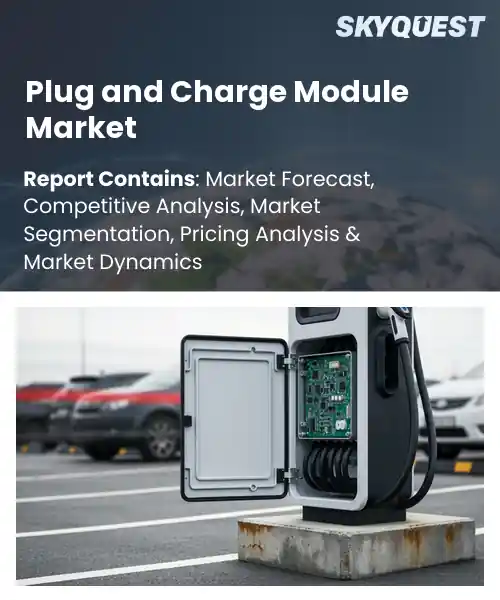
Plug and Charge Module Market
Report ID: SQMIG45J2569
Report ID: SQMIG45J2569
[email protected]
USA +1 351-333-4748
Report ID:
SQMIG45J2569 |
Region:
Global |
Published Date: June, 2026
Pages:
157
|Tables:
173
|Figures:
79


Global Plug And Charge Module Market size was valued at USD 287.4 Million in 2024 and is poised to grow from USD 369.6 Million in 2025 to USD 2764.75 Million by 2033, growing at a CAGR of 28.6% during the forecast period (2026-2033).
The primary driver of the global plug‑and‑charge (PnC) module market is the rise of electric‑vehicle (EV) adoption, which creates demand for secure charging. Plug‑and‑charge modules embed ISO 15118 communication in the vehicle and charger, letting drivers authenticate and pay with a tap, removing the need for RFID cards or apps. Since the first commercial rollout in 2018 by Nissan and Bosch, the technology has spread from premium fleets in Europe to mass‑market models in China and the United States. This evolution matters because it cuts friction at the point of use, boosts public‑charger utilization, and enables automated load management for grid integration.
Regulatory mandates for charging standards drive the plug‑and‑charge module market because they force automakers and charger makers to adopt solutions that simplify payment. The EU’s Directive 2022/123, obligating all public chargers to support ISO 15118 by 2025, has spurred a surge in orders from firms such as ABB and ChargePoint, which embed the firmware in Level 2 and DC‑fast stations. In the United States, pilot projects in California and New York show how plug‑and‑charge data enable dynamic pricing and demand‑response, creating revenue while easing peak‑load stress. These policy incentives, combined with fleet cost savings, open extensive opportunities across residential, commercial, and highway networks.
How is AI influencing adoption trends in the Plug and Charge module market?
AI is changing the way Plug and Charge modules are implemented, turning the charging experience into an automated service of data. No cards, no apps – machine learning models will look at driver behaviour and grid conditions to determine when to authenticate. Real-time analytics allow the operators to identify where modules should be deployed in areas of likely increased demand. AI based diagnostics allow to know of faults before they could cause downtime. Seamless billing and personalized pricing reduce friction and build consumer confidence. This has enabled fleet operators and public networks to make Plug and Charge the default.
In March 2026, Clean Energy Transportation also launched an AI-based Plug and Charge module that automates vehicle authentication and optimizes energy flow, letting stations handle more sessions with fewer staff. A pilot on regional networks shows how intelligent software helps providers of charging to get to market faster and operate more efficiently.
Market snapshot - (2026-2033)
Global Market Size
USD 287.4 Million
Largest Segment
Fastest Growth
Growth Rate
28.6% CAGR
To get more insights on this market click here to Request a Free Sample Report
Global plug and charge module market is segmented by component type, charging type, vehicle type, installation type, end user, sales channel and region. Based on component type, the market is segmented into Hardware Modules, Software Modules, Integrated Modules and Others. Based on charging type, the market is segmented into AC Charging Systems, DC Fast Charging Systems and Ultra-Fast Charging Systems. Based on vehicle type, the market is segmented into Passenger Electric Vehicles, Commercial Electric Vehicles, Electric Buses and Others. Based on installation type, the market is segmented into OEM Installed Modules and Retrofit Modules. Based on end user, the market is segmented into Automotive OEMs, Charging Point Operators, Fleet Operators and Others. Based on sales channel, the market is segmented into Direct Sales, System Integrators and Others. Based on region, the market is segmented into North America, Europe, Asia Pacific, Latin America and Middle East & Africa.
The communication module segment has the highest share as it provides the necessary interface for the electric vehicle and charger to communicate with each other for seamless authentication and billing without manual steps. With support for multiple protocols and over-the-air updates, it’s helping OEMs and service providers build trust, encouraging wide integration in new charging stations. Hence, manufacturers are focusing on robust communication solutions to meet security requirements and ensure a seamless user experience, thereby reinforcing its market leadership.
On the other hand, power electronics sub-segment is witnessing the strongest momentum of growth as higher charging power demands are forcing developers to come up with more efficient converters and safety features. The market is driven by new OEM contracts for silicon carbide and vehicle-to-grid integration, opening new revenue streams for module suppliers.
The forerunner is the public installation type, as municipal and commercial charging networks are highly visible and serve a variety of driver populations, leading to economies of scale for plug-and-charge modules. Operators like uniform authentication that reduce dwell time and regulatory incentives encourage mass deployment . Public sites are the main strategic deployment area . This wide exposure fuels recurrent hardware upgrades and software enhancements, making public installations the leading use case of the total market.
Meanwhile, private installation is the fastest growing segment, with corporations and residential complexes installing dedicated plug-and-charge stations to support EV use by employees and tenants. The integration with building management systems and the convenience of these systems, along with corporate sustainability goals, are fuelling the rapid adoption of these systems, opening up new demand for custom modules and broadening the overall market horizon.
To get detailed segments analysis, Request a Free Sample Report
North America’s preeminence stems from an amalgamation of state-of-the-art technological ecosystems, forward-looking policy frameworks and a deeply ingrained culture of automotive innovation. The area has the benefit of an established supply chain linking leading semiconductor companies with large carmakers, supporting fast development cycles and quality requirements. Strong government incentives encourage wide adoption of electric vehicles and large-scale public and private charging networks form the critical infrastructure backbone. Ongoing investment in plug-and-charge solutions, driven by consumer demand for effortless and secure charging experiences, is helping to reinforce the market’s leading position. Through joint efforts between academia, industry and standards organizations, the technology is being refined at an accelerated pace, keeping North America on the leading edge of the world’s plug-and-charge module development.
United States Plug and Charge Module Market is characterized by strong innovation culture and well-developed ecosystem of technology providers, auto-makers and energy firms. The regulatory environment is forcing manufacturers to design for security and ease of use, driving interoperability and consumer protection. With the increasing number of public charging stations and sophisticated home-charging solutions, there is a great testing ground for new module architectures. Top car brands are partnering with software developers. This accelerates the deployment of fancy authentication protocols. It puts the US on the map as a standard for simple electric vehicle charging experiences.
Strong government backing for clean transportation and a collaborative ecosystem of research institutions are driving Canada’s Plug and Charge Module Market. The manufacturers are building modules compatible with smart-grid initiatives with a focus on grid resilience and renewable energy integration. The pilot projects in major cities provide valuable real-world feedback to improve the user interface and security features. A supportive policy environment and an emerging domestic component manufacturing base further reinforce Canada’s value as a key contributor to the broader North American plug‑and‑charge ecosystem.
Europe is booming on the back of an ambitious sustainability agenda, harmonised regulatory standards and a dense network of charging infrastructure across member states. The region’s commitment to lowering emissions is driving collaboration among car makers, technology companies and policy makers to standardise plug-and-charge protocols that will enable cross-border compatibility. To meet the high consumer demand for convenient and secure charging experiences, manufacturers innovate around ease of use and cybersecurity. Moreover the combination with new mobility services and smart grid solutions increases the value proposition of plug-and-charge modules and Europe is a dynamic center of market growth and technology leadership.
Germany Plug and Charge Module Market is driven by highly engineered automotive industry where precision and reliability is the key. Robust, high‑performance modules are being developed through collaborative initiatives between leading car manufacturers and specialized electronics firms. A regulatory framework that promotes safety and interoperability will help accelerate adoption for both passenger and commercial fleets. Broad public charging corridors and sophisticated home-charging systems provide a wide range of deployment scenarios to fine-tune product offerings and reinforce Germany’s leading market position.
In the UK, the Plug and Charge Module market is rapidly expanding, driven by proactive government incentives and a thriving startup sector dedicated to mobility innovation. The drive for seamless user experiences is creating the demand for modules that can work with a variety of charging points and digital payment platforms. Car manufacturers partnering with telecoms companies is a move to improve connectivity and security features and speed up market penetration. Cities are also pushing for the roll out of sophisticated plug-in-and-charge technologies across the UK’s transport system, to encourage the use of electric cars.
The Plug and Charge Module Market in France is emerging, with a strong policy push to decarbonize transportation and increase public charging coverage. Academic-industry cocreation research programs foster early-stage innovations that center on the convenience of the user and data protection. Such pilot deployments in major metropolitan hubs enable manufacturers to collect real-world feedback to design modules that meet the expectations of the French audience. As interoperable standards gain more and more importance, France is becoming an increasingly influential player in the European plug-and-charge landscape.
Rapid urbanization, aggressive electric vehicle adoption strategies and major investments in modern charging infrastructure are solidifying the Asia Pacific position. The regional technology focused markets are concentrated around incorporation of next generation communication protocols and advanced authentication mechanisms in plug and charge modules. Automotive manufacturers, semiconductor companies and energy utilities can collaborate within ecosystems that facilitate rapid iterations and local customization. Government support for smart-city initiatives also aligns plug-and-charge development with broader digital transformation goals, boosting the region’s global marketplace competitiveness.
Our Plug and Charge Module market in Japan draws on a heritage of precision engineering and progressive automotive culture. A close collaboration between vehicle manufacturers and component specialists creates modules that are reliable, compact and interact smoothly with the user. This country’s strong public charging network and widespread residential charging provide a full-scale testbed for iterative improvements. Policy incentives for enhancing electric vehicle accessibility are prompting manufacturers to focus on interoperability and strong security features in the Japanese market.
The South Korea Plug and Charge Module Market is driven by dynamic electronics industry and strong governmental commitment towards electric mobility. The focus on high speed data transfer and secure authentication drives module design innovation that matches the country’s sophisticated telecommunications infrastructure. Automotive and semiconductor partnerships speed up the adoption of next-generation connectivity standards. Through the aggressive roll-out of public and private charging stations, South Korea is establishing a growing influence in the plug & charge space that provides fertile ground for widespread adoption.
To know more about the market opportunities by region and country, click here to
Buy The Complete Report
Growing Demand for Fast Charging
Regulatory Support for Interoperability
High Initial Installation Costs
Fragmented Standards Across Regions
Request Free Customization of this report to help us to meet your business objectives.
The competitive landscape is marked by aggressive M&A activity (e.g., Blink Charging’s acquisition of four niche startups), strategic partnerships (e.g., ChargePoint’s partnership with automakers to embed plug‑and‑charge protocols), and rapid tech innovation (e.g., FreeWire’s modular fast‑charging units and AmpUp’s cloud‑based charging management platform). All of these feed into differentiation and market share battles among emerging and incumbent players.
SkyQuest’s ABIRAW (Advanced Business Intelligence, Research & Analysis Wing) is our Business Information Services team that Collects, Collates, Correlates, and Analyses the Data collected by means of Primary Exploratory Research backed by robust Secondary Desk research.
As per SkyQuest analysis the global plug‑and‑charge module market is being propelled primarily by rapid electric‑vehicle adoption that creates strong demand for seamless, secure charging, while AI‑enabled authentication and load‑management provide a second driver accelerating uptake across fleets and public networks. The communication‑module segment leads the market because it delivers the essential interface for ISO 15118 authentication and over‑the‑air updates, and North America dominates due to its advanced technology ecosystem, supportive policies and extensive charging infrastructure. However, high initial installation costs remain a restraint, slowing some operators’ rollout plans until economies of scale reduce hardware and certification expenses. Investors are also focusing on smart‑grid integration which further fuels market growth.
| Report Metric | Details |
|---|---|
| Market size value in 2024 | USD 287.4 Million |
| Market size value in 2033 | USD 2764.75 Million |
| Growth Rate | 28.6% |
| Base year | 2024 |
| Forecast period | (2026-2033) |
| Forecast Unit (Value) | USD Million |
| Segments covered |
|
| Regions covered | North America (US, Canada), Europe (Germany, France, United Kingdom, Italy, Spain, Rest of Europe), Asia Pacific (China, India, Japan, Rest of Asia-Pacific), Latin America (Brazil, Rest of Latin America), Middle East & Africa (South Africa, GCC Countries, Rest of MEA) |
| Companies covered |
|
| Customization scope | Free report customization with purchase. Customization includes:-
|
To get a free trial access to our platform which is a one stop solution for all your data requirements for quicker decision making. This platform allows you to compare markets, competitors who are prominent in the market, and mega trends that are influencing the dynamics in the market. Also, get access to detailed SkyQuest exclusive matrix.
Table Of Content
Executive Summary
Market overview
Parent Market Analysis
Market overview
Market size
KEY MARKET INSIGHTS
COVID IMPACT
MARKET DYNAMICS & OUTLOOK
Market Size by Region
KEY COMPANY PROFILES
Methodology
For the Plug and Charge Module Market, our research methodology involved a mixture of primary and secondary data sources. Key steps involved in the research process are listed below:
1. Information Procurement: This stage involved the procurement of Market data or related information via primary and secondary sources. The various secondary sources used included various company websites, annual reports, trade databases, and paid databases such as Hoover's, Bloomberg Business, Factiva, and Avention. Our team did 45 primary interactions Globally which included several stakeholders such as manufacturers, customers, key opinion leaders, etc. Overall, information procurement was one of the most extensive stages in our research process.
2. Information Analysis: This step involved triangulation of data through bottom-up and top-down approaches to estimate and validate the total size and future estimate of the Plug and Charge Module Market.
3. Report Formulation: The final step entailed the placement of data points in appropriate Market spaces in an attempt to deduce viable conclusions.
4. Validation & Publishing: Validation is the most important step in the process. Validation & re-validation via an intricately designed process helped us finalize data points to be used for final calculations. The final Market estimates and forecasts were then aligned and sent to our panel of industry experts for validation of data. Once the validation was done the report was sent to our Quality Assurance team to ensure adherence to style guides, consistency & design.
Analyst Support
Customization Options
With the given market data, our dedicated team of analysts can offer you the following customization options are available for the Plug and Charge Module Market:
Product Analysis: Product matrix, which offers a detailed comparison of the product portfolio of companies.
Regional Analysis: Further analysis of the Plug and Charge Module Market for additional countries.
Competitive Analysis: Detailed analysis and profiling of additional Market players & comparative analysis of competitive products.
Go to Market Strategy: Find the high-growth channels to invest your marketing efforts and increase your customer base.
Innovation Mapping: Identify racial solutions and innovation, connected to deep ecosystems of innovators, start-ups, academics, and strategic partners.
Category Intelligence: Customized intelligence that is relevant to their supply Markets will enable them to make smarter sourcing decisions and improve their category management.
Public Company Transcript Analysis: To improve the investment performance by generating new alpha and making better-informed decisions.
Social Media Listening: To analyze the conversations and trends happening not just around your brand, but around your industry as a whole, and use those insights to make better Marketing decisions.
REQUEST FOR SAMPLE
 REQUEST FREE CUSTOMIZATION
Global Plug And Charge Module Market size was valued at USD 287.4 Million in 2024 and is poised to grow from USD 369.6 Million in 2025 to USD 2764.75 Million by 2033, growing at a CAGR of 28.6% during the forecast period (2026-2033).
The competitive landscape is shaped by aggressive M&A activity such as Blink Charging’s acquisition of four niche startups, strategic partnerships like ChargePoint’s collaboration with automakers to embed plug‑and‑charge protocols, and rapid tech innovation demonstrated by FreeWire’s modular fast‑charging units and AmpUp’s cloud‑based charging management platform, all driving differentiation and market share battles among emerging and incumbent players. 'Hubject GmbH', 'Vector Informatik GmbH', 'Pionix GmbH', 'ChargePoint Holdings, Inc.', 'ABB Ltd.', 'Siemens AG', 'Schneider Electric SE', 'Alpitronic GmbH', 'Tritium DCFC Limited', 'EVBox Group', 'Wallbox N.V.', 'Delta Electronics, Inc.', 'Autel Energy', 'StarCharge Energy Pte. Ltd.', 'Blink Charging Co.', 'bp pulse', 'Shell Recharge Solutions', 'Driivz Ltd.', 'Phoenix Contact GmbH & Co. KG', 'Keysight Technologies, Inc.'
Deploying plug‑and‑charge infrastructure requires substantial capital outlay for sophisticated hardware, secure communication modules, and site preparation, which can deter investors operating under tight budget constraints. The need for compliance with evolving safety and electromagnetic compatibility standards further elevates engineering and certification expenses. Consequently, many potential adopters postpone or scale back rollout plans, opting for less advanced solutions until cost reductions become evident, thereby slowing overall market penetration and limiting short‑term growth prospects for sustainable transportation initiatives globally.
Smart Grid Integration: The rise of intelligent energy management systems is driving widespread adoption of plug‑and‑charge modules that can communicate directly with smart grids. Manufacturers are embedding advanced communication protocols, enabling real‑time load balancing, demand response, and renewable energy utilization. Utilities view these modules as critical nodes for grid stability, while automakers leverage them to offer seamless charging experiences. This convergence accelerates infrastructure investment, promotes interoperability, and positions plug‑and‑charge technology as a cornerstone of future energy ecosystems in global power networks and resilience.
Why does North America Dominate the Global Plug and Charge Module Market? |@12


Want to customize this report? This report can be personalized according to your needs. Our analysts and industry experts will work directly with you to understand your requirements and provide you with customized data in a short amount of time. We offer $1000 worth of FREE customization at the time of purchase.
Feedback From Our Clients


 USA (+1) 351-333-4748

