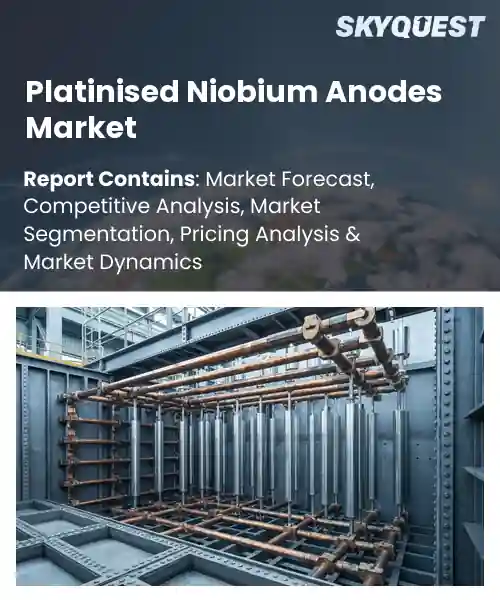
Platinised Niobium Anodes Market
Report ID: SQMIG20I2860
Report ID: SQMIG20I2860
[email protected]
USA +1 351-333-4748
Report ID:
SQMIG20I2860 |
Region:
Global |
Published Date: March, 2026
Pages:
157
|Tables:
116
|Figures:
77


Global Platinised Niobium Anodes Market size was valued at USD 3.3 Billion in 2024 and is poised to grow from USD 3.53 Billion in 2025 to USD 6.02 Billion by 2033, growing at a CAGR of 6.9% during the forecast period (2026-2033).
Platinised Nb anodes are primarily used in the industrial world because they provide electrodes with high levels of corrosion resistance and reliable catalytic activity in very aggressive electrolytic environments. Anode material is typically produced by electroplating or coating a niobium substrate with platinum to achieve very low overpotentials and service lives. By combining these two properties together results in reduced downtime for the end-user and lower total ownership costs for processes such as electrochlorination, chlor-alkali production and advanced oxidation of wastewater.
Platinised Nb Anodes started off as a substitute for titanium-based anodes when users began experiencing field failures due to the dissolution of the substrate. Manufacturers now have however grown to have the ability to scale up production as utility and chemical companies have placed more emphasis on lifecycle performance rather than on initial capital costs. The increased push to comply with regulatory standards for discharging effluents has created a demand for platinised Nb anodes as utilities are being forced into finding more reliable electrochemical solutions.
How is AI Optimizing Production and Quality Control in the Platinised Niobium Anodes Market?
The alloying of niobium with a small amount or less of platinum creates electrodes with a highly corrosion resistant substrate and are generally used for many of the same end uses, such as electrochemical manufacturing and corrosion protection. Development and production of these electrodes can be improved by using an AI driven model to simulate the dynamics of the electrode deposition process, controlling both the chemical and electrical inputs to the process, and using advanced machine vision technology to identify surface defects prior to applying the electrode coating. Additionally, by closely monitoring these processes in real-time using digital twins, manufacturers will be able to optimize their operations to both improve quality and reduce variability about the application of electrode coatings. The continued adoption by manufacturers of machine learning technology for both performance measurements and inspection of plated coatings will further enhance the use of machine learning and AI based inspection systems for plating operations.
Market snapshot - 2026-2033
Global Market Size
USD 3.3 Billion
Largest Segment
Niobium Mesh Anodes
Fastest Growth
Niobium Mesh Anodes
Growth Rate
6.9% CAGR
To get more insights on this market click here to Request a Free Sample Report
Global platinised niobium anodes market is segmented into substrate configuration, platinum coating thickness, manufacturing process, application vertical and region. Based on substrate configuration, the market is segmented into niobium mesh anodes, niobium rod/wire anodes and niobium sheet/plate anodes. Based on platinum coating thickness, the market is segmented into standard and heavy duty. Based on manufacturing process, the market is segmented into electroplating and thermal decomposition/cladding. Based on application vertical, the market is segmented into impressed current cathodic protection (ICCP), hard chrome plating & electro-galvanizing, precious metal electroplating and wastewater treatment & electrolysis. Based on region, the market is segmented into North America, Europe, Asia Pacific, Latin America and Middle East & Africa.
As per global platinised niobium anodes market outlook, the niobium mesh anodes are the dominant segment with open architecture to facilitate electrolyte circulation and create a more even current distribution resulting in better platinum use and extended catalytic activity in demanding electrochemical applications. The mesh also allows for the heat to dissipate and for gas to evolve therefore creating less local degradation mechanisms so less maintenance will be required. The performance and serviceability benefits are fuelingend-user specifications for these types of electrodes for continual operating applications and/or those that need to retrofit electrodes.
As per global platinised niobium anodes market analysis, niobium sheet/plate anodes are emerging as the most rapidly expanding area due to fabrication efficiencies and ease of integration into high current density cells. Their planar geometry has made uniform platinum deposition much easier and supports scaling up for larger installations leading to an increase in adoption for heavy-duty electroplating and industrial electrolysis applications with new product formats and/or procurement models.
Impressed current cathodic protection segment dominates with large global platinised niobium anodes market share because protection programs prioritize electrodes that deliver long term stability, predictable potential control and chemical inertness in aggressive environments. Impressed current cathodic protection segment dominates because protection programs prioritize electrodes that deliver long term stability, predictable potential control and chemical inertness in aggressive environments. The use of platinised niobium anodes, which provide catalytic activity during continuous operation, decreases the frequency with which they must be replaced and allows for more uniform corrosion protection strategies. Specification engineers and original equipment manufacturers are opting to specify platinised niobium anodes for use in system corrosion control systems due to their alignment with long term asset integrity and life cycle planning.
As per global platinised niobium anodes market forecast, the wastewater treatment and electrolysis segment are experiencing exceptional growth due to the growing use of electrochemical treatment and resource recovery using robust, low maintenance anodes. The availability of improved cell designs along with increased interest in decentralized and circular water uses is creating a higher demand for the adoption of platinised niobium solutions, resulting in the development of innovative electrode designs.
To get detailed segments analysis, Request a Free Sample Report
As per global platinised niobium anodes market regional outlook, the Asia Pacific region are increasingly taking the lead in the market due to synergies of high volumes of production and expertise in materials development; as well as the growing number of ends uses across a range of industries which makes the two regions have many similarities. Examples include strong development of the electronics industry and the chemical processing industry, both of which contribute to the demand for high-performance anodes. Besides, both regions have developed coordinated supply chains and the ability to manufacture specialized components. Both also require strong R&D networks and collaboration between industry and academia to improve the development and use of the material; while at the same time having the ability to provide low-cost manufacturing and having engineering capabilities in their respective regions allows the fast track of commercialization.
As per global platinised niobium anodes market regional forecast, Japan market is driven primarily by the combination of the large number of businesses in the precision manufacturing industry. The expertise in materials science that support the demand for high-performance anodes in the semiconductors, automotive, and industrial electrochemical usage markets. The established supply chains and the strict quality standards allow for the close collaboration of the component manufacturers and end users. The technical service networks and pilot plants provide opportunities for customizing the application of new anode technologies for use in high-reliability environments, while the continuing emphasis on innovation will sustain the growth of new anode technologies across the manufacturing sectors.
As per global platinised niobium anodes industry analysis, South Korea market is creating an increased need for high-performance coatings and durable components for energy storage and electronic manufacturers to meet increased demand for these types of products. Strong process engineering capabilities and the ability to rapidly scale customized and tailor-made solutions result in South Korea having a distinct advantage compared to many other countries.
The rapid development of Europe has been driven by convergence of regulatory focus on environmental performance, activities to modernize industry and a strategic goal to implement diversification of supply chains. Increased use of more advanced ways to use electrochemical technology, such as in water purification, chemical processing and energy production, has created an increased need for high-quality niobium anodes that have been Platinised. There is a large regional network of engineering companies, specialty material manufacturers, and research organizations that support fast application development and certification of innovative products. The support given to sustainable technologies by targeted industrial policies and public procurement programs, as well as the strong service culture developing among the companies supplying niobium anodes, promotes after-market performance and long-term reliability. These interrelated elements incentivize market entrants looking for technical partners and provide existing players with a way to expand the capabilities of advanced anodes to fulfill the changing requirements of end users in Europe.
Platinised niobium anodes market has a strong industrial base and a strong engineering capability focused on reliability and process integration; sources of demand are from the chemical processing industry, car industry (automotive parts), and specialized industrial electrolysis applications, all of which have stringent specifications for supplier components. Close cooperation between manufacturers, research institutes, and engineering firms facilitates the rapid qualification of specially tailored anode products. The overall supplier ecosystem and operational emphasis on it ensures Germany's dominance as the European center for the development of anode technology.
The platinised niobium anodes market in the United Kingdom is a growing center for applied research and niche manufacturing which aids deployment within the environmental and energy sectors. The presence of a dynamic start-up community & excellent services sector has all helped to foster the development of specific anode systems. Furthermore, close cooperation between the utilities, research organizations and specialist manufactures promotes the field validation of new ideas. The emphasis on clean technologies, innovationand procurement of solutions by the UK government supports the creation of pathways for greater adoption of these systems across all the different sectors of the UK industry.
The french platinised niobium anodes market has been experiencing rapid adoption due to process modernization, investment in electrochemical technologies for energy and environmental purposes. National Research centres, Industrial Leaders work collaboratively on advanced coating technology and designing anodes specifically for local process conditions. Strong policy signals and procurement programs further promote the use of these materials/technologies as an alternative solution for wastewater treatment as well as electrolysis. Growing supplier capabilities and Services infrastructure also assist with broader use of these products across the French industry.
North America is enhancing its competitiveness by strategically investing in research and local manufacturing capacity as well as forming alliances to respond to increased demand for environmentally sustainable technologies and renewable energy sources. The development of materials through collaboration between industry and academia enables the scaling up of improved performance and extended service lives.
The platinised niobium anodes market in the United States is driven by a high level of collaboration among national laboratories, universities, and manufacturers on next generation materials and process reliability. Utilities, specialty chemical manufacturers, and systems integrators are driving demand for durable anodes with long term supportability. Pilot projects allow for empirical proof of concept, and a developing supplier and service network provides customization and after-sale services. Strategic procurement priorities result in increased domestic sourcing and greater technology advancement.
The platinised niobium anodes market in Canada relies upon extensive materials processing capabilities and resource supply chains to support the development of platinised niobium anodes. Significant focus on clean technology has created collaborations between research institutions and small to medium-sized manufacturers to accelerate application testing and industrialization. Engineering and service providers help customize solutions for water treatment, electrochemical synthesis, and industrial processes. Collaborations with partners in the region also provide Canadian suppliers with increased access to markets and support in their operations.
To know more about the market opportunities by region and country, click here to
Buy The Complete Report
Expansion in Power Generation
The overall increase of renewable energy generation and infrastructure development has created an increasing demand for long-lasting anode coatings resistant to corrosion that also have reliable performance within these highly aggressive electrochemical environments. In addition to the increasing expectations for reliable and continuous operation, an emphasis is being placed on reducing maintenance cycles, which has resulted in utility and industrial operators specifying platinised niobium anodes for their critical electrochemical processes. As more operators begin to favour materials that offer good conductance and structural integrity over a prolonged period while in continuous operation, suppliers are investing more in improving their products to meet this global platinised niobium anodes market trend. Thus, supporting the long-term purchase of these materials by project owners and their infrastructure and energy facilities from all types of projects.
Innovations in Coatings & Surface Engineering
Coatings and surface engineering innovations have improved the overall performance and longevity of platinised niobium anodes, making them a more viable option for many electrochemical applications. Innovations in coating uniformity and adhesion have contributed to reducing the potential for anode failure and increasing the length of time before service interruptions occur, which the industry interprets as lower overall costs over the life of an aspect and a more dependable source. As manufacturers improve their manufacturing processes related to coating deposition as well as their associated quality assurance processes, the level of manufacturer's reliability increases with the increasing level of the manufacturer's consistency; leading to the specification of more premium quality anodes within application projects where durability is important. This trend also creates substantial interest in developing retainer strategies aimed at selecting premium anode solutions over less durable solutions.
High Raw Material Costs
The increased costs associated with specialty niobium substrates and noble metal coatings pushes additional costs into producing Platinised niobium anodes, decreasing manufacturers’ pricing flexibility. As a result, increased costs make it more difficult for suppliers to provide competitively priced products for cost sensitive projects. As a result, procurement teams are evaluating alternative materials or postponing orders. Procurement practices that are capital intensive due to the need for replacement cycles and caution required due to limited funding will slow the adoption of products in the market, as stated above. Buyers will often seek lower upfront costs for solutions even if there is an overall benefit across the long term for performance.
Manufacturing and Handling Challenges
The manufacturing process of Platinised niobium anodes requires a complex approach and maintains a precise handling requirement that presents operational challenges for producers to achieve rapid market scaling. Manufacturers of Platinised niobium anodes are required to adhere to high quality standards and utilize qualified personnel and specialized tools to ensure they provide customers with consistent products. This may pose barriers to entry for potential new players as well limit the capacity expansion of suppliers and/or contribute to longer lead times, which may also deter potential buyers that require readily available products or manufacturers who are using simple manufacturing solutions.
Request Free Customization of this report to help us to meet your business objectives.
The competition in the market is being fueled by the scale of niobium supply chains and partnerships between electrode manufacturers and battery material companies. In addition, existing companies are seeking to create partnerships and strategically acquire new businesses while companies that focus on developing new materials are working to improve coatings and substrates. A few examples include CBMM increasing its production of niobium anodes and De Nora forming collaborative relationships for electrolyzers, which are both speeding up the process of consolidation of suppliers and accelerating the time for qualifying Platinised niobium anodes.
Performance Driven Product Differentiation: Manufacturers are placing increasing emphasis on performance-based differentiation through improved performance of their niobium anode materials, through the control or improvement of the plating process to increase performance durability, performance consistency, and electrochemical stability. In order to achieve these performance enhancements, Suppliers are focused on customized surface treatments, proprietary deposition processes, and joint engineering efforts with the end users for the purposes of meeting specific process requirements that have resulted in shifting the purchasing decision towards integrated solution providers who can deliver technical service support.
Sustainability and Circular Economy Adoption: The increasing emphasis on the environmental impact of the product has led to increased adoption of circular economy strategies across the entire value chain of the platinised niobium anode. The stakeholders are requesting material traceability, supplier transparency and processes that will allow for the easier reclamation of the precious coatings utilized to produce these anodes which will strengthen the suppliers brand and meet the evolving expectations of procurement. By adopting closed loops and recyclability of electrode architectures there are many additional service based revenue streams available to Manufacturers, have a lessened reliance on virgin resources, and position themselves as leaders of sustainability due to their documented cradle to cradle stewardship.
SkyQuest’s ABIRAW (Advanced Business Intelligence, Research & Analysis Wing) is our Business Information Services team that Collects, Collates, Correlates, and Analyses the Data collected by means of Primary Exploratory Research backed by robust Secondary Desk research.
As per SkyQuest analysis, a key driver is industrial demand for electrodes that combine extreme corrosion resistance with reliable catalytic activity to reduce downtime and ownership costs, while a second driver is expansion in power generation and tighter environmental regulations driving broader adoption of electrochemical treatment. A restraint is high raw material costs tied to platinum and specialty niobium that constrain pricing and uptake. The dominating region is Asia Pacific, supported by manufacturing scale, R&D and concentrated end use demand, and the dominating segment is Niobium Mesh Anodes due to their open architecture, uniform current distribution and retrofit flexibility, favoringperformance‑led, service‑oriented suppliers.
| Report Metric | Details |
|---|---|
| Market size value in 2024 | USD 3.3 Billion |
| Market size value in 2033 | USD 6.02 Billion |
| Growth Rate | 6.9% |
| Base year | 2024 |
| Forecast period | 2026-2033 |
| Forecast Unit (Value) | USD Billion |
| Segments covered |
|
| Regions covered | North America (US, Canada), Europe (Germany, France, United Kingdom, Italy, Spain, Rest of Europe), Asia Pacific (China, India, Japan, Rest of Asia-Pacific), Latin America (Brazil, Rest of Latin America), Middle East & Africa (South Africa, GCC Countries, Rest of MEA) |
| Companies covered | |
| Customization scope | Free report customization with purchase. Customization includes:-
|
To get a free trial access to our platform which is a one stop solution for all your data requirements for quicker decision making. This platform allows you to compare markets, competitors who are prominent in the market, and mega trends that are influencing the dynamics in the market. Also, get access to detailed SkyQuest exclusive matrix.
Table Of Content
Executive Summary
Market overview
Parent Market Analysis
Market overview
Market size
KEY MARKET INSIGHTS
COVID IMPACT
MARKET DYNAMICS & OUTLOOK
Market Size by Region
KEY COMPANY PROFILES
Methodology
For the Platinised Niobium Anodes Market, our research methodology involved a mixture of primary and secondary data sources. Key steps involved in the research process are listed below:
1. Information Procurement: This stage involved the procurement of Market data or related information via primary and secondary sources. The various secondary sources used included various company websites, annual reports, trade databases, and paid databases such as Hoover's, Bloomberg Business, Factiva, and Avention. Our team did 45 primary interactions Globally which included several stakeholders such as manufacturers, customers, key opinion leaders, etc. Overall, information procurement was one of the most extensive stages in our research process.
2. Information Analysis: This step involved triangulation of data through bottom-up and top-down approaches to estimate and validate the total size and future estimate of the Platinised Niobium Anodes Market.
3. Report Formulation: The final step entailed the placement of data points in appropriate Market spaces in an attempt to deduce viable conclusions.
4. Validation & Publishing: Validation is the most important step in the process. Validation & re-validation via an intricately designed process helped us finalize data points to be used for final calculations. The final Market estimates and forecasts were then aligned and sent to our panel of industry experts for validation of data. Once the validation was done the report was sent to our Quality Assurance team to ensure adherence to style guides, consistency & design.
Analyst Support
Customization Options
With the given market data, our dedicated team of analysts can offer you the following customization options are available for the Platinised Niobium Anodes Market:
Product Analysis: Product matrix, which offers a detailed comparison of the product portfolio of companies.
Regional Analysis: Further analysis of the Platinised Niobium Anodes Market for additional countries.
Competitive Analysis: Detailed analysis and profiling of additional Market players & comparative analysis of competitive products.
Go to Market Strategy: Find the high-growth channels to invest your marketing efforts and increase your customer base.
Innovation Mapping: Identify racial solutions and innovation, connected to deep ecosystems of innovators, start-ups, academics, and strategic partners.
Category Intelligence: Customized intelligence that is relevant to their supply Markets will enable them to make smarter sourcing decisions and improve their category management.
Public Company Transcript Analysis: To improve the investment performance by generating new alpha and making better-informed decisions.
Social Media Listening: To analyze the conversations and trends happening not just around your brand, but around your industry as a whole, and use those insights to make better Marketing decisions.
REQUEST FOR SAMPLE
 REQUEST FREE CUSTOMIZATION
Global Platinised Niobium Anodes Market size was valued at USD 3.3 Billion in 2024 and is poised to grow from USD 3.53 Billion in 2025 to USD 6.02 Billion by 2033, growing at a CAGR of 6.9% during the forecast period (2026-2033).
Market competition is driven by scale-up of niobium supply chains and strategic tie ups between electrode fabricators and battery material specialists; incumbents pursue partnerships and targeted acquisitions while material innovators push coating and substrate improvements. Examples include CBMM scaling production for niobium anode technology and De Nora forming electrolyzer collaborations, both accelerating supplier consolidation and faster qualification of platinised niobium anodes. 'CBMM', 'De Nora', 'Titanium Industries', 'Tiaano', 'Magneto Special Anodes', 'Umicore', 'CMOC', 'Neo Performance Materials', 'Merck Group', 'Taki Chemical', 'Taseko Mines', 'Anglo American', 'NioCorp Developments', 'Alkane Resources', 'IAMGOLD Corporation', 'F&X Electromaterials', 'H.C. Starck', 'KEMET', 'Materion Corporation', 'ATI Specialty Materials'
The increasing deployment of power generation and renewable energy facilities has elevated demand for durable, corrosion resistant anodes that ensure long service life in demanding electrolytic environments. Stronger emphasis on operational reliability and reduced maintenance cycles encourages utility and industrial operators to specify platinised niobium anodes for critical electrochemical processes. The preference for materials that maintain conductivity and structural integrity under continuous operation drives supplier investment and adoption, reinforcing market expansion through sustained procurement by infrastructure and energy project stakeholders across sectors.
Performance Driven Product Differentiation: Manufacturers increasingly pursue performance-led differentiation by refining platinised niobium anode compositions and coating processes to enhance longevity, consistency, and electrochemical stability in diverse applications. Suppliers focus on tailored surface treatments, proprietary deposition techniques, and collaborative engineering with end users to meet specific process demands. This shifts purchasing decisions toward integrated solution providers offering technical service, predictable lifecycle outcomes, and reduced process variability, fostering closer supplier-user partnerships and premium positioning based on demonstrable operational benefits rather than commodity pricing alone. Effectively.
Asia Pacific Dominate the Global Platinised Niobium Anodes Market.


Want to customize this report? This report can be personalized according to your needs. Our analysts and industry experts will work directly with you to understand your requirements and provide you with customized data in a short amount of time. We offer $1000 worth of FREE customization at the time of purchase.
Feedback From Our Clients


 USA (+1) 351-333-4748

