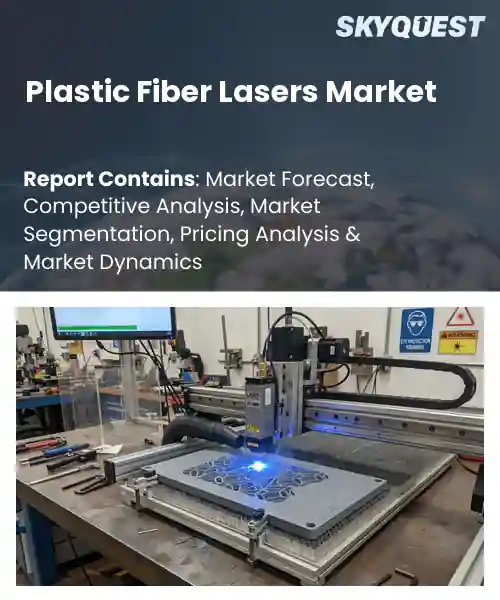
Plastic Fiber Lasers Market
Report ID: SQMIG45J3019
Report ID: SQMIG45J3019
[email protected]
USA +1 351-333-4748
Report ID:
SQMIG45J3019 |
Region:
Global |
Published Date: November, 2026
Pages:
157
|Tables:
119
|Figures:
77


Global Plastic Fiber Lasers Market size was valued at USD 450.0 Million in 2024 and is poised to grow from USD 491.4 Million in 2025 to USD 993.62 Million by 2033, growing at a CAGR of 9.2% during the forecast period (2026-2033).
The global plastic fiber lasers market refers to the segment of photonics that supplies diode‑pumped solid‑state lasers coupled to polymer‑based optical fibers for precision cutting, welding and medical procedures. Its importance stems from the ability of polymer fibers to transmit high‑power beams while remaining lightweight, flexible and cost‑effective compared with glass‑based counterparts. The market emerged in the early 2010s when manufacturers such as IPG Photonics introduced polymer‑clad fibers for industrial marking, and has accelerated as additive‑manufacturing and micro‑electronics demand finer, faster material processing. Today, revenues exceed hundred million dollars, driven by expanding applications in automotive lightweighting and minimally invasive surgery. Beyond the initial adoption, the principal growth engine for the global plastic fiber lasers market is the convergence of Industry 4.0 automation with demand for localized material removal. As factories embed sensors and robotic arms, manufacturers seek laser sources that can be mounted on platforms without compromising beam quality. Plastic fiber delivery satisfies this need, enabling on‑line micro‑drilling of battery electrodes, real‑time welding of composite panels in aerospace assembly, and laser ablation for dermatology. Each application reduces cycle time, lowers waste, improves product reliability, and drives investment in polymer fibers engineered for thermal resistance and longer lifespans, expanding the market further.
How is AI-driven automation impacting the growth of the plastic fiber lasers market?
AI-driven automation is reshaping the plastic fiber lasers market by streamlining design, production, and quality control. Machine‑learning algorithms optimize laser parameters in real time, reducing waste and shortening setup cycles. Integrated vision systems inspect fiber coatings and detect defects faster than manual checks, boosting yield. Smart scheduling tools coordinate multiple production lines, allowing manufacturers to respond quickly to fluctuating demand. These technologies also enable predictive maintenance, preventing downtime and extending equipment life. Together, they create a more agile supply chain and lower operational costs, making plastic fiber lasers more attractive for applications such as medical device manufacturing and automotive component fabrication. The result is a market that is expanding as manufacturers adopt AI to improve efficiency and product consistency.In July 2024, Raydiance announced an AI‑enhanced fiber laser system that automatically adjusts pulse energy for varying plastic thicknesses, accelerating processing speed and reducing material waste, thereby reinforcing market growth.
Market snapshot - (2026-2033)
Global Market Size
USD 450.0 Million
Largest Segment
Plastic Optical Fiber Lasers
Fastest Growth
Polymer Fiber Lasers
Growth Rate
9.2% CAGR
To get more insights on this market click here to Request a Free Sample Report
Global plastic fiber lasers market is segmented by laser type, operating mode, application, end-use industry and region. Based on laser type, the market is segmented into Plastic Optical Fiber Lasers, Polymer Fiber Lasers and Other Plastic-Based Fiber Laser Systems. Based on operating mode, the market is segmented into Continuous-Wave Lasers and Pulsed Lasers. Based on application, the market is segmented into Material Processing, Medical & Biomedical Applications, Sensing & Measurement, Telecommunications and Research & Development. Based on end-use industry, the market is segmented into Industrial Manufacturing, Healthcare, Telecommunications and Research & Scientific Institutions. Based on region, the market is segmented into North America, Europe, Asia Pacific, Latin America and Middle East & Africa.
Plastic optical fiber lasers segment dominates because they combine the flexibility of polymer waveguides with the high beam quality traditionally associated with glass fibers, enabling seamless integration into existing manufacturing lines. Their material compatibility reduces coupling losses and simplifies thermal management, which makes them the preferred choice for high volume industrial users. This technical edge fuels broad adoption across diverse processing tasks, cementing their leadership in the plastic fiber lasers market.
However, polymer fiber lasers segment is witnessing the strongest growth momentum as advances in dopant chemistry and extrusion techniques are unlocking higher power outputs while retaining polymer’s lightweight advantage. These innovations broaden the range of viable applications, attracting new entrants and accelerating overall market expansion in the near term for stakeholders.
Continuous wave lasers segment leads because they provide a stable, uninterrupted beam that is essential for precision cutting and welding where consistent energy delivery minimizes thermal distortion. Their simplicity eliminates the need for complex pulse shaping electronics, reducing system cost and maintenance overhead. This reliability aligns with manufacturers’ demand for repeatable quality, fostering widespread deployment across the plastic fiber lasers market and reinforcing the segment’s leadership position in a broad array of industrial contexts.
Meanwhile, pulsed lasers segment is emerging as the key high growth area as their ability to deliver ultra short bursts enables micro structuring and biomedical procedures that continuous beams cannot achieve. Growing interest in minimally invasive therapies and high precision additive manufacturing drives rapid adoption, opening new revenue streams and propelling market expansion for the industry.
To get detailed segments analysis, Request a Free Sample Report
Asia Pacific leverages a combination of deep manufacturing expertise, robust research ecosystems, and extensive supply chain networks that together create a fertile environment for plastic fiber laser technologies. The region’s industrial sectors prioritize high‑precision machining and lightweight component production, driving demand for flexible laser solutions. Government initiatives encourage advanced photonics development and support collaborative projects between academia and industry. A skilled workforce coupled with cost‑effective production capabilities enables rapid scaling of innovative laser systems. Moreover, the strategic positioning of key manufacturers near major automotive and electronics hubs facilitates swift adoption and customization, reinforcing the region’s leadership in the global market.
Plastic Fiber Lasers Market in Japan benefits from a heritage of precision engineering and a strong focus on automation across automotive and consumer electronics. The country’s commitment to high‑quality manufacturing drives continuous refinement of laser processes for intricate plastic components. Close collaboration between equipment producers and downstream users ensures that solutions are tailored to stringent performance criteria, while government support for advanced manufacturing bolsters investment in next‑generation laser capabilities.
Plastic Fiber Lasers Market in South Korea is propelled by intensive activity in semiconductor, display, and high‑tech manufacturing sectors that demand reliable, high‑speed laser processing. A culture of rapid technology adoption and significant private‑sector R&D spending fuels innovative applications of fiber lasers for plastic parts. Strong export orientation encourages manufacturers to develop versatile laser systems that meet diverse international standards, reinforcing the country’s competitive edge in the global arena.
Europe’s expansion is anchored by a commitment to sustainability, stringent quality standards, and a tradition of engineering excellence that together stimulate demand for efficient plastic processing solutions. The automotive and aerospace sectors prioritize lightweight, high‑performance components, fostering adoption of fiber laser technologies that enhance precision while reducing waste. Collaborative research networks across leading nations accelerate innovation, while regulatory frameworks promote energy‑efficient manufacturing practices. The region’s mature industrial base, coupled with a growing focus on medical and defense applications, creates a diverse set of opportunities that collectively accelerate market growth.
Plastic Fiber Lasers Market in Germany thrives on a reputation for meticulous engineering and a powerful automotive supply chain that values exacting tolerances. German manufacturers emphasize reliability and performance, driving the integration of advanced laser systems into high‑volume plastic component production. Strong partnerships between technology providers and industrial firms enable continuous improvement of laser capabilities, while local research institutions contribute cutting‑edge developments that sustain the country’s dominant position.
Plastic Fiber Lasers Market in the United Kingdom is characterized by swift uptake in medical device fabrication, aerospace, and defense sectors where innovation and agility are paramount. A vibrant start‑up ecosystem and substantial investment in photonics research accelerate the deployment of flexible laser solutions for complex plastic geometries. Collaborative initiatives between universities and industry foster rapid prototyping and customizable manufacturing, positioning the United Kingdom as a fast‑growing hub for laser‑enabled plastic processing.
Plastic Fiber Lasers Market in France is emerging through focused efforts in aerospace, renewable energy, and high‑precision instrumentation. French manufacturers value the adaptability of fiber lasers for intricate plastic parts, supporting the transition to lighter, more efficient designs. National research programs and industry consortia promote technology transfer, facilitating the adoption of advanced laser platforms that align with France’s strategic objectives for sustainable and high‑tech manufacturing.
North America reinforces its role through a combination of aggressive R&D investment, strong integration of laser technology into advanced manufacturing, and a culture of customization that caters to diverse industrial needs. The region’s emphasis on aerospace, defense, and high‑tech automotive applications creates demand for precise, high‑power fiber lasers capable of handling complex plastic components. Collaborative partnerships between equipment manufacturers and leading end users accelerate the development of tailored solutions, while supportive policy environments encourage innovation and workforce development. This dynamic ecosystem sustains a progressive trajectory that enhances North America’s influence in the global market.
Plastic Fiber Lasers Market in the United States benefits from extensive research infrastructures and a vibrant ecosystem of technology firms that drive continuous advancement in laser performance. High‑tech industries such as aerospace, defense, and medical device manufacturing prioritize adaptable laser systems for intricate plastic parts, fostering a culture of rapid adoption and iterative improvement. Strategic collaborations between universities, startups, and established manufacturers accelerate the translation of emerging photonics research into commercial solutions.
Plastic Fiber Lasers Market in Canada is shaped by strong academic‑industry linkages that nurture specialized applications in aerospace, medical, and precision engineering sectors. Canadian firms leverage collaborative research environments to develop customized laser equipment that meets exacting performance criteria. Emphasis on sustainable manufacturing practices and government support for innovative technologies further reinforces the country’s growing presence in the North American plastic fiber laser landscape.
To know more about the market opportunities by region and country, click here to
Buy The Complete Report
Rising Adoption In Manufacturing
Advances In Beam Quality
High Capital Expenditure
Stringent Environmental Regulations
Request Free Customization of this report to help us to meet your business objectives.
The competitive landscape is shaped by intense rivalry among established laser manufacturers and emerging fiber‑laser specialists, driving rapid technology upgrades and strategic collaborations. Recent M&A activity, such as the acquisition of a niche fiber‑laser developer by a major optics group, and partnerships linking laser producers with polymer processing firms, underscore the focus on expanding application portfolios and enhancing beam quality for plastic processing. Companies are also investing in next‑generation diode‑pumped fiber lasers to improve efficiency and reduce operating costs, directly influencing market dynamics.
Top Player’s Company Profile
Recent Developments
SkyQuest’s ABIRAW (Advanced Business Intelligence, Research & Analysis Wing) is our Business Information Services team that Collects, Collates, Correlates, and Analyses the Data collected by means of Primary Exploratory Research backed by robust Secondary Desk research. As per SkyQuest analysis, the market is being propelled primarily by the rising adoption of plastic fiber lasers in manufacturing, where their precision and lightweight delivery enable faster, automated production. A second driver is the recent advance in beam quality and stability that broadens application possibilities across aerospace, automotive and medical sectors. However, high capital expenditure for laser systems remains a significant restraint, especially for SMEs. Asia Pacific dominates the market, benefitting from strong manufacturing bases, supportive policies and deep research ecosystems. Within the product mix, plastic optical fiber lasers hold the largest share because their flexible polymer waveguides and superior beam characteristics fit high‑volume industrial use.
| Report Metric | Details |
|---|---|
| Market size value in 2024 | USD 450.0 Million |
| Market size value in 2033 | USD 993.62 Million |
| Growth Rate | 9.2% |
| Base year | 2024 |
| Forecast period | (2026-2033) |
| Forecast Unit (Value) | USD Million |
| Segments covered |
|
| Regions covered | North America (US, Canada), Europe (Germany, France, United Kingdom, Italy, Spain, Rest of Europe), Asia Pacific (China, India, Japan, Rest of Asia-Pacific), Latin America (Brazil, Rest of Latin America), Middle East & Africa (South Africa, GCC Countries, Rest of MEA) |
| Companies covered |
|
| Customization scope | Free report customization with purchase. Customization includes:-
|
To get a free trial access to our platform which is a one stop solution for all your data requirements for quicker decision making. This platform allows you to compare markets, competitors who are prominent in the market, and mega trends that are influencing the dynamics in the market. Also, get access to detailed SkyQuest exclusive matrix.
Table Of Content
Executive Summary
Market overview
Parent Market Analysis
Market overview
Market size
KEY MARKET INSIGHTS
COVID IMPACT
MARKET DYNAMICS & OUTLOOK
Market Size by Region
KEY COMPANY PROFILES
Methodology
For the Plastic Fiber Lasers Market, our research methodology involved a mixture of primary and secondary data sources. Key steps involved in the research process are listed below:
1. Information Procurement: This stage involved the procurement of Market data or related information via primary and secondary sources. The various secondary sources used included various company websites, annual reports, trade databases, and paid databases such as Hoover's, Bloomberg Business, Factiva, and Avention. Our team did 45 primary interactions Globally which included several stakeholders such as manufacturers, customers, key opinion leaders, etc. Overall, information procurement was one of the most extensive stages in our research process.
2. Information Analysis: This step involved triangulation of data through bottom-up and top-down approaches to estimate and validate the total size and future estimate of the Plastic Fiber Lasers Market.
3. Report Formulation: The final step entailed the placement of data points in appropriate Market spaces in an attempt to deduce viable conclusions.
4. Validation & Publishing: Validation is the most important step in the process. Validation & re-validation via an intricately designed process helped us finalize data points to be used for final calculations. The final Market estimates and forecasts were then aligned and sent to our panel of industry experts for validation of data. Once the validation was done the report was sent to our Quality Assurance team to ensure adherence to style guides, consistency & design.
Analyst Support
Customization Options
With the given market data, our dedicated team of analysts can offer you the following customization options are available for the Plastic Fiber Lasers Market:
Product Analysis: Product matrix, which offers a detailed comparison of the product portfolio of companies.
Regional Analysis: Further analysis of the Plastic Fiber Lasers Market for additional countries.
Competitive Analysis: Detailed analysis and profiling of additional Market players & comparative analysis of competitive products.
Go to Market Strategy: Find the high-growth channels to invest your marketing efforts and increase your customer base.
Innovation Mapping: Identify racial solutions and innovation, connected to deep ecosystems of innovators, start-ups, academics, and strategic partners.
Category Intelligence: Customized intelligence that is relevant to their supply Markets will enable them to make smarter sourcing decisions and improve their category management.
Public Company Transcript Analysis: To improve the investment performance by generating new alpha and making better-informed decisions.
Social Media Listening: To analyze the conversations and trends happening not just around your brand, but around your industry as a whole, and use those insights to make better Marketing decisions.
REQUEST FOR SAMPLE
 REQUEST FREE CUSTOMIZATION


Want to customize this report? This report can be personalized according to your needs. Our analysts and industry experts will work directly with you to understand your requirements and provide you with customized data in a short amount of time. We offer $1000 worth of FREE customization at the time of purchase.
Feedback From Our Clients


 USA (+1) 351-333-4748

