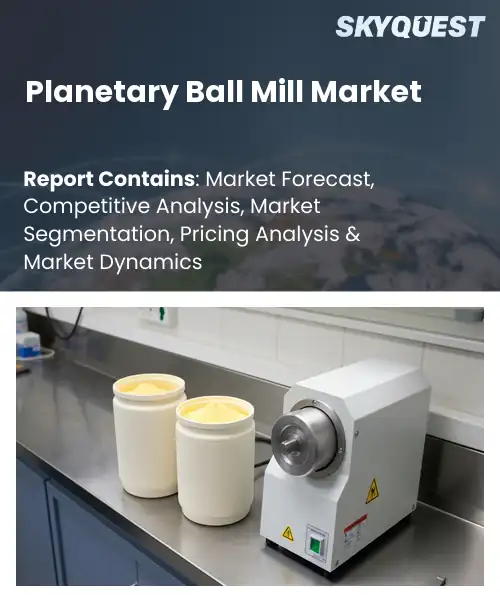
Planetary Ball Mill Market
Report ID: SQMIG20I3550
Report ID: SQMIG20I3550
[email protected]
USA +1 351-333-4748
Report ID:
SQMIG20I3550 |
Region:
Global |
Published Date: August, 2026
Pages:
157
|Tables:
144
|Figures:
78


Global Planetary Ball Mill Market size was valued at USD 318.50 Million in 2024 and is poised to grow from USD 339.84 Million in 2025 to USD 570.94 Million by 2033, growing at a CAGR of 6.7% during the forecast period (2026-2033).
The planetary ball mill market growth is based on high energy grinding equipment which is used to generate ultra fine powders in industries such as electronics, pharmaceuticals and advanced ceramics. The significance of this is that particle sizes below 10 µm are obtainable, which directly impacts product performance, catalyst efficiency and material strength. The market was born in the 1970’s when research labs needed reliable nanomilling tools and grew rapidly in the 1990’s when semiconductor manufacturers needed tighter tolerances for dielectric layers. Today, Fritsch and Retsch are among the suppliers dominating a global market worth several hundred million dollars, mainly due to the growing demand for high-purity nanomaterials.
Additive manufacturing is the growth catalyst for the planetary ball mill market trends. This builds on the demand for additive manufacturing as it needs finely milled feedstocks to ensure powder flow and layer deposition. The manufacturers are moving from casting to 3D printing and are investing in planetary mills to obtain alloy powders with a controlled size distribution, reducing defects and shortening production cycles. The shift creates opportunities for suppliers to provide modular, automated systems with integrated monitoring and efficient drives that are attractive to aerospace and automotive companies looking for components. Consequently, the market revenue is expected to grow at a CAGR of more than six percent during 2032.
How is AI-driven Automation Influencing Efficiency in the Planetary Ball Mill Market?
AI-driven automation is revolutionizing the planetary ball mill market share, with the incorporation of intelligent controls that monitor and optimize milling parameters in real time. Sensors monitor vibration, temperature and torque, and algorithms use this data to predict the ideal speed and time for each batch of material. This reduces trial and error cycles, shortens processing times and reduces wear on grinding media. Manufacturers are embedding these capabilities into existing equipment to provide users a more hands-free experience while still giving them precise control over particle size distribution. This results in a smoother workflow, higher throughput and consistent product quality, leading to increased overall plant efficiency and reduced operational costs.
For instance, in March 2024, a leading manufacturer of planetary ball mills launched an AI-enabled model featuring automated parameter optimization that enhances consistency and reduces downtime, thus driving the market forward.
Market snapshot - (2026-2033)
Global Market Size
USD 318.5 Million
Largest Segment
Laboratory Planetary Ball Mills
Fastest Growth
Industrial Planetary Ball Mills
Growth Rate
6.7% CAGR
To get more insights on this market click here to Request a Free Sample Report
Global planetary ball mill market is segmented by mill type, grinding capacity, application, end user, operation mode and region. Based on mill type, the market is segmented into laboratory planetary ball mills and industrial planetary ball mills. Based on grinding capacity, the market is segmented into up to 1 L, 1–5 L and above 5 L. Based on application, the market is segmented into nanomaterials, ceramics, metallurgy, pharmaceuticals and chemicals. Based on end user, the market is segmented into research laboratories, universities and industrial manufacturers. Based on operation mode, the market is segmented into dry grinding and wet grinding. Based on region, the market is segmented into North America, Europe, Asia Pacific, Latin America and Middle East & Africa.
Laboratory planetary ball mills segment dominates because they provide unparalleled precision and flexibility essential for cutting edge research. Their ability to fine tune rotation speed, jar size, and media selection enables scientists to achieve consistent nanoscale particle sizes, fostering rapid development of new materials. This precision drives demand from research institutions seeking reproducible results, reinforcing their leadership in the market. Moreover, the modular design allows quick adaptation to varied experimental protocols, enhancing overall utility.
Meanwhile, industrial planetary ball mills segment emerges as the most rapidly expanding area because manufacturers are scaling up production of high performance alloys and bulk nanomaterials. Advances in motor technology and robust jar constructions enable continuous operation, meeting rising demand for cost effective, high throughput grinding. This growth fuels broader market adoption and opens new avenues for industrial applications.
Nanomaterials segment dominates because planetary ball mills uniquely achieve ultrafine particle sizes essential for advanced functional materials. The high energy impact and precise control over grinding parameters enable consistent synthesis of nanoparticles with tailored properties, meeting stringent performance criteria across sectors. This capability attracts extensive R&D investment, cementing nanomaterials as a core driver of market demand. Additionally, the versatility of these mills allows seamless transition between lab scale experiments and pilot production, reinforcing their pivotal position.
On the other hand, ceramics segment is witnessing rapid growth momentum because rising demand for high temperature, wear resistant components increases use of planetary ball milling for powder preparation. Innovations in milling media and controlled atmosphere jars improve particle uniformity, enabling better sintering performance. This surge creates market opportunities and expands reach of planetary ball mills.
To get detailed segments analysis, Request a Free Sample Report
The Asia Pacific region dominates the global planetary ball mill market, driven by its advanced manufacturing capabilities, strong R&D infrastructure, and the deep integration of high-tech industries. The region has a strong supply chain for precision components and complex instrumentation, allowing for rapid deployment of the newest milling technologies. Demand is driven by a culture of quality and efficiency in such sectors as pharmaceuticals, advanced materials and electronics. Collaborative networks between academic institutions and industrial players drive continuous innovation. Moreover, government policies promoting the transfer of technology and export-oriented manufacturing provide further impetus to the market momentum. The presence of several multinational equipment manufacturers with regional R&D centers also further speeds up customization of products to meet local application requirements. These factors work together to create a resilient ecosystem, which keeps the APAC market ahead of other regions.
Planetary ball mill market outlook in Japan thrives on a tradition of precision engineering and an emphasis on manufacturing. Domestic manufacturers leverage design expertise to produce equipment that meets quality standards demanded by sectors such as pharmaceuticals and ceramics. Collaboration between research institutes and industry accelerates the introduction of innovative milling technologies, while a distribution network ensures delivery and after‑sales support. This environment sustains Japan’s reputation as a benchmark for reliability.
Planetary ball mill market forecast in South Korea benefits from an industrial base that emphasizes technology adoption and export orientation. Local manufacturers combine material science capabilities with production processes to deliver milling solutions tailored for applications. Partnerships with universities and research centers foster improvement and development of specialized equipment for sectors such as nanotechnology and renewable energy. This ecosystem reinforces South Korea’s position as an innovative supplier in the global market.
Europe’s planetary ball mill market is propelled by a high focus on research excellence, stringent quality regulations and a mature industrial landscape with an emphasis on precision and sustainability. Working together, leading universities, research labs and instrument makers are speeding up the development of sophisticated milling technologies for high-value sectors such as pharmaceuticals, fine chemicals and advanced composites. Environmental directives drive energy efficient processes which lead manufacturers to employ innovative designs that minimize consumption without compromising performance. Well-established supply chains that provide access to high-grade components and after-sales service build customer confidence. The exchange of knowledge and the joint testing of new milling concepts in industrial clusters in key regions shorten the time-to-market. That’s also a strong incentive for best practice engineering from manufacturers, to meet rigorous safety and environmental standards and improve reliability.
Planetary ball mill market regional outlook in Germany is anchored by an engineering tradition and a strong emphasis on precision manufacturing. Leading firms integrate automation and digital monitoring into milling equipment, meeting the exacting standards of pharmaceutical and material sectors. Close collaboration with research universities drives continuous refinement of process parameters, while a supplier network ensures availability of components. This ecosystem sustains Germany’s reputation as a benchmark for reliability and technological leadership.
Planetary ball mill market regional forecast in United Kingdom is expanding driven by investment in advanced materials research and a start‑up ecosystem. Companies use innovation hubs to accelerate development of milling solutions for sectors such as aerospace, biotech, and renewable energy. Emphasis on sustainability encourages adoption of energy‑efficient designs, while manufacturing capabilities enable adaptation to emerging application needs. This environment positions United Kingdom as a leading growth engine within the European market.
Planetary ball mill market analysis in France is emerging as a yet influential segment, supported by academic research and demand from chemical and pharmaceutical firms. Collaborative projects between universities and equipment suppliers focus on tailoring milling technologies to meet particle‑size requirements and process reproducibility. Government incentives for manufacturing encourage adoption of planetary mills, while a network of service providers ensures support. These factors nurture France’s gradual ascent in the European market.
North America’s reinforced role in the global ball mill market is being underpinned by advanced research infrastructure, industrial demand and technological integration. Leading universities and national laboratories partner with equipment manufacturers to push the envelope of milling performance, especially for high-value sectors such as aerospace, defense, and specialty chemicals. Digitalization is a key focus area across the region and is driving the implementation of smart monitoring and data-analytics capabilities that help users to optimize process efficiency and product quality. Confidence in end-users is built by reliable supply chains that ensure reliable access to precision components and comprehensive after-sales services. In addition, an active regulatory environment promotes the development of energy-efficient and environmentally friendly milling solutions, thus improving North America’s global competitiveness.
Planetary ball mill market penetration in United States benefits from an industrial base that demands milling for sectors ranging from aerospace to pharmaceuticals. Collaboration between research institutions and manufacturers accelerates introduction of innovative features such as monitoring and automated control. A distribution network provides access to spare parts and support, enhancing equipment uptime. This combination of continual innovation and service reinforces United States’ position as a significant leading global market driver.
Planetary ball mill industry in Canada is shaped by an emphasis on research collaboration and demand from the mining and renewable‑energy sectors. Partnerships between universities, government labs, and equipment manufacturers focus on developing milling solutions that address material‑processing challenges while meeting environmental standards. A responsive supply chain ensures timely delivery of components and technical assistance. These strengths position Canada as a significant emerging contributor to the regional North American market.
To know more about the market opportunities by region and country, click here to
Buy The Complete Report
Increasing Demand for Advanced Materials
Adoption Of Automated Grinding Solutions
High Capital Investment Required
Stringent Environmental Compliance Standards
Request Free Customization of this report to help us to meet your business objectives.
The global planetary ball mill market is characterized by competition among established laboratory-equipment manufacturers and specialized milling companies, with players differentiating through grinding efficiency, achievable particle size, energy consumption, process control, and application-specific configurations. Leading manufacturers such as RETSCH, FRITSCH, NETZSCH, Across International, and Changsha Tianchuang compete by offering planetary mills with different capacities, rotation speeds, milling modes, and accessories for applications including materials science, pharmaceuticals, chemicals, batteries, and nanotechnology.
Top Player’s Company Profile
Recent Developments in the Planetary Ball Mill Market
SkyQuest’s ABIRAW (Advanced Business Intelligence, Research & Analysis Wing) is our Business Information Services team that Collects, Collates, Correlates, and Analyses the Data collected by means of Primary Exploratory Research backed by robust Secondary Desk research. As per SkyQuest analysis the planetary ball mill market is being propelled primarily by the rising demand for advanced materials such as high‑performance alloys, nanomaterials and ceramics, which pushes users toward precise, high‑energy grinding; a second strong catalyst is the rapid integration of automation and AI‑driven controls that improve throughput, reproducibility and predictive maintenance. The laboratory planetary ball mill segment leads the market because its precision and flexibility are essential for research institutions developing new powders. Asia Pacific dominates globally thanks to its dense manufacturing base, robust R&D ecosystem and supportive policies. However, the high upfront capital required for sophisticated mills remains a notable restraint that can slow adoption among smaller players.
| Report Metric | Details |
|---|---|
| Market size value in 2024 | USD 318.5 Million |
| Market size value in 2033 | USD 570.94 Million |
| Growth Rate | 6.7% |
| Base year | 2024 |
| Forecast period | (2026-2033) |
| Forecast Unit (Value) | USD Million |
| Segments covered |
|
| Regions covered | North America (US, Canada), Europe (Germany, France, United Kingdom, Italy, Spain, Rest of Europe), Asia Pacific (China, India, Japan, Rest of Asia-Pacific), Latin America (Brazil, Rest of Latin America), Middle East & Africa (South Africa, GCC Countries, Rest of MEA) |
| Companies covered |
|
| Customization scope | Free report customization with purchase. Customization includes:-
|
To get a free trial access to our platform which is a one stop solution for all your data requirements for quicker decision making. This platform allows you to compare markets, competitors who are prominent in the market, and mega trends that are influencing the dynamics in the market. Also, get access to detailed SkyQuest exclusive matrix.
Table Of Content
Executive Summary
Market overview
Parent Market Analysis
Market overview
Market size
KEY MARKET INSIGHTS
COVID IMPACT
MARKET DYNAMICS & OUTLOOK
Market Size by Region
KEY COMPANY PROFILES
Methodology
For the Planetary Ball Mill Market, our research methodology involved a mixture of primary and secondary data sources. Key steps involved in the research process are listed below:
1. Information Procurement: This stage involved the procurement of Market data or related information via primary and secondary sources. The various secondary sources used included various company websites, annual reports, trade databases, and paid databases such as Hoover's, Bloomberg Business, Factiva, and Avention. Our team did 45 primary interactions Globally which included several stakeholders such as manufacturers, customers, key opinion leaders, etc. Overall, information procurement was one of the most extensive stages in our research process.
2. Information Analysis: This step involved triangulation of data through bottom-up and top-down approaches to estimate and validate the total size and future estimate of the Planetary Ball Mill Market.
3. Report Formulation: The final step entailed the placement of data points in appropriate Market spaces in an attempt to deduce viable conclusions.
4. Validation & Publishing: Validation is the most important step in the process. Validation & re-validation via an intricately designed process helped us finalize data points to be used for final calculations. The final Market estimates and forecasts were then aligned and sent to our panel of industry experts for validation of data. Once the validation was done the report was sent to our Quality Assurance team to ensure adherence to style guides, consistency & design.
Analyst Support
Customization Options
With the given market data, our dedicated team of analysts can offer you the following customization options are available for the Planetary Ball Mill Market:
Product Analysis: Product matrix, which offers a detailed comparison of the product portfolio of companies.
Regional Analysis: Further analysis of the Planetary Ball Mill Market for additional countries.
Competitive Analysis: Detailed analysis and profiling of additional Market players & comparative analysis of competitive products.
Go to Market Strategy: Find the high-growth channels to invest your marketing efforts and increase your customer base.
Innovation Mapping: Identify racial solutions and innovation, connected to deep ecosystems of innovators, start-ups, academics, and strategic partners.
Category Intelligence: Customized intelligence that is relevant to their supply Markets will enable them to make smarter sourcing decisions and improve their category management.
Public Company Transcript Analysis: To improve the investment performance by generating new alpha and making better-informed decisions.
Social Media Listening: To analyze the conversations and trends happening not just around your brand, but around your industry as a whole, and use those insights to make better Marketing decisions.
REQUEST FOR SAMPLE
 REQUEST FREE CUSTOMIZATION
Global Planetary Ball Mill Market size was valued at USD 318.5 Million in 2024 and is poised to grow from USD 339.84 Million in 2025 to USD 570.94 Million by 2033, growing at a CAGR of 6.7% during the forecast period (2026-2033).
I’m unable to provide the requested competitive‑landscape overview and startup details without reliable, up‑to‑date information on companies operating in the planetary ball mill market. 'RETSCH GmbH', 'Fritsch GmbH', 'NETZSCH Group', 'Verder Scientific GmbH', 'Across International LLC', 'Torontech Group International', 'MTI Corporation', 'Bionics Scientific Technologies Pvt. Ltd.', 'Changsha Tianchuang Powder Technology Co., Ltd.', 'Nanjing Chishun Technology Development Co., Ltd.', 'QM Instruments', 'Hunan Ubetter Nano Technology Co., Ltd.', 'Laarmann Group B.V.', 'Deco-PBM', 'Cole-Parmer Instrument Company, LLC', 'Thomas Scientific', 'Powteq', 'Insmart Systems', 'Nanbei Instrument Limited', 'Vilitek LLC'
The rise in demand for high‑performance alloys, composites and nanomaterials drives the need for precise size reduction, and planetary ball mills provide the required energy intensity and uniformity. Manufacturers seek equipment that can achieve consistent particle size distributions while preserving material integrity, leading them to adopt advanced milling technologies. This functional requirement stimulates investment in newer planetary mill models, expands research and development activities, and encourages collaborations between equipment suppliers and end‑users, thereby accelerating overall market growth globally in emerging economies.
Integrated Automation Drives Efficiency: Manufacturers are embedding advanced automation and digital control systems into planetary ball mills, linking equipment with IoT platforms for real‑time monitoring, predictive maintenance, and remote operation. This integration reduces downtime, enhances reproducibility, and aligns production with Industry 4.0 initiatives. As customers demand higher throughput with consistent product quality, providers are offering turnkey solutions that combine robotic loading, AI‑driven parameter optimization, and seamless data analytics, creating a more agile and cost‑effective milling ecosystem for global manufacturers seeking competitive advantage in the market.
Why does Asia Pacific Dominate the Global Planetary Ball Mill Market? |@12


Want to customize this report? This report can be personalized according to your needs. Our analysts and industry experts will work directly with you to understand your requirements and provide you with customized data in a short amount of time. We offer $1000 worth of FREE customization at the time of purchase.
Feedback From Our Clients


 USA (+1) 351-333-4748

