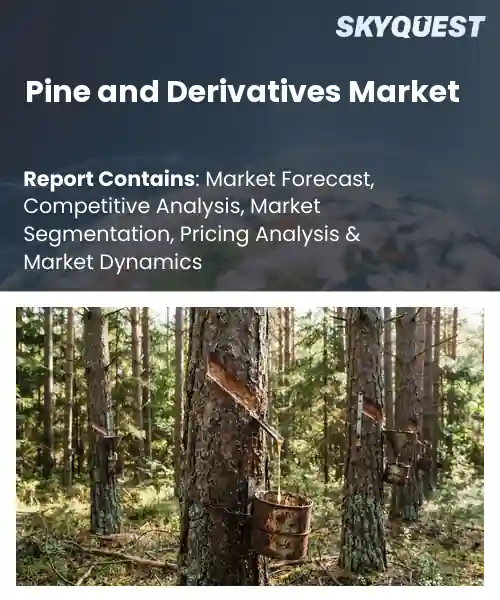
Pine and Derivatives Market
Report ID: SQMIG15P2067
Report ID: SQMIG15P2067
[email protected]
USA +1 351-333-4748
Report ID:
SQMIG15P2067 |
Region:
Global |
Published Date: September, 2026
Pages:
157
|Tables:
128
|Figures:
77


Global Pine And Derivatives Market size was valued at USD 45.0 Billion in 2024 and is poised to grow from USD 47.61 Billion in 2025 to USD 74.75 Billion by 2033, growing at a CAGR of 5.8% during the forecast period (2026-2033).
The global pine market encompasses the cultivation, harvesting, and processing of Pinus species for timber, resin, and pulp, while its derivatives segment includes engineered wood products, bio‑based chemicals, and instruments linked to pine price indices. Demand for sustainable construction materials and renewable bio‑energy has positioned pine as a strategic commodity, driving investment in plantation forestry across North America, Scandinavia, and China. Historically, the sector evolved from small‑scale logging to integrated supply chains that leverage certification schemes such as FSC, which have boosted consumer confidence and opened export channels. Consequently, price stability and volume growth have become performance metrics for investors. One pivotal factor shaping the global pine and derivatives market is the rising adoption of carbon‑offset programs, which translate forest sequestration into tradable credits and stimulate demand for pine‑based products that qualify for certification. As corporations seek to meet ESG targets, they purchase certified timber and bio‑derived polymers, creating a feedback loop where higher prices incentivize reforestation and the development of processing technologies. For example, a European furniture manufacturer switched to FSC‑certified pine panels, reducing its carbon footprint by 15 % and unlocking access to retail contracts. This dynamic expands market depth, attracts capital, and accelerates innovation across the supply chain.
How is AI influencing pricing and risk management in the pine derivatives market?
AI is reshaping how participants price and hedge pine derivatives by ingesting weather patterns, forest growth models, and market sentiment in real time. Machine learning algorithms generate forward curves that reflect subtle shifts in supply from seasonal harvests and demand from construction trends. Traders can test scenario outcomes instantly, reducing reliance on manual spreadsheets. Risk managers use anomaly detection to flag unexpected price moves that may stem from pest outbreaks or logistics bottlenecks. The result is tighter spreads, faster order execution and more confidence in contract valuation. As data sources expand, the ecosystem becomes increasingly predictive and responsive.West Fraser August 2023, introduced an AI driven pricing engine that blends satellite imagery with market data to update pine lumber futures values every hour. The tool cuts latency in risk assessments and enables traders to lock in prices with greater certainty, driving efficiency across the market.
Market snapshot - (2026-2033)
Global Market Size
USD 45.0 Billion
Largest Segment
Rosin
Fastest Growth
Pine Wood Extracts
Growth Rate
5.8% CAGR
To get more insights on this market click here to Request a Free Sample Report
Global pine and derivatives market is segmented by product type, form, application, end user and region. Based on product type, the market is segmented into Pine Oil, Pine Resin, Rosin, Turpentine, Tall Oil, Pine Wood Extracts and Others. Based on form, the market is segmented into Liquid, Solid and Powder. Based on application, the market is segmented into Adhesives and Sealants, Paints and Coatings, Fragrances and Flavors, Pharmaceuticals, Personal Care, Chemicals and Others. Based on end user, the market is segmented into Chemical Industry, Construction, Cosmetics and Personal Care, Pharmaceutical, Food and Beverage and Others. Based on region, the market is segmented into North America, Europe, Asia Pacific, Latin America and Middle East & Africa.
Pine resin segment dominates because it offers a versatile raw material that can be chemically modified into rosin, adhesives, and specialty chemicals, making it indispensable across multiple downstream industries. Its natural abundance and renewable profile provide a stable supply chain, while its functional properties such as tackiness and film forming ability meet critical performance criteria. These attributes reinforce its central role and sustain strong demand in the pine and derivatives market.
Meanwhile, turpentine segment is witnessing the strongest growth momentum as manufacturers adopt it for bio based solvents and renewable feedstock in polymer production. Environmental regulations encourage replacing petro derived solvents, and innovation in green chemistry amplifies turpentine’s appeal. This surge is unlocking applications and expanding market opportunities for pine derivatives.
Paints and coatings application segment dominates because it relies heavily on pine rosin and turpentine to provide resinous binders, drying agents, and aesthetic qualities that meet stringent performance standards. The sector’s long standing dependence on these natural polymers ensures consistent procurement, while the push for low VOC formulations reinforces the preference for pine based additives. Consequently, this application sustains the largest consumption share within the pine and derivatives market global.
On the other hand, pharmaceuticals application segment is emerging as the high growth area as pine extracts are incorporated into drug delivery systems and anti inflammatory formulations. Consumer preference for plant derived actives and incentives boost interest. Momentum is expanding investment and creating revenue streams, propelling market expansion for pine derivatives.
To get detailed segments analysis, Request a Free Sample Report
North America’s leadership stems from a confluence of abundant forest resources, sophisticated processing infrastructure, and a culture of innovation that permeates the entire value chain. Extensive plantation programs ensure a reliable supply of high‑quality pine, while integrated mills and bio‑refining facilities convert raw material into a broad spectrum of derivatives, from structural timber to specialty chemicals. Strong collaboration between research institutions and industry accelerates technology adoption, and a supportive regulatory environment encourages sustainable harvesting and low‑carbon product development. Consumer demand for eco‑friendly construction and renewable materials further reinforces market depth, while export capabilities extend North American expertise to global markets, cementing its dominant position.
United States Pine and Derivatives Market
Pine and Derivatives Market in United States benefits from extensive plantation acreage, sophisticated milling facilities, and a mature logistics network that links forest regions to manufacturing hubs. Innovation clusters around bio‑based product development drive value‑added applications, while strong collaboration between research institutions and industry accelerates technology transfer. Consumer demand for sustainable building materials and renewable chemicals reinforces the market’s depth and resilience across multiple sectors and geographic regions in the.
Canada Pine and Derivatives Market
Pine and Derivatives Market in Canada leverages vast boreal forest coverage, low‑density timber supply, and a strong emphasis on sustainable forest stewardship. Integrated processing facilities convert raw material into high‑quality pulp, engineered wood, and bio‑based chemicals, while government incentives encourage low‑impact harvesting practices. Growing awareness of carbon‑neutral construction and renewable energy solutions fuels demand, and cross‑border trade with neighboring markets enhances commercial viability for domestic and export opportunities across sectors.
Europe’s pine and derivatives market is expanding swiftly due to a confluence of regulatory ambition, consumer preference for low‑impact materials, and deep industrial expertise. Stringent environmental directives encourage the substitution of virgin timber with certified pine products, while advanced engineering capabilities enable the creation of high‑performance composites and bio‑based chemicals. Collaborative research networks across the continent accelerate innovation, and well‑established logistics corridors facilitate efficient distribution to construction, packaging, and energy sectors. The region’s commitment to circular economy principles further fuels demand for recyclable and renewable pine derivatives, positioning Europe as a hub of sustainable value creation. Public‑private partnerships channel funding into pilot projects that test novel conversion pathways, while trade agreements streamline cross‑border movement of certified pine goods. Educational programs nurture a skilled workforce capable of handling sophisticated processing technologies, reinforcing the market’s capacity for continuous growth.
Germany Pine and Derivatives Market
Pine and Derivatives Market in Germany stands as a cornerstone of the nation’s renewable material strategy, supported by extensive forest management practices and a robust engineering sector. High‑precision milling and advanced chemical conversion facilities produce a wide array of value‑added products, from structural timber to bio‑based polymers. Strong collaboration between research institutes and manufacturers accelerates product innovation, while domestic demand for sustainable construction fuels market depth and resilience globally today.
United Kingdom Pine and Derivatives Market
Pine and Derivatives Market in United Kingdom is experiencing rapid acceleration driven by ambitious climate targets and a vibrant design community that embraces timber innovation. Advanced processing hubs convert raw pine into engineered wood systems and bio‑based adhesives, supporting a shift toward low‑carbon construction. Government incentives encourage the adoption of certified forest products, while academic‑industry consortia develop next‑generation applications for packaging and renewable energy, expanding market reach in the sector.
France Pine and Derivatives Market
Pine and Derivatives Market in France is emerging as a niche yet promising segment, buoyed by strong cultural appreciation for timber craftsmanship and increasing policy focus on circularity. Specialized mills transform pine into high‑quality veneers and bio‑based resins, catering to luxury interiors and sustainable automotive components. Collaborative projects between regional universities and start‑ups explore innovative conversion pathways, while consumer awareness of carbon‑footprint reduction drives gradual market adoption for future growth.
Asia Pacific is solidifying its role in the pine and derivatives landscape through a blend of resource abundance, strategic policy frameworks, and accelerating technological adoption. Nations across the region are channeling public and private capital into modern milling facilities and bio‑refining plants, enabling the production of high‑value timber components and renewable chemicals. Trade initiatives reduce barriers, fostering cross‑border supply chains that link forest‑rich areas with industrial hubs. Growing consumer consciousness around sustainability drives demand for certified pine products in construction, furniture, and packaging. Collaborative research programs between universities and industry accelerate the development of innovative conversion processes, while government incentives promote low‑impact harvesting and carbon‑neutral manufacturing, positioning the region as a competitive source of renewable material solutions. Export strategies also focus on meeting emerging market needs in neighboring economies.
Japan Pine and Derivatives Market
Pine and Derivatives Market in Japan leverages a long tradition of timber craftsmanship combined with bio‑refining technologies. Integrated processing complexes convert pine into engineered wood and specialty bio‑based polymers for automotive and electronics sectors. Strong governmental support for sustainable forestry ensures a supply of certified material, while consumer preference for products drives demand across construction and interior design. Collaborative research between universities and corporations accelerates innovation in low‑emission conversion pathways.
South Korea Pine and Derivatives Market
Pine and Derivatives Market in South Korea is characterized by rapid adoption of advanced bio‑processing and a strong focus on high‑value applications. State‑of‑the‑art facilities transform pine into lightweight composite panels and specialty chemicals used in electronics, renewable energy, and high‑performance coatings. Government incentives promote sustainable forest management and encourage investment in green technology. Growing domestic demand for low‑carbon building materials, coupled with export ambitions, fuels continued market expansion through partnerships.
To know more about the market opportunities by region and country, click here to
Buy The Complete Report
Rising Preference For Eco‑Friendly Products
Advancements In Processing Technology
Limited Availability Of High‑Quality Timber
Regulatory Pressures On Forestry Practices
Request Free Customization of this report to help us to meet your business objectives.
The pine and derivatives market is shaped by intense rivalry as major resin processors pursue strategic M&A to consolidate supply chains, while niche manufacturers form joint ventures to expand geographic reach. Recent tech innovation drives competition, with firms adopting advanced extraction methods and bio‑based formulation platforms to differentiate product lines and meet sustainability mandates, intensifying pressure on pricing and market share.
Top Player’s Company Profile
Recent Developments
SkyQuest’s ABIRAW (Advanced Business Intelligence, Research & Analysis Wing) is our Business Information Services team that Collects, Collates, Correlates, and Analyses the Data collected by means of Primary Exploratory Research backed by robust Secondary Desk research. As per SkyQuest analysis the global pine and derivatives market is set to expand at a 5.8 % CAGR through 2033, driven primarily by the rising preference for eco‑friendly products that push manufacturers toward renewable pine timber and its derivatives, while advancements in processing technology serve as a second catalyst by improving efficiency and product quality. Limited availability of high‑quality timber acts as a restraint, curbing supply for premium segments. North America remains the dominating region thanks to abundant forests and integrated milling infrastructure, and the pine resin product type continues to dominate the market owing to its versatile use across adhesives, coatings and specialty chemicals.
| Report Metric | Details |
|---|---|
| Market size value in 2024 | USD 45.0 Billion |
| Market size value in 2033 | USD 74.75 Billion |
| Growth Rate | 5.8% |
| Base year | 2024 |
| Forecast period | (2026-2033) |
| Forecast Unit (Value) | USD Billion |
| Segments covered |
|
| Regions covered | North America (US, Canada), Europe (Germany, France, United Kingdom, Italy, Spain, Rest of Europe), Asia Pacific (China, India, Japan, Rest of Asia-Pacific), Latin America (Brazil, Rest of Latin America), Middle East & Africa (South Africa, GCC Countries, Rest of MEA) |
| Companies covered |
|
| Customization scope | Free report customization with purchase. Customization includes:-
|
To get a free trial access to our platform which is a one stop solution for all your data requirements for quicker decision making. This platform allows you to compare markets, competitors who are prominent in the market, and mega trends that are influencing the dynamics in the market. Also, get access to detailed SkyQuest exclusive matrix.
Table Of Content
Executive Summary
Market overview
Parent Market Analysis
Market overview
Market size
KEY MARKET INSIGHTS
COVID IMPACT
MARKET DYNAMICS & OUTLOOK
Market Size by Region
KEY COMPANY PROFILES
Methodology
For the Pine and Derivatives Market, our research methodology involved a mixture of primary and secondary data sources. Key steps involved in the research process are listed below:
1. Information Procurement: This stage involved the procurement of Market data or related information via primary and secondary sources. The various secondary sources used included various company websites, annual reports, trade databases, and paid databases such as Hoover's, Bloomberg Business, Factiva, and Avention. Our team did 45 primary interactions Globally which included several stakeholders such as manufacturers, customers, key opinion leaders, etc. Overall, information procurement was one of the most extensive stages in our research process.
2. Information Analysis: This step involved triangulation of data through bottom-up and top-down approaches to estimate and validate the total size and future estimate of the Pine and Derivatives Market.
3. Report Formulation: The final step entailed the placement of data points in appropriate Market spaces in an attempt to deduce viable conclusions.
4. Validation & Publishing: Validation is the most important step in the process. Validation & re-validation via an intricately designed process helped us finalize data points to be used for final calculations. The final Market estimates and forecasts were then aligned and sent to our panel of industry experts for validation of data. Once the validation was done the report was sent to our Quality Assurance team to ensure adherence to style guides, consistency & design.
Analyst Support
Customization Options
With the given market data, our dedicated team of analysts can offer you the following customization options are available for the Pine and Derivatives Market:
Product Analysis: Product matrix, which offers a detailed comparison of the product portfolio of companies.
Regional Analysis: Further analysis of the Pine and Derivatives Market for additional countries.
Competitive Analysis: Detailed analysis and profiling of additional Market players & comparative analysis of competitive products.
Go to Market Strategy: Find the high-growth channels to invest your marketing efforts and increase your customer base.
Innovation Mapping: Identify racial solutions and innovation, connected to deep ecosystems of innovators, start-ups, academics, and strategic partners.
Category Intelligence: Customized intelligence that is relevant to their supply Markets will enable them to make smarter sourcing decisions and improve their category management.
Public Company Transcript Analysis: To improve the investment performance by generating new alpha and making better-informed decisions.
Social Media Listening: To analyze the conversations and trends happening not just around your brand, but around your industry as a whole, and use those insights to make better Marketing decisions.
REQUEST FOR SAMPLE
 REQUEST FREE CUSTOMIZATION


Want to customize this report? This report can be personalized according to your needs. Our analysts and industry experts will work directly with you to understand your requirements and provide you with customized data in a short amount of time. We offer $1000 worth of FREE customization at the time of purchase.
Feedback From Our Clients


 USA (+1) 351-333-4748

