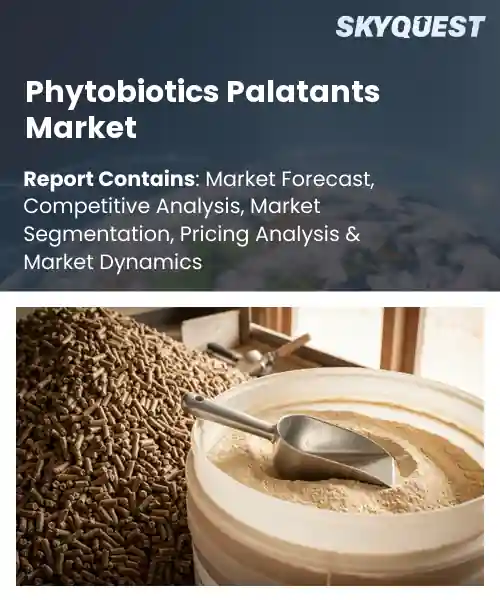
Phytobiotics Palatants Market
Report ID: SQMIG30I2894
Report ID: SQMIG30I2894
[email protected]
USA +1 351-333-4748
Report ID:
SQMIG30I2894 |
Region:
Global |
Published Date: March, 2026
Pages:
157
|Tables:
119
|Figures:
77


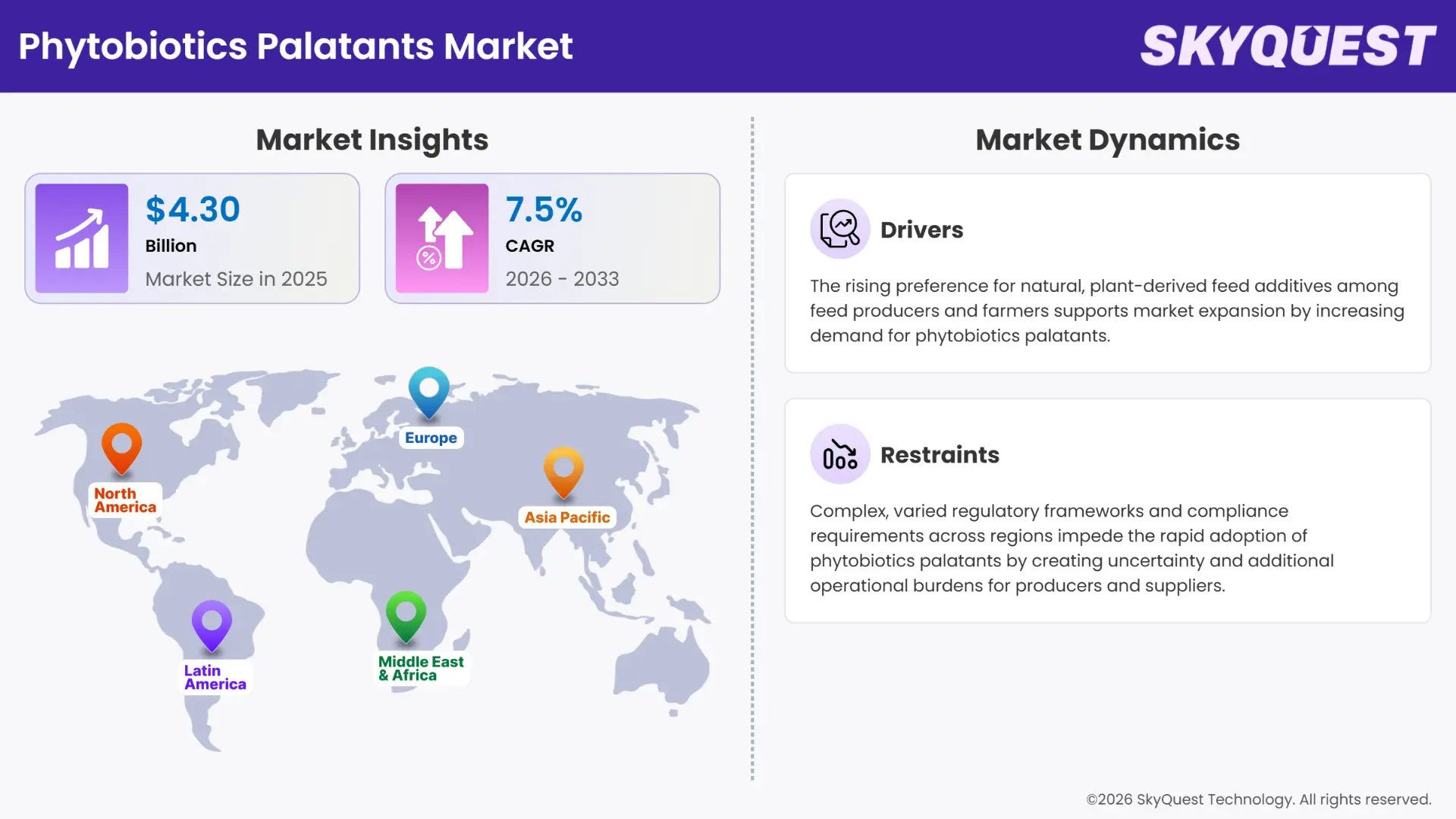
Global Phytobiotics Palatants Market size was valued at USD 4.00 Billion in 2024 and is poised to grow from USD 4.30 Billion in 2025 to USD 7.67 Billion by 2033, growing at a CAGR of 7.5% during the forecast period (2026-2033).
Key Takeaways: Market Trends & Insights
The improved animal health and consumer demand for natural ingredients as the primary driver of the global phytobiotics palatants market growth, a sector producing plant-derived flavor and appetite stimulants for livestock and aquaculture feed. The market matters because palatability increases feed intake, improves growth rates and reduces variability in production cycles, which translates into economic gains for farmers and formulators. This can be seen in the adoption of rosemary, thyme, and citrus derivatives as substitutes for synthetic enhancers, impacting how procurement is done, how much regulatory oversight there is in each country, and how companies can market their products across borders.
Building on these shifts, regulatory tightening on antibiotic growth promoters is a key factor accelerating adoption of phytobiotics palatants because producers require safe, natural alternatives that support gut health and maintain feed conversion ratios under antibiotic restrictions. In piglet weaning studies, feed manufacturers incorporate standardized botanical palatants plus probiotics/proteins, which have improved the overall consistency of intake. Additionally, they have reduced the incidence of refusal of feed on trout farms. Furthermore, both the performance improvements due to these integrated approaches as well as the reduced need for veterinary intervention are measurable. Consequently, market opportunities emerge for firms offering validated efficacy data, scalable extraction processes and regional supply chains to meet traceability and sustainability demands and cost reductions.
How is AI Improving Flavor Optimization in the Phytobiotics Palatants Market?
AI is reshaping flavor optimization in phytobiotics palatants by linking chemical profiles sensory data and feeding behavior into predictive models. Machine learning helps map which botanical compounds drive acceptance for different species and life stages. The current state shows faster formulation cycles and fewer physical trials as companies blend instrumental analytics with expert tasting and in field feedback. Market demand for natural clean label palatants and species specific solutions makes this capability valuable. Examples of industry adoption include flavor houses using algorithmic design and research using generative models to predict ingredient interactions.
In January 2026, Phytobiotics highlighted enhanced pet food palatability with a new PetArom product which aligns with AI driven flavor optimization by enabling quicker targeted trials and more efficient reformulation to boost acceptance and support market growth.
To get more insights on this market click here to Request a Free Sample Report
Global phytobiotics palatants market is segmented by product source/base, functional benefit, target livestock, form of application and region. Based on product source/base, the market is segmented into essential oils, herbs & spices, saponins & tannins and flavonoids & glucosinolates. Based on functional benefit, the market is segmented into appetite stimulation, gut health & antimicrobial, immune system support and antioxidant properties. Based on target livestock, the market is segmented into poultry, swine, ruminants and aquaculture. Based on form of application, the market is segmented into dry/powdered additives and liquid/spray-on palatants. Based on region, the market is segmented into North America, Europe, Asia Pacific, Latin America, and Middle East & Africa.
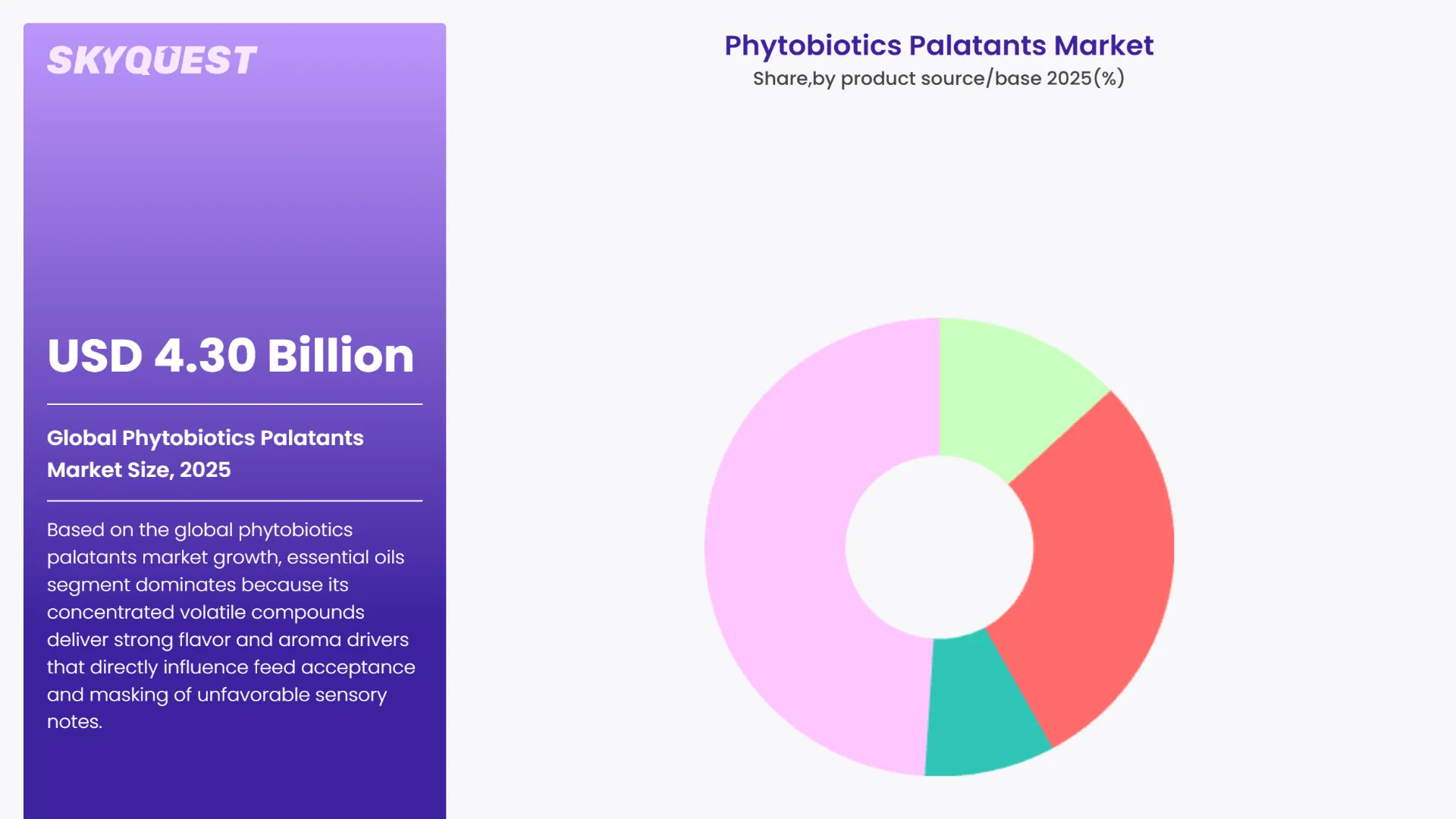
Based on the global phytobiotics palatants market growth, essential oils segment dominates because its concentrated volatile compounds deliver strong flavor and aroma drivers that directly influence feed acceptance and masking of unfavorable sensory notes. The widespread use of flavours is increasing due to their ability to enhance feed palatability across all types of feed matrices, their long history as effective flavouring agents, advances made in the development and stability of raw material ingredients used in flavour manufacturing, and previously experienced use of essential oils within many aspects of the feed industry.
However, herbs & spices are emerging as the most rapidly expanding area due to consumer demand for whole-plant flavor profiles and versatile culinary notes that enable tailored palatant recipes. As more and more suppliers are using palatant in their products, standardizing the extraction process and using microencapsulation are driving faster rates of product adoption while at the same time, new formulations will continue to be created through an increased variety of palatant applications across many types of feed.
Gut health & antimicrobial segment dominates because palatants that deliver bioactive compounds influence both feed intake and intestinal microenvironment, addressing a core performance constraint for livestock. The function of providing flavour as well as maintaining beneficial microbial balance is what makes these palatants a key ingredient for formulators who want to provide multifunctional options. The increasing number of studies showing synergy with other nutritional strategies and feed additives confirms that there will be an increased preference for using palatants as a base component of performance-oriented feeds.
Meanwhile, appetite stimulation is the fastest growing area as precision flavor science and tailored palatant blends drive targeted intake responses in young and high performing animals. Advances in flavor masking and delivery technologies, together with demand for rapid intake recovery, are expanding applications and creating new commercial opportunities for palatant developers.
To get detailed segments analysis, Request a Free Sample Report
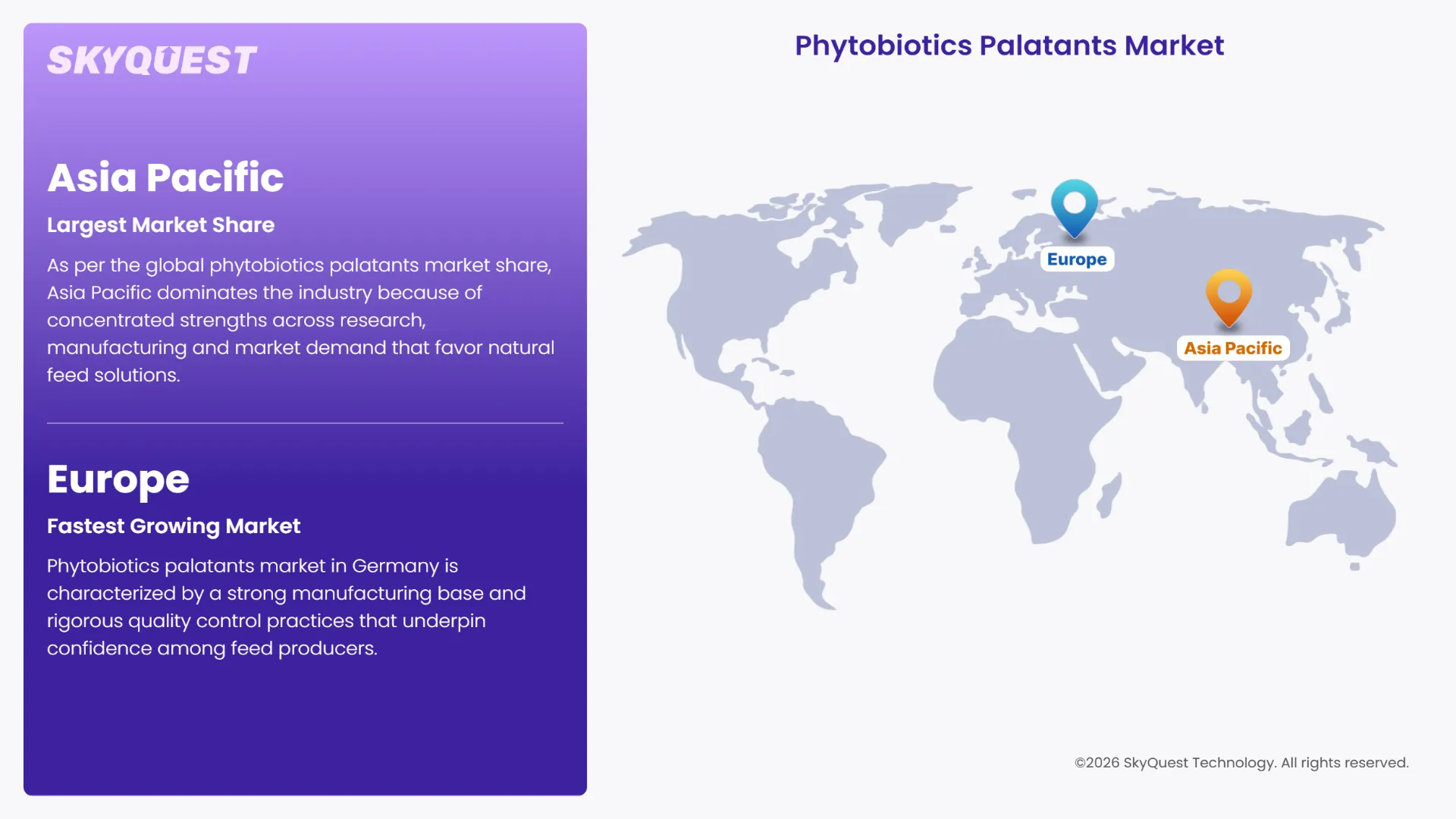
As per the global phytobiotics palatants market share, Asia Pacific dominates the industry because of concentrated strengths across research, manufacturing and market demand that favor natural feed solutions. Palatability and flavour innovations continue to be developed as a result of large and diverse animal production systems. At the same time, producers and manufacturers are looking for botanically derived structurally or functionally alternative products (i.e. other than traditional substances). Countries such as Japan and Korea have strong research capabilities and technical competencies, which help create product refinements and regulatory compliant products. Ingredient suppliers, feed manufacturers and animal health advisors work very closely together to speed up practical application of new products in animals. Partnerships with academics & private industry provide for acceleration in translational research on novel botanical extracts into commercialised palatants.
Phytobiotics palatants market in Japan benefits from advanced research capabilities and deep expertise in flavor science, enabling tailored formulations for diverse animal species. Quick product development stems from strong connections between ingredient suppliers and feed producers, backed by research facilities. A regulatory framework has been established that provides clarity on natural palatant safety and efficacy across the entire supply chain, enabling commercial success through the industry's existing quality assurance system.
Phytobiotics palatants market in South Korea demonstrates strong commercialization capability driven by focused innovation and close industry collaboration. Using local ingredients and expertise in food production will produce an appropriate palatant (flavor enhancer) for livestock and companion animal needs. A collaborative effort exists between private sector companies and research facilities, to develop effective sensory profiles and stability of products/solutions and to create a greater awareness of the benefits associated with the use of naturally produced feeds by manufacturers.
Based on global phytobiotics palatants regional forecast, rapid expansion in Europe is driven by regulatory emphasis on natural and sustainable feed additives, heightened focus on animal welfare and strong demand for premium pet food formulations. Developed feed production systems and distribution networks provide all players in the marketplace the opportunity to utilize both economies of scale and innovative development efforts. The collaborative relationship among university-based, independent research facilities, and industry assists in rapidly converting botanical science into effective flavourings. Adoption of flavouring products is supported by strong product development nationally as well as a consumer preference for clean labels and transparency in sourcing. Commercialization of products across borders is enabled by harmonized standards in international trade, while also supporting emerging companies that provide unique sensory solutions tailored to a region’s production methods and species thereby strengthening the market as a whole and encouraging competitive activity.
Phytobiotics palatants market in Germany is characterized by a strong manufacturing base and rigorous quality control practices that underpin confidence among feed producers. Close collaboration between laboratories and research institutions supports evidence driven product development and validation. There is great demand for reliable natural palatants in a variety of production systems due in part because of the mature supply chain and established technical advisory services that support the integration of palatants into commercial feed products.
Phytobiotics palatants market in United Kingdom is marked by a vibrant innovation ecosystem with clusters of enterprises focusing on botanical extracts and sensory optimization. The academic sector is working with industry to test palatability additives for companion animals and livestock. Advanced feed formulations and specialty pet foods are facilitating use of palatants using consulting services and channel distribution to convert research into products that are commercially viable and locally viable to meet the needs of producers and consumers.
Phytobiotics palatants market in France has emerged as an expanding market due to strong research orientation and shifting consumer preferences toward natural ingredients. A vigorous network of research institutions, ingredient expertise, and culinary talent supports the production of distinct palatable products for the premium pet food and specialty livestock feed marketplace. Focused on provenance and traceability, along with creative, small-volume manufacturers and direct access to culinary ingredients help create product differentiation and greater regional success.
As per global phytobiotics palatants regional outlook, North America is strengthening its position through focused investment in applied research, strong private sector engagement and an established commercial ecosystem that bridges ingredient innovation with feed manufacturing. The expertise, expertise with a significant companion animal industry demand, as well as partnerships with ingredient developers and contract manufacturers enable U.S.-based companies to scale quickly. Canada adds a different layer of complementary resources by providing specialized research centres, access to plant-based raw material sources, as well as collaborative efforts and regional feeding solutions. Both countries are taking advantage of the advisory networks, technical services and distribution channels available to them to assist with adoption in the livestock and pet food marketplaces while an emphasis on evidentiary support of any claims made and strong quality control procedures to support credibility within both nations’ marketplaces and the movement of products across the border.
Phytobiotics palatants market trends in United States benefits from a sophisticated commercial landscape where ingredient innovation, contract manufacturing and sensory science converge to create scalable solutions. The companion animal category is witnessing an increase in demand that is resulting in greater investment into the development and effectiveness of palatant ingredients. At the same time, pet food manufacturers are also partnering with research laboratories and technical service providers to optimize palatant manufacturing processes.
Phytobiotics palatants market in Canada benefits from focused research institutions and close collaboration between ingredient suppliers and feed formulators to develop regionally adapted palatants. The use of ancestral botanical raw materials and a focus on sustainable sources create a distinct advantage for companies that develop products. Small producers who contribute to these initiatives along with demonstration projects and technical assistance will help facilitate the practical use of such materials by animal feed producers, including those producing specialty pet food.
To know more about the market opportunities by region and country, click here to
Buy The Complete Report
Increased Demand for Natural Ingredients
Preference For Animal Welfare Friendly Products
Regulatory Approval and Compliance Challenges
Limited Technical Knowledge and Adoption
Request Free Customization of this report to help us to meet your business objectives.
Competitive landscape in the global phytobiotics palatants market outlook is marked by consolidation and ingredient led differentiation, driven by demand for natural clean label palatability solutions and brand performance at product launch. Several of the most prominent food manufacturers acquire companies and expand their capacity within specific regions while several other food ingredient companies innovate with the introduction of enzymatic and yeast-based palatants such as Symrise's clean-label palatants or kemin's palatant innovation center. This has shifted the competitive nature of the food industry toward the development of formulation science and establishing partnerships in the supply chain.
SkyQuest’s ABIRAW (Advanced Business Intelligence, Research & Analysis Wing) is our Business Information Services team that Collects, Collates, Correlates, and Analyses the Data collected by means of Primary Exploratory Research backed by robust Secondary Desk research.
As per SkyQuest analysis, the global phytobiotics palatants industry is being driven primarily by improved animal health and rising consumer demand for natural ingredients, which boost adoption of botanical palatability enhancers. A second driver is regulatory tightening on antibiotic growth promoters that pushes feed formulators toward natural alternatives. A key limitation is the complexity and inconsistency of regulations for getting approved for market and product entry; this typically leads to delays in launching products. Asia Pacific region dominates this application area because they have good access to research and production resources and are close to sources for their raw materials. Additionally, the use of essential oils still remains the largest segment in this product category due to their effective flavours' contributions as well as the versatility in their use.
| Report Metric | Details |
|---|---|
| Market size value in 2024 | USD 4.00 Billion |
| Market size value in 2033 | USD 7.67 Billion |
| Growth Rate | 7.5% |
| Base year | 2024 |
| Forecast period | 2026-2033 |
| Forecast Unit (Value) | USD Billion |
| Segments covered |
|
| Regions covered | North America (US, Canada), Europe (Germany, France, United Kingdom, Italy, Spain, Rest of Europe), Asia Pacific (China, India, Japan, Rest of Asia-Pacific), Latin America (Brazil, Rest of Latin America), Middle East & Africa (South Africa, GCC Countries, Rest of MEA) |
| Companies covered |
|
| Customization scope | Free report customization with purchase. Customization includes:-
|
To get a free trial access to our platform which is a one stop solution for all your data requirements for quicker decision making. This platform allows you to compare markets, competitors who are prominent in the market, and mega trends that are influencing the dynamics in the market. Also, get access to detailed SkyQuest exclusive matrix.
Table Of Content
Executive Summary
Market overview
Parent Market Analysis
Market overview
Market size
KEY MARKET INSIGHTS
COVID IMPACT
MARKET DYNAMICS & OUTLOOK
Market Size by Region
KEY COMPANY PROFILES
Methodology
For the Phytobiotics Palatants Market, our research methodology involved a mixture of primary and secondary data sources. Key steps involved in the research process are listed below:
1. Information Procurement: This stage involved the procurement of Market data or related information via primary and secondary sources. The various secondary sources used included various company websites, annual reports, trade databases, and paid databases such as Hoover's, Bloomberg Business, Factiva, and Avention. Our team did 45 primary interactions Globally which included several stakeholders such as manufacturers, customers, key opinion leaders, etc. Overall, information procurement was one of the most extensive stages in our research process.
2. Information Analysis: This step involved triangulation of data through bottom-up and top-down approaches to estimate and validate the total size and future estimate of the Phytobiotics Palatants Market.
3. Report Formulation: The final step entailed the placement of data points in appropriate Market spaces in an attempt to deduce viable conclusions.
4. Validation & Publishing: Validation is the most important step in the process. Validation & re-validation via an intricately designed process helped us finalize data points to be used for final calculations. The final Market estimates and forecasts were then aligned and sent to our panel of industry experts for validation of data. Once the validation was done the report was sent to our Quality Assurance team to ensure adherence to style guides, consistency & design.
Analyst Support
Customization Options
With the given market data, our dedicated team of analysts can offer you the following customization options are available for the Phytobiotics Palatants Market:
Product Analysis: Product matrix, which offers a detailed comparison of the product portfolio of companies.
Regional Analysis: Further analysis of the Phytobiotics Palatants Market for additional countries.
Competitive Analysis: Detailed analysis and profiling of additional Market players & comparative analysis of competitive products.
Go to Market Strategy: Find the high-growth channels to invest your marketing efforts and increase your customer base.
Innovation Mapping: Identify racial solutions and innovation, connected to deep ecosystems of innovators, start-ups, academics, and strategic partners.
Category Intelligence: Customized intelligence that is relevant to their supply Markets will enable them to make smarter sourcing decisions and improve their category management.
Public Company Transcript Analysis: To improve the investment performance by generating new alpha and making better-informed decisions.
Social Media Listening: To analyze the conversations and trends happening not just around your brand, but around your industry as a whole, and use those insights to make better Marketing decisions.
REQUEST FOR SAMPLE
 REQUEST FREE CUSTOMIZATION
Global Phytobiotics Palatants Market size was valued at USD 4.0 Billion in 2024 and is poised to grow from USD 4.3 Billion in 2025 to USD 7.67 Billion by 2033, growing at a CAGR of 7.5% during the forecast period (2026-2033).
Competitive landscape in the global phytobiotics palatants market is marked by consolidation and ingredient led differentiation, driven by demand for natural clean label palatability solutions and brand performance at product launch. Major incumbents pursue acquisitions and regional capacity expansion while ingredient firms introduce enzymatic and yeast based palatants, examples include Symrise clean label palatants and Kemin's palatant innovation center shifting competition toward formulation science and supply chain partnerships. 'Delacon', 'BIOMIN', 'Phytobiotics Futterzusatzstoffe', 'Kerry Group', 'Symrise', 'Alltech', 'Kemin Industries', 'Pancosma', 'Indena S.p.A.', 'Nor-Feed', 'Silvateam S.p.A.', 'Lucta S.A.', 'Adisseo', 'Nutreco', 'Provimi', 'Dupont', 'Phytosynthese', 'Natural Remedies', 'Dostofarm', 'Vinayak Ingredients'
The rising preference for natural, plant-derived feed additives among feed producers and farmers supports market expansion by increasing demand for phytobiotics palatants. As stakeholders prioritize alternatives to synthetic compounds, phytobiotics are chosen for their perceived safety, consumer acceptance, and compatibility with animal welfare objectives. Their application enhances feed palatability and intake, which aligns with goals to optimize animal nutrition through natural means. The cumulative effect of shifting procurement policies, retailer requirements, and awareness among formulators drives broader adoption within feed formulations and product portfolios.
Sustainable Feed Ingredient Demand: Weighing consumer and OEM preferences, livestock and aquaculture producers increasingly prioritize ecofriendly, traceable palatants that align with circular feed strategies and supply chain transparency. Demand for botanically derived flavor and appetite stimulants is driven by sustainability commitments, encouraging ingredient producers to emphasize sustainable sourcing, regenerative practices, and lower environmental footprints. This shift fosters partnerships across feed formulators, farmers, and ingredient suppliers, accelerating product innovation while reinforcing market positioning focused on naturalness, ethical sourcing, longterm resilience without sacrificing palatability and trust.
Asia Pacific Dominate the Global Phytobiotics Palatants Market.
Phytobiotics palatants are plant-derived feed additives designed to improve feed palatability, stimulate appetite, support animal health, and enhance feed intake across livestock and aquaculture species.
The Essential Oils segment holds the largest market share due to its strong flavor-enhancing properties, effectiveness in improving feed acceptance, and widespread use across livestock feed formulations.
AI is helping manufacturers optimize flavor formulations by analyzing chemical profiles, sensory data, and feeding behavior, enabling faster product development and more effective species-specific palatant solutions.


Want to customize this report? This report can be personalized according to your needs. Our analysts and industry experts will work directly with you to understand your requirements and provide you with customized data in a short amount of time. We offer $1000 worth of FREE customization at the time of purchase.
Feedback From Our Clients


 USA (+1) 351-333-4748

