Photovoltaic Market
Report ID: SQMIG55E2089
Report ID: SQMIG55E2089
[email protected]
USA +1 351-333-4748
Report ID:
SQMIG55E2089 |
Region:
Global |
Published Date: July, 2025
Pages:
182
|Tables:
174
|Figures:
71


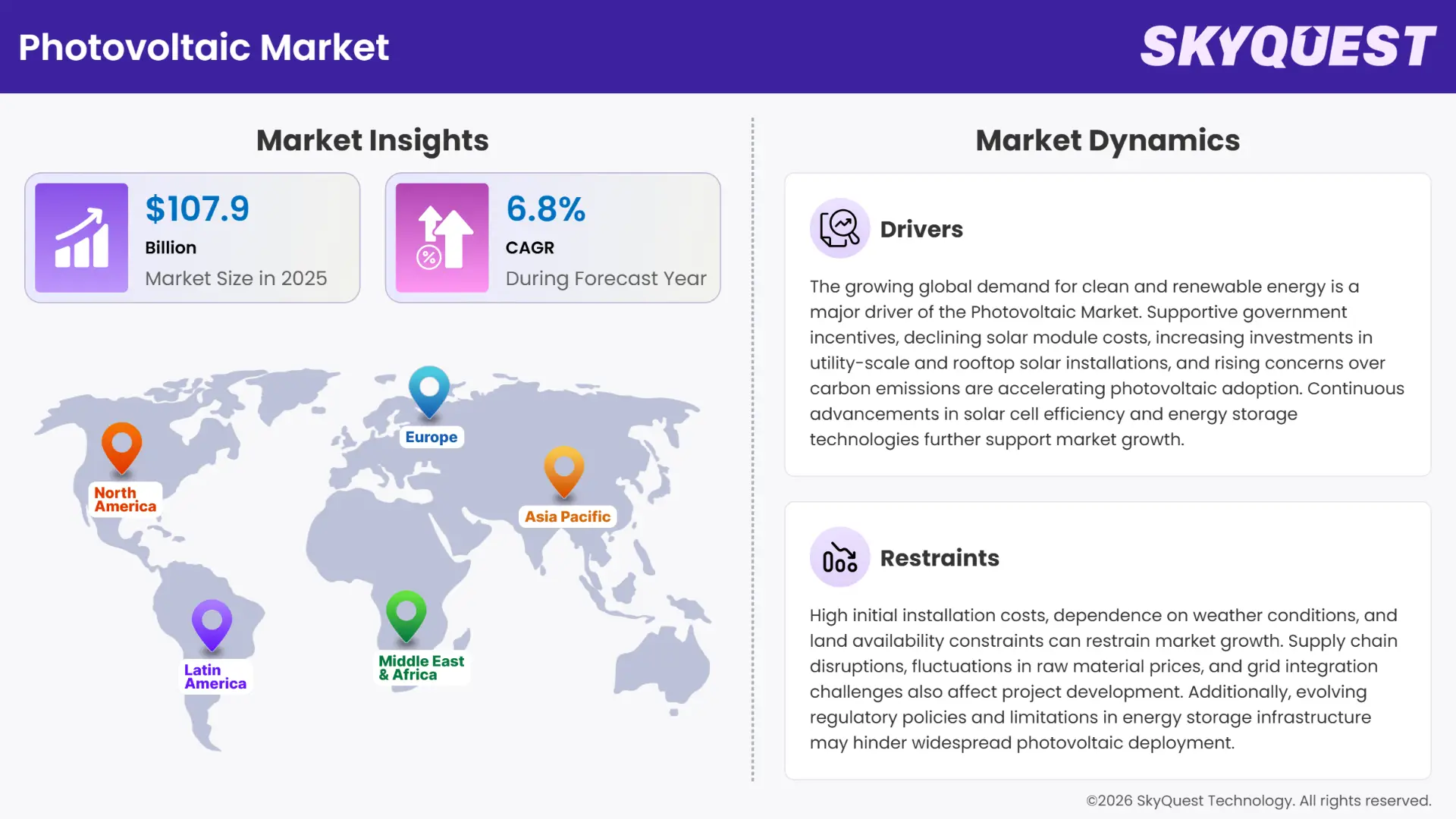
Global Photovoltaic Market size was valued at USD 101.03 Billion in 2024 and is poised to grow from USD 107.9 Billion in 2025 to USD 182.64 Billion by 2033, growing at a CAGR of 6.8% during the forecast period (2026–2033).
Key Takeaways: Market Trends & Insights
Surging demand for environmentally-responsible and practical renewable energy sources are driving robust growth in the global photovoltaic (PV) market. Heightened awareness around climate change, falling prices for solar modules, and supportive government initiatives will continue to accelerate solar adoption in the residential, commercial, and utility sector. Furthermore, improvements in the quality and efficiency of PV materials will positively contribute to growth in the solar market. Countries around the world are making substantial investments in solar infrastructure that will help integrate photovoltaic systems into their future energy mix.
With electricity demand rising alongside energy security concerns, the solar photovoltaic market continues to flourish as a result of supportive policies. Incentives such as government subsidies, tax incentives, and net metering policies are helping trigger action amongst investors to adopt solar power systems. State and federal governments are also taking actions to encourage widespread adoption of solar power systems for environmental benefits. Improvements in efficiency of photovoltaic panels, as well as energy storage, technology will allow for a positive boost in system performance. Furthermore, the global desire to reduce greenhouse gas emissions and achieve climate targets is catalyzing actions from governments and businesses to shift to solar energy, which bodes well for opportunities in the PV market.
The high factoring of installation costs that continues to arise in photovoltaic systems presents potentially detrimental deterrents for higher adoption rates, especially in developing countries. Photovoltaic systems also suffer from different technical challenges, such as limited grid infrastructure and intermittency; limit how widely solar energy can be deployed in a large scale. Additionally, fluctuating raw material prices and supply chain disruptions can affect panel production and pricing stability. In some countries, policy uncertainties and reduced financial incentives have slowed growth. Land availability for large solar farms can also become a constraint in densely populated areas.
How is Artificial Intelligence Reshaping the Landscape of Photovoltaic?
AI technology is opening new pathways for solar energy forecasting and allowing better grid integration. It determines short-term solar variability using historical patterns, current weather information, and live sensor (IoT) data to deliver operators with the best forecast with improved accuracy. This ability does not eliminate intermittency, but instead smooths output variability, allowing utility operators to better balance electricity supply and demand. Advanced machine learning algorithms can apply real-time sensor data to optimize inverter operation set points, panel angle, and panel dispatch decisions to improve project lifetime energy yield by possibly 15-20%, and reduce grid balance costs. These developments are allowing a smoother transition to large-scale integration of solar into existing electricity systems.
To get more insights on this market click here to Request a Free Sample Report
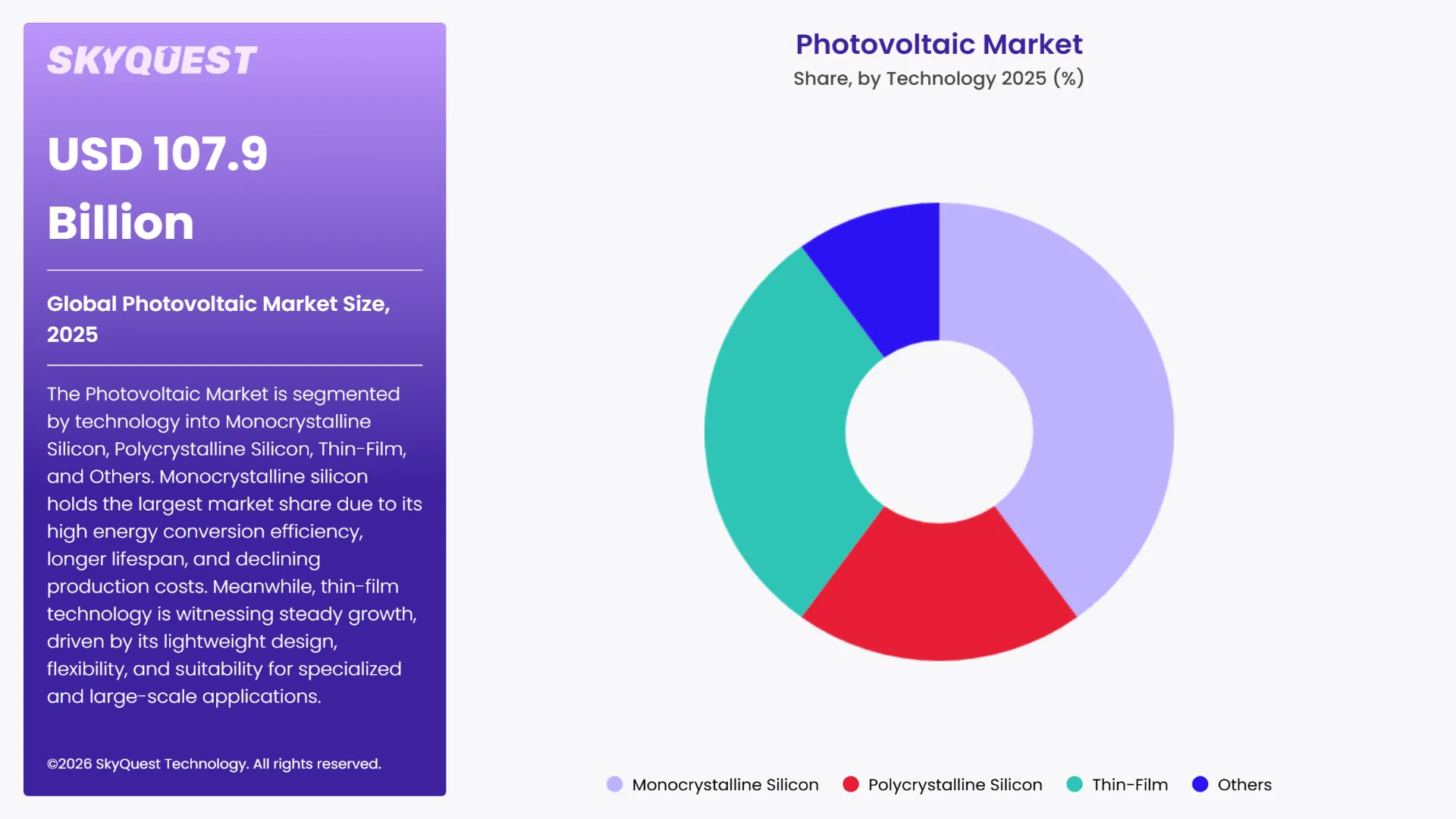
Global Photovoltaic Market is segmented by Technology, Grid Type, Deployment, Component, Application, End-User and region. Based on Technology, the market is segmented into Thin Film, Crystalline Silicon, Perovskite Solar Cells and Other Emerging Technologies. Based on Grid Type, the market is segmented into On-Grid / Grid-Connected and Off-Grid / Standalone. Based on Deployment, the market is segmented into Rooftop PV and Ground-Mounted PV. Based on Component, the market is segmented into Modules, Inverters, Balance of System (BoS) and Tracking Systems.
Based on Application, the market is segmented into Residential, Commercial & Industrial and Utility. Based on End-User, the market is segmented into Energy Producers, Government & Municipal Entities, Agriculture Sector, Telecom & Remote Infrastructure, Military & Defense and Others. Based on region, the market is segmented into North America, Europe, Asia Pacific, Latin America and Middle East & Africa.
Thin film photovoltaic (PV) technology uses ultrathin layers of semiconductor materials including cadmium telluride (CdTe), amorphous silicon (a-Si), or copper indium gallium selenide (CIGS) to turn sunlight into electricity. Their panels are light-weight, flexible and are cheaper to produce than silicon-based PV. Thin films are especially suitable for lightweight, or building integrated photovoltaics (BIPV). While thin films tend to be less efficient than crystalline silicon, they tend to perform better at lower-light levels or higher temperatures, making them ideal for utility scale in hot climate and lower direct sunlight.
Crystalline silicon (c-Si) technology dominates the global photovoltaic market due to its high efficiency and long-term reliability. It is categorized into monocrystalline and polycrystalline types. Monocrystalline panels are made from a single crystal structure, offering higher efficiency and better space utilization, whereas polycrystalline panels are made from multiple silicon crystals and are more cost-effective. Crystalline silicon panels are known for their durability, proven performance, and widespread availability. They are commonly used in residential, commercial, and large-scale solar power systems, maintaining strong market preference despite the emergence of alternative technologies.
To get detailed segments analysis, Request a Free Sample Report
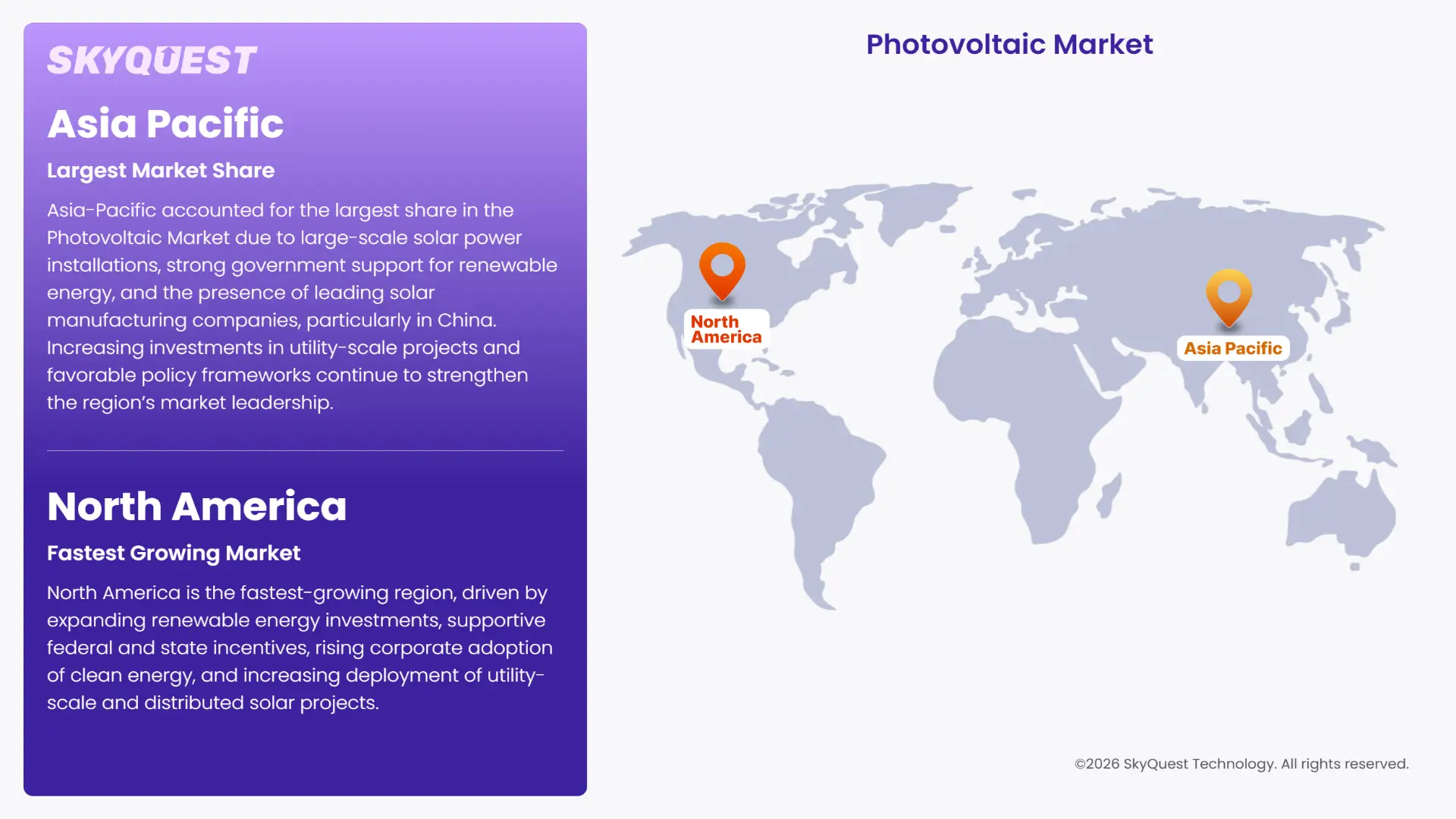
Asia Pacific leads global PV expansion, led by China’s massive centralized solar deployments. In 2023, Asia contributed about 58 % of new global PV additions, with China alone accounting for over 235 GW—nearly 60 % of the total. Government commitments under China’s Five‑Year Plan and aggressive oversupply corrections are supporting quality growth.
China Photovoltaic Market
China remains the world’s largest PV market with over 350 GW added in 2024 alone, largely via centralized installations in inland deserts. Government interventions to stabilize prices amid oversupply—urging producers to keep prices above manufacturing cost and phasing out outdated capacity—have boosted confidence, leading to a surge in solar stocks (JA Solar, Longi, Jinko) in mid‑2025, signaling healthier market dynamics.
India Photovoltaic Market
India has quickly developed into one of Asia’s fastest- growing PV markets, around 25–33 GW to add in 2024, over 95 GW cumulative capacity by year-end. The latest news confirms that India went beyond 100 GW of installed solar capacity after achieving approximately 297 GW of hybrid and round-the-clock renewable energy projects under implementation or tendering, further accelerating the transition to large utility and hybrid solar projects.
North America, driven by U.S. federal incentives and manufacturing investments, saw a 22 % annual growth in 2024 with the region reaching over 74 GW from the Americas. Policy support via the U.S. Inflation Reduction Act enabled new installations and domestic module factories (8.6 GW added in Q1 2025) in Texas, Ohio, Arizona, and South Carolina.
The United States Photovoltaic Market
The U.S. added 33 GW of solar in 2023 (57 % growth), reaching 177 GW cumulative PV capacity. In Q1 2025, U.S. solar module manufacturing expanded by 8.6 GW across multiple states, doubling cell production to 2 GW and reinforcing domestic supply chains despite looming policy uncertainty.
Canada Photovoltaic Market
Canada’s PV growth is more modest but accelerating with federal and provincial support mechanisms. While still smaller than the U.S., Canada is ramping up community solar and rooftop programs in provinces like Ontario and Alberta, driven by clean-transition targets. A recent round of funding launched in 2025 to support carbon‑neutral electricity plans includes multi‑million‑dollar bids for large community solar projects across provinces—a sign of accelerating PV planning and deployment.
Europe is expanding steadily, with installations projected at 75–88 GW in 2025 (5–22 % growth), representing about 15 % of global PV additions. Germany remains a leader within Europe.
Germany Photovoltaic Market
Germany added 14 GW of new PV capacity in 2023, representing around 32 % of Europe’s total, bringing its cumulative capacity to 82 GW. Recent VAT exemptions for residential installations and a new PV strategy targeting 10 GW have fuelled explosive demand for small‑scale PV in early 2025, with year‑on‑year growth rates over 70 % in some segments.
France Photovoltaic Market
France reached 20 GW of total PV capacity by end‑2023, adding 3.2 GW during that year. By early 2025, authorities set an accelerated roadmap to hit 65 GW by 2030 and up to 100 GW by 2035. Recent tender rounds secured 1.5 GW of ground‑mounted capacity and 378 MW of commercial/rooftop PV, alongside inflation‑indexed feed‑in‑tariffs now at €131/MWh—signalling stronger economic support for deployment.
Spain Photovoltaic Market
Spain remains one of Europe’s top PV contributors, reaching nearly 38 GW cumulative capacity by end‑2023. In 2024–2025, ramped‑up national auctions and grid integration reforms have sparked investments in both utility‑scale and self‑consumption solar projects. Recent policy moves include simplified permitting for rooftop and agrivoltaic installations, plus updated compensation rules for distributed generation—accelerating PV uptake across commercial and industrial sectors.
To know more about the market opportunities by region and country, click here to
Buy The Complete Report
Declining Cost of Solar Technology
Government Policies and Climate Goals
Intermittency and Grid Integration Challenges
Land and Infrastructure Limitations
Request Free Customization of this report to help us to meet your business objectives.
The photovoltaic market is highly competitive, with major players like LONGi Green Energy and First Solar focusing on vertical integration and high-efficiency modules. LONGi invested in next-gen n-type TOPCon cells, while First Solar is expanding cadmium telluride (CdTe) thin-film capacity in the U.S. to meet IRA-driven demand. Companies are also forming alliances—e.g., JinkoSolar partnered with Tongwei for upstream polysilicon security—to mitigate supply volatility and improve margins.
Shift Toward High-Efficiency PV Technologies
Integration of Storage with Solar Projects
SkyQuest’s ABIRAW (Advanced Business Intelligence, Research & Analysis Wing) is our Business Information Services team that Collects, Collates, Correlates, and Analyses the Data collected using Primary Exploratory Research backed by robust Secondary Desk research.
SkyQuest’s study suggests that the photovoltaic (PV) market is rapidly evolving, driven by the declining cost of solar technology, making clean energy more accessible and cost-effective across regions. However, the sector faces key restraints such as intermittency and high grid integration costs, which limit reliability without storage solutions. Asia Pacific dominates the market, led by China’s massive centralized deployments and policy-driven expansion. Utility-scale PV systems remain the leading segment due to their ability to generate power at competitive costs for large populations. A second major driver is strong government support—through subsidies, mandates, and tax incentives—especially in countries like India and the U.S., which is accelerating both solar deployment and domestic manufacturing under programs like the Inflation Reduction Act.
| Report Metric | Details |
|---|---|
| Market size value in 2024 | USD 101.03 Billion |
| Market size value in 2033 | USD 182.64 Billion |
| Growth Rate | 6.8% |
| Base year | 2024 |
| Forecast period | 2026–2033 |
| Forecast Unit (Value) | USD Billion |
| Segments covered |
|
| Regions covered | North America (US, Canada), Europe (Germany, France, United Kingdom, Italy, Spain, Rest of Europe), Asia Pacific (China, India, Japan, Rest of Asia-Pacific), Latin America (Brazil, Rest of Latin America), Middle East & Africa (South Africa, GCC Countries, Rest of MEA) |
| Companies covered |
|
| Customization scope | Free report customization with purchase. Customization includes:-
|
To get a free trial access to our platform which is a one stop solution for all your data requirements for quicker decision making. This platform allows you to compare markets, competitors who are prominent in the market, and mega trends that are influencing the dynamics in the market. Also, get access to detailed SkyQuest exclusive matrix.
Table Of Content
Executive Summary
Market overview
Parent Market Analysis
Market overview
Market size
KEY MARKET INSIGHTS
COVID IMPACT
MARKET DYNAMICS & OUTLOOK
Market Size by Region
KEY COMPANY PROFILES
Methodology
For the Photovoltaic Market, our research methodology involved a mixture of primary and secondary data sources. Key steps involved in the research process are listed below:
1. Information Procurement: This stage involved the procurement of Market data or related information via primary and secondary sources. The various secondary sources used included various company websites, annual reports, trade databases, and paid databases such as Hoover's, Bloomberg Business, Factiva, and Avention. Our team did 45 primary interactions Globally which included several stakeholders such as manufacturers, customers, key opinion leaders, etc. Overall, information procurement was one of the most extensive stages in our research process.
2. Information Analysis: This step involved triangulation of data through bottom-up and top-down approaches to estimate and validate the total size and future estimate of the Photovoltaic Market.
3. Report Formulation: The final step entailed the placement of data points in appropriate Market spaces in an attempt to deduce viable conclusions.
4. Validation & Publishing: Validation is the most important step in the process. Validation & re-validation via an intricately designed process helped us finalize data points to be used for final calculations. The final Market estimates and forecasts were then aligned and sent to our panel of industry experts for validation of data. Once the validation was done the report was sent to our Quality Assurance team to ensure adherence to style guides, consistency & design.
Analyst Support
Customization Options
With the given market data, our dedicated team of analysts can offer you the following customization options are available for the Photovoltaic Market:
Product Analysis: Product matrix, which offers a detailed comparison of the product portfolio of companies.
Regional Analysis: Further analysis of the Photovoltaic Market for additional countries.
Competitive Analysis: Detailed analysis and profiling of additional Market players & comparative analysis of competitive products.
Go to Market Strategy: Find the high-growth channels to invest your marketing efforts and increase your customer base.
Innovation Mapping: Identify racial solutions and innovation, connected to deep ecosystems of innovators, start-ups, academics, and strategic partners.
Category Intelligence: Customized intelligence that is relevant to their supply Markets will enable them to make smarter sourcing decisions and improve their category management.
Public Company Transcript Analysis: To improve the investment performance by generating new alpha and making better-informed decisions.
Social Media Listening: To analyze the conversations and trends happening not just around your brand, but around your industry as a whole, and use those insights to make better Marketing decisions.
REQUEST FOR SAMPLE
 REQUEST FREE CUSTOMIZATION
Global Photovoltaic Market size was valued at USD 101.03 Billion in 2024 and is poised to grow from USD 107.9 Billion in 2025 to USD 182.64 Billion by 2033, growing at a CAGR of 6.8% during the forecast period (2026–2033).
Key vendors in the Photovoltaic Market include JinkoSolar Holding Co., Ltd., Trina Solar Co., Ltd., LONGi Green Energy Technology Co., Ltd., Canadian Solar Inc., First Solar, Inc., JA Solar Technology Co., Ltd., Hanwha Qcells, Risen Energy Co., Ltd., TCL Zhonghuan Renewable Energy Technology Co., Ltd., and Tongwei Co., Ltd.. These companies are leading manufacturers of photovoltaic modules and solar technologies, focusing on high-efficiency solar cells, large-scale production, and continuous innovation in renewable energy solutions.
The key driver of the Photovoltaic Market is the growing global demand for clean and renewable energy. Supportive government policies, declining solar module costs, increasing investments in utility-scale and rooftop solar projects, and rising concerns over carbon emissions are accelerating photovoltaic adoption. Additionally, advancements in solar cell efficiency and energy storage technologies are further driving market growth.
The key market trend in the Photovoltaic Market is the increasing adoption of high-efficiency solar technologies, including TOPCon, HJT, and bifacial solar modules. Manufacturers are focusing on improving energy conversion efficiency, integrating energy storage systems, and developing smart solar solutions to enhance performance, reduce costs, and support the global transition toward clean energy.
Asia-Pacific accounted for the largest share in the Photovoltaic Market due to extensive solar power installations, strong government support for renewable energy, and the presence of leading solar module manufacturers, particularly in China. Rapid industrialization, increasing investments in utility-scale solar projects, and favorable policy initiatives further strengthen the region’s market dominance.


Want to customize this report? This report can be personalized according to your needs. Our analysts and industry experts will work directly with you to understand your requirements and provide you with customized data in a short amount of time. We offer $1000 worth of FREE customization at the time of purchase.
Feedback From Our Clients


 USA (+1) 351-333-4748

