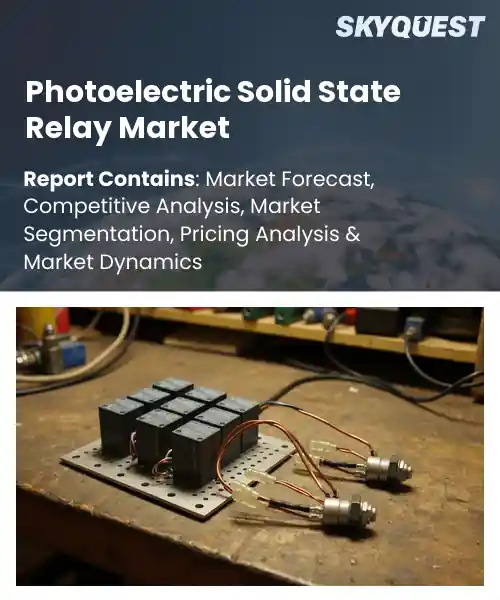
Photoelectric Solid State Relay Market
Report ID: SQMIG45J2409
Report ID: SQMIG45J2409
[email protected]
USA +1 351-333-4748
Report ID:
SQMIG45J2409 |
Region:
Global |
Published Date: February, 2026
Pages:
157
|Tables:
120
|Figures:
77


Global Photoelectric Solid State Relay Market size was valued at USD 2.18 Billion in 2024 and is poised to grow from USD 2.35 Billion in 2025 to USD 4.29 Billion by 2033, growing at a CAGR of 7.8% during the forecast period (2026-2033).
A solid-state relay that utilizes photoelectric sensors in place of metal contacts is becoming an increasingly common type of switch in many different types of industries. Such relays can provide compact and reliable switching of electrical loads without the use of mechanical moving parts and therefore reduce electrical load interference, improve operational reliability by extending load life, and provide safer system designs. Manufacturers have used photoelectric SSRs in place of mechanical relays in factory automation systems to reduce the amount of unexpected downtime and to increase their ability to perform predictive maintenance.
As the use of semiconductor technologies continues to advance, these advancements are likely to be an important driver for the global photoelectric solid state relay market growth because the increased current density leads to lower on-resistance (which reduces heat loss) and better thermal management, thus making it possible for manufacturers and end users to use photoelectric SSRs across a greater number of applications than in the past. As manufacturers create smaller and more efficient photoelectric SSRs, design engineers are likely to replace bulky mechanical switches with smaller and more efficient solid-state switches in applications such as electric vehicle (EV) charging stations, inverters for solar arrays, and motor control cabinets to minimize energy waste and maintenance costs and to meet regulatory requirements.
Additionally, digitally integrated diagnostics will provide tools for end users to create predictive maintenance capabilities and to generate service revenue through the sale of equipment maintenance services.
How is IoT Integration Influencing Demand in the Photoelectric Solid State Relay Market?Photoelectric solid-state relays (SSR) replace electromechanical contactors for switching applications with MOSFET switching and offer several beneficial features: optical isolation for galvanic separation, silent operation (no wear or mechanical noise), low control voltage and current requirements, and compact size. With increased integration of the Internet of Things (IoT), there is a growing need for these relays since devices require reliable switching remotely and should include diagnostic capabilities.
In addition to IoT integration, there is a growing demand for photoelectric relays at the Edge and Smart Controllers. These relays must be capable of tolerating higher ambient temperatures and fitting into dense board layouts. Industrial automation, smart buildings, renewable energy systems, and medical instruments are examples of applications where these relays are being widely adopted due to remote monitoring and low-maintenance design priorities. Additionally, the shift towards predictive maintenance and digital control has increased the value of PhotoMOS relays to system designers.
Market snapshot - (2026-2033)
Global Market Size
USD 2.18 Billion
Largest Segment
DIN Rail Mount
Fastest Growth
Surface Mount
Growth Rate
7.8% CAGR
To get more insights on this market click here to Request a Free Sample Report
Global photoelectric solid state relay market is segmented intomounting type, input control type, output configuration, application and region. Based on mounting type, the market is segmented into panel mount, din rail mount and surface mount. Based on input control type, the market is segmented into voltage control, current control, and optically isolated. Based on output configuration, the market is segmented into normally open, normally closed and bidirectional. Based on application, the market is segmented into industrial automation, consumer electronics, telecommunications, automotive, medical devices, and others. Based on region, the market is segmented into North America, Europe, Asia Pacific, Latin America and Middle East & Africa.
As per photoelectric solid state relay market outlook, the panel mount segment dominates the market due to its solid and durable enclosure and its standard mounting interface that provides consistent mechanical stability and efficient thermal paths, which minimize the risk of failure during continuous use. The familiar practice of installing control cabinet relays simplifies ongoing maintenance and their ease of use fosters greater placement in systems, making designers more likely to use pull-ready relays in applications that have higher than average needs. This reliability will continue to build momentum throughout industrial and infrastructure applications where expectations for performance and serviceability impact the purchasing process. As per photoelectric solid state relay market analysis, the surface mount segment is fast growing because of the continued trend toward miniaturizing components and seamlessly integrating the component into the PCB during the assembly process increases the efficiency of automated assembly reducing the cost on a per-unit basis. The small size of the surface mount component enables the design of portable and consumer-oriented products, creating demand for new applications and increasing the need among manufacturers to reduce size and increase production efficiency using many smaller components.
As per photoelectric solid state relay market forecast, optically isolated segment leads because optical coupling provides galvanic isolation between control and power domains, markedly reducing the risk of ground loops and hazardous fault propagation. This also provides a high level of immunity to electromagnetic interference and allows for a much safer interface with sensitive controllers and enables compliance with very strict safety requirements. This is why designers are specifying and utilizing optically isolated relays in the most critical applications requiring complete electrical separation and reliable failure modes of the relay for the integrity of the system.
Current control continues to grow at an accelerated rate because the need for an extremely accurate amount of current controlled within the current limits of the device is driving the increased usage of this technology in conjunction with advanced motor drives and energy efficient power systems, especially in the applications requiring accurate load regulation. The continued improvements in sensing and control will allow for even more types of load regulation applications where loads are dynamically changing. These innovations, as well as the expansion of applications requiring dynamic load handling, are profoundly impacting this marketplace, generating substantial growth potential for this sector and creating many new design possibilities.
To get detailed segments analysis, Request a Free Sample Report
As per photoelectric solid state relay market regional forecast, the Asia Pacific region is a powerhouse of manufacturing due to its concentration of advanced manufacturing capabilities, integrated supply chain ecosystems and a knowledgeable workforce with vast experience in Semiconductor and Industrial Electronics. There are several major industrial clusters that enable fast prototyping, scalable production, and close collaboration between components of manufacturers and system integrators. High volume demand for consumer electronics, automotive electrification, and automation will further create a healthy domestic market that promotes domestic innovation and cost efficiencies.
Photoelectric solid state relay market in Japan thrives on its culture of precision engineering as well as strict quality control standards, resulting in a high level of reliability, functionality and performance. The close collaboration between OEMs/Researchers and Specialized Suppliers fosters continuous innovation within the industry as well as providing lifecycle support for component manufacturers. Additionally, the domestic focus on factory automation, automotive safety systems and industrial robotics increases demand for compact and durable relays.
The photoelectric solid state relay market in South Korea is heavily influenced by the highly integrated electronics and semiconductor industries with an emphasis on miniaturization, high throughput and performance scaling. Most manufacturers place a high priority on advanced packaging of devices and system-level integration of components which allows them to provide compact relay solutions for their consumer electronics, industrial automation and automotive applications.
As per photoelectric solid state relay market outlook, North America's growth is supported by the advancing trend of modernizing manufacturing, increased demand for quality control devices, and strategic investments made by utilities in accordance with regulatory requirements pertaining to improving energy and infrastructure resilience. Additionally, systems integrators and manufacturers of original equipment (OEMs) are increasingly focusing on their demand for high-reliability and safety componentcharacteristics to develop more complex relay products for use in industrial applications, automotive applications and critical infrastructure applications.
Relays in the United States photoelectric solid state relay industry are characterized by a strong preference for high levels of reliability and compliance with extremely strict requirements set forth by different industrial and safety standards. Most of the demand for relays is driven from demand created by existing and new systems that are being developed as part of an automation project, the electric vehicle ecosystem, or upgrades to critical infrastructure. A robust supply network of systems integrators, specialty distributors, and systems support service providers exist to facilitate relays entering the market and is vital to supporting the effective lifecycle of relays.
In the Canada photoelectric solid state relay market, the focus is on the use of durable solid-state components that provide long-term reliability and can provide functionality for customers in sectors such as energy; mining; and process industries. When choosing the relay products to be used in their systems, most buyers emphasize the importance of selecting reliable, ruggedized components that will stand up to the severe environmental conditions and properly interface with the control systems currently in use. Continued close business relationships with its neighboring markets enhances the opportunities for technology transfers and collaborative source agreements for suppliers of relay products in Canada.
As per photoelectric solid state relay industry analysis, the strengths of Europe are being built around strong industrial engineering capabilities and best practice standards, a comprehensive regulatory framework, and an emphasis on innovative energy-efficient and safety control systems. Core manufacturing locations in Europe focus on high productivity, strong reliability, and long life to appeal to a wide range of high-end users in the automotive, machine tool, and energy industries.
The Germany photoelectric solid state relay market provides high-quality industrial automation and machine engineering based on trusted expertise in manufacturing processes and technology. Manufacturers and systems integrators are looking for components that meet as many of their stringent performance and safety criteria as possible to support their manufacturing and automotive industries. There are many strong local suppliers of photoelectric solid-state relay products and engineering services in Germany to support customized implementations and complex systems integration.
The United Kingdom photoelectric solid state relay market is affected by strengths in systems integration and automation services, along with unique industrial application areas, such as rail transportation and maritime applications. Customers want services and solutions they can use for complex legacy systems and changing regulations. Innovation clusters, as well as technical consulting firms assist with pilot projects and customized implementations, while the U.K. has a very robust distribution channel in place to give access to all global suppliers of these products.
The France photoelectric solid state relay market benefits from expert knowledge in industries like aerospace, automotive, and energy, which tend to place a heavy value on reliability and certification. Collaboration between industry and research institutions is driving new applications, as well as leading to enhanced application-specific solutions and more rigorous testing standards. Furthermore, suppliers are emphasizing robust lifecycle support, integration capabilities, and the ability to meet fast-growing performance requirements. A strategic emphasis is placed on local manufacturing and technical partnerships as they relate to national infrastructure projects and industrial modernization efforts; therefore, the market favors engineered solutions, and dependable supplier relationships.
To know more about the market opportunities by region and country, click here to
Buy The Complete Report
Growth in Industrial Automation
The growth in demand for compact switch components, that provide reliable operation for industrial automation, has seen a rise in numbers of photoelectric & solid-state relays because they provide isolation, a long life and noise immunity that meets all requirements for automation. Manufacturers are interested in using photoelectric & solid-state relays since they will increase their machines' uptime and to have reduced maintenance requirements; because they can integrate with their control systems and can handle the wear and tear of continuous switches.
Growth of Renewable Energy
The continued growth of the market will see a corresponding growth in the need for reliable power conversion & protection equipment that photoelectric & solid-state relays can provide. Applications include inverters and batteries. Photoelectric & solid-state devices reduce the amount of maintenance & they significantly increase the operational life of the distributed energy systems, meeting the desire of manufacturers who want the long-term operational reliability of their designed products. By helping create sustainable energy architecture and providing small, compact & integrated control modules to the manufacturers of the control modules, photoelectric & solid-state relays contribute to the ongoing growth of solar, wind and hybrid energy projects.
Complex Thermal Dissipation Requirements
Operating a photoelectric solid-state relay for extended periods can produce considerable amounts of heat. This increased thermal load requires unique considerations during system design and may increase the necessary amount of specialized heat sinks or thermal interface materials. As a result of heat generated, the designer needs to allocate area and implement a method for cooling the relay, ensuring reliability, which can conflict with the designer’s intent to maintain compactness of the product. The need for additional engineering effort and cost allocated to thermal performance may limit the use of the relay in areas where size or cost constraints exist due to lengthy lead times. Consequently, product lines requiring thermal management will not see as much rapid integration due to not being able to accommodate this additional thermal management without affecting other design priorities.
Supply Chain Component Shortages
Reliance on specialized optoelectronic components and semiconductor substrates puts manufacturers at an increased risk for supply chain disruption. When manufacturers experience intermittent availability of key components, they are often forced to either delay production planning or have longer lead times for component procurement. This uncertainty in procurement causes companies to focus on fulfilling the requirements of their existing contracts first, then redesign products utilizing alternate components, thus increasing design and development time and decreasing the company’s ability to respond quickly to changing market demand. The risk averse behavior of buyers and manufactures ultimately restrict the overall market from experiencing a rapid growth, as companies delay investments in production capacity or reduce current production capacity due to concerns regarding the potential for excess inventory and the potential mismatch between supply of and demand for the product.
Request Free Customization of this report to help us to meet your business objectives.
Competition in the global photoelectric solid state relay market is shaped by incumbent manufacturers accelerating product innovation, vertical integration, and selective consolidation to secure automotive and renewable energy design wins. Companies are using M&A and targeted product introductions to defend photoelectric solid state relay market share, exemplified by Sensata acquiring Crydom, Toshiba releasing the TLX9910 photovoltaic optocoupler, Vishay launching automotive-grade SSRs, and Littelfuse extending its OptoMOS SSR lineup.
Growing Industrial Automation: Industrial automation is rapidly increasing the need for photoelectric solid-state relays with features such as silent operation, improved durability, and protection against mechanical wear. Additionally, the ability to connect easily with state-of-the-art control systems and fieldbus interfaces is allowing these products to be integrated into robotic systems, conveyor systems, and manufacturing facility instrumentation. Manufacturers prefer devices that reduce system complexity, shorten the amount of time their device will need maintenance (maintenance cycle), and support a modular system design. As smart factories expand, more designers are choosing to use solid state photoelectric solid-state relays due to their predictable performance, lower electromagnetic interference (EMI), and the ease with which predictive maintenance and remote diagnostic systems can implement them.
Miniaturization and Integration: The trend towards smaller form factors and integrated photoelectric solid-state relays has led to new market preferences for very smallform factor, fully integrated units. These products enable high-density electronic assemblies and simplify the design of boards for these products. Many manufacturers are creating smaller size packages as well as multi-function modules that will combine the switch, sensor, and protection functionality needed in many industrial control, smart appliance, and transportation electronic applications where space is at a premium. The trend in the photoelectric solid state relay market will encourage relay manufacturers and system designers to work closer together to accelerate the time taken to bring the devices to the market, support standardization of platforms, and provide custom solutions that will support an appropriate form factor, reliability and ease of certification across a diverse range of applications.
SkyQuest’s ABIRAW (Advanced Business Intelligence, Research & Analysis Wing) is our Business Information Services team that Collects, Collates, Correlates, and Analyses the Data collected by means of Primary Exploratory Research backed by robust Secondary Desk research.
As per SkyQuest analysis, the global photoelectric solid state relay industry is heavily influenced by a growing requirement for trustworthy, compact, and low-maintenance switching technologies in industrial automation; with advances in semiconductor materials to enhance current density, thermal performance and miniaturization as a secondary influence on market growth. Geographically, Asia Pacific has been the leading market segment; this market continues to be the main region driving forward because of its competitive advantage of manufacturing at scale, established integrated supply chains, and overall high levels of demand from both the electronics and automotive sectors. The largest growing products within the overall market will remain in the panel mount type relay due to their superior mechanic stability and superior thermal pathways to ensure proper operating conditions for extended periods of time. One of the major barriers that is preventing quicker adoption rates is the thermal dissipation complexities associated with continuous high-power applications, which increases design costs and requires additional space to facilitate proper cooling requirements.
| Report Metric | Details |
|---|---|
| Market size value in 2024 | USD 2.18 Billion |
| Market size value in 2033 | USD 4.29 Billion |
| Growth Rate | 7.8% |
| Base year | 2024 |
| Forecast period | (2026-2033) |
| Forecast Unit (Value) | USD Billion |
| Segments covered |
|
| Regions covered | North America (US, Canada), Europe (Germany, France, United Kingdom, Italy, Spain, Rest of Europe), Asia Pacific (China, India, Japan, Rest of Asia-Pacific), Latin America (Brazil, Rest of Latin America), Middle East & Africa (South Africa, GCC Countries, Rest of MEA) |
| Companies covered |
|
| Customization scope | Free report customization with purchase. Customization includes:-
|
To get a free trial access to our platform which is a one stop solution for all your data requirements for quicker decision making. This platform allows you to compare markets, competitors who are prominent in the market, and mega trends that are influencing the dynamics in the market. Also, get access to detailed SkyQuest exclusive matrix.
Table Of Content
Executive Summary
Market overview
Parent Market Analysis
Market overview
Market size
KEY MARKET INSIGHTS
COVID IMPACT
MARKET DYNAMICS & OUTLOOK
Market Size by Region
KEY COMPANY PROFILES
Methodology
For the Photoelectric Solid State Relay Market, our research methodology involved a mixture of primary and secondary data sources. Key steps involved in the research process are listed below:
1. Information Procurement: This stage involved the procurement of Market data or related information via primary and secondary sources. The various secondary sources used included various company websites, annual reports, trade databases, and paid databases such as Hoover's, Bloomberg Business, Factiva, and Avention. Our team did 45 primary interactions Globally which included several stakeholders such as manufacturers, customers, key opinion leaders, etc. Overall, information procurement was one of the most extensive stages in our research process.
2. Information Analysis: This step involved triangulation of data through bottom-up and top-down approaches to estimate and validate the total size and future estimate of the Photoelectric Solid State Relay Market.
3. Report Formulation: The final step entailed the placement of data points in appropriate Market spaces in an attempt to deduce viable conclusions.
4. Validation & Publishing: Validation is the most important step in the process. Validation & re-validation via an intricately designed process helped us finalize data points to be used for final calculations. The final Market estimates and forecasts were then aligned and sent to our panel of industry experts for validation of data. Once the validation was done the report was sent to our Quality Assurance team to ensure adherence to style guides, consistency & design.
Analyst Support
Customization Options
With the given market data, our dedicated team of analysts can offer you the following customization options are available for the Photoelectric Solid State Relay Market:
Product Analysis: Product matrix, which offers a detailed comparison of the product portfolio of companies.
Regional Analysis: Further analysis of the Photoelectric Solid State Relay Market for additional countries.
Competitive Analysis: Detailed analysis and profiling of additional Market players & comparative analysis of competitive products.
Go to Market Strategy: Find the high-growth channels to invest your marketing efforts and increase your customer base.
Innovation Mapping: Identify racial solutions and innovation, connected to deep ecosystems of innovators, start-ups, academics, and strategic partners.
Category Intelligence: Customized intelligence that is relevant to their supply Markets will enable them to make smarter sourcing decisions and improve their category management.
Public Company Transcript Analysis: To improve the investment performance by generating new alpha and making better-informed decisions.
Social Media Listening: To analyze the conversations and trends happening not just around your brand, but around your industry as a whole, and use those insights to make better Marketing decisions.
REQUEST FOR SAMPLE
 REQUEST FREE CUSTOMIZATION
Global Photoelectric Solid State Relay Market size was valued at USD 2.18 Billion in 2024 and is poised to grow from USD 2.35 Billion in 2025 to USD 4.29 Billion by 2033, growing at a CAGR of 7.8% during the forecast period (2026-2033).
Competition in the global photoelectric solid state relay market is shaped by incumbent manufacturers accelerating product innovation, vertical integration, and selective consolidation to secure automotive and renewable energy design wins. Companies are using M&A and targeted product introductions to defend share, exemplified by Sensata acquiring Crydom, Toshiba releasing the TLX9910 photovoltaic optocoupler, Vishay launching automotive-grade SSRs, and Littelfuse extending its OptoMOS SSR lineup. 'Omron Corporation', 'Vishay Intertechnology', 'Crydom', 'TE Connectivity', 'Panasonic Corporation', 'Schneider Electric', 'Siemens AG', 'Fujitsu', 'Carlo Gavazzi', 'Littelfuse', 'Broadcom Inc.', 'Adafruit Industries', 'Microchip Technology', 'NTE Electronics', 'Moxa Inc.', 'Renesas Electronics', 'Honeywell', 'Mitsubishi Electric', 'Eaton Corporation', 'Sharp Corporation'
Industrial automation drives demand for reliable, compact switching components, and photoelectric solid state relays provide isolation, long life, and noise immunity that align with automation requirements. Their ability to integrate with control systems and withstand repetitive switching improves machine uptime and reduces maintenance needs, making them attractive for manufacturers seeking predictable performance. As factories prioritize safety and process consistency, designers favor solid state relays for their low electromagnetic interference and minimal mechanical wear, encouraging steady incorporation of these devices into automated equipment and control panels.
Growing Industrial Automation: Growing industrial automation drives demand for photoelectric solid state relays that offer silent switching, enhanced durability, and immunity to mechanical wear. Their compatibility with advanced control architectures and fieldbus interfaces enables seamless integration into robotics, conveyors, and factory instrumentation. Manufacturers prioritize devices that simplify system design, reduce maintenance cycles, and support modularization strategies. As smart manufacturing expands, designers favor solid state options for their predictable performance, reduced electromagnetic interference, and ease of implementation within predictive maintenance and remote diagnostic frameworks.
Asia Pacific Dominates the Global Photoelectric Solid State Relay Market.


Want to customize this report? This report can be personalized according to your needs. Our analysts and industry experts will work directly with you to understand your requirements and provide you with customized data in a short amount of time. We offer $1000 worth of FREE customization at the time of purchase.
Feedback From Our Clients


 USA (+1) 351-333-4748

