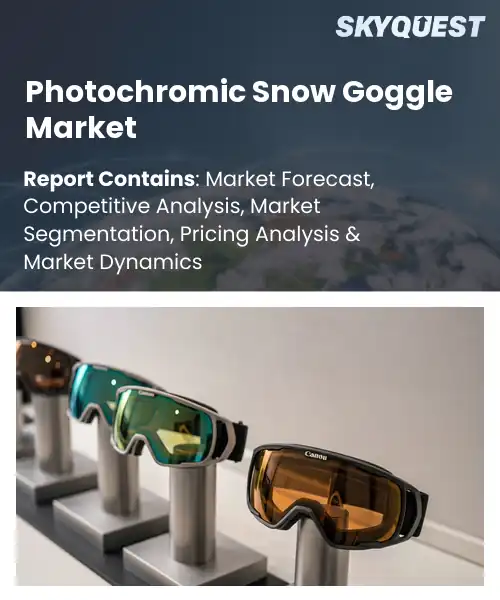
Photochromic Snow Goggle Market
Report ID: SQMIG25J2173
Report ID: SQMIG25J2173
[email protected]
USA +1 351-333-4748
Report ID:
SQMIG25J2173 |
Region:
Global |
Published Date: March, 2026
Pages:
157
|Tables:
116
|Figures:
77


Global Photochromic Snow Goggle Market size was valued at USD 150 Million in 2024 and is poised to grow from USD 159.75 Million in 2025 to USD 264.39 Million by 2033, growing at a CAGR of 6.5% during the forecast period (2026-2033).
Many consumers have expressed a growing desire for adaptive eye protection (photochromic lenses) that respond quickly and appropriately to rapidly changing alpine lighting. Water and/or other elements of snow create glare in bright light conditions, which may negatively impact the ability of skiers and mountaineers to perform safely, but photochromic snow goggles offer continuous visual comfort without the need to change lenses. The existing alpine photochromic snow goggle market will play a significant role in reducing the risk of accidents while enhancing the performance of athletes; therefore, it will meet consumers' demands for ease of use and technological advancement.
Over the past ten years, manufacturers have made significant progress in both lens activation speed and durability via improvements in the chemistry of photochromic lenses, as shown in the associated technological advancements applied by all the key manufactures within the photochromic snow goggle market. In addition to the importance of these technological advances, consumers increasingly desire multifunctional eyewear; thus, photochromic goggle products will drive global photochromic snow goggle market growth because of consumers’ desire for the versatility to reduce the complexity of travelling.
Manufacturers will be able to successfully target their products toward ski tourers while satisfying various retailers’ merchandise assortments; and these consumer preferences for the products will drive the average selling prices of ski tourers and the simplification of ski-related retailer assortments. These categories of product will create a significant opportunity for manufacturers to develop and market premium products at resorts and develop partnerships for rental of these products at resorts to foster additional market penetration in developing areas of the market.
How is AI Enhancing Performance And Consumer Adoption In The Photochromic Snow Goggle Market?
Combining smarter light sensing with machine learning and user focused design, AI will increase the performance of the photochromic ski goggle market as well as consumers’ willingness to buy them. This is being achieved through devices equipped with sensors that send data regarding both the environment and riders through algorithms that can predict how much light will change and how quickly the lens of a pair of goggles will respond.
Processing images on the devices can significantly improve contrast in flat light conditions as well as provide the ability to customize a user's tint curve to match their preferences. The combination of traditional optics and smart technology in the current market allows for a more consistent and convenient experience when wearing adaptive lenses. Examples of this blending would be brands like Oakley using more efficient lenses, and aboard companies enhancing the lag time between wearer movements and corresponding visuals to enable them to have a superior level of comfort while they ride. REKKIE has recently developed a pair of skis with smart lenses, and their heads up displays which provide customized contrast enhancement and live data linking. Their introduction into the market demonstrates how AI-enabled sensor fusion and customization can enhance reliability and drive consumers towards accepting photochromic skis as a viable option in their gear selection.
Market snapshot - 2026-2033
Global Market Size
USD 0.77 Billion
Largest Segment
Traditional Photochromic
Fastest Growth
Electronic/Instant Transition Lenses
Growth Rate
9.5% CAGR
To get more insights on this market click here to Request a Free Sample Report
Global photochromic snow goggle market is segmented into lens technology, frame architecture, light transmission range (VLT), sales channel and region. Based on lens technology, the market is segmented into traditional photochromic, electronic/instant transition lenses and hybrid polarized-photochromic. Based on frame architecture, the market is segmented into frameless/rimless design, full-frame over-the-glasses (OTG) and spherical vs. cylindrical lenses. Based on light transmission range (VLT), the market is segmented into category S1 - S3 and category S2 - S4. Based on sales channel, the market is segmented into specialty winter sports retailers, online e-commerce/D2C and luxury outdoor boutiques. Based on region, the market is segmented into North America, Europe, Asia Pacific, Latin America and Middle East & Africa.
Traditional photochromic segment dominates with large global photochromic snow goggle market share because longstanding manufacturing familiarity, proven photo-reactive chemistry, and established supply chains make it the default for most producers and buyers in the market. The photochromic snow goggle market is dominated by the traditional photochromic segment due to long-standing manufacturing familiarity, established supply chains, and proven photo-reactive chemistry, which all make it the primary product for almost all producers and purchasers of photochromic goggles. It offers consistent optical attributes that are compatible with existing coatings and frame designs, which aid OEM and add-on suppliers in reducing integration challenges, provides broad acceptance with retailers, rental program support.
As per global photochromic snow goggle market outlook, the electronic/instant transition lenses segment is positioning itself as the fastest-growing segment by taking advantage of advances in sensor technology and miniaturized control systems. Performance athletes and tech-savvy consumers are representing a significant component of the primary target consumer base for these innovative products and driving premium positioning within the photochromic category along with new accessory systems and industry partnerships.
As per global photochromic snow goggle market forecast, the full-frame over-the-glasses (OTG) segment dominates the space as its inclusive frame architecture was developed primarily for a large group of wearers whose prescription lens requirements can still meet the need for photochromic performance. This compatibility makes consumer and rental provider fit and purchase decisions much easier, while also reducing retailer return friction for retailers and incentivizing brands to prioritize OTG models to their assortments, making these models a reliable and utility-based offering in the photochromic snow goggle market.
As per global photochromic snow goggle market analysis, the fastest-growing segment is frameless/rimless design. The demand for greater peripheral vision, lighter weight, and modern design continues to be driven by both Performance and Lifestyle users. The improvements in lens attachment and lens sealing technologies allow for a strong integration of photochromic technology with reliable anti-fog performance and strong opportunities for premium positioning, influencer-driven desirability.
To get detailed segments analysis, Request a Free Sample Report
As per global photochromic snow goggle market regional outlook, North America is the leader because of the convergence of different factors; these include high levels of consumer demand for high-quality eyewear, a concentration of specialists in developing optical materials and coatings, and a high degree of integration between manufacturers. The evolution of premium protective gear as well as a strong tradition of winter recreation has helped create an environment where customers are more willing to try advanced photochromic technologies. Established R&D ecosystems within North America enable the quick improvement of lens chemistry and frame fit, and extensive retail and rental networks provide opportunities for customers to see and try products before purchasing.
As per global photochromic snow goggle market regional forecast, United States demonstrates strong consumer appetite for performance eyewear through the support of major domestic brands and specialty retail channels. The close relationship between manufacturers, test labs, and top-performing athletes allows for faster validation and adoption of products. Different types of snow exist throughout North America, combined with a culture of many winter sports, which promotes a need for adaptive lens technologies.
The photochromic snow goggle market in Canada has a significant advantage because of its winter tourism culture and varying light conditions, which drive the demand for adaptive lenses. In addition, many specialty retailers and outfitters have established hands-on trials and educational programs. Manufacturers and importers emphasize durability and performance for extreme cold; as well, partnerships with safety organizations and local outdoor guides help establish credibility among customers.
The rapid growth of the European market is a result of the complementary factors of increased consumer interest in outdoor winter sports, increased demand for premium quality eyewear, and a strong network of specialty retailers and resorts providing consumers with the ability to see and test products before purchasing them. Manufacturers in the region are investing in lens technology and ergonomic frame design which are suited for use in different types of alpine light conditions. The awareness of the benefits to performance is raised through the relationships that exist between brands and resort operators along with safety regulations that are progressive in nature.
The market in Germany for photochromic goggles has an emerging profile that is based on technology expertise in materials and engineering. The growth in consumer adoption is supported by specialty retailers and outdoor clubs that appreciate long-term durability and optical clarity. Suppliers are focused on advancing lens technology while independent testing agencies provide evidence of up to-date performance across a variety of environmental conditions. The consumer's desire to use environmentally sustainable materials/constructs coupled with functional designs continue to drive purchases of photochromic goggles by discerning consumers. Retail and rental locations servicing the alpine communities support the ability of consumers to see and evaluate products and are important for overall market growth.
In the United Kingdom, there has been an increasing uptake of photochromic snow goggles over the last few years, fueled by lifestyle trends and improvements in access to resorts. Digital channels worldwide are aiding in fast discovery of products. Fashion-conscious individuals who ride wintersports prefer to use multifunctional eyewear that combines style and adaptive light control. Robust marketing strategies, collaborations with influencers, and retail activations have made these products more visible to younger generations. Rental fleets available at activity centers and experiential stores provide opportunities for customers to try them out, which will facilitate the speed of adoption and help increase brand recognition.
As per global photochromic snow goggle industry analysis, France holds a position of strength within Europe due to its numerous and extensive networks of resorts, strong domestic brands, and the high degree of sophistication expected by consumers when it comes to product performance and aesthetics. The high level of awareness of winter sports from a cultural perspective has resulted in educated consumers who are prepared to pay a premium for goods. Companies in the collection process between manufacturers of the goggles and the operators of resort rentals having strong relationships have allowed for both trial and product exposure. An emphasis placed on product safety certifications, craftsmanship, and curated in-store experiences has bred deep levels of consumer trust and preference for lens technology products.
As per global photochromic snow goggle industry analysis, the Asia Pacific region is enhancing its presence in the market for winter sports equipment by capitalizing on the increasing popularity among consumers and the growing capabilities of local manufacturers to produce quality products. Manufacturers are investing in new, specialized production capabilities and forming partnerships with global technology providers to create customized lens chemistry and fit profiles for the varying light conditions that exist in the local market.
As per global photochromic snow goggle market regional forecast, Japan market has been driven by high-quality optical engineering from local manufacturers, which has resulted in superior performance and refined aesthetics. The collaborative approach with component suppliers has allowed local manufacturers to establish quality control and customize lens chemistry and fit profiles to accommodate a variety of light conditions. Urban interest in recreational winter activities and new indoor snow facilities will continue to create a year-round demand for these products. As a result, various distribution channels are employed, including specialty stores, experiential retail environments, and traditional department stores that emphasize craftsmanship and product credentials.
As per global photochromic snow goggle market regional outlook, South Korea market is thriving through high levels of tech adoption coupled with an active Ecommerce environment creating fast, trend-driven purchasing opportunities. Brand offerings combine cutting-edge styles with adaptive lens performance catered toward the urban and resort consumer. Brands offering both designer and optics manufacturer collaborations will create unique products to attract younger consumers.
To know more about the market opportunities by region and country, click here to
Buy The Complete Report
Rising Demand from Winter Sports
Winter sports enthusiasts have a preference for photochromic snow goggles that automatically change with light levels to reduce eye strain and improve visibility when using snow goggles in the various lighting conditions of the mountains. They encourage premium purchases by replacing snow goggles more frequently than using a single lens of snow goggle no matter what the lighting condition. Retailers are expanding their selection of photochromic equipment, while companies are focusing on developing photochromic products. Therefore, spurring research investment, creating retail partnerships, and marketing activity, all of which work together to create continued market growth for photochromic products in this category.
Increasing Acceptance of Smart Lenses
Combining new photochromic materials with smart lens technologies improves the performance of these products by allowing them to produce a faster response to changing light levels and to be used with helmet mounted devices. Thus, enhancing user safety and operational performance in the multitude of weather conditions outdoors. Manufacturers are motivated to invest in development and collaborate strategically to differentiate their products by their intelligent capabilities and superior optical performance, while retailers continue to emphasize these features. Thus, increasing interest and acceptance amongst consumers in more performance driven categories and increasing the market presence and premium positioning of these products.
High Manufacturing Costs Remain
The final manufacturing price is significantly higher than traditional eyewear; thus, limiting the potential for widespread adoption by recreational and cost-sensitive customers who are not willing to pay higher retail prices. Other essential factors such as manufacturing and development costs associated with quality control and lack of compatibility with protective coatings will lead manufacturers to prioritize existing product lines and supply as much product as possible with less riskier investments. These cost pressures will limit the ability of distributors to expand into these regions and slow down the time it takes to establish distribution into low-priced segments and ultimately limit overall market growth, as well as potential increases in unit volume.
Lack of Consumer Awareness in Emerging Geographies
Many consumers in certain regions have little or no awareness of the functional benefits of photochromic snow goggles; therefore, they are unable to recognize these goggle advantages over traditional snow wear, including safety and convenience, leading to less widespread acceptance of photochromic goggles. The limited number of retail locations where photochromic snow goggles are displayed and sold along with a lack of demonstration opportunities continues to limit consideration as these customers are only seasonal users or first-time purchasers and have a lower adoption rate. Manufacturers and distributors will have limited resources to invest in less desirable markets; therefore, perceived low demand limits the regional expansion, and the establishment of stronger sales and service networks will continue to be constrained.
Request Free Customization of this report to help us to meet your business objectives.
The global photochromic snow goggle industry is currently developing as a result of merger and acquisition activity, collaborative efforts between lens manufacturers and sporting brands, and new products developed by newly-funded companies that have been able to effectively bring their products to market quickly. Mergers and acquisitions, licensing agreements, and crowdfunding platforms are all present in recent data from research organizations and vendors. New entrants are entering the market with products that feature immediate tinting and flip-up ventilation and are competing with long-term companies in the business.
SkyQuest’s ABIRAW (Advanced Business Intelligence, Research & Analysis Wing) is our Business Information Services team that Collects, Collates, Correlates, and Analyses the Data collected by means of Primary Exploratory Research backed by robust Secondary Desk research.
As per SkyQuest analysis, the global photochromic snow goggle market is driven by increasing demand for adaptive eye protection that responds to rapidly changing alpine light conditions, while growth is further supported by expanding adoption of smart lenses that enhance response and personalization. However, high manufacturing costs remain a restraint, constraining lower price entry and wider adoption in cost sensitive regions. North America dominates the market due to mature winter sports participation, robust research and development and deep retail channels, and traditional photochromic lenses remain the leading segment due to established chemistry, supply chains and proven optical performance. Manufacturers can capitalize on premiumization and resort partnerships to broaden penetration.
| Report Metric | Details |
|---|---|
| Market size value in 2024 | USD 150 Million |
| Market size value in 2033 | USD |
| Growth Rate | 6.5% |
| Base year | 2024 |
| Forecast period | 2026-2033 |
| Forecast Unit (Value) | USD Xml:lang="EN-US" |
| Segments covered |
|
| Regions covered | North America (US, Canada), Europe (Germany, France, United Kingdom, Italy, Spain, Rest of Europe), Asia Pacific (China, India, Japan, Rest of Asia-Pacific), Latin America (Brazil, Rest of Latin America), Middle East & Africa (South Africa, GCC Countries, Rest of MEA) |
| Companies covered |
|
| Customization scope | Free report customization with purchase. Customization includes:-
|
To get a free trial access to our platform which is a one stop solution for all your data requirements for quicker decision making. This platform allows you to compare markets, competitors who are prominent in the market, and mega trends that are influencing the dynamics in the market. Also, get access to detailed SkyQuest exclusive matrix.
Table Of Content
Executive Summary
Market overview
Parent Market Analysis
Market overview
Market size
KEY MARKET INSIGHTS
COVID IMPACT
MARKET DYNAMICS & OUTLOOK
Market Size by Region
KEY COMPANY PROFILES
Methodology
For the Photochromic Snow Goggle Market, our research methodology involved a mixture of primary and secondary data sources. Key steps involved in the research process are listed below:
1. Information Procurement: This stage involved the procurement of Market data or related information via primary and secondary sources. The various secondary sources used included various company websites, annual reports, trade databases, and paid databases such as Hoover's, Bloomberg Business, Factiva, and Avention. Our team did 45 primary interactions Globally which included several stakeholders such as manufacturers, customers, key opinion leaders, etc. Overall, information procurement was one of the most extensive stages in our research process.
2. Information Analysis: This step involved triangulation of data through bottom-up and top-down approaches to estimate and validate the total size and future estimate of the Photochromic Snow Goggle Market.
3. Report Formulation: The final step entailed the placement of data points in appropriate Market spaces in an attempt to deduce viable conclusions.
4. Validation & Publishing: Validation is the most important step in the process. Validation & re-validation via an intricately designed process helped us finalize data points to be used for final calculations. The final Market estimates and forecasts were then aligned and sent to our panel of industry experts for validation of data. Once the validation was done the report was sent to our Quality Assurance team to ensure adherence to style guides, consistency & design.
Analyst Support
Customization Options
With the given market data, our dedicated team of analysts can offer you the following customization options are available for the Photochromic Snow Goggle Market:
Product Analysis: Product matrix, which offers a detailed comparison of the product portfolio of companies.
Regional Analysis: Further analysis of the Photochromic Snow Goggle Market for additional countries.
Competitive Analysis: Detailed analysis and profiling of additional Market players & comparative analysis of competitive products.
Go to Market Strategy: Find the high-growth channels to invest your marketing efforts and increase your customer base.
Innovation Mapping: Identify racial solutions and innovation, connected to deep ecosystems of innovators, start-ups, academics, and strategic partners.
Category Intelligence: Customized intelligence that is relevant to their supply Markets will enable them to make smarter sourcing decisions and improve their category management.
Public Company Transcript Analysis: To improve the investment performance by generating new alpha and making better-informed decisions.
Social Media Listening: To analyze the conversations and trends happening not just around your brand, but around your industry as a whole, and use those insights to make better Marketing decisions.
REQUEST FOR SAMPLE
 REQUEST FREE CUSTOMIZATION
Global Photochromic Snow Goggle Market size was valued at USD 0.77 Billion in 2024 and is poised to grow from USD 0.84 Billion in 2025 to USD 1.74 Billion by 2033, growing at a CAGR of 9.5% during the forecast period (2026-2033).
The competitive landscape of the global photochromic snow goggle market is shaped by consolidation among legacy eyewear groups, strategic partnerships between lens chemists and sports brands, and rapid product innovation from funded startups. Recent market reports and vendor activity show M and A, licensing deals, and crowdfunding launches driving differentiation. New entrants push instant tint and flip up ventilation features to challenge incumbents. 'Oakley', 'Smith Optics', 'Giro', 'Anon Optics', 'Bolle', 'POC Sports', 'Dragon Alliance', 'Tifosi Optics', 'Zeal Optics', 'Atomic Skis', 'Scott Sports', 'Salomon', 'K2 Sports', 'Julbo', 'Swans', 'Wildhorn Outfitters', 'Electric Eyewear', 'NIXON', 'Eyelevel', 'Uvex Sports'
Photochromic snow goggles have gained preference among winter sports participants because they automatically adjust to changing light, reducing eye strain and improving visibility in variable mountain environments, which encourages replacement and premium purchases. The convenience of a single lens for multiple conditions appeals to recreational and professional users, prompting retailers to expand assortments and manufacturers to prioritize photochromic features, thereby stimulating investments in research, retail partnerships, and marketing efforts that collectively contribute to sustained market expansion in this application segment.
Integration With Smart Wearables: The photochromic snow goggle market is moving toward seamless integration with wearable electronics and mobile ecosystems, focusing on sensor arrays, wireless control, and connectivity with helmets and eyewear. Brands are prioritizing user-friendly app interfaces and interoperable platforms to deliver adaptive tinting and environmental feedback without compromising ergonomics. Collaboration with tech firms enhances functionality and aftersales service, while designers emphasize lightweight construction and intuitive controls to meet consumer demand for connected, performance-oriented winter sports equipment and season-long durability expectations and serviceability.
As per global photochromic snow goggle market regional outlook, North America is the leader because of the convergence of different factors; these include high levels of consumer demand for high-quality eyewear, a concentration of specialists in developing optical materials and coatings, and a high degree of integration between manufacturers.
The market faces restraints such as high product costs and seasonal demand dependency, which can limit adoption and create fluctuations in sales.
Key trends include continuous innovation in lens technologies and increasing consumer preference for high-performance and adaptive sports eyewear.


Want to customize this report? This report can be personalized according to your needs. Our analysts and industry experts will work directly with you to understand your requirements and provide you with customized data in a short amount of time. We offer $1000 worth of FREE customization at the time of purchase.
Feedback From Our Clients


 USA (+1) 351-333-4748

