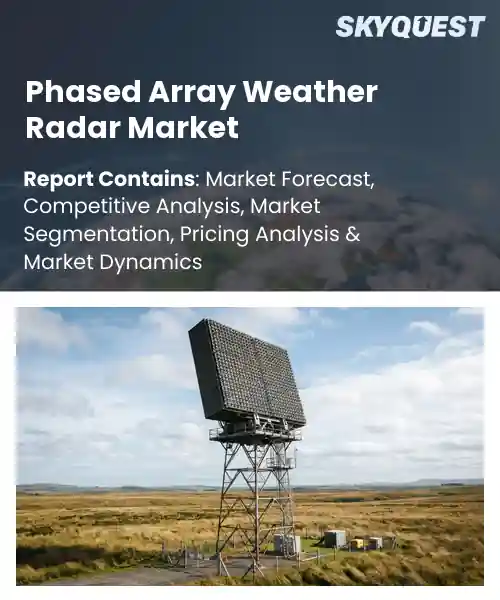
Phased Array Weather Radar Market
Report ID: SQMIG45J2998
Report ID: SQMIG45J2998
[email protected]
USA +1 351-333-4748
Report ID:
SQMIG45J2998 |
Region:
Global |
Published Date: September, 2026
Pages:
157
|Tables:
125
|Figures:
77


Global Phased Array Weather Radar Market size was valued at USD 1.19 Billion in 2024 and is poised to grow from USD 1.27 Billion in 2025 to USD 2.19 Billion by 2033, growing at a CAGR of 7.0% during the forecast period (2026-2033).
The global phased‑array weather radar market comprises systems that replace mechanically steered antennas with electronically scanned arrays, delivering rapid beam steering and finer spatial resolution. Its primary driver is the escalating demand for accurate severe‑weather detection, which governments and private operators view as essential for safety and resilience. Historically, the sector emerged from the 2000s research prototypes, progressed through 2010‑2015 deployments, and entered scale as agencies such as NOAA installed a phased‑array unit in Norman, Oklahoma, while Europe’s MeteoSat program launched networks. These milestones illustrate how the technology has evolved from experimental labs to key infrastructure, underscoring its growing relevance. Building on adoption, the market’s key factor is integration of digital beamforming and data analytics, unlocking revenue streams for meteorological services and defense agencies. By converting raw echo data into detailed wind fields, operators can issue local warnings that reduce alarms and protect infrastructure, leading municipalities to invest in phased‑array upgrades for flood‑prone regions like the Mississippi Delta. Defense contractors leverage the sensors for battlefield surveillance, creating demand that drives economies of scale and lowers unit costs. Consequently, the convergence of analytics, safety incentives, and dual‑use applications fuels growth and positions the technology as a cornerstone of next‑generation weather monitoring.
How are AI and IoT innovations reshaping the phased array weather radar market?
AI and IoT are turning phased‑array weather radars into smart sensing platforms that can adapt beam patterns in real time, fuse data from distributed sensors, and deliver near‑instantaneous forecasts. Machine‑learning models analyze raw echo returns to identify storm signatures with greater confidence, while edge‑connected IoT nodes stream environmental parameters that refine radar calibration on the fly. This convergence reduces latency, improves detection of rapid‑evolving weather events, and lowers operational costs by automating maintenance alerts. Vendors are integrating cloud‑based analytics to offer subscription services, enabling meteorological agencies to scale capabilities without massive hardware upgrades. The market is thus shifting from legacy mechanically steered systems toward flexible, data‑driven networks that support both public safety and commercial aviation needs.In June 2024, Raytheon, unveiled an AI‑enhanced phased‑array radar that leverages IoT connectivity to auto‑tune its scanning strategy, boosting coverage efficiency and shortening warning times for severe weather. This rollout exemplifies how intelligent automation is accelerating adoption across the sector.
Market snapshot - (2026-2033)
Global Market Size
USD 1.19 Billion
Largest Segment
Active Electronically Scanned Array Radar
Fastest Growth
Multifunction Phased Array Radar
Growth Rate
7.0% CAGR
To get more insights on this market click here to Request a Free Sample Report
Global phased array weather radar market is segmented by radar type, frequency band, application, end-use industry and region. Based on radar type, the market is segmented into Active Electronically Scanned Array Radar, Passive Electronically Scanned Array Radar, Multifunction Phased Array Radar and Others. Based on frequency band, the market is segmented into S-Band, C-Band, X-Band and Others. Based on application, the market is segmented into Weather Forecasting, Severe Weather Detection, Precipitation Monitoring, Aviation Weather Monitoring, Hydrological Monitoring and Others. Based on end-use industry, the market is segmented into Meteorological Services, Aviation, Government & Defense, Agriculture, Energy & Utilities and Others. Based on region, the market is segmented into North America, Europe, Asia Pacific, Latin America and Middle East & Africa.
Active Electronically Scanned Array Radar segment dominates because its real‑time beam steering eliminates mechanical wear, enabling continuous high‑resolution atmospheric scanning. This capability reduces maintenance downtime and improves data reliability, which is critical for operational meteorological services. The technology’s scalability allows integration with existing weather observation networks, and its electronic agility supports rapid response to evolving storm systems, driving widespread adoption across national weather agencies and public safety stakeholders worldwide.
However, Passive Electronically Scanned Array Radar is witnessing the strongest growth momentum as it offers lower cost architecture and easier retrofitting for legacy sites. Its simplified hardware reduces capital expenditure, prompting many emerging markets to upgrade their observation capabilities, thereby expanding the overall market footprint and creating new innovation pathways.
C-Band segment dominates because it strikes an optimal balance between atmospheric penetration and resolution, making it ideal for routine weather surveillance. Its wavelength efficiently traverses moderate precipitation while delivering detailed echo signatures, supporting accurate forecasting. The established global infrastructure and proven reliability attract both legacy operators and new entrants, reinforcing its position as the core technology for national radar networks and continuous operational upgrades throughout the industry.
Meanwhile, X-Band emerges as the key high growth area as its finer wavelength enables ultra‑high resolution detection of micro‑scale weather phenomena. This precision is increasingly demanded by advanced aviation safety systems and localized flood monitoring, prompting rapid adoption and stimulating R&D investment that broadens application horizons across the market.
To get detailed segments analysis, Request a Free Sample Report
North America leads the global phased array weather radar market because of mature aerospace and defense ecosystems, strong research institutions, and significant investment in advanced meteorological infrastructure. The United States benefits from extensive federal programs that prioritize resilience and public safety, fostering collaboration between government agencies, universities, and technology firms. Canada leverages its commitment to climate adaptation and its proximity to critical weather patterns, encouraging early adoption of innovative radar solutions. Both nations have robust supply chains, skilled engineering talent, and regulatory frameworks that support rapid testing and deployment. The integration of phased array technology into national weather services and aviation safety networks further consolidates the region's leadership, creating a virtuous cycle of innovation and market confidence across multiple sectors.
Phased Array Weather Radar Market in United States is propelled by close collaboration among federal weather agencies, defense contractors, and leading research universities. The focus on resilient infrastructure drives adoption in aviation, emergency management, and renewable energy forecasting. Strong intellectual property ecosystems encourage commercial spin‑offs, while extensive testing facilities accelerate proof‑of‑concept deployments. The convergence of public safety priorities and private sector innovation creates a fertile environment for sustained continual advancement.
Phased Array Weather Radar Market in Canada benefits from a national emphasis on climate resilience and a supportive regulatory landscape that encourages early technology adoption. Partnerships between government meteorological services, indigenous research hubs, and private radar manufacturers foster tailored solutions for vast and varied terrains. Emphasis on renewable energy integration and northern weather monitoring drives significant demand, while collaborative funding mechanisms reduce risk and accelerate field trials across remote regions.
Europe experiences rapid expansion of the phased array weather radar market driven by ambitious climate mitigation agendas, dense transportation networks, and a strong tradition of collaborative research. Germany leads with extensive defense and aerospace programs that prioritize high‑resolution atmospheric sensing for both civilian and security purposes. The United Kingdom accelerates growth through substantial public‑private partnerships focused on modernising national weather services and protecting offshore energy assets. France contributes emerging capabilities by integrating radar technology into smart city initiatives and renewable energy forecasting. Cross‑border initiatives under EU frameworks facilitate data sharing and standardisation, encouraging manufacturers to target multiple markets simultaneously. The convergence of regulatory support, funding for innovative pilots, and the need for precise weather data across sectors creates a fertile environment for accelerated adoption throughout the continent.
Phased Array Weather Radar Market in Germany is anchored by engineering expertise and a defense industrial base emphasizing cutting‑edge sensing solutions. Government investment in national meteorological networks drives deployment across aviation, shipping, and renewable energy sectors. Collaboration between research institutes and manufacturers accelerates technology transfer, while standards frameworks ensure interoperability. The focus on data for flood prevention and air quality monitoring reinforces Germany’s pivotal role in shaping the European market.
Phased Array Weather Radar Market in United Kingdom accelerates through governmental commitment to modernising meteorological services and protecting infrastructure. Collaborative research initiatives link universities with radar manufacturers, fostering prototyping and field validation. Emphasis on integrating radar data with twin platforms for energy grids and transport enhances operational efficiency. The policy environment encourages investment in weather monitoring, positioning United Kingdom as a catalyst for European significant adoption of advanced radar technologies.
Phased Array Weather Radar Market in France is emerging as smart city planners integrate atmospheric data into management systems. Government incentives support pilot projects that combine radar observations with air quality and traffic flow models, enhancing agendas. Partnerships between research agencies and radar innovators accelerate commercialization of low‑cost arrays suitable for municipal deployment. This convergence of environmental policy and technology adoption fuels France’s growing presence in the continental radar landscape.
Asia Pacific is strengthening its position in the phased array weather radar market through a combination of strategic government initiatives, burgeoning technology ecosystems, and heightened awareness of climate risks across diverse geographies. Japan leverages its advanced electronics manufacturing base and strong ties between meteorological agencies and private firms to pioneer compact, high‑performance radar solutions for disaster‑prone regions. South Korea accelerates adoption by integrating radar data into city projects and energy management. Regional collaboration under multilateral panels facilitates data sharing and standard development, encouraging manufacturers to address both mature and emerging market segments. The confluence of robust R&D capabilities, proactive policy frameworks, and a pressing need for precise weather intelligence positions Asia Pacific as a dynamic growth engine for next‑generation radar technologies.
Phased Array Weather Radar Market in Japan benefits from an electronics supply chain and collaboration between the Japan Meteorological Agency and technology firms. Emphasis on miniaturised arrays supports deployment in mountainous terrains and densely populated coastal zones vulnerable to typhoons. Government‑backed research programs accelerate integration of radar data with AI‑driven forecasting platforms, enhancing early warning capabilities. This ecosystem enables rapid commercialization of advanced radar solutions tailored to Japan’s climatic challenges.
Phased Array Weather Radar Market in South Korea is driven by strategies that link radar technology with projects and management. Partnerships between defense research institutes and commercial manufacturers produce arrays for urban traffic monitoring and offshore wind forecasting. Funding supports pilot deployments that blend radar data with big‑data analytics, improving predictive accuracy. This coordinated approach positions South Korea as a key driver of radar adoption across the Asia Pacific region.
To know more about the market opportunities by region and country, click here to
Buy The Complete Report
Advanced Weather Forecasting Demands
Integration With Smart City Initiatives
High Initial Capital Investment
Complex System Maintenance Requirements
Request Free Customization of this report to help us to meet your business objectives.
I’m unable to provide the requested competitive‑landscape details without reliable source information.
Top Player’s Company Profile
Recent Developments
SkyQuest’s ABIRAW (Advanced Business Intelligence, Research & Analysis Wing) is our Business Information Services team that Collects, Collates, Correlates, and Analyses the Data collected by means of Primary Exploratory Research backed by robust Secondary Desk research. As per SkyQuest analysis, the global phased‑array weather radar market is being propelled primarily by the escalating demand for advanced weather forecasting, which requires rapid, high‑resolution scanning to improve short‑term predictions for aviation, agriculture and emergency management. A secondary catalyst is the growing integration of these radars into smart‑city projects, where real‑time precipitation and wind data enhance traffic, flood control and energy distribution. The market is led by North America, where mature aerospace, defense and research ecosystems accelerate deployments, and the active electronically scanned array radar segment holds the largest share thanks to its electronic beam steering and low‑maintenance advantages. However, high upfront capital costs remain a significant restraint, tempering adoption in budget‑constrained agencies.
| Report Metric | Details |
|---|---|
| Market size value in 2024 | USD 1.19 Billion |
| Market size value in 2033 | USD 2.19 Billion |
| Growth Rate | 7.0% |
| Base year | 2024 |
| Forecast period | (2026-2033) |
| Forecast Unit (Value) | USD Billion |
| Segments covered |
|
| Regions covered | North America (US, Canada), Europe (Germany, France, United Kingdom, Italy, Spain, Rest of Europe), Asia Pacific (China, India, Japan, Rest of Asia-Pacific), Latin America (Brazil, Rest of Latin America), Middle East & Africa (South Africa, GCC Countries, Rest of MEA) |
| Companies covered |
|
| Customization scope | Free report customization with purchase. Customization includes:-
|
To get a free trial access to our platform which is a one stop solution for all your data requirements for quicker decision making. This platform allows you to compare markets, competitors who are prominent in the market, and mega trends that are influencing the dynamics in the market. Also, get access to detailed SkyQuest exclusive matrix.
Table Of Content
Executive Summary
Market overview
Parent Market Analysis
Market overview
Market size
KEY MARKET INSIGHTS
COVID IMPACT
MARKET DYNAMICS & OUTLOOK
Market Size by Region
KEY COMPANY PROFILES
Methodology
For the Phased Array Weather Radar Market, our research methodology involved a mixture of primary and secondary data sources. Key steps involved in the research process are listed below:
1. Information Procurement: This stage involved the procurement of Market data or related information via primary and secondary sources. The various secondary sources used included various company websites, annual reports, trade databases, and paid databases such as Hoover's, Bloomberg Business, Factiva, and Avention. Our team did 45 primary interactions Globally which included several stakeholders such as manufacturers, customers, key opinion leaders, etc. Overall, information procurement was one of the most extensive stages in our research process.
2. Information Analysis: This step involved triangulation of data through bottom-up and top-down approaches to estimate and validate the total size and future estimate of the Phased Array Weather Radar Market.
3. Report Formulation: The final step entailed the placement of data points in appropriate Market spaces in an attempt to deduce viable conclusions.
4. Validation & Publishing: Validation is the most important step in the process. Validation & re-validation via an intricately designed process helped us finalize data points to be used for final calculations. The final Market estimates and forecasts were then aligned and sent to our panel of industry experts for validation of data. Once the validation was done the report was sent to our Quality Assurance team to ensure adherence to style guides, consistency & design.
Analyst Support
Customization Options
With the given market data, our dedicated team of analysts can offer you the following customization options are available for the Phased Array Weather Radar Market:
Product Analysis: Product matrix, which offers a detailed comparison of the product portfolio of companies.
Regional Analysis: Further analysis of the Phased Array Weather Radar Market for additional countries.
Competitive Analysis: Detailed analysis and profiling of additional Market players & comparative analysis of competitive products.
Go to Market Strategy: Find the high-growth channels to invest your marketing efforts and increase your customer base.
Innovation Mapping: Identify racial solutions and innovation, connected to deep ecosystems of innovators, start-ups, academics, and strategic partners.
Category Intelligence: Customized intelligence that is relevant to their supply Markets will enable them to make smarter sourcing decisions and improve their category management.
Public Company Transcript Analysis: To improve the investment performance by generating new alpha and making better-informed decisions.
Social Media Listening: To analyze the conversations and trends happening not just around your brand, but around your industry as a whole, and use those insights to make better Marketing decisions.
REQUEST FOR SAMPLE
 REQUEST FREE CUSTOMIZATION


Want to customize this report? This report can be personalized according to your needs. Our analysts and industry experts will work directly with you to understand your requirements and provide you with customized data in a short amount of time. We offer $1000 worth of FREE customization at the time of purchase.
Feedback From Our Clients


 USA (+1) 351-333-4748

