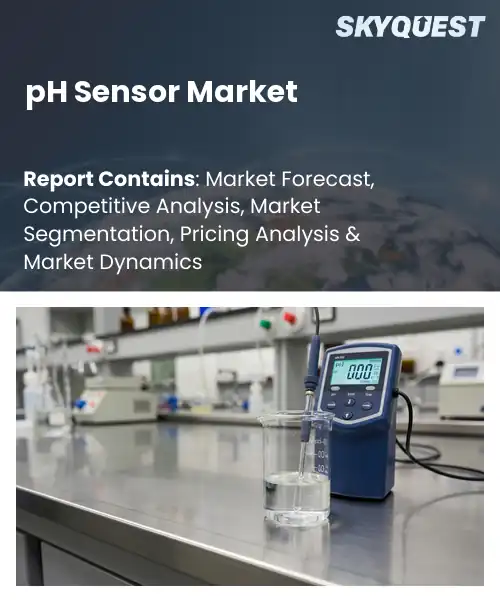
pH Sensor Market
Report ID: SQMIG45N2162
Report ID: SQMIG45N2162
[email protected]
USA +1 351-333-4748
Report ID:
SQMIG45N2162 |
Region:
Global |
Published Date: February, 2026
Pages:
157
|Tables:
175
|Figures:
79


Global pH sensor Market size was valued at USD 1.4 Billion in 2024 and is poised to grow from USD 1.46 Billion in 2025 to USD 2.1 Billion by 2033, growing at a CAGR of 4.6% during the forecast period (2026-2033).
Increasing demand for industrial automation solutions, high emphasis on water quality monitoring, tightening environmental regulations, expansion of pharmaceutical and food processing industries, and advancements in smart sensing technologies are forecasted to boost the adoption of pH sensors in the future.
High emphasis on precise, real-time water and process quality monitoring is expected to primarily drive pH sensor market growth. Precise pH measurement is essential for ensuring product quality, regulatory compliance, and environmental sustainability, necessitates the adoption of pH sensors. With the need for continuous and automated pH monitoring in various industries, wireless pH probes with edge computing and cloud connectivity are becoming more common, replacing manual sampling processes. This is especially true in pharmaceutical and chemical production facilities, wastewater treatment plants, and aquaculture operations, where downtime and response times are reduced, and water quality control is optimized. Stricter discharge standards and the adoption of smart factory concepts are also creating new opportunities for pH sensor vendors.
Conversely, factors such as high installation and maintenance costs, calibration and drift problems associated with sensors, susceptibility to harsh operating conditions, and the availability of low-cost substitutes are slated to impede pH sensor market penetration over the coming years.
How is IoT Technology Impacting Functionality and Adoption of pH Sensors?
IoT-enabled pH sensors are increasingly used in industrial and other types of water testing applications. Modern pH sensors not only give accurate reading but also offer continuous online monitoring, automatic notifications, comprehensive calibration history, and easy connectivity with cloud-based analytics and control solutions. Growing demand for digital and smart solutions across industries is expected to make this a prominent trend in the long run.
Market snapshot - 2026-2033
Global Market Size
USD 1.4 Billion
Largest Segment
Combination Sensors
Fastest Growth
Process Sensors
Growth Rate
4.6% CAGR
To get more insights on this market click here to Request a Free Sample Report
The global pH sensor market is segmented by pH sensor type, component, system type, product type, application, end-use industry, and region. Based on pH sensor type, the market is segmented into combination sensors, differential sensors, laboratory sensors, and process sensors. In terms of categorization by component, the market is segmented into hardware and software. As per classification by system type, the market is segmented into benchtops and portable. Based on product type, the market is segmented into digital and analog. Based on application, the market is segmented into agriculture, food and beverage, water treatment, pharmaceuticals, biotechnology processes, and clinical analysis. Based on end-use industry, the market is segmented into water and wastewater, paper, chemical, oil and gas, medical and pharmaceutical, and metal and mining. Based on region, the market is segmented into North America, Europe, Asia Pacific, Latin America, and Middle East & Africa.
The processes sensors segment is slated to spearhead the global pH sensor market revenue generation in the future. High use of these sensors in wastewater treatment, chemical processing, pharmaceuticals, and food production applications is helping this segment maintain its dominance. Strong integration with control systems and industrial automation platforms is also reinforcing the segment’s high share. Meanwhile, the demand for combination sensors is slated to rise at a robust pace through 2033. Simplified installation and reduced maintenance complexity are the key benefits that help this segment generate new business scope for market players in the future.
The benchtop segment is estimated to hold the largest global pH sensor market share going forward. High stability, accuracy, and advanced calibration capabilities of this segment are helping it hold sway over others. Strong demand from regulated industries requiring stringent documentation and compliance continues to reinforce their leading position. The demand for portable segment is slated to rise at a robust CAGR as per this pH sensor industry analysis. Rising demand for decentralized testing and rapid decision-making in remote or outdoor environments is accelerating growth within this segment.
To get detailed segments analysis, Request a Free Sample Report
Asia Pacific dominates the global pH sensor market because the region combines robust manufacturing ecosystems, concentrated demand from water treatment, semiconductor, pharmaceutical and food processing sectors, and strong research capabilities. Local producers deliver a wide spectrum of sensor types and custom solutions that match regional process requirements and cost expectations. Supportive regulatory frameworks for environmental monitoring and increasing deployment of industrial automation favor sensor adoption. South Korea and Japan bring expertise in advanced materials and electronics integration, which makes them highly attractive markets in this region. Effective supply chain management and proximity to large industrial consumers enable quick cycles of product development and service delivery, solidifying market dominance and encouraging collaborations between equipment suppliers and consumers for customized sensor applications. Cost-effectiveness also draws in more customers.
Japan pH Sensor Market
Robust collaboration between academia and industry and high demand for precision measurement across industries are helping govern pH sensor demand in Japan. pH sensorcompanies in the country are expected to focus on sensor miniaturization, robust materials, and integration with automation platforms. pH sensors that offer maximum uptime and feature superior calibration capabilities are expected to be highly popular among Japanese end users.
South Korea pH Sensor Market
High semiconductor manufacturing and industrial automation is expected to boost the integration of pH sensors with electronic control systems in the country. Local OEMs are also developing compact sensors with high stability, which is suitable for intensive process conditions. Increasing partnerships between manufacturers and integrators is also expected to boost the use of pH sensors in specialized applications across South Korea.
Imposition of stringent environmental and process quality regulations and early adoption of advanced instrumentation solutions make North America an opportune region for pH sensor providers. The majority of pH sensor sales in the region are expected to come from water treatment, pharmaceuticals and food processing sectors. The presence of expansive analytical lab and service support systems for deploying, calibrating and maintaining sensors is also creating new business scope. Availability of robust aftermarket services offered by specialized distributors is also expected to boost confidence of end users in novel pH sensors.
United States pH Sensor Market
Surge in demand for highly accurate instruments in municipal water treatment, pharmaceutical labs and process industries is governing pH sensor sales in the United States. Emphasis on integrated monitoring platforms and remote data management is also expected to increase reliance on pH sensors. PH sensor companies offering comprehensive technical support, customization, and interoperability capabilities are expected to be popular in the country going forward.
Canada pH Sensor Market
High emphasis on improving environmental monitoring across industries and growing water treatment activity are boosting sales of pH sensors in Canada. End users are favoring pH sensors that are ruggedized and durable owing to the harsh cold climates of the country. Joint ventures between equipment suppliers and consulting firms assist in the development of customized monitoring programs, and the need for reliability affects the purchase of pH sensors.
The imposition of stringent environmental regulations and emphasis on technological refinement across industries are shaping the sales of pH sensors across Europe. Manufacturers located in Germany, the UK and France focus on the use of precise materials, the durability of sensors, and the compatibility of these sensors with industrial automation platforms. Cross-border collaboration and launch of new environmental conservation policies are also expected to uplift the sales of pH sensors in the future. European suppliers also provide extensive service options to their buyers, many of whom view long-term reliability, traceability, and ecosystem compliance as primary purchase criteria.
Germany pH Sensor Market
Stringent industrial quality standards and strong engineering sectors are supporting consistent demand for pH sensors in the country. Robust sensor construction, high accuracy, and smooth integration with control systems is highly prized among end users in Germany. Presence of established chemical manufacturing sector in the country is also expected to boost the sales of pH sensor in the long run. pH sensor companies that focus on local technical support, calibration, and long product life are expected to be popular in the country.
United Kingdom pH Sensor Market
Innovation in analytical instrumentation and ties between research institutions and industry players are helping drive pH sensor demand in the United Kingdom. Preference for sensors with user-friendly interfaces, small probes, and compatibility with laboratory information systems is slated to be high in the country. Service agreements and calibration facilities act as a major factor influencing procurement decisions of end users in the country.
France pH Sensor Market
High demand for environmental monitoring, laboratory testing and support for pharmaceutical manufacturing is primarily shaping pH sensor adoption in France. Vendors providing installation services and calibration services are viewed as key differentiators when working with municipal and industrial customers in the country. Demand for traceable measurement solutions with local technical assistance is expected to rise rapidly over the coming years.
To know more about the market opportunities by region and country, click here to
Buy The Complete Report
Expansion of Industrial Monitoring Applications
Increased Use in Pharmaceutical and Food
High Maintenance and Calibration Requirements
Sensor Fouling and Risk of Contamination
Request Free Customization of this report to help us to meet your business objectives.
The pH sensor competitive landscape is defined by consolidation among instrument incumbents and targeted tech-led competition from specialist innovators. Market drivers tied to competition include acquisitions to enter life sciences and water segments, partnerships to embed cloud and analytics, and product differentiation via optical, ISFET and wireless pH technologies—for example recent strategic purchases of niche optical and biopharma pH capabilities and growing platform partnerships across water and life science channels.
IoT and Connectivity Adoption
Nonglass Solid-State Sensors
SkyQuest’s ABIRAW (Advanced Business Intelligence, Research & Analysis Wing) is our Business Information Services team that Collects, Collates, Correlates, and Analyses the Data collected by means of Primary Exploratory Research backed by robust Secondary Desk research.
As per SkyQuest analysis, a key driver escalates the demand for precise real-time water and process quality monitoring across industries, which fuels uptake of robust pH probesand integrated systems. On the other side, the high maintenance and frequent calibration requirements that increase total ownership and slow adoption in resource-constrained environments is considered the key restraint. Asia Pacific holds the dominant position in the global market, supported by strong manufacturing ecosystems, research capabilities,and concentrated industrial demand. The dominating segment is a combination of sensors, whose integrated measuring and reference functions simplify deployment and maintenance. However, IoT-enabled connectivity and analytics convert measurements into actionable insights, enabling remote monitoring, predictive maintenance, and new service-led business models.
On the flip side, factors such as high installation and maintenance costs, calibration of sensors, and low performance in harsh environments are expected to slow down the growth of pH sensors in the coming years. The Asia Pacific market is expected to lead to the demand for pH sensors in the coming years due to the rapid industrialization of the Asia Pacific region and the growth of the pharmaceutical industry. Integration of smart connectivity, wireless telemetry, and cloud-based analytics platforms are estimated to be key trends driving the pH sensor market through 2033.
| Report Metric | Details |
|---|---|
| Market size value in 2024 | USD 1.4 Billion |
| Market size value in 2033 | USD 2.1 Billion |
| Growth Rate | 4.6% |
| Base year | 2024 |
| Forecast period | 2026-2033 |
| Forecast Unit (Value) | USD Billion |
| Segments covered |
|
| Regions covered | North America (US, Canada), Europe (Germany, France, United Kingdom, Italy, Spain, Rest of Europe), Asia Pacific (China, India, Japan, Rest of Asia-Pacific), Latin America (Brazil, Rest of Latin America), Middle East & Africa (South Africa, GCC Countries, Rest of MEA) |
| Companies covered |
|
| Customization scope | Free report customization with purchase. Customization includes:-
|
To get a free trial access to our platform which is a one stop solution for all your data requirements for quicker decision making. This platform allows you to compare markets, competitors who are prominent in the market, and mega trends that are influencing the dynamics in the market. Also, get access to detailed SkyQuest exclusive matrix.
Table Of Content
Executive Summary
Market overview
Parent Market Analysis
Market overview
Market size
KEY MARKET INSIGHTS
COVID IMPACT
MARKET DYNAMICS & OUTLOOK
Market Size by Region
KEY COMPANY PROFILES
Methodology
For the pH Sensor Market, our research methodology involved a mixture of primary and secondary data sources. Key steps involved in the research process are listed below:
1. Information Procurement: This stage involved the procurement of Market data or related information via primary and secondary sources. The various secondary sources used included various company websites, annual reports, trade databases, and paid databases such as Hoover's, Bloomberg Business, Factiva, and Avention. Our team did 45 primary interactions Globally which included several stakeholders such as manufacturers, customers, key opinion leaders, etc. Overall, information procurement was one of the most extensive stages in our research process.
2. Information Analysis: This step involved triangulation of data through bottom-up and top-down approaches to estimate and validate the total size and future estimate of the pH Sensor Market.
3. Report Formulation: The final step entailed the placement of data points in appropriate Market spaces in an attempt to deduce viable conclusions.
4. Validation & Publishing: Validation is the most important step in the process. Validation & re-validation via an intricately designed process helped us finalize data points to be used for final calculations. The final Market estimates and forecasts were then aligned and sent to our panel of industry experts for validation of data. Once the validation was done the report was sent to our Quality Assurance team to ensure adherence to style guides, consistency & design.
Analyst Support
Customization Options
With the given market data, our dedicated team of analysts can offer you the following customization options are available for the pH Sensor Market:
Product Analysis: Product matrix, which offers a detailed comparison of the product portfolio of companies.
Regional Analysis: Further analysis of the pH Sensor Market for additional countries.
Competitive Analysis: Detailed analysis and profiling of additional Market players & comparative analysis of competitive products.
Go to Market Strategy: Find the high-growth channels to invest your marketing efforts and increase your customer base.
Innovation Mapping: Identify racial solutions and innovation, connected to deep ecosystems of innovators, start-ups, academics, and strategic partners.
Category Intelligence: Customized intelligence that is relevant to their supply Markets will enable them to make smarter sourcing decisions and improve their category management.
Public Company Transcript Analysis: To improve the investment performance by generating new alpha and making better-informed decisions.
Social Media Listening: To analyze the conversations and trends happening not just around your brand, but around your industry as a whole, and use those insights to make better Marketing decisions.
REQUEST FOR SAMPLE
 REQUEST FREE CUSTOMIZATION
Global Ph Sensor Market size was valued at USD 1.4 Billion in 2024 and is poised to grow from USD 1.46 Billion in 2025 to USD 2.1 Billion by 2033, growing at a CAGR of 4.6% during the forecast period (2026-2033).
Endress+Hauser Group Services AG, Hamilton Company, Honeywell International, Thermo Fisher Scientific Inc., Yokogawa Electric Corporation, LTH Electronics Ltd., Omega Engineering Inc, Campbell Scientific, Inc., Krohne Messtechnik GmbH, PreSens Precision Sensing GmbH, Schneider Electric, ABB, HACH, Halma Plc, Emerson Electric Co., Metrohm AG, Horiba, Ltd., Ametek, Inc., Mettler-Toledo International Inc., Xylem Inc.
The key driver of the pH Sensor Market is the growing demand for accurate and real-time monitoring of industrial processes, water quality, and environmental parameters. Rising industrial automation, increasing focus on food & beverage safety, and stringent regulatory standards are significantly boosting the adoption of pH sensors globally.
Key trends in the pH Sensor Market include the growing adoption of smart and digital pH sensors with IoT connectivity, increasing use of wireless and real‑time monitoring solutions, advancements in miniaturized and low‑maintenance sensor technologies, and expanding applications in water treatment, food & beverage, and industrial automation.
North America accounted for the largest share in the pH Sensor Market, driven by advanced industrial automation, strong adoption of smart monitoring technologies, stringent environmental and water quality regulations, and high demand from chemical, food & beverage, and pharmaceutical industries in the United States and Canada.


Want to customize this report? This report can be personalized according to your needs. Our analysts and industry experts will work directly with you to understand your requirements and provide you with customized data in a short amount of time. We offer $1000 worth of FREE customization at the time of purchase.
Feedback From Our Clients


 USA (+1) 351-333-4748

