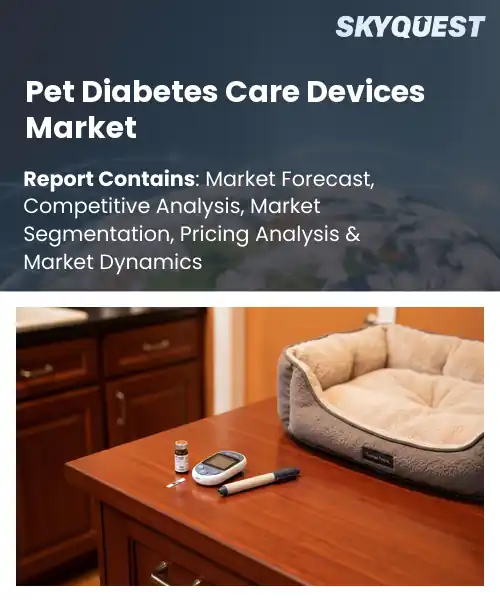
Pet Diabetes Care Devices Market
Report ID: SQMIG35A4014
Report ID: SQMIG35A4014
[email protected]
USA +1 351-333-4748
Report ID:
SQMIG35A4014 |
Region:
Global |
Published Date: June, 2026
Pages:
157
|Tables:
176
|Figures:
79


Global Pet Diabetes Care Devices Market size was valued at USD 2.5 Billion in 2024 and is poised to grow from USD 2.67 Billion in 2025 to USD 4.48 Billion by 2033, growing at a CAGR of 6.7% during the forecast period (2026-2033).
The key factor driving the global pet diabetes care devices market is the growth in the prevalence of diabetes in companion animals owing to the aging population of pets, obesity and more attentive screening by veterinarians. This market, comprising glucose monitors, insulin delivery aids and connected software, together provides for accurate glycemic management for dogs and cats, and is significant because improved monitoring reduces complications, increases life expectancy and reduces overall treatment costs for owners. Over the past ten years, the industry has gone from clinic-only glucometers to pet-specific continuous glucose monitors and telehealth integrations, as shown by the veterinary adoption of modified human CGMs and app-connected insulin pens today.
One of the main drivers for accelerating market growth is technological convergence, with the adoption of compact continuous glucose sensors and smart insulin delivery from human medicine enabling practical at-home monitoring for owners. This enables clinics to offer remote titration services that reduce emergency admissions and extend the lifetime use of devices, attracting manufacturers to subscription consumables and analytics platforms. Real-world examples show owners using CGMs to optimize insulin regimens, avoid frequent clinic sampling and support personalized care. Growth in pet insurance and urban ownership is creating real opportunities for device makers to partner with veterinary services and telehealth providers, and tap into emerging markets, as it generates addressable demand.
How is AI driving innovation in the pet diabetes care devices market?
AI is changing the game in pet diabetes management with continuous sensing and machine learning to turn raw data into actionable insights. Key features include glucose monitoring via wearables, integration of behavioral and environmental signals and predictive analytics to anticipate glucose trends before they become problematic. The current market is shifting from episodic testing to continuous, connected care to enable remote veterinary oversight and easier day-to-day management for owners. This includes renewed commercial interest in pet CGM devices and the rise of AI-enabled pet health ecosystems with a focus on usability, richer insights, and easier clinic workflows.
SATELLAI January 2026 launched Petsense AI, a multimodal pet data model that translates biometrics into actionable health signals. This AI driven capability enhances glucose pattern recognition and remote alerting, which drives market growth and increased efficiency in care delivery.
Market snapshot - (2026-2033)
Global Market Size
USD 2.5 Billion
Largest Segment
Blood Glucose Monitoring Devices
Fastest Growth
Diabetes Management Software & Apps
Growth Rate
6.7% CAGR
To get more insights on this market click here to Request a Free Sample Report
Global pet diabetes care devices market is segmented by by product type, by animal type, by application, by end user, by distribution channel, by technology and region. Based on by product type, the market is segmented into Blood Glucose Monitoring Devices, Insulin Delivery Devices, Diabetes Management Software & Apps and Others. Based on by animal type, the market is segmented into Dogs, Cats and Others. Based on by application, the market is segmented into Blood Glucose Monitoring, Insulin Administration, Diabetes Management & Tracking and Others. Based on by end user, the market is segmented into Veterinary Hospitals, Veterinary Clinics, Homecare Settings, Animal Shelters and Others. Based on by distribution channel, the market is segmented into Veterinary Clinics & Hospitals, Retail Pharmacies, Online Retail and Others. Based on by technology, the market is segmented into Conventional Monitoring Devices, Smart Connected Devices and Wearable Monitoring Devices. Based on region, the market is segmented into North America, Europe, Asia Pacific, Latin America and Middle East & Africa.
The Blood Glucose Monitoring Devices segment accounts for the largest share because these devices are the backbone of diagnosis and monitoring in pet diabetes care, helping veterinarians and pet owners to identify glycemic trends and guide treatment decisions. Their demonstrated clinical reliability, ease of use, widespread acceptance among the veterinary community and integration with routine exams continue to drive demand. Central to ongoing disease management, they are supported by familiar workflows, simpler training requirements and broad availability through clinics and homecare channels.
However, Insulin Delivery Devices is the fastest growing segment as innovations in pens and pumps help owners feel more confident and allow accurate home dosing. Easier ways to offer long-term treatment and better training for vets are fuelling adoption, creating new care models and commercial opportunities for manufacturers and service providers.
Conventional Monitoring Devices segment is dominating the market as these are the proven tools and remains the trusted choice for diagnostic clarity and routine monitoring in veterinary practice. They are simple, robust and fit with existing clinical protocols, which reduces friction for clinic owners and clinics to implement. Reliable performance, straightforward interpretation of results and well understood maintenance requirements all support the steady preference among veterinarians, sustaining procurement and widespread use across clinical and homecare settings.
Meanwhile, Wearable Monitoring Devices are emerging as the key high growth area and continuous real time glucose sensing and remote data sharing allow proactive owner and veterinary management. Adoption for chronic care is driven by improvements in sensor comfort and app integration, leading to new subscription services and long term monitoring opportunities that change treatment pathways.
To get detailed segments analysis, Request a Free Sample Report
North America’s dominance in the global pet diabetes care devices market is due to a confluence of factors such as advanced veterinary infrastructure, early adoption of medical device innovations, strong private investment, and a culture that highly values companion animal health. Well developed networks of specialty veterinary hospitals and clinics provide fertile ground for clinical adoption of continuous monitoring and adjunct management tools. Mature distribution and after sales channels ensure availability and service reliability. Ongoing collaboration among academic centers, veterinary associations, and manufacturers facilitates clinical validation and education of practitioners. This increased appetite from owners for comprehensive chronic disease management and the ease of access to experienced suppliers means a competitive environment for product quality, innovation and integrated care pathways in both the specialty and general practice settings.
United States Pet Diabetes Care Devices Market is marked by a network of specialized veterinary practices and a significant presence of device manufacturers and distributors. Clinical familiarity with monitoring technologies and integrated care pathways facilitate adoption. High owner expectation for advanced care and established professional training stimulate product development. Strong post sales support and channel depth maintain device utilization in both specialty and general practice settings and continuity of care.
The Pet Diabetes Care Devices Market in Canada displays a healthcare landscape with specialist centers in urban areas and growing use of veterinary technology in community clinics. Continuing education and referral networks engagement of practitioners supports diagnosis and long term management. International manufacturers and local distributor networks have improved the accessibility of devices. The focus on owner education and care models encourages routine monitoring, and clinics working together promote uptake and standardization of services.
The rapid expansion in Europe is driven by changing pet care culture, strengthening veterinary standards, and improving market access across national boundaries. Greater focus on companion animal welfare and clinical guidelines supports routine screening and management of chronic disease in the clinic. Select countries have a mature medtech manufacturing base which supports localized supply and product tailoring, and cross border distribution networks enable efficient reach across diverse markets. Professional bodies are investing in the continuing education of their members. Demand from owners for integrated diagnostic and care solutions is growing. Adoption is accelerating. Regulatory harmonization and favorable reimbursement environments in some jurisdictions lower barriers to entry and promote collaborations between clinicians, industry and research institutions that drive innovation and broader clinical uptake.
Pet Diabetes Care Devices Market in Germany represents an established leadership position driven by domestic manufacturing capabilities and high level of clinical expertise in veterinary medicine. A close network of referral hospitals and specialist clinics encourages uptake of monitoring technologies. Professional societies and training programs reinforce protocol-driven management. Industry and institutional collaboration is the basis for product refinement. Quality focused procurement and distribution channels are a characteristic of market maturity.
The United Kingdom Pet Diabetes Care Devices Market is the fastest growing market in Europe owing to digital adoption, wide e commerce reach, and proactive veterinary networks. Remote monitoring and integrated care pathways speed clinician adoption. Demand is driven by the willingness of the owners to pay for better pet care and targeted education campaigns. Practice groups partner with agile startups and global suppliers to extend distribution and support to clinics in urban areas.
Market in France is an emerging segment driven by increased owner awareness and modernization of veterinary practices. Local distributors and global suppliers are bringing flexible monitoring solutions to practice settings. Training practitioners and piloting programs in centers helps show clinical value. Preventive pet health consumer interest and communication from veterinary teams drive increasing acceptance and integration into routine chronic care pathways.
Asia Pacific is solidifying its position through technology specialization, expanding veterinary capacity and a more engaged pet-ownership population. Strong electronics and medtech know-how in key markets is being applied to compact and cost-efficient monitoring devices tailored to regional needs. The rising number of trained veterinary professionals and growing clinic networks improve diagnosis and long term management while agile local manufacturers and startups cut time to market. Digital health platforms and telemedicine models enable remote monitoring and owner engagement, and supplement device adoption. Device makers, e-commerce channels and professional bodies can collaborate across sectors to tailor global innovations to regional clinical and cultural preferences.
Japan Pet Diabetes Care Devices Market is supported by a robust culture of precision engineering and continuous research in veterinary medical technology. The innovation in compact monitoring systems and intuitive user interfaces is driven by established manufacturers and suppliers. Veterinary training programs and clinics across the country are promoting clinical validation and adoption, while owner acceptance of health solutions is supporting market demand. Collaborations between industry and academic centers can result in iterative product development and after sales service networks.
Pet Diabetes Care Devices market is characterized by rapid technology adoption and consumer engagement in connected health solutions. Local electronics expertise allows for the development of compact sensors and integrated mobile platforms. E commerce channels and distribution networks speed up the delivery of products to urban clinics and users. Working together, startups, manufacturers and veterinarians develop tailored device features, and owner education and tech comfort encourage adoption and regular monitoring behaviours.
To know more about the market opportunities by region and country, click here to
Buy The Complete Report
Growing Pet Owner Awareness
Advancements In Monitoring Technologies
High Device and Treatment Costs
Regulatory and Reimbursement Complexity
Request Free Customization of this report to help us to meet your business objectives.
The global pet diabetes devices market is experiencing rising competitive intensity as companies are looking for distribution tie-ups, veterinary-specific product development and technology differentiation to get clinic workflow benefits. Strategic actions include ALR Technologies’ co-branded distribution deal with Covetrus for the GluCurve Pet CGM, Lifecare Veterinary’s spin out and production financing for the Sencell implantable sensor and launches from new entrants including Adapet.
SkyQuest’s ABIRAW (Advanced Business Intelligence, Research & Analysis Wing) is our Business Information Services team that Collects, Collates, Correlates, and Analyses the Data collected by means of Primary Exploratory Research backed by robust Secondary Desk research. As per SkyQuest analysis, a key driver is the rising diabetes prevalence among companion animals driven by aging, obesity and increased screening, while a second driver is rapid technological convergence that brings continuous glucose sensors, smart insulin delivery and AI-enabled analytics into home and clinic care. The dominating region is North America, supported by advanced veterinary infrastructure and early technology adoption. The dominating segment is Blood Glucose Monitoring Devices, which remain the diagnostic backbone despite growth in insulin delivery systems and wearables. A key restraint is the high device and treatment costs that limit uptake among cost-conscious owners and smaller clinics, slowing broader market penetration.
| Report Metric | Details |
|---|---|
| Market size value in 2024 | USD 2.5 Billion |
| Market size value in 2033 | USD 4.48 Billion |
| Growth Rate | 6.7% |
| Base year | 2024 |
| Forecast period | (2026-2033) |
| Forecast Unit (Value) | USD Billion |
| Segments covered |
|
| Regions covered | North America (US, Canada), Europe (Germany, France, United Kingdom, Italy, Spain, Rest of Europe), Asia Pacific (China, India, Japan, Rest of Asia-Pacific), Latin America (Brazil, Rest of Latin America), Middle East & Africa (South Africa, GCC Countries, Rest of MEA) |
| Companies covered |
|
| Customization scope | Free report customization with purchase. Customization includes:-
|
To get a free trial access to our platform which is a one stop solution for all your data requirements for quicker decision making. This platform allows you to compare markets, competitors who are prominent in the market, and mega trends that are influencing the dynamics in the market. Also, get access to detailed SkyQuest exclusive matrix.
Table Of Content
Executive Summary
Market overview
Parent Market Analysis
Market overview
Market size
KEY MARKET INSIGHTS
COVID IMPACT
MARKET DYNAMICS & OUTLOOK
Market Size by Region
KEY COMPANY PROFILES
Methodology
For the Pet Diabetes Care Devices Market, our research methodology involved a mixture of primary and secondary data sources. Key steps involved in the research process are listed below:
1. Information Procurement: This stage involved the procurement of Market data or related information via primary and secondary sources. The various secondary sources used included various company websites, annual reports, trade databases, and paid databases such as Hoover's, Bloomberg Business, Factiva, and Avention. Our team did 45 primary interactions Globally which included several stakeholders such as manufacturers, customers, key opinion leaders, etc. Overall, information procurement was one of the most extensive stages in our research process.
2. Information Analysis: This step involved triangulation of data through bottom-up and top-down approaches to estimate and validate the total size and future estimate of the Pet Diabetes Care Devices Market.
3. Report Formulation: The final step entailed the placement of data points in appropriate Market spaces in an attempt to deduce viable conclusions.
4. Validation & Publishing: Validation is the most important step in the process. Validation & re-validation via an intricately designed process helped us finalize data points to be used for final calculations. The final Market estimates and forecasts were then aligned and sent to our panel of industry experts for validation of data. Once the validation was done the report was sent to our Quality Assurance team to ensure adherence to style guides, consistency & design.
Analyst Support
Customization Options
With the given market data, our dedicated team of analysts can offer you the following customization options are available for the Pet Diabetes Care Devices Market:
Product Analysis: Product matrix, which offers a detailed comparison of the product portfolio of companies.
Regional Analysis: Further analysis of the Pet Diabetes Care Devices Market for additional countries.
Competitive Analysis: Detailed analysis and profiling of additional Market players & comparative analysis of competitive products.
Go to Market Strategy: Find the high-growth channels to invest your marketing efforts and increase your customer base.
Innovation Mapping: Identify racial solutions and innovation, connected to deep ecosystems of innovators, start-ups, academics, and strategic partners.
Category Intelligence: Customized intelligence that is relevant to their supply Markets will enable them to make smarter sourcing decisions and improve their category management.
Public Company Transcript Analysis: To improve the investment performance by generating new alpha and making better-informed decisions.
Social Media Listening: To analyze the conversations and trends happening not just around your brand, but around your industry as a whole, and use those insights to make better Marketing decisions.
REQUEST FOR SAMPLE
 REQUEST FREE CUSTOMIZATION
Global Pet Diabetes Care Devices Market size was valued at USD 2.5 Billion in 2024 and is poised to grow from USD 2.67 Billion in 2025 to USD 4.48 Billion by 2033, growing at a CAGR of 6.7% during the forecast period (2026-2033).
Competitive intensity in the global pet diabetes devices market is increasing as companies pursue distribution partnerships, veterinary specific product development, and technology differentiation to capture clinic workflow advantages. Strategic moves include ALR Technologies’ co branded distribution agreement with Covetrus for the GluCurve Pet CGM, Lifecare Veterinary’s spin off and production funding for the Sencell implantable sensor, and launches from new entrants such as Adapet. 'Zoetis', 'Merck Animal Health', 'Boehringer Ingelheim Animal Health', 'Abbott Laboratories', 'Dexcom', 'Roche Diagnostics', 'i-SENS', 'Trividia Health', 'Medtronic', 'Bayer', 'UltiMed', 'VetMate', 'ALR Technologies', 'Nova Biomedical', 'Ypsomed', 'Allison Medical', 'PetTest', 'Acon Laboratories', 'TaiDoc Technology', 'Apacor'
Rising awareness among pet owners about diabetes and its long-term health implications drives demand for accessible monitoring and management solutions, because informed owners are more likely to seek diagnosis and adopt home-use devices. Educational campaigns, veterinary counseling, and peer-shared experiences increase recognition of symptoms and the perceived value of continuous glucose monitoring and insulin administration aids, prompting purchases. Greater owner engagement encourages regular disease management, sustained device utilization, and preference for technologies that simplify care, thereby expanding market penetration and supporting innovation in product offerings.
Integrated Monitoring Platforms: Adoption of interoperable monitoring ecosystems is driving demand for devices that integrate continuous glucose sensing, cloud connectivity, and veterinary practice workflows. Manufacturers and service providers are prioritizing seamless data sharing, remote monitoring capabilities, and caregiver interfaces that simplify diabetes management for pet owners. This trend encourages partnerships between device developers, software firms, and clinics to deliver end to end care pathways, improve adherence through timely alerts, and enable personalized treatment adjustments without imposing complex operational changes on veterinary clinical teams.
Why does North America Dominate the Global Pet Diabetes Care Devices Market? |@12


Want to customize this report? This report can be personalized according to your needs. Our analysts and industry experts will work directly with you to understand your requirements and provide you with customized data in a short amount of time. We offer $1000 worth of FREE customization at the time of purchase.
Feedback From Our Clients


 USA (+1) 351-333-4748

