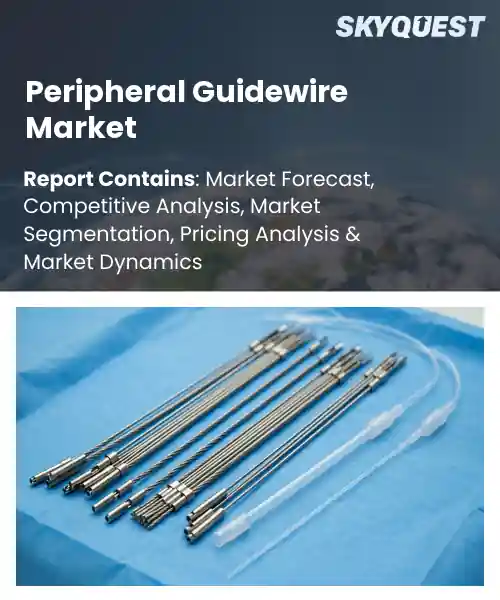
Peripheral Guidewire Market
Report ID: SQMIG35A3826
Report ID: SQMIG35A3826
[email protected]
USA +1 351-333-4748
Report ID:
SQMIG35A3826 |
Region:
Global |
Published Date: June, 2026
Pages:
157
|Tables:
146
|Figures:
78


Global Peripheral Guidewire Market size was valued at USD 2.79 Billion in 2024 and is poised to grow from USD 2.94 Billion in 2025 to USD 4.52 Billion by 2033, growing at a CAGR of 5.5% during the forecast period (2026-2033).
The primary driver of the peripheral guidewire market is the marked increase in peripheral artery disease prevalence combined with a shift to endovascular interventions. Peripheral guidewires are flexible wires used to access and traverse peripheral vessels during angioplasty, stenting and atherectomy, and they matter because they directly influence procedural success, safety and limb salvage rates in patients with critical limb ischemia. Over time the market has evolved from reliance on open surgical bypass toward minimally invasive catheter-based therapies; innovations such as hydrophilic coatings, nitinol cores and dedicated total occlusion wires, with commercialization by firms, have expanded indications and procedure volumes.Building on that clinical shift, a key market factor is rapid technological improvement in guidewire design that drives adoption and creates commercial opportunities. When manufacturers refine tip shapes, core stiffness gradients and hydrophilic coatings, interventionalists can cross tortuous lesions and chronic total occlusions more reliably, which reduces procedure time, contrast use and complication rates; consequently hospitals favor endovascular therapy and procurement volumes rise. Simultaneously growing prevalence of diabetes and peripheral artery disease increases case volumes, producing scale for niche specialty wires and enabling companies to invest in regional expansion, training programs and bundled solutions for complex femoropopliteal and below-the-knee interventions.
How is AI improving procedural accuracy in the peripheral guidewire market?
AI is improving procedural accuracy in the peripheral guidewire market by combining advanced image analysis, sensor fusion and real time decision support that help clinicians navigate tortuous anatomy with greater confidence. Key aspects include automated path planning, live feedback from sensorized guidewires and enhancement of fluoroscopic imaging to clarify vessel geometry. The market is seeing growing integration of AI into devices and procedural workflows as manufacturers and hospitals focus on minimally invasive options and predictable outcomes. Examples range from AI assisted intraprocedural guidance to sensor enabled guidewires and robotic systems that translate algorithmic suggestions into steadier instrument control.Sensome March 2026, announced a proof of concept for its Clotild smart guidewire used with Robocath robotic systems. The device pairs microsensing with AI driven tissue classification to guide wire placement and clot engagement, improving targeting and reducing guesswork which supports market efficiency and broader adoption of peripheral interventions.
Market snapshot - (2026-2033)
Global Market Size
USD 2.79 Billion
Largest Segment
Peripheral Guidewires
Fastest Growth
Neurovascular Guidewires
Growth Rate
5.5% CAGR
To get more insights on this market click here to Request a Free Sample Report
Global peripheral guidewire market is segmented by product, material, by coating type, application, end user and region. Based on product, the market is segmented into Coronary Guidewires, Peripheral Guidewires, Urology Guidewires, Neurovascular Guidewires and Others. Based on material, the market is segmented into Stainless Steel, Nitinol and Others. Based on by coating type, the market is segmented into Hydrophilic Coating, Hydrophobic Coating and Others. Based on application, the market is segmented into Peripheral Vascular Procedures, Coronary Interventions and Others. Based on end user, the market is segmented into Hospitals, Ambulatory Surgical Centers and Specialty Clinics. Based on region, the market is segmented into North America, Europe, Asia Pacific, Latin America and Middle East & Africa.
Nitinol segment dominates because its superelasticity and shape memory enable superior navigability through complex peripheral vasculature, which directly reduces vessel trauma and procedural complications; these mechanical advantages drive clinician preference and manufacturer investment in nitinol-based designs, prompting iterative improvements in tip control and durability and supporting broader adoption across challenging peripheral interventions.
However, Stainless Steel is emerging as the fastest growing material due to renewed interest in its torque control and cost effectiveness, coupled with advances in alloy processing and surface treatments that enhance flexibility and kink resistance; these improvements are widening its application set and encouraging hybrid constructions that create new commercial opportunities.
Hydrophilic Coating segment dominates because its low-friction surface markedly improves deliverability through tortuous peripheral vessels, shortening procedure time and enhancing lesion crossing success; this performance advantage fosters physician preference, encourages pairing with advanced core materials, and stimulates product differentiation and adoption in minimally invasive peripheral interventions where maneuverability and reduced vessel trauma are critical.
Conversely, hydrophobic coating is gaining the strongest growth momentum as innovations in durable, thromboresistant polymers improve tactile feedback and long-term device handling; regulatory acceptance of new biocompatible chemistries and expanding applications demanding controlled surface interaction are accelerating interest and opening pathways for novel guidewire offerings.
To get detailed segments analysis, Request a Free Sample Report
North America commands the global peripheral guidewire market due to an integrated ecosystem that combines advanced clinical expertise, accessible high-quality healthcare infrastructure, and strong institutional procurement practices. A well established network of specialist centers and influential opinion leaders fosters rapid clinical adoption and iterative device refinement. Payer models that enable investment in minimally invasive interventions, coupled with concentrated industry presence and robust regulatory support, facilitate efficient product development and commercialization. Focused investment in training, collaborative clinical research, and post market evidence generation strengthens clinician confidence and informs purchasing decisions. Collaborative relationships between academic centers and industry further accelerate evidence translation and iterative design.
Peripheral Guidewire Market in the United States benefits from concentration of specialty vascular centers, strong clinical trial activity, and close collaboration between device developers and leading clinicians. Well established reimbursement pathways and extensive training programs encourage adoption of novel guidewire designs. Market dynamics favor innovation that addresses complex anatomy and operator preferences, while sophisticated hospital systems provide a receptive environment for new product introduction and scaling through national distribution channels.
Peripheral Guidewire Market in Canada is characterized by integrated provincial procurement and a focus on equitable access across urban and regional centers. Clinician networks and academic hospitals play a central role in validating clinical utility and training. Market uptake emphasizes devices that improve procedural consistency and ease of use for varied practice settings. Collaboration between suppliers and public health institutions supports evaluation and staged adoption aligned with system level priorities.
Europe is experiencing rapid expansion in the peripheral guidewire market driven by a combination of centralized clinical expertise, cross country exchange of best practices, and coordinated investment in minimally invasive vascular care. Strong hospital networks and specialized interventional teams accelerate clinical uptake of refined guidewire technologies that address complex peripheral anatomy. Harmonized regulatory pathways and growing emphasis on value based procurement encourage suppliers to demonstrate clinical benefits and cost effectiveness through collaborative studies. Germany leads with a deep industrial base and high procedural volumes that set clinical benchmarks, while United Kingdom markets show agile adoption bolstered by focused training initiatives and private public partnerships. France exhibits growing research activity and targeted regional programs that position it as an emerging adopter of advanced guidewire solutions.
Peripheral Guidewire Market in Germany is anchored by a robust manufacturing ecosystem and dense network of specialized vascular centers that influence regional clinical practice. Strong collaboration between industry and academic hospitals supports iterative device development and clinical evaluation. Procurement in tertiary hospitals prioritizes advanced guidewire capability through established institutional channels. Germany often functions as a testing ground for complex procedural innovations, creating clinical evidence and expertise that inform European standards.
Peripheral Guidewire Market in the United Kingdom benefits from agile adoption pathways, focused training programs, and active engagement between clinical networks and device innovators. Public and private sector initiatives facilitate skills development and targeted introduction of advanced guidewire designs into specialist units. Focus on outcomes driven procurement and pilot programs enables rapid assessment of clinical value. A strong emphasis on clinician education and multidisciplinary collaboration underpins momentum in procedural adoption.
Peripheral Guidewire Market in France is emerging through targeted clinical research, regional programs, and collaboration between academic centers and medical device companies. Emphasis on procedural training and evidence generation supports integration of new guidewire technology into practice. Hospital groups and specialist clinics are selectively incorporating advanced guidewire options where procedural complexity demands enhanced device performance. Local innovation and focused pilot initiatives are positioning France as a developing market within Europe.
Asia Pacific is strengthening its position in the peripheral guidewire market through concentrated investment in interventional capacity, growing clinical expertise, and an expanding base of local device innovation. Advanced hospital systems in major markets are adopting refined guidewire technologies to address procedural complexity, while national research institutions and industry partnerships accelerate product testing and localization. Emerging regulatory clarity and tailored training initiatives support clinician confidence and informed procurement decisions. Domestic manufacturers focused on design adaptations for regional clinical practice are increasing competition and driving differentiated offerings. Cross border collaborations and targeted pilot programs are enabling faster technology transfer and establishment of regional centers of excellence that collectively elevate the strategic importance of Asia Pacific in the global guidewire landscape. Investment in clinician-led real world studies further supports adoption.
Peripheral Guidewire Market in Japan is shaped by high standards of clinical practice, advanced hospital infrastructure, and a strong domestic medical device sector. Clinician engagement with industry fosters device refinement and careful evaluation in specialized centers. Regulatory frameworks and institutional procurement emphasize quality and demonstrated clinical benefit, encouraging suppliers to focus on precision engineering. Continuous training and collaborative research initiatives support integration of sophisticated guidewire solutions into routine vascular care.
Peripheral Guidewire Market in South Korea is advancing through strong collaboration between innovative device companies and progressive clinical centers. Focus on precision manufacturing enables tailored guidewire solutions for complex procedures. Hospitals with concentrated interventional expertise serve as hubs for clinical evaluation and training. Government research programs and industry partnerships foster technology development and pilot adoption. The resulting environment promotes competitive domestic offerings and growing regional influence in advanced vascular instrumentation.
To know more about the market opportunities by region and country, click here to
Buy The Complete Report
Growing Peripheral Arterial Disease Burden
Technological Innovation and Development
Reimbursement and Cost Constraints
Regulatory Approval and Complexity
Request Free Customization of this report to help us to meet your business objectives.
Competition in the global peripheral guidewire market is intensifying as incumbents and newcomers pursue sensor integration, robotic navigation, and commercial partnerships to differentiate access and procedural insight. Strategic moves include co-development deals and OEM partnerships such as Sensome’s collaboration with Asahi Intecc and Microbot’s technology agreement with Stryker, while startups like Xenter introduce wireless sensor guidewires to challenge legacy device portfolios.
Top Player’s Company Profile
Recent Developments
SkyQuest’s ABIRAW (Advanced Business Intelligence, Research & Analysis Wing) is our Business Information Services team that Collects, Collates, Correlates, and Analyses the Data collected by means of Primary Exploratory Research backed by robust Secondary Desk research. As per SkyQuest analysis, a key driver is the rising prevalence of peripheral arterial disease and the shift to endovascular interventions, which increase procedure volumes and demand for specialized guidewires, while a restraint is reimbursement and cost constraints that limit uptake of premium devices in budget-pressured settings. North America remains the dominating region due to advanced clinical expertise, reimbursement frameworks and concentrated industry presence, and the nitinol segment is the dominating segment because its superelasticity and shape memory enhance navigability in complex vasculature. A second driver is rapid technological innovation in materials, coatings and AI-enabled guidance, which improves procedural success and opens new commercial opportunities for manufacturers and providers.
| Report Metric | Details |
|---|---|
| Market size value in 2024 | USD 2.79 Billion |
| Market size value in 2033 | USD 4.52 Billion |
| Growth Rate | 5.5% |
| Base year | 2024 |
| Forecast period | (2026-2033) |
| Forecast Unit (Value) | USD Billion |
| Segments covered |
|
| Regions covered | North America (US, Canada), Europe (Germany, France, United Kingdom, Italy, Spain, Rest of Europe), Asia Pacific (China, India, Japan, Rest of Asia-Pacific), Latin America (Brazil, Rest of Latin America), Middle East & Africa (South Africa, GCC Countries, Rest of MEA) |
| Companies covered |
|
| Customization scope | Free report customization with purchase. Customization includes:-
|
To get a free trial access to our platform which is a one stop solution for all your data requirements for quicker decision making. This platform allows you to compare markets, competitors who are prominent in the market, and mega trends that are influencing the dynamics in the market. Also, get access to detailed SkyQuest exclusive matrix.
Table Of Content
Executive Summary
Market overview
Parent Market Analysis
Market overview
Market size
KEY MARKET INSIGHTS
COVID IMPACT
MARKET DYNAMICS & OUTLOOK
Market Size by Region
KEY COMPANY PROFILES
Methodology
For the Peripheral Guidewire Market, our research methodology involved a mixture of primary and secondary data sources. Key steps involved in the research process are listed below:
1. Information Procurement: This stage involved the procurement of Market data or related information via primary and secondary sources. The various secondary sources used included various company websites, annual reports, trade databases, and paid databases such as Hoover's, Bloomberg Business, Factiva, and Avention. Our team did 45 primary interactions Globally which included several stakeholders such as manufacturers, customers, key opinion leaders, etc. Overall, information procurement was one of the most extensive stages in our research process.
2. Information Analysis: This step involved triangulation of data through bottom-up and top-down approaches to estimate and validate the total size and future estimate of the Peripheral Guidewire Market.
3. Report Formulation: The final step entailed the placement of data points in appropriate Market spaces in an attempt to deduce viable conclusions.
4. Validation & Publishing: Validation is the most important step in the process. Validation & re-validation via an intricately designed process helped us finalize data points to be used for final calculations. The final Market estimates and forecasts were then aligned and sent to our panel of industry experts for validation of data. Once the validation was done the report was sent to our Quality Assurance team to ensure adherence to style guides, consistency & design.
Analyst Support
Customization Options
With the given market data, our dedicated team of analysts can offer you the following customization options are available for the Peripheral Guidewire Market:
Product Analysis: Product matrix, which offers a detailed comparison of the product portfolio of companies.
Regional Analysis: Further analysis of the Peripheral Guidewire Market for additional countries.
Competitive Analysis: Detailed analysis and profiling of additional Market players & comparative analysis of competitive products.
Go to Market Strategy: Find the high-growth channels to invest your marketing efforts and increase your customer base.
Innovation Mapping: Identify racial solutions and innovation, connected to deep ecosystems of innovators, start-ups, academics, and strategic partners.
Category Intelligence: Customized intelligence that is relevant to their supply Markets will enable them to make smarter sourcing decisions and improve their category management.
Public Company Transcript Analysis: To improve the investment performance by generating new alpha and making better-informed decisions.
Social Media Listening: To analyze the conversations and trends happening not just around your brand, but around your industry as a whole, and use those insights to make better Marketing decisions.
REQUEST FOR SAMPLE
 REQUEST FREE CUSTOMIZATION


Want to customize this report? This report can be personalized according to your needs. Our analysts and industry experts will work directly with you to understand your requirements and provide you with customized data in a short amount of time. We offer $1000 worth of FREE customization at the time of purchase.
Feedback From Our Clients


 USA (+1) 351-333-4748

