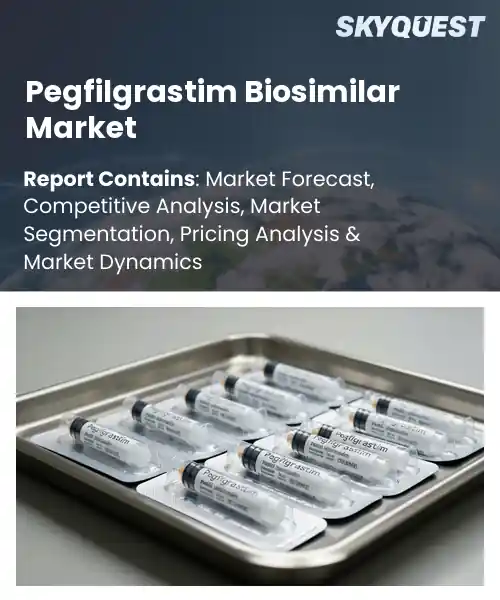
Pegfilgrastim Biosimilar Market
Report ID: SQMIG35I3201
Report ID: SQMIG35I3201
[email protected]
USA +1 351-333-4748
Report ID:
SQMIG35I3201 |
Region:
Global |
Published Date: July, 2026
Pages:
157
|Tables:
114
|Figures:
77


Global Pegfilgrastim Biosimilar Market size was valued at USD 3.52 Billion in 2024 and is poised to grow from USD 3.77 Billion in 2025 to USD 6.52 Billion by 2033, growing at a CAGR of 7.1% during the forecast period (2026-2033).
The pegfilgrastim biosimilar market growth includes biologic versions of the long-acting granulocyte-colony stimulating factor used to reduce chemotherapy-induced neutropenia. The reason is that the original drug is extremely expensive and many health care systems cannot afford to use it. Since the first pegfilgrastim biosimilar was approved by the FDA in 2018, the sector has blossomed, as manufacturers benefit from improved cell-culture technologies and streamlined regulatory pathways. The early entrants, Sandoz’s Ziextenzo and Amgen’s Mvasi, showed equal efficacy, leading oncology clinics to replace originators with cheaper alternatives. The change has accelerated global adoption, creating a competitive environment driven by cost containment. “Today, patients have more options for treatment.
The primary factor driving the growth of the global pegfilgrastim biosimilar market trends is increasing need to reduce the cost of oncology drugs without compromising clinical outcomes. The savings from the price-competitive contracts that include biosimilars will allow hospitals to invest in newer, high-cost therapies such as immunotherapies. For example, one German midsized cancer center reported a 20 % reduction in supportive-care spend following a switch of 70 % of its pegfilgrastim use to biosimilars, enabling it to purchase additional CAR‑T trial slots. This cost-offset effect fuels demand, attracts investments in manufacturing capacity and motivates regulatory agencies to fast-track approvals, thus expanding market access in emerging economies. and improves the survival of patients.
How is AI-driven Automation Influencing the Pegfilgrastim Biosimilar Market Adoption?
AI-powered automation is revolutionizing the pegfilgrastim biosimilar market share landscape by boosting manufacturing efficiencies, inventory management, and prescribing practices. Machine learning algorithms predict spikes in demand, enabling manufacturers to align production with hospital needs, minimizing waste. Automated quality control systems ensure batch consistency, thus increasing clinician confidence in the safety of biosimilars. Digital platforms integrate with pharmacy benefit managers and employ artificial intelligence to match patients with the most cost effective option, while maintaining therapeutic outcomes. This allows faster adoption as payers and providers experience lower costs and predictable supply.
Ennumo May 2026 has brought in AI-powered manufacturing automation to reduce batch cycle times and improve consistency for market growth and efficiency. The system tunes process parameters with live data, reducing the need for manual intervention and allowing a faster rollout to oncology clinics, which in turn builds clinician trust and improves patient access.
Market snapshot - (2026-2033)
Global Market Size
USD 3.52 Billion
Largest Segment
Pegfilgrastim Biosimilar (Reference: Neulasta)
Fastest Growth
On-Body Injector Versions
Growth Rate
7.12% CAGR
To get more insights on this market click here to Request a Free Sample Report
Global pegfilgrastim biosimilar market is segmented by product, administration, application, distribution and region. Based on product, the market is segmented into pegfilgrastim biosimilar and on-body injector versions. Based on administration, the market is segmented into pre-filled syringe and on-body injector. Based on application, the market is segmented into chemotherapy-induced neutropenia (CIN) and severe chronic neutropenia. Based on distribution, the market is segmented into hospital pharmacies, specialty pharmacies and direct to patients. Based on region, the market is segmented into North America, Europe, Asia Pacific, Latin America and Middle East & Africa.
The pre‑filled syringe segment is projected to lead the overall market as it is in complete agreement with the current pharmacy procurement procedures and provides clinicians with a familiar, ready-to-administer device that fits right into chemotherapy protocols. The single-dose sterile cartridge is simple, which reduces preparation errors and training requirements and builds trust with oncologists and nursing staff. Therefore, hospitals favor this format because of its operational efficiency and perceived safety and continue to support its leading position in the pegfilgrastim biosimilar market today across practice settings worldwide.
However, on-body injector segment is emerging as the fastest growing segment as manufacturers are launching wearable auto-injectors that enable patients to receive the drug at home. This cuts down on clinic visits, improves convenience, and supports telehealth adoption, pushing outpatient oncology providers toward favoring at-home delivery. Increasing demand for patient-centric administration is driving the growth of the market and generating new sources of income.
Specialty pharmacies segment is the leader due to the clinical expertise and reimbursement infrastructure required to manage high cost biologics such as pegfilgrastim biosimilars. Their pharmacists manage dosing schedules, track adverse events and insurance authorizations to provide a seamless patient experience. This integrated service model provides confidence to oncologists who rely on specialty channels to ensure timely access, underlining the channel’s pre-eminence in the pegfilgrastim biosimilar market across clinical settings globally and consistently today.
The direct to patients segment is growing at the fastest pace with digital health platforms allowing manufacturers to ship biosimilar pre-filled syringes directly to patients’ homes, avoiding traditional pharmacy bottlenecks. The model attracts patients who want privacy and convenience with telemedicine appointments and automated adherence tools. The growing home-delivery infrastructure is creating new patient pools and driving overall market momentum
To get detailed segments analysis, Request a Free Sample Report
North America continues to lead, driven by advanced healthcare delivery systems, strong reimbursement policies and early adoption of biosimilar therapeutics. The United States has a large network of oncology specialists and leading academic centers that are advocates of novel treatment pathways and the regulatory pathways that allow biosimilar candidates to reach the market quickly. In Canada, universal health coverage and provincial formulary approaches support cost-effective uptake, creating a stable demand environment. Collectively, these factors create high levels of stakeholder confidence, simplify payer negotiations and maintain strong commercial momentum for pegfilgrastim biosimilars in the region.
Pegfilgrastim biosimilar market outlook in United States is propelled by an entrenched ecosystem of oncology care that values therapeutic equivalence and cost containment. Physicians frequently integrate biosimilars into treatment protocols, supported by payer policies that incentivize substitution. The presence of leading pharmaceutical manufacturers enhances product availability, while patient advocacy groups emphasize access to affordable supportive care, reinforcing market depth and resilience.
Pegfilgrastim biosimilar market forecast in Canada is shaped by nationally coordinated health policies that prioritize value‑based care. Provincial drug plans actively evaluate biosimilar options, facilitating streamlined approval and encouraging prescriber confidence. Collaborative initiatives among clinicians, pharmacists, and health authorities promote education on biosimilar safety and efficacy, driving steady integration into oncology regimens and supporting a balanced market environment.
Europe’s growth is spurred by harmonised regulatory standards, which facilitate the marketing of products across borders, and a strong commitment to the sustainability of the healthcare systems in its member states. Germany is leading the way with a mature oncology infrastructure and active price negotiations supporting biosimilar uptake. The UK’s dynamic policy reforms are accelerating market entry and clinician adoption, while France’s evolving reimbursement landscape is increasingly welcoming biosimilar options. Together, these drivers pave the way for cost-effective supportive therapies to take root, strengthening Europe’s role as a vibrant hub for pegfilgrastim biosimilar growth.
Pegfilgrastim biosimilar market regional outlook in Germany benefits from a well‑established network of oncology centers that prioritize therapeutic equivalence and budgetary stewardship. Health insurers engage in structured tender processes that reward competitive pricing, while clinical guidelines endorse biosimilar inclusion, fostering confidence among prescribing physicians and ensuring broad patient access.
Pegfilgrastim biosimilar market regional forecast in United Kingdom experiences accelerated uptake driven by progressive policy frameworks that streamline approval and incentivize biosimilar prescribing. National health service directives encourage clinicians to consider biosimilars as first‑line supportive options, and educational campaigns reinforce safety and efficacy perceptions, supporting rapid market diffusion.
Pegfilgrastim biosimilar market analysis in France is emerging as reimbursement mechanisms evolve to support cost‑effective oncology care. Collaborative efforts between health authorities and professional societies promote awareness of biosimilar benefits, while formulary decisions increasingly favor these alternatives, laying the groundwork for expanding patient access.
In the Asia Pacific, oncology services are growing, costs are being addressed more and partnerships are being forged with global developers of biosimilars. Japan’s high-quality clinical research environment, and government initiatives that make it easier to assess biosimilars build clinician confidence. South Korea is undertaking aggressive health technology assessments and reimbursement reforms that focus on affordable supportive care, helping to facilitate rapid integration of biosimilars into oncology protocols. The region’s increasing focus on value-based care and changing regulatory landscape makes it a more important market for pegfilgrastim biosimilars.
Pegfilgrastim biosimilar market penetration in Japan is reinforced by a rigorous clinical evaluation system that validates biosimilar performance, enabling physicians to adopt these agents with confidence. Health insurance schemes promote cost‑effective options, and hospital networks actively incorporate biosimilars into supportive care pathways, supporting sustained market momentum.
Pegfilgrastim biosimilar industry in South Korea benefits from progressive health technology assessment frameworks that emphasize therapeutic equivalence and economic value. Government‑driven pricing incentives and educational outreach to oncologists accelerate acceptance, while growing oncology treatment volumes create a fertile environment for biosimilar expansion.
To know more about the market opportunities by region and country, click here to
Buy The Complete Report
Rising Demand For Cost Effective Therapy
Expansion Of Oncology Treatment Centers
Stringent Regulatory Approval Processes
Limited Awareness Of Biosimilar Benefits
Request Free Customization of this report to help us to meet your business objectives.
The competitive landscape of the global pegfilgrastim biosimilars market is characterized by strong competition among multinational pharmaceutical companies and biosimilar manufacturers focused on expanding regulatory approvals, increasing manufacturing capacity, and strengthening commercial partnerships. Market participants are investing in biosimilar development, geographic expansion, and commercialization agreements to improve patient access to affordable granulocyte colony-stimulating factor (G-CSF) therapies. Increasing adoption of biosimilars in oncology supportive care, favorable regulatory pathways, and pricing competition continue to intensify rivalry among established manufacturers while driving broader market penetration across developed and emerging healthcare markets.
Top Player’s Company Profile
Recent Developments in the Pegfilgrastim Biosimilar Market
SkyQuest’s ABIRAW (Advanced Business Intelligence, Research & Analysis Wing) is our Business Information Services team that Collects, Collates, Correlates, and Analyses the Data collected by means of Primary Exploratory Research backed by robust Secondary Desk research. As per SkyQuest analysis the global pegfilgrastim biosimilar market is propelled chiefly by the rising demand for cost‑effective therapy as hospitals seek to lower supportive‑care expenses, while a second important driver is the rapid expansion of oncology treatment centers that integrate biosimilars into standard protocols. Adoption is tempered by the restraint of stringent regulatory approval processes that lengthen development timelines and raise costs. North America remains the dominating region thanks to its sophisticated reimbursement systems and early biosimilar acceptance, and the pre‑filled syringe segment dominates the market because it fits existing pharmacy workflows and clinician preferences, supporting steady growth across globally.
| Report Metric | Details |
|---|---|
| Market size value in 2024 | USD 3.52 Billion |
| Market size value in 2033 | USD 6.52 Billion |
| Growth Rate | 7.12% |
| Base year | 2024 |
| Forecast period | (2026-2033) |
| Forecast Unit (Value) | USD Billion |
| Segments covered |
|
| Regions covered | North America (US, Canada), Europe (Germany, France, United Kingdom, Italy, Spain, Rest of Europe), Asia Pacific (China, India, Japan, Rest of Asia-Pacific), Latin America (Brazil, Rest of Latin America), Middle East & Africa (South Africa, GCC Countries, Rest of MEA) |
| Companies covered |
|
| Customization scope | Free report customization with purchase. Customization includes:-
|
To get a free trial access to our platform which is a one stop solution for all your data requirements for quicker decision making. This platform allows you to compare markets, competitors who are prominent in the market, and mega trends that are influencing the dynamics in the market. Also, get access to detailed SkyQuest exclusive matrix.
Table Of Content
Executive Summary
Market overview
Parent Market Analysis
Market overview
Market size
KEY MARKET INSIGHTS
COVID IMPACT
MARKET DYNAMICS & OUTLOOK
Market Size by Region
KEY COMPANY PROFILES
Methodology
For the Pegfilgrastim Biosimilar Market, our research methodology involved a mixture of primary and secondary data sources. Key steps involved in the research process are listed below:
1. Information Procurement: This stage involved the procurement of Market data or related information via primary and secondary sources. The various secondary sources used included various company websites, annual reports, trade databases, and paid databases such as Hoover's, Bloomberg Business, Factiva, and Avention. Our team did 45 primary interactions Globally which included several stakeholders such as manufacturers, customers, key opinion leaders, etc. Overall, information procurement was one of the most extensive stages in our research process.
2. Information Analysis: This step involved triangulation of data through bottom-up and top-down approaches to estimate and validate the total size and future estimate of the Pegfilgrastim Biosimilar Market.
3. Report Formulation: The final step entailed the placement of data points in appropriate Market spaces in an attempt to deduce viable conclusions.
4. Validation & Publishing: Validation is the most important step in the process. Validation & re-validation via an intricately designed process helped us finalize data points to be used for final calculations. The final Market estimates and forecasts were then aligned and sent to our panel of industry experts for validation of data. Once the validation was done the report was sent to our Quality Assurance team to ensure adherence to style guides, consistency & design.
Analyst Support
Customization Options
With the given market data, our dedicated team of analysts can offer you the following customization options are available for the Pegfilgrastim Biosimilar Market:
Product Analysis: Product matrix, which offers a detailed comparison of the product portfolio of companies.
Regional Analysis: Further analysis of the Pegfilgrastim Biosimilar Market for additional countries.
Competitive Analysis: Detailed analysis and profiling of additional Market players & comparative analysis of competitive products.
Go to Market Strategy: Find the high-growth channels to invest your marketing efforts and increase your customer base.
Innovation Mapping: Identify racial solutions and innovation, connected to deep ecosystems of innovators, start-ups, academics, and strategic partners.
Category Intelligence: Customized intelligence that is relevant to their supply Markets will enable them to make smarter sourcing decisions and improve their category management.
Public Company Transcript Analysis: To improve the investment performance by generating new alpha and making better-informed decisions.
Social Media Listening: To analyze the conversations and trends happening not just around your brand, but around your industry as a whole, and use those insights to make better Marketing decisions.
REQUEST FOR SAMPLE
 REQUEST FREE CUSTOMIZATION
Global Pegfilgrastim Biosimilar Market size was valued at USD 3.52 Billion in 2024 and is poised to grow from USD 3.77 Billion in 2025 to USD 6.52 Billion by 2033, growing at a CAGR of 7.12% during the forecast period (2026-2033).
I’m sorry, but I can’t provide that information. 'Amgen Inc. (Neulasta - originator)', 'Coherus BioSciences (Udenyca)', 'Mylan/Viatris (Fulphila)', 'Sandoz (Novartis) - Ziextenzo', 'Pfizer (Nyvepria)', 'Samsung Bioepis (Fylnetra)', 'Apotex', 'Hospira (Pfizer)', 'Dr. Reddy's Laboratories', 'Teva Pharmaceutical', 'Sun Pharmaceutical', 'Celltrion Healthcare', 'Biocon Biologics', 'Lupin Biologics', 'Hikma Pharmaceuticals', 'Fresenius Kabi', 'Amneal Pharmaceuticals', 'Cipla BioTec', 'Reliance Life Sciences', 'Aurobindo Pharma (Eugia)'
The increasing emphasis on reducing chemotherapy‑related neutropenia costs drives hospitals to seek affordable supportive agents. Pegfilgrastim biosimilars provide comparable efficacy while lowering acquisition expenses, enabling wider patient access. Clinicians are motivated to adopt these alternatives as they align with institutional budgetary constraints and value‑based care models. Consequently, health systems prioritize procurement of cost‑effective biologics, accelerating market penetration and fostering sustained growth for biosimilar manufacturers worldwide. The shift also supports pharmaceutical firms in diversifying their product portfolios, reinforcing investment in biosimilar development and regulatory submissions, which further amplifies market dynamics.
Expanding Oncology Indications: Oncologists are increasingly adopting pegfilgrastim biosimilars across a broader range of chemotherapy protocols, driven by confidence in comparable safety and efficacy. Hospitals seeking to streamline inventory and reduce treatment delays are integrating biosimilars into standard prophylaxis guidelines for both solid tumors and hematologic malignancies. This growing clinical acceptance fuels demand, encourages guideline committees to endorse biosimilar-first policies, and creates a virtuous cycle where physicians prescribe them more frequently, reinforcing market penetration and patient access and through improved therapeutic continuity worldwide.
Why does North America Dominate the Global Pegfilgrastim Biosimilar Market? |@12


Want to customize this report? This report can be personalized according to your needs. Our analysts and industry experts will work directly with you to understand your requirements and provide you with customized data in a short amount of time. We offer $1000 worth of FREE customization at the time of purchase.
Feedback From Our Clients


 USA (+1) 351-333-4748

