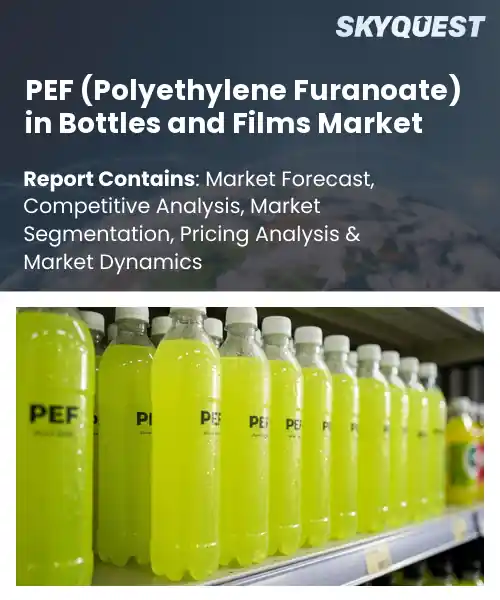
PEF (Polyethylene Furanoate) in Bottles and Films Market
Report ID: SQMIG15E3256
Report ID: SQMIG15E3256
[email protected]
USA +1 351-333-4748
Report ID:
SQMIG15E3256 |
Region:
Global |
Published Date: February, 2026
Pages:
157
|Tables:
93
|Figures:
76


Global Pef (Polyethylene Furanoate) In Bottles And Films Market size was valued at USD 190.5 Million in 2024 and is poised to grow from USD 230.7 Million in 2025 to USD 1067.07 Million by 2033, growing at a CAGR of 21.1% during the forecast period (2026-2033).
The primary driver for polyethylene furanoate (PEF) bottles and films is rising demand for lower‑carbon materials that also deliver stronger barrier performance. Derived from plant sugars, PEF offers markedly improved oxygen and carbon dioxide barriers versus PET, allowing longer shelf life and thinner packages for beverages, food and personal‑care. The market matters because brands and regulators seek lower climate impact alongside reduced product waste. Since early research the technology has moved through pilot plants and commercial trials, with developers and brand partners scaling purification and processing to de‑risk supply chains, demonstrate uses such as long‑life carbonated bottles and film laminates.Building on those demonstrations, the central growth factor for global PEF adoption is the polymer's performance‑sustainability combination driving commercial benefits. Because PEF's superior CO2 and O2 barrier properties extend shelf life, beverage and food brands can thin walls and lower transportation emissions while reducing spoilage costs, which encourages pilot-to-scale production and packaging redesign. As FDCA feedstock and catalytic process scale up, manufacturing costs decline and create opportunities for multilayer films, mono‑material recyclable bottles and high‑barrier labels. Policy incentives for low‑carbon materials and consumer demand for sustainably sourced packaging further accelerate offtake, enabling strategic partnerships between biorefineries, converters and brand owners.
How will AI optimize production efficiency in the PEF bottles and films market?
AI will optimize production efficiency in the PEF, polyethylene furanoate, bottles and films market by improving process control and shortening development cycles. Key aspects include predictive process optimization, real time visual quality inspection, digital twins for line simulation, and smarter supply chain coordination. The market is moving from pilots to early commercial runs with brand testing and scale up pressure, so reducing variability is critical. For instance machine learning can tune polymerization and extrusion parameters to stabilize barrier performance while computer vision finds surface defects before conversion. These applications cut waste, lower energy use, and help manufacturers reach reliable production faster.Avantium May 2025, announced collaboration to integrate PEF into fiber based bottle production, and AI can support that innovation by optimizing molding and liner parameters, predicting maintenance needs, and monitoring barrier quality in real time to speed scale up and improve efficiency.
Market snapshot - (2026-2033)
Global Market Size
USD 190.5 Million
Largest Segment
Monolayer PEF Bottles
Fastest Growth
Biaxially-Oriented PEF Films
Growth Rate
21.1% CAGR
To get more insights on this market click here to Request a Free Sample Report
Global pef (polyethylene furanoate) in bottles and films market is segmented by product type, application, end-use industry and region. Based on product type, the market is segmented into Monolayer PEF Bottles, Multilayer PEF Bottles, Biaxially-Oriented PEF Films, Cast PEF Films and Other Product Types. Based on application, the market is segmented into Bottles and Films. Based on end-use industry, the market is segmented into Food and Beverage, Cosmetics and Personal Care, Pharmaceuticals, Household and Cleaning and Other End-use Industries. Based on region, the market is segmented into North America, Europe, Asia Pacific, Latin America and Middle East & Africa.
Monolayer PEF Bottles segment dominates because its simplicity aligns with existing bottling infrastructure and brand sustainability goals, enabling rapid adoption across beverage producers. The single layer construction reduces processing complexity and facilitates reliable barrier and clarity performance while easing recycling streams, which lowers operational resistance. These practical advantages, combined with growing demand for bio based alternatives and lightweighting benefits, drive manufacturers and fillers to prioritize this format in the PEF bottles and films market.
However, Multilayer PEF Bottles are emerging as the most rapidly expanding area because multilayer construction enables tailored barrier stacks for oxygen and moisture sensitive products and allows functional barrier layers and design differentiation. Innovations in co extrusion and lamination, together with demand for extended shelf life and premium packaging, accelerate adoption and create new commercial opportunities.
Food and Beverage segment dominates because its vast demand for high barrier, clear, and lightweight packaging makes PEF an attractive alternative to traditional polymers. The sector prioritizes shelf life extension, flavor protection, and visible product presentation, which PEF’s inherent barrier and aesthetic properties support. Combined with intense pressure to reduce carbon footprint and adopt bio based materials, these end-use requirements propel rapid incorporation of PEF into bottles and films across diverse food and drink formats.
Meanwhile, Cosmetics and Personal Care is emerging as the fastest growing area because brands seek premium, sustainable packaging that enhances product perception while protecting delicate formulations. PEF’s clarity, barrier properties, and compatibility with decorative finishes enable upscale designs and refillable solutions. Innovation in small batch production and brand driven sustainability commitments accelerate market entry and create high value opportunities.
To get detailed segments analysis, Request a Free Sample Report
Europe leads the global PEF market due to a combination of established chemical manufacturing infrastructure, proactive regulatory frameworks favoring sustainable polymers, and concentrated demand from packaging and specialty films sectors. Strong collaboration among research institutes, pilot plants, and established polymer producers has accelerated commercialization and scale up. Consumer awareness and corporate sustainability commitments have encouraged brand adoption of bio-based alternatives for bottles and films. Integrated supply chains for feedstocks and investment in recycling and circularity initiatives enhance value capture and supply security. Policy incentives and public-private partnerships support pilot commercialization and de-risking of new production routes, while packaging companies and brand owners pilot PEF in premium beverage and specialty packaging applications.
PEF (Polyethylene Furanoate) in Bottles and Films Market Germany has a strong industrial base for polymer production, with advanced R&D centers and pilot facilities supporting material development and scale up. Demand from premium beverage and specialty packaging sectors, alongside commitments from major manufacturers to sustainable materials, drives early adoption. Collaborative initiatives between academia, corporations, and technology providers promote supply chain integration and practical deployment of PEF solutions across packaging portfolios.
PEF (Polyethylene Furanoate) in Bottles and Films Market United Kingdom benefits from active sustainability initiatives, strong brand engagement, and a dynamic packaging innovation ecosystem that favors bio-based polymers. Retailers and beverage companies are exploring PEF for differentiated, eco-conscious packaging. Supportive testing facilities and recycling pilot programs help validate performance and end-of-life pathways. Partnerships among converters, material developers, and brand owners accelerate market trials and commercial adoption across selective packaging segments.
PEF (Polyethylene Furanoate) in Bottles and Films Market France combines strong chemical industry expertise with active sustainability policies and growing appetite for bio-based packaging among food and beverage brands. Research consortia and industrial partnerships focus on adapting PEF for film applications and barrier performance. Pilot production and brand-led trials foster confidence in material properties and supply chain logistics. Emphasis on circular economy approaches encourages investment in recycling and reuse strategies.
Asia Pacific rapid expansion of the PEF market is driven by growing corporate commitments to sustainable packaging, strong industrial capabilities in polymer processing, and active collaboration between local technology developers and global material suppliers. Major packaging converters and beverage brands in key markets are engaging in trials and early commercial use, seeking high-performance bio-based alternatives for both bottles and films. Government initiatives and innovation ecosystems support pilot facilities and industrial partnerships that de-risk scale up, while dense manufacturing clusters and export-oriented supply chains enable efficient scaling. Investment in downstream processing and film conversion technologies ensures performance parity with conventional materials, enabling wider acceptance across retail and industrial segments. Cross-border collaboration with European technology leaders brings knowledge transfer and joint ventures that expedite commercialization.
PEF (Polyethylene Furanoate) in Bottles and Films Market Japan leverages advanced material science, strong packaging chains, close collaboration between beverage brands and converters to advance PEF applications. R&D institutions and pilot facilities focus on achieving required barrier and thermal performance for beverage and food films. Brand-led trials and consumer demand for sustainable packaging stimulate supplier investment. Emphasis on quality control, certification pathways, and integration with recycling systems supports gradual commercialization.
PEF (Polyethylene Furanoate) in Bottles and Films Market South Korea combines established polymer manufacturing capabilities with advanced film conversion expertise, creating conditions for PEF adoption. Large converters and technology providers collaborate with consumer brands to test PEF in bottles and flexible films. Government innovation programs and sustainability agendas support pilot projects and supply chain development. Focus on production efficiency, material performance, and integration into packaging lines underpins growing commercial interest.
North America is strengthening its role in the PEF market through focused investments in research, pilot production, and industry partnerships that de-risk scale up and validate commercial use cases. Major beverage and consumer goods companies are engaging in pilot programs with material developers and converters to evaluate PEF for high-value bottles and barrier films. The region's manufacturing ecosystem, combined with growing interest in circular economy solutions and corporate sustainability goals, supports development of end-to-end supply chains. Cross-sector collaboration among academics, technology startups, and established polymer producers accelerates innovation in feedstock sourcing, conversion technologies, and recycling pathways. State and provincial incentives, combined with private capital, create environments for demonstration facilities and initial commercial runs.
PEF (Polyethylene Furanoate) in Bottles and Films Market United States shows strong interest from major beverage and consumer goods brands seeking high-performance, bio-based packaging solutions. R&D centers, pilot plants, and polymer specialists collaborate with converters to adapt PEF to production lines. Investment from private backers supports demonstration activities. Emphasis on supply chain integration, performance validation, and alignment with recycling systems aims to facilitate commercial trials and adoption across packaging segments.
PEF (Polyethylene Furanoate) in Bottles and Films Market Canada benefits from collaborative industry networks, supportive provincial initiatives, and interest from food and beverage companies exploring sustainable packaging. Research organizations and converters engage in pilot trials to assess film and bottle performance in local logistics and recycling conditions. Emphasis on circular economy principles and supply chain partnerships encourages development efforts. Investment in pilot manufacturing and certification pathways supports cautious commercial engagement.
To know more about the market opportunities by region and country, click here to
Buy The Complete Report
Renewable Feedstock Interest
Performance Advantages Over PET
High Production Scale Challenges
Recycling Infrastructure Limitations
Request Free Customization of this report to help us to meet your business objectives.
Competitive dynamics in the global PEF bottles and films market are concentrated on licensing, capacity reservation and brand offtake deals that allocate feedstock and market access to technology licensors and early converters. Market drivers tied to competition include material-integration pilots and licensing revenue, spurring co development, targeted partnerships and processing innovation. Notable examples include Avantium’s licensed PEF supply agreements and collaborations with the Bottle Collective and Origin Materials.
Top Player’s Company Profile
Recent Developments
SkyQuest’s ABIRAW (Advanced Business Intelligence, Research & Analysis Wing) is our Business Information Services team that Collects, Collates, Correlates, and Analyses the Data collected by means of Primary Exploratory Research backed by robust Secondary Desk research. As per SkyQuest analysis, the global PEF in bottles and films market is being propelled by growing demand for lower carbon materials that pair sustainability with commercial benefits, with a second major driver being PEF’s superior oxygen and carbon dioxide barrier performance which enables shelf life extension and lightweighting. Adoption is led by Europe and primarily through monolayer PEF bottles which align with existing bottling infrastructure and recycling aims. However growth is restrained by high production scale challenges that complicate reliable supply and deter large scale investment. Overall the market outlook is robust as feedstock scaling, policy incentives and brand pilots continue to de risk supply chains and stimulate broader commercial deployment.
| Report Metric | Details |
|---|---|
| Market size value in 2024 | USD 190.5 Million |
| Market size value in 2033 | USD 1067.07 Million |
| Growth Rate | 21.1% |
| Base year | 2024 |
| Forecast period | (2026-2033) |
| Forecast Unit (Value) | USD Million |
| Segments covered |
|
| Regions covered | North America (US, Canada), Europe (Germany, France, United Kingdom, Italy, Spain, Rest of Europe), Asia Pacific (China, India, Japan, Rest of Asia-Pacific), Latin America (Brazil, Rest of Latin America), Middle East & Africa (South Africa, GCC Countries, Rest of MEA) |
| Companies covered |
|
| Customization scope | Free report customization with purchase. Customization includes:-
|
To get a free trial access to our platform which is a one stop solution for all your data requirements for quicker decision making. This platform allows you to compare markets, competitors who are prominent in the market, and mega trends that are influencing the dynamics in the market. Also, get access to detailed SkyQuest exclusive matrix.
Table Of Content
Executive Summary
Market overview
Parent Market Analysis
Market overview
Market size
KEY MARKET INSIGHTS
COVID IMPACT
MARKET DYNAMICS & OUTLOOK
Market Size by Region
KEY COMPANY PROFILES
Methodology
For the PEF (Polyethylene Furanoate) in Bottles and Films Market, our research methodology involved a mixture of primary and secondary data sources. Key steps involved in the research process are listed below:
1. Information Procurement: This stage involved the procurement of Market data or related information via primary and secondary sources. The various secondary sources used included various company websites, annual reports, trade databases, and paid databases such as Hoover's, Bloomberg Business, Factiva, and Avention. Our team did 45 primary interactions Globally which included several stakeholders such as manufacturers, customers, key opinion leaders, etc. Overall, information procurement was one of the most extensive stages in our research process.
2. Information Analysis: This step involved triangulation of data through bottom-up and top-down approaches to estimate and validate the total size and future estimate of the PEF (Polyethylene Furanoate) in Bottles and Films Market.
3. Report Formulation: The final step entailed the placement of data points in appropriate Market spaces in an attempt to deduce viable conclusions.
4. Validation & Publishing: Validation is the most important step in the process. Validation & re-validation via an intricately designed process helped us finalize data points to be used for final calculations. The final Market estimates and forecasts were then aligned and sent to our panel of industry experts for validation of data. Once the validation was done the report was sent to our Quality Assurance team to ensure adherence to style guides, consistency & design.
Analyst Support
Customization Options
With the given market data, our dedicated team of analysts can offer you the following customization options are available for the PEF (Polyethylene Furanoate) in Bottles and Films Market:
Product Analysis: Product matrix, which offers a detailed comparison of the product portfolio of companies.
Regional Analysis: Further analysis of the PEF (Polyethylene Furanoate) in Bottles and Films Market for additional countries.
Competitive Analysis: Detailed analysis and profiling of additional Market players & comparative analysis of competitive products.
Go to Market Strategy: Find the high-growth channels to invest your marketing efforts and increase your customer base.
Innovation Mapping: Identify racial solutions and innovation, connected to deep ecosystems of innovators, start-ups, academics, and strategic partners.
Category Intelligence: Customized intelligence that is relevant to their supply Markets will enable them to make smarter sourcing decisions and improve their category management.
Public Company Transcript Analysis: To improve the investment performance by generating new alpha and making better-informed decisions.
Social Media Listening: To analyze the conversations and trends happening not just around your brand, but around your industry as a whole, and use those insights to make better Marketing decisions.
REQUEST FOR SAMPLE
 REQUEST FREE CUSTOMIZATION


Want to customize this report? This report can be personalized according to your needs. Our analysts and industry experts will work directly with you to understand your requirements and provide you with customized data in a short amount of time. We offer $1000 worth of FREE customization at the time of purchase.
Feedback From Our Clients


 USA (+1) 351-333-4748

