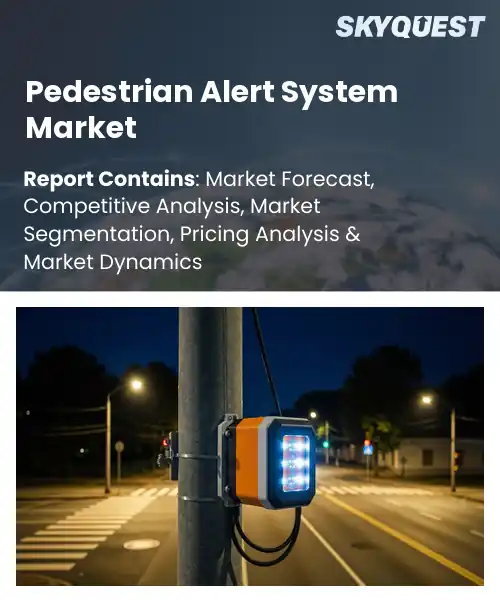
Pedestrian Alert System Market
Report ID: SQMIG25A2917
Report ID: SQMIG25A2917
[email protected]
USA +1 351-333-4748
Report ID:
SQMIG25A2917 |
Region:
Global |
Published Date: August, 2026
Pages:
157
|Tables:
149
|Figures:
78


Global Pedestrian Alert System Market size was valued at USD 1.84 Billion in 2024 and is poised to grow from USD 2.0 Billion in 2025 to USD 3.97 Billion by 2033, growing at a CAGR of 8.9% during the forecast period (2026-2033).
The global pedestrian alert system market comprises technologies that detect and warn drivers of nearby pedestrians, ranging from acoustic beacons to AI‑driven vision sensors integrated into vehicle safety suites. Its importance stems from rising urban congestion and the mounting societal cost of pedestrian fatalities, which have pressured regulators to mandate active protection measures.
The integration of AI analytics emerges as the pivotal growth catalyst, because it transforms raw sensor feeds into predictive alerts that can pre‑empt collisions. Automakers such as Toyota and Volvo have begun embedding neural‑network processors in their driver‑assist modules, enabling classification of pedestrian intent and resulting in lower insurance premiums for fleets that adopt the technology. Consequently, insurers are offering risk‑based discounts, which incentivizes broader deployment across rideshare platforms and public transit buses. This feedback loop expands data ecosystems, attracts investment in edge‑computing hardware, and ultimately accelerates market penetration in both mature and emerging economies.
How is AI and IoT integration shaping the global pedestrian alert system market?
AI and IoT are redefining pedestrian alert systems by merging real time sensor data with predictive analytics. Edge AI processes camera, radar and lidar inputs on the vehicle while IoT connectivity streams updates to cloud platforms that aggregate citywide traffic patterns. This synergy enables alerts that adapt to changing lighting, weather and crowd density making warnings more timely and less intrusive. Manufacturers now embed low power processors that learn from each encounter reducing false alarms and improving driver confidence. Urban planners benefit from aggregated data that highlights high risk crossings guiding infrastructure upgrades. The market is therefore shifting toward integrated software defined solutions that can be upgraded over the air.
Mobileye in June 2024, introduced an AI driven pedestrian detection module that leverages IoT cloud updates to refine its models continuously. The rollout cuts response latency and expands coverage, demonstrating how integrated intelligence accelerates market growth and enhances safety for city commuters.
Market snapshot - (2026-2033)
Global Market Size
USD 1.84 Billion
Largest Segment
Hardware
Fastest Growth
Services
Growth Rate
8.9% CAGR
To get more insights on this market click here to Request a Free Sample Report
Global pedestrian alert system market is segmented by component, vehicle type, alert type, application, end user and region. Based on component, the market is segmented into Hardware, Software and Services. Based on vehicle type, the market is segmented into Passenger Cars, Commercial Vehicles, Electric Vehicles and Hybrid Vehicles. Based on alert type, the market is segmented into Audible Alerts, Visual Alerts, Haptic Alerts and Combined Alerts. Based on application, the market is segmented into Pedestrian Detection, Vehicle Reversing, Low-Speed Maneuvering, Blind-Spot & Cross-Traffic Warning and Others. Based on end user, the market is segmented into Automotive OEMs, Fleet Operators, Commercial Vehicle Operators and Aftermarket. Based on region, the market is segmented into North America, Europe, Asia Pacific, Latin America and Middle East & Africa.
Hardware segment dominates with large global pedestrian alert system market share because it provides the physical sensors and processing units essential for reliable pedestrian detection, and manufacturers prioritize robust durable components to meet safety standards. The tangible nature of hardware facilitates compliance testing integration with vehicle architecture and scalability across model lines, driving strong adoption among original equipment manufacturers. Its proven performance under diverse environmental conditions reinforces its leadership in the pedestrian alert system market global automotive industry market.
As per global pedestrian alert system market outlook, software segment is witnessing the fastest growth because advances in artificial intelligence enable more accurate pedestrian classification and adaptive alert logic, reducing false alarms. Integration with cloud platforms supports over the air updates, while developers capitalize on modular architectures to create customizable solutions, expanding appeal across vehicle families.
As per global pedestrian alert system market forecast, audible alerts segment dominates because drivers instinctively respond to sound cues, making audible signals the most reliable method for immediate warning during reverse and low speed maneuvers. Regulatory bodies often mandate audible warnings to complement visual systems, ensuring compliance across jurisdictions. The simplicity of acoustic devices facilitates integration with existing vehicle electronics, while their cost effectiveness enhances adoption by manufacturers seeking universal safety solutions for pedestrian protection worldwide in all markets.
Meanwhile, combined alerts segment emerges as the fastest growing because it merges acoustic visual and haptic cues to create a multimodal warning that addresses diverse driver preferences and accessibility needs. This integration improves detection reliability in noisy environments, prompting manufacturers to prioritize combined solutions as a competitive differentiator in future vehicle designs.
To get detailed segments analysis, Request a Free Sample Report
North America leads the global pedestrian alert system market because of a confluence of mature technology ecosystems, proactive safety regulations, and deep integration of advanced driver assistance features within vehicle platforms. The United States and Canada benefit from strong collaboration between automotive manufacturers, technology providers, and municipal authorities, fostering rapid deployment of sensor‑rich solutions in dense urban corridors. Robust funding mechanisms and a culture of liability awareness encourage early adoption by both public and private sectors. Additionally, the region’s extensive research infrastructure accelerates innovation in computer vision, lidar and connectivity, ensuring that new alert capabilities are continuously refined. Consumer demand for safer walking environments further reinforces market momentum, positioning North America as the benchmark for comprehensive pedestrian protection strategies. This ecosystem of collaboration and innovation sustains its leadership position.
As per global pedestrian alert system market regional outlook, United States is shaped by extensive deployment of smart city initiatives and a strong emphasis on reducing traffic fatalities. Leading automotive OEMs integrate sophisticated sensor arrays into new vehicle lines, while municipal agencies pilot networked crosswalk solutions that communicate directly with drivers. Academic research centers contribute cutting‑edge algorithms, and insurance providers incentivize adoption through risk‑based pricing models, creating a virtuous cycle of safety enhancement.
As per global pedestrian alert system market regional forecast, Canada benefits from coordinated federal and provincial safety frameworks that prioritize vulnerable road users. Collaborative projects between technology firms and city planners focus on integrating real‑time alert beacons within high‑traffic corridors. Research institutions advance machine‑learning detection techniques tailored to diverse weather conditions, while public transit agencies adopt system upgrades to protect passengers at stations. This multi‑stakeholder approach reinforces a culture of proactive safety management nationwide.
Europe’s rapid expansion of the market is propelled by a cohesive regulatory environment that emphasizes pedestrian safety across the continent. Harmonized standards encourage manufacturers to embed advanced detection technologies into vehicle designs, while urban planners integrate alert infrastructure into evolving smart city frameworks. Strong commitment to sustainable mobility drives investment in low‑impact, energy‑efficient sensor networks. Collaborative research hubs in Germany, the United Kingdom and France generate cutting‑edge algorithms that address diverse traffic scenarios. Public awareness campaigns reinforce demand for protective solutions, and funding mechanisms support pilot deployments in dense city centers. This blend of policy alignment, technological excellence and societal focus positions Europe as a leading incubator for next‑generation pedestrian safety innovations. The collaborative spirit among member states further accelerates standard adoption and market diffusion.
Germany is anchored by a robust automotive engineering tradition and strong governmental safety mandates. Leading manufacturers embed high‑precision lidar and camera suites into vehicle platforms, while federal programs fund city‑wide sensor deployments at critical intersections. Universities collaborate with industry to refine detection algorithms for complex urban environments. This synergy creates a reliable ecosystem that supports widespread adoption across both new vehicle fleets and legacy retrofits.
United Kingdom is experiencing growth driven by city safety agendas and proactive legislative frameworks. Public transport authorities integrate alert beacons within bus and tram networks, while private sector pilots advanced driver assistance modules on highways. Research institutions focus on AI‑driven perception models that perform reliably in variable weather. Funding schemes encourage partnerships, accelerating the rollout of comprehensive pedestrian protection solutions across metropolitan zones nationwide.
France is emerging through coordinated urban renewal projects and targeted safety incentives. Municipalities embed compact alert devices along historic streets, balancing preservation with modern protection. Automotive firms collaborate with research labs to adapt detection systems for narrow lanes and mixed traffic. Government subsidies support pilot programs in cities, fostering broader acceptance. This integrated approach nurtures a growing ecosystem that aligns heritage conservation with pedestrian safety.
Asia Pacific is strengthening its position in the market through a dynamic blend of rapid urban growth, forward‑looking government policies and a world‑class electronics manufacturing base. Nations such as Japan and South Korea prioritize smart‑city deployments that embed sensor networks along crowded walkways, while simultaneously advancing autonomous vehicle platforms that rely on precise pedestrian detection. Public‑private partnerships accelerate the translation of cutting‑edge research from university labs into commercial products. Strong export capabilities enable regional firms to supply components globally, reinforcing a feedback loop of innovation. Consumer expectations for safe, connected mobility further drive adoption, creating a virtuous cycle that elevates the region’s influence in shaping next‑generation pedestrian safety standards. Regional standards bodies collaborate to harmonize protocols, ensuring interoperability across borders and accelerating market penetration.
Japan is driven by a strong emphasis on safety culture and advanced robotics expertise. Automotive manufacturers integrate high‑resolution lidar and AI‑based vision systems into both conventional and electric models. Municipalities deploy networked crosswalk beacons that communicate with nearby vehicles, enhancing real‑time awareness. Collaboration between research universities and industry accelerates algorithm refinement for complex urban environments, fostering widespread acceptance across densely populated corridors and public spaces.
South Korea benefits from a vibrant semiconductor sector and aggressive smart‑city initiatives. Vehicle makers embed compact radar and deep‑learning cameras to achieve rapid pedestrian recognition. City planners install interactive alert panels at high‑traffic intersections, linking them to centralized traffic management hubs. Government grants support startups developing edge‑computing solutions, while academic collaborations refine detection accuracy under diverse weather conditions, driving broad market uptake for public safety.
To know more about the market opportunities by region and country, click here to
Buy The Complete Report
Urban Growth Boosts Adoption
Increasing Awareness Reduces Accidents
High Installation Costs Limit Deployment
Privacy Concerns Restrict Data Use
Request Free Customization of this report to help us to meet your business objectives.
Competitive dynamics in the global pedestrian alert system industry are intensified by OEMs and technology firms racing to embed advanced safety features. Mobileye’s partnership with BMW to integrate its EyeQ‑based pedestrian warning into upcoming models, Bosch’s collaboration with Nvidia for AI‑driven detection chips, and Valeo’s acquisition of Israeli lidar specialist LidarTech illustrate how M&A, strategic alliances and rapid tech innovation are shaping market leadership.
SkyQuest’s ABIRAW (Advanced Business Intelligence, Research & Analysis Wing) is our Business Information Services team that Collects, Collates, Correlates, and Analyses the Data collected by means of Primary Exploratory Research backed by robust Secondary Desk research.
As per SkyQuest analysis, the global pedestrian alert system market growth driven first by rapid urban growth that pushes municipalities to embed sensor‑rich safety solutions in traffic networks. A second driver is rising public awareness of pedestrian‑vehicle collisions, which fuels demand for advanced warning technologies. The hardware segment, providing sensors and processing units, remains the dominant share, while North America leads the market due to mature tech ecosystems, proactive regulations and strong OEM adoption. However, high installation costs act as a restraint, slowing rollout in budget‑constrained cities and limiting overall penetration. The global pedestrian alert system market trend is being driven primarily by the rapid adoption of electric and hybrid vehicles, which operate much more quietly than conventional vehicles at low speeds.
| Report Metric | Details |
|---|---|
| Market size value in 2024 | USD 1.84 Billion |
| Market size value in 2033 | USD 3.97 Billion |
| Growth Rate | 8.9% |
| Base year | 2024 |
| Forecast period | (2026-2033) |
| Forecast Unit (Value) | USD Billion |
| Segments covered |
|
| Regions covered | North America (US, Canada), Europe (Germany, France, United Kingdom, Italy, Spain, Rest of Europe), Asia Pacific (China, India, Japan, Rest of Asia-Pacific), Latin America (Brazil, Rest of Latin America), Middle East & Africa (South Africa, GCC Countries, Rest of MEA) |
| Companies covered |
|
| Customization scope | Free report customization with purchase. Customization includes:-
|
To get a free trial access to our platform which is a one stop solution for all your data requirements for quicker decision making. This platform allows you to compare markets, competitors who are prominent in the market, and mega trends that are influencing the dynamics in the market. Also, get access to detailed SkyQuest exclusive matrix.
Table Of Content
Executive Summary
Market overview
Parent Market Analysis
Market overview
Market size
KEY MARKET INSIGHTS
COVID IMPACT
MARKET DYNAMICS & OUTLOOK
Market Size by Region
KEY COMPANY PROFILES
Methodology
For the Pedestrian Alert System Market, our research methodology involved a mixture of primary and secondary data sources. Key steps involved in the research process are listed below:
1. Information Procurement: This stage involved the procurement of Market data or related information via primary and secondary sources. The various secondary sources used included various company websites, annual reports, trade databases, and paid databases such as Hoover's, Bloomberg Business, Factiva, and Avention. Our team did 45 primary interactions Globally which included several stakeholders such as manufacturers, customers, key opinion leaders, etc. Overall, information procurement was one of the most extensive stages in our research process.
2. Information Analysis: This step involved triangulation of data through bottom-up and top-down approaches to estimate and validate the total size and future estimate of the Pedestrian Alert System Market.
3. Report Formulation: The final step entailed the placement of data points in appropriate Market spaces in an attempt to deduce viable conclusions.
4. Validation & Publishing: Validation is the most important step in the process. Validation & re-validation via an intricately designed process helped us finalize data points to be used for final calculations. The final Market estimates and forecasts were then aligned and sent to our panel of industry experts for validation of data. Once the validation was done the report was sent to our Quality Assurance team to ensure adherence to style guides, consistency & design.
Analyst Support
Customization Options
With the given market data, our dedicated team of analysts can offer you the following customization options are available for the Pedestrian Alert System Market:
Product Analysis: Product matrix, which offers a detailed comparison of the product portfolio of companies.
Regional Analysis: Further analysis of the Pedestrian Alert System Market for additional countries.
Competitive Analysis: Detailed analysis and profiling of additional Market players & comparative analysis of competitive products.
Go to Market Strategy: Find the high-growth channels to invest your marketing efforts and increase your customer base.
Innovation Mapping: Identify racial solutions and innovation, connected to deep ecosystems of innovators, start-ups, academics, and strategic partners.
Category Intelligence: Customized intelligence that is relevant to their supply Markets will enable them to make smarter sourcing decisions and improve their category management.
Public Company Transcript Analysis: To improve the investment performance by generating new alpha and making better-informed decisions.
Social Media Listening: To analyze the conversations and trends happening not just around your brand, but around your industry as a whole, and use those insights to make better Marketing decisions.
REQUEST FOR SAMPLE
 REQUEST FREE CUSTOMIZATION
Global Pedestrian Alert System Market size was valued at USD 1.84 Billion in 2024 and is poised to grow from USD 2.0 Billion in 2025 to USD 3.97 Billion by 2033, growing at a CAGR of 8.9% during the forecast period (2026-2033).
Competitive dynamics in the global pedestrian alert system market are intensified by OEMs and technology firms racing to embed advanced safety features. Mobileye’s partnership with BMW to integrate its EyeQ‑based pedestrian warning into upcoming models, Bosch’s collaboration with Nvidia for AI‑driven detection chips, and Valeo’s acquisition of Israeli lidar specialist LidarTech illustrate how M&A, strategic alliances and rapid tech innovation are shaping market leadership. 'Robert Bosch GmbH', 'Continental AG', 'ZF Friedrichshafen AG', 'Aptiv PLC', 'Valeo SE', 'DENSO Corporation', 'Magna International Inc.', 'Autoliv Inc.', 'Aisin Corporation', 'Hyundai Mobis Co., Ltd.', 'Panasonic Holdings Corporation', 'Harman International Industries, Incorporated', 'Mobileye Global Inc.', 'Gentex Corporation', 'Forvia SE', 'Veoneer Safety Systems, Inc.', 'Hitachi Astemo, Ltd.', 'NVIDIA Corporation', 'Qualcomm Incorporated', 'Sony Semiconductor Solutions Corporation'
Cities worldwide are investing heavily in connected infrastructure, and pedestrian alert systems are becoming integral components of traffic management networks. This integration allows real‑time communication between vehicles and pedestrians, enhancing safety perceptions and encouraging municipalities to prioritize such technologies. Consequently, public sector budgets allocate resources for pilot projects and full‑scale rollouts, creating a supportive environment that accelerates market expansion through broader acceptance and sustained demand across urban corridors and reinforcing the overall resilience of transportation ecosystems in city environments for sustainable mobility and fostering community confidence.
Smart City Integration: Municipal planners are embedding pedestrian alert systems into broader smart‑city infrastructures, linking them with traffic management platforms, connected streetlights, and real‑time data hubs. This convergence enables dynamic risk assessment, where alerts adapt to changing traffic patterns, weather conditions, and crowd densities. As cities prioritize multimodal mobility and safety, manufacturers are collaborating with urban authorities to ensure seamless interoperability, fostering ecosystems that enhance situational awareness for drivers, cyclists, and pedestrians alike, ultimately reducing accidents and supporting sustainable urban growth. Community resilience.
Why does North America Dominate the Global Pedestrian Alert System Market? |@12


Want to customize this report? This report can be personalized according to your needs. Our analysts and industry experts will work directly with you to understand your requirements and provide you with customized data in a short amount of time. We offer $1000 worth of FREE customization at the time of purchase.
Feedback From Our Clients


 USA (+1) 351-333-4748

