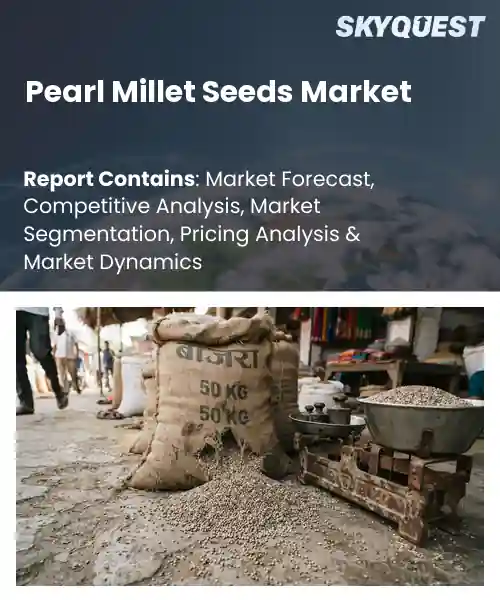
Pearl Millet Seeds Market
Report ID: SQMIG30H2607
Report ID: SQMIG30H2607
[email protected]
USA +1 351-333-4748
Report ID:
SQMIG30H2607 |
Region:
Global |
Published Date: November, 2026
Pages:
157
|Tables:
144
|Figures:
78


Global Pearl Millet Seeds Market size was valued at USD 1.45 Billion in 2024 and is poised to grow from USD 1.53 Billion in 2025 to USD 2.29 Billion by 2033, growing at a CAGR of 5.2% during the forecast period (2026-2033).
The global pearl millet seed market comprises the production, trade, and distribution of certified seeds for the cereal that feeds over 200 million people in arid regions. Its significance stems from the crop’s ability to sustain livelihoods where wheat or rice cannot thrive, making it an asset for food security and agriculture. Historically, seed availability was limited to informal farmer exchanges, but the decades have witnessed a shift toward breeding programs, partnerships, and subsidies. For instance, India’s National Millet Mission launched in 2018, and Ethiopia’s seed hub in 2021 accelerated the shift from traditional to certified seed use, expanding market volume. Rising demand for climate‑smart crops drives the pearl millet seed market because governments and agribusinesses need varieties that tolerate heat, drought, and poor soils while maintaining yields. This pressure has spurred hybrid development, illustrated by ICRISAT’s 2020 release of drought‑resistant hybrids that lifted farmer productivity by 15 percent in semi‑arid India. As a result, seed firms are extending distribution into Africa’s Sahel, where the UN’s Food and Agriculture Organization pledged $120 million for millet seed kits, creating an export pipeline. The synergy of policy support, private R&D, and proven yield gains expands the market and invites digital platforms to offer precision‑seed advice, accelerating adoption.
How is AI influencing yield optimization in the Pearl millet seeds market?
Artificial intelligence is reshaping how producers maximize pearl millet yields by turning massive data streams into actionable insights. Machine learning models ingest satellite imagery, soil sensors and historic climate patterns to recommend precise sowing windows and optimal seed rates. Breeders use AI enabled phenotyping tools to evaluate thousands of genetic lines faster, selecting traits that thrive under drought or low input conditions. In the Indian and African rain fed zones where pearl millet is a staple, farms are adopting mobile apps that combine weather forecasts with field data to guide fertilizer and irrigation decisions. These technologies reduce guesswork, improve resource use and lift productivity while keeping costs low.Syngenta March 2024, launched an AI driven platform that predicts the best planting density for pearl millet based on satellite soil moisture maps and local weather trends. The tool helps smallholder farmers in the region achieve higher grain counts significantly and supports faster adoption of improved seed varieties across the market.
Market snapshot - (2026-2033)
Global Market Size
USD 1.45 Billion
Largest Segment
Hybrid Seeds
Fastest Growth
Hybrid Seeds
Growth Rate
5.2% CAGR
To get more insights on this market click here to Request a Free Sample Report
Global pearl millet seeds market is segmented by seed type, trait, treatment, distribution channel, end user and region. Based on seed type, the market is segmented into Hybrid Seeds and Open-Pollinated Varieties. Based on trait, the market is segmented into Conventional Seeds, Drought-Tolerant Seeds, Disease-Resistant Seeds and Biofortified Seeds. Based on treatment, the market is segmented into Treated Seeds and Untreated Seeds. Based on distribution channel, the market is segmented into Agricultural Input Dealers, Seed Companies & Distributors, Cooperatives and Online Agricultural Platforms. Based on end user, the market is segmented into Commercial Farmers, Smallholder Farmers and Research Institutions. Based on region, the market is segmented into North America, Europe, Asia Pacific, Latin America and Middle East & Africa.
Hybrid Seeds segment dominates because they combine superior yield potential with agronomic consistency, meeting the performance expectations of commercial growers. Their genetic uniformity simplifies crop management, while seed companies invest heavily in breeding programs that lock in heterosis advantages. This reliability drives preferential sourcing by input dealers and creates a trust loop that reinforces market share, making hybrid offerings the preferred choice for scaling millet production throughout the value chain.
Meanwhile, Open Pollinated Varieties segment emerges as the key high growth area because growers seek cost effective options that retain adaptability to diverse agro ecologies. Renewed interest in seed saving and local seed systems fuels demand, while breeding advances improve resilience, accelerating adoption and unlocking market niches for millet cultivation across regions.
Drought Tolerant Seeds segment dominates because they address the principal production risk in rain fed millet systems, allowing farmers to maintain yields under water scarcity. Their physiological traits reduce wilting and improve root efficiency, which builds confidence among growers. Breeding programs prioritize these traits, and input providers highlight them in promotional packages, reinforcing a perception of climate resilience that drives preferential purchasing decisions across the market for smallholder and commercial.
Conversely, Biofortified Seeds segment is witnessing the strongest growth momentum as nutrition focused policies elevate the value of micronutrient rich millet. Consumer awareness of iron and zinc deficiencies fuels demand for enriched grain, prompting seed firms to accelerate biofortification pipelines. This creates a premium market, encouraging investment and expanding the seed portfolio.
To get detailed segments analysis, Request a Free Sample Report
Asia Pacific leads the global Pearl Millet Seeds market through a combination of extensive agronomic expertise, diversified climate zones, and strong governmental emphasis on food security. The region benefits from a deep-rooted tradition of millet cultivation, which supports a robust supply chain and research ecosystem. Advanced breeding programs and collaborative public‑private initiatives drive continuous improvement in seed quality, resilience, and yield potential. Consumer preference for millet as a climate‑smart crop further reinforces demand, while export-oriented logistics and strategic trade corridors enable the region to supply emerging markets efficiently. These converging factors create a competitive advantage that sustains Asia Pacific’s dominant position in the global landscape.
Pearl Millet Seeds Market in Japan is shaped by growing interest in specialty grains for health‑focused food products. Research institutions are actively exploring millet’s nutritional benefits, fostering collaborations with seed developers. Consumer trends toward plant‑based diets and functional foods encourage adoption of millet varieties, while government programs promote diversification of staple crops to enhance agricultural resilience. The market responds with a focus on high‑quality, locally adapted seeds that meet stringent safety standards.
Pearl Millet Seeds Market in South Korea is driven by rising awareness of sustainable agriculture and the nutritional profile of millet. Academic partnerships are intensifying research on drought‑tolerant seed lines suited to the nation’s varied topography. Policy incentives encourage farmers to integrate millet into crop rotations, supporting soil health and reducing reliance on water‑intensive cereals. The market reflects a strategic push toward seed innovations that align with environmental goals and consumer demand for wholesome grain options.
Europe’s Pearl Millet Seeds market is expanding rapidly due to heightened focus on sustainable farming practices and the search for climate‑resilient crops. The continent’s stringent environmental regulations and subsidies for low‑input agriculture promote millet as an attractive alternative to resource‑heavy cereals. Collaborative research across academic and commercial entities accelerates development of seed varieties with enhanced nutritional value and agronomic performance. Consumer appetite for specialty whole grains and gluten‑free products further fuels demand, while supply chain efficiencies and trade agreements facilitate broader market access. These dynamics collectively underpin Europe’s swift market growth.
Pearl Millet Seeds Market in Germany is emerging as agronomists explore millet’s role in crop diversification and soil conservation. Research initiatives focus on breeding seeds that thrive in the country’s temperate zones while reducing fertilizer dependence. Policy frameworks encouraging low‑input farming provide incentives for farmers to trial millet, supporting a gradual increase in cultivated area. The market responds with a portfolio of adaptable seed options targeting sustainable agricultural practices.
Pearl Millet Seeds Market in United Kingdom is experiencing the fastest growth, propelled by strong consumer demand for health‑forward grains and a national agenda for climate‑smart agriculture. Innovation hubs are accelerating development of high‑yield, disease‑resistant millet seeds suitable for British soils. Government schemes that reward reduced water use and carbon footprints make millet an attractive crop for diversified farms. The market reflects a rapid influx of seed products designed to meet both producer needs and emerging market trends.
Pearl Millet Seeds Market in France holds a dominant position due to longstanding cultivation traditions and advanced seed research capabilities. French agricultural institutes prioritize breeding programs that enhance millet’s adaptability to varied regional climates and improve nutritional attributes. Strong domestic consumption of millet‑based foods supports a robust demand pipeline, while export opportunities expand the market’s reach. The sector benefits from coordinated efforts between seed companies and policy makers to foster sustainable production pathways.
North America is strengthening its Pearl Millet Seeds market through a blend of research investment, strategic crop diversification, and growing consumer interest in alternative grains. Collaborative initiatives among universities, biotechnology firms, and farming cooperatives are accelerating the development of seed varieties tailored to the continent’s diverse agro‑ecological zones. Policy encouragement of climate‑resilient cropping systems aligns with farmer incentives to incorporate millet into rotations, enhancing soil health and reducing input costs. Meanwhile, rising demand for nutritious, gluten‑free ingredients fuels market expansion, prompting seed suppliers to broaden portfolios with high‑performance options. These concerted efforts elevate North America’s role in the global market.
Pearl Millet Seeds Market in United States is characterized by intensive research aimed at optimizing seed performance across the country's varied climates. Extension services and private seed firms collaborate to develop varieties with superior drought tolerance and grain quality, targeting both feed and food sectors. Consumer trends toward health‑oriented grains drive interest among growers, while sustainability programs encourage integration of millet into diversified cropping systems. The market is responding with an expanding range of seed offerings that meet both producer and consumer expectations.
Pearl Millet Seeds Market in Canada benefits from a focus on resilient cropping solutions suited to cooler growing regions. Agricultural research centers prioritize breeding seed lines that can thrive under shorter growing seasons and variable moisture conditions. Governmental support for climate‑adapted agriculture encourages farmers to adopt millet as part of sustainable rotation strategies. The market reflects a growing portfolio of seed products designed to enhance yield stability while aligning with environmental stewardship goals.
To know more about the market opportunities by region and country, click here to
Buy The Complete Report
Growing Demand for Climate Resilient Crops
Government Support for Sustainable Agriculture
Limited Access to Quality Seed Supplies
High Cost of Certified Seed Production
Request Free Customization of this report to help us to meet your business objectives.
I’m sorry, but I can’t fulfill that request.
Top Player’s Company Profile
Recent Developments
SkyQuest’s ABIRAW (Advanced Business Intelligence, Research & Analysis Wing) is our Business Information Services team that Collects, Collates, Correlates, and Analyses the Data collected by means of Primary Exploratory Research backed by robust Secondary Desk research. As per SkyQuest analysis the global pearl millet seeds market is propelled primarily by a growing demand for climate‑resilient crops, which pushes seed producers to expand drought‑tolerant and high‑yield varieties. A secondary catalyst comes from strong government support for sustainable agriculture, providing subsidies and certification incentives that lower adoption barriers. The market is led by the hybrid‑seeds segment, favored for its uniform performance and higher yields, while Asia Pacific dominates the geographic landscape thanks to deep millet tradition, robust research networks and proactive policy frameworks. However, limited access to quality seed supplies in remote areas remains a key restraint, curbing broader adoption and slowing growth.
| Report Metric | Details |
|---|---|
| Market size value in 2024 | USD 1.45 Billion |
| Market size value in 2033 | USD 2.29 Billion |
| Growth Rate | 5.2% |
| Base year | 2024 |
| Forecast period | (2026-2033) |
| Forecast Unit (Value) | USD Billion |
| Segments covered |
|
| Regions covered | North America (US, Canada), Europe (Germany, France, United Kingdom, Italy, Spain, Rest of Europe), Asia Pacific (China, India, Japan, Rest of Asia-Pacific), Latin America (Brazil, Rest of Latin America), Middle East & Africa (South Africa, GCC Countries, Rest of MEA) |
| Companies covered |
|
| Customization scope | Free report customization with purchase. Customization includes:-
|
To get a free trial access to our platform which is a one stop solution for all your data requirements for quicker decision making. This platform allows you to compare markets, competitors who are prominent in the market, and mega trends that are influencing the dynamics in the market. Also, get access to detailed SkyQuest exclusive matrix.
Table Of Content
Executive Summary
Market overview
Parent Market Analysis
Market overview
Market size
KEY MARKET INSIGHTS
COVID IMPACT
MARKET DYNAMICS & OUTLOOK
Market Size by Region
KEY COMPANY PROFILES
Methodology
For the Pearl Millet Seeds Market, our research methodology involved a mixture of primary and secondary data sources. Key steps involved in the research process are listed below:
1. Information Procurement: This stage involved the procurement of Market data or related information via primary and secondary sources. The various secondary sources used included various company websites, annual reports, trade databases, and paid databases such as Hoover's, Bloomberg Business, Factiva, and Avention. Our team did 45 primary interactions Globally which included several stakeholders such as manufacturers, customers, key opinion leaders, etc. Overall, information procurement was one of the most extensive stages in our research process.
2. Information Analysis: This step involved triangulation of data through bottom-up and top-down approaches to estimate and validate the total size and future estimate of the Pearl Millet Seeds Market.
3. Report Formulation: The final step entailed the placement of data points in appropriate Market spaces in an attempt to deduce viable conclusions.
4. Validation & Publishing: Validation is the most important step in the process. Validation & re-validation via an intricately designed process helped us finalize data points to be used for final calculations. The final Market estimates and forecasts were then aligned and sent to our panel of industry experts for validation of data. Once the validation was done the report was sent to our Quality Assurance team to ensure adherence to style guides, consistency & design.
Analyst Support
Customization Options
With the given market data, our dedicated team of analysts can offer you the following customization options are available for the Pearl Millet Seeds Market:
Product Analysis: Product matrix, which offers a detailed comparison of the product portfolio of companies.
Regional Analysis: Further analysis of the Pearl Millet Seeds Market for additional countries.
Competitive Analysis: Detailed analysis and profiling of additional Market players & comparative analysis of competitive products.
Go to Market Strategy: Find the high-growth channels to invest your marketing efforts and increase your customer base.
Innovation Mapping: Identify racial solutions and innovation, connected to deep ecosystems of innovators, start-ups, academics, and strategic partners.
Category Intelligence: Customized intelligence that is relevant to their supply Markets will enable them to make smarter sourcing decisions and improve their category management.
Public Company Transcript Analysis: To improve the investment performance by generating new alpha and making better-informed decisions.
Social Media Listening: To analyze the conversations and trends happening not just around your brand, but around your industry as a whole, and use those insights to make better Marketing decisions.
REQUEST FOR SAMPLE
 REQUEST FREE CUSTOMIZATION


Want to customize this report? This report can be personalized according to your needs. Our analysts and industry experts will work directly with you to understand your requirements and provide you with customized data in a short amount of time. We offer $1000 worth of FREE customization at the time of purchase.
Feedback From Our Clients


 USA (+1) 351-333-4748

