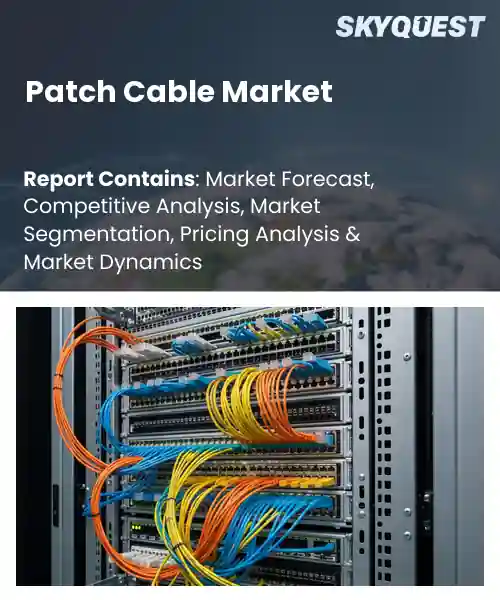
Patch Cable Market
Report ID: SQMIG45K2338
Report ID: SQMIG45K2338
[email protected]
USA +1 351-333-4748
Report ID:
SQMIG45K2338 |
Region:
Global |
Published Date: July, 2026
Pages:
157
|Tables:
118
|Figures:
77


Global Patch Cable Market size was valued at USD 4.8 Billion in 2024 and is poised to grow from USD 5.16 Billion in 2025 to USD 9.28 Billion by 2033, growing at a CAGR of 7.6% during the forecast period (2026-2033).
Global Patch Cable Market is the production and delivery of short and flexible copper or optical fiber cables that connect various networking devices in data centers, telecommunication centers, and business locations. The importance of the market is justified by the continuous expansion of the digital infrastructure that requires highly reliable and high-performance connections. Traditionally, the expansion of the market is associated with the development of broadband in the first decade of the 21st century and the later rise of cloud technology and 5G networks.
The key factor influencing the market of patch cables now is the rise of the workloads of computers that require connections. This makes data center managers upgrade from older Category 5e connections to Category 8 or active optical connections, thus broadening the product market. The cause-and-effect sequence begins with enterprises adopting artificial intelligence inference and edge computing, which results in rising traffic per rack and tight latency requirements; therefore, vendors release modular cable solutions that make upgrades easier and faster. Such implementation as the introduction of 400 Gbps connections in 2023 in Europe for one cloud provider exemplifies the revenue-generating processes of manufacturers.
How is AI-driven Automation Influencing the Design and Demand for High‑performance Patch Cables?
The use of AI-driven automation has revolutionized high-performance patch cable engineering through the implementation of speedy topological optimization and selection of materials for simulation-based performance testing. Through this process, engineers can optimize signal integrity and mechanical stress without going through manual testing procedures that take longer. This minimizes the need for multiple prototypes and allows the manufacture of customized patch cables suitable for the new data center speeds and tough environments in industries. These capabilities also enhance continuous quality monitoring by making it possible to meet stricter tolerances in real time.
Market snapshot - (2026-2033)
Global Market Size
USD 4.8 Billion
Largest Segment
Copper Patch Cables
Fastest Growth
Fiber Optic Patch Cables
Growth Rate
7.6% CAGR
To get more insights on this market click here to Request a Free Sample Report
Global patch cable market is segmented by product type, connector type, application, end user and region. Based on product type, the market is segmented into Copper Patch Cables and Fiber Optic Patch Cables. Based on connector type, the market is segmented into LC Connector, SC Connector, MPO / MTP and RJ45. Based on application, the market is segmented into Networking and Non-Networking. Based on end user, the market is segmented into IT & Network Security, Telecommunications, Broadcast & Media, Industrial Automation and Enterprise & Data Centers. Based on region, the market is segmented into North America, Europe, Asia Pacific, Latin America and Middle East & Africa.
Copper Patch Cables segment rules due to the provision of cost-effective options for short reach communication, serving the enormous requirement coming from the existing Ethernet system. The easy installation process and strong mechanical features along with compatibility with current equipment make it a preferred option for many companies. The popularity of this segment is further supported by the need to have reliable low-latency connections in the data center, office building, or industrial facility environment, contributing to its leadership position and future scaling of networks.
On the other side, the Fiber Optic Patch Cables segment takes the place of the fastest-growing area due to the increasing need for high capacity and low signal loss connection caused by higher bandwidth needs and the transition towards 40/100-gigabit networks.
The LC Connector Segment is in the lead since its small size and high-density design allow efficient use of ports in modern equipment. In data center switches and optical transceivers, there is an increasing need to increase the number of ports; therefore, LC connectors become an appropriate choice due to the good reliability and low insertion losses that come with it. The extensive usage of LC connectors in telecom and enterprise markets is also making them an important component in future network scaling and fast deployment.
Meanwhile, MPO/MTP connector segment is growing at the highest pace since data centers deploy high-density link aggregation and parallel optics technologies. The multi-channel design decreases the cabling bulk, allowing petabit-level interconnects.
To get detailed segments analysis, Request a Free Sample Report
Asia Pacific holds dominance owing to its highly advanced electronics manufacturing capacity, robust R&D environment, large-scale manufacturing, efficient logistics chain, dominant participation in telecom and data center infrastructure, adoption of faster networking standards, government support for digitalization, and existence of large multinationals in the market. The region enjoys an advantage in terms of deep integration of component providers, fast pace of product iterations, and a highly skilled labor force, which helps in bringing about consistent innovation. All these features combine to form a self-reinforcing circle of demand and capabilities, thus cementing its status as the major producer of patch cables across the globe. Besides, the region’s efficient logistics chains and port facilities make sure that its products reach customers all over the world in no time at all.
In Japan, there is emphasis on precision engineering and reliability. Manufacturers use automated production processes and strict quality control to offer products to consumer electronics and corporate network industries. There is close coordination between manufacturers of components and those of systems. This makes it possible to quickly address changes in connectivity needs. There is also an emphasis on environmental sustainability resulting in eco-friendly products.
South Korea Patch Cables Market is a perfect mixture of semiconductor know-how and a highly export-oriented nature. The technology parks that abound in the country facilitate good relationships between the OEMs, design companies, and logisticscompanies, hence reducing the time-to-market for advanced cable assembly products. The incentives provided by the government for smart infrastructural projects encourage domestic demand, whereas the association with global brands increases their presence in new market segments.
Rapid growth of the Europe market is fueled by significant demand for broadband connectivity in the fields of industrial automation, automotive electronics, and cloud computing. Well-structured regulations facilitate the process of standardization and integration, motivating companies to develop products meeting exact requirements for performance. Investment in green data centers and environmental sustainability leads to the development of cables which lose little energy and can be easily recycled. International trade between countries of the European Union makes possible effective logistics, whereas the presence of skilled engineers and experienced research organizations results in constant improvement of products. Thus, there is formed an interactive system in which European companies are simultaneously creating and benefiting from growing need for advanced patch cables. Emphasis on digital sovereignty in the region stimulates local production of components, making Europe less dependent on foreign supply.
The Patch Cable Market in Germany is built upon the image of superior engineering and stringent product certification. The most prominent players incorporate superior shielding and modular construction in their products to cater to the demands of industrial automation and fast data transmission. Closely working with the automotive and manufacturing industries leads to expertise in designing highly durable cables. Quality control takes precedence in the market as OEMs and system integrators in Europe have faith in German cable manufacturers because of the same.
UK Patch Cable Market is witnessing fast growth owing to an active tech startup ecosystem and heavy investments in digital infrastructure. Innovation centers help in the quick development of cables that work efficiently at high frequencies and are compatible with fiber optics, catering to a growing demand for data centers and fintech environments. Collaboration programs by academic institutes and the industry ensure quick prototyping of products, and a flexible regulatory framework helps in embracing the latest networking technologies.
France Patch Cable Market is growing due to the implementation of the government-supported initiative of digital transformation and a focus on green manufacturing. French manufacturers are focused on the usage of environmentally friendly material and recycling procedures, which are consistent with the general European objectives. Collaboration with telecommunications providers and aircraft producers fuels the need for special cables. With time, France will be able to become one of the players of the European patch cable market.
The continent has consolidated its position by virtue of the combination of high value technology implementation, huge bandwidth, and robust demand from industries such as media content production, cloud computing, and autonomous systems. North America enjoys significant investments in research and development, thus continuously enhancing the quality and reliability of cables. A well-developed logistics network facilitates quick delivery of diverse products to end users, while the synergy between components suppliers and system integrators expedites the product launches. Also, compliance and cyber security considerations contribute to trust in patch cables produced in North America, thus strengthening their competitive position on the global market. The growing number of infrastructures for 5G networks and edge computing data centers drives the need for high-frequency and low-attenuation cables, thus stimulating cable producers to increase their capacities and use cutting-edge materials. Collaboration between universities and companies speeds up the creation of smart cable monitoring systems.
The U.S. Patch Cable Market is fueled by the massive growth of data center facilities along with a flourishing consumer electronics sector. Key players ensure that their offerings are both ultrafast and ultra-low latency through sophisticated automated production capabilities and rigorous testing processes. Collaboration between vendors and cloud service providers as well as telecom companies inspires product development on an ongoing basis, while a quick innovation culture helps adopt new standards in connectivity.
Patch Cable Industry of Canada represents an adherence to reliability and sustainability principles in a broad geographic market setting. The manufacturers pay attention to durable shields and temperature-resistant design for their products to ensure their application in remote mining, oil and gas, and telecom projects that operate in difficult geographical environments. Joint research projects with universities are dedicated to the development of low-loss material and recycling processes in accordance withsustainability goals of the country.
To know more about the market opportunities by region and country, click here to
Buy The Complete Report
Increasing Data Center Deployment
With more data centers being set up both in enterprises and in the clouds, there is always a high demand for connectivity solutions which should be highly performing, and patch cables become the vital elements to connect network devices. As modular design becomes more popular due to low latency requirements, the need for reliable small-size cables which can be easily reconfigured arises. Such an environment motivates manufacturers to come up with innovative cable assemblies which have enhanced shielding capabilities and durability, which in turn promotes further adoption of such products.
Growth of High‑Speed Networking Standards
The implementation of the 10 GbE, 40 GbE, and soon-to-be-implemented 100 GbE Ethernet technologies necessitates the use of cable assemblies capable of transmitting high-frequency signals. Cable assemblies that are designed with greater tolerances and better shielding allow for easy implementation of these protocols and ensure signal integrity and no downtime. As companies increase their bandwidth demands at the core and access layers, there is greater demand for flexible and standardized solutions, leading suppliers to develop a wider range of products and different connector types, which contributes to growth in the industry.
Rising Cost of Advanced Materials
The introduction of high-performance alloys, fluorinated plastics, and shielding results in increased manufacturing costs, thus forcing manufacturers to weigh performance and cost factors. Customers looking for cheaper products can limit the usage of advanced patch cables due to price sensitivity, especially among price-conscious customers in sectors such as educational institutions and small businesses. Therefore, manufacturers could be more inclined to develop standards rather than advanced products. This price barrier can also prevent smaller companies from developing new technology.
Complexity of Emerging Connectivity Standards
The advancement of technologies in the form of HDMI 2.1, USB4, and Thunderbolt 4 necessitates complex conditions for patch cables, requiring expert engineering and comprehensive testing. Companies that are not experienced will encounter long development processes, thus increasing time-to-market and the chance of non-compliance. All these factors may prevent companies from developing new lines of products, which means that they would have to continue using their old product range and will not be able to develop new cable technology, resulting in limited market growth. Moreover, continuous certification update processes add additional burden of administration, thus preventing new market participants from joining.
Request Free Customization of this report to help us to meet your business objectives.
Competitive dynamics in the worldwide patch cable industry are fueled by the fierce competition among cable manufacturers who differentiate their offerings at a faster rate through the adoption of higher speed data rates technology, acquisitions of specialized component companies, and joint ventures with telco infrastructure service providers in order to ensure supply chain resilience as well as expansion into upcoming markets including 5G and data centers.
Data Center Consolidation Drives Demand: With the swift trend of data center consolidation in enterprises, it becomes necessary to upgrade the older data center equipment infrastructure, which involves a need for higher density network cabling systems. With shrinking sizes and increasing power requirements in server rack cabinets, there is a growing need for cables that have better performance characteristics and shielding capabilities. Not only does this boost the demand for better quality cables, but it also speeds up the implementation of modular cable systems.
Iot Proliferation Fuels Connectivity: The proliferation of IoT gadgets in industries such as manufacturing, health care, and building construction is resulting in a mesh of connected endpoints requiring efficient cabling. With the number of sensors, controllers, and edge processors increasing, the use of patch cables that provide high frequency and little interference has become essential. The manufacturers are now producing customized and flexible cables that meet space constraints and performance requirements to enable market growth and standardization in favor of seamless plug-and-play connections within the expanding ecosystem.
SkyQuest’s ABIRAW (Advanced Business Intelligence, Research & Analysis Wing) is our Business Information Services team that Collects, Collates, Correlates, and Analyses the Data collected by means of Primary Exploratory Research backed by robust Secondary Desk research.
As per SkyQuest analysis, the global market for patch cables is driven mainly by the rising installations of data centers, creating constant need for short reach interconnects, whereas at the same time high-speed networking technologies like 40 GbE and 100 GbE emerge as the second driving force behind the adoption of higher frequency copper and optical products. However, the increasing price for advanced technologies used to achieve shielding or low loss in optics is acting as a restraint due to the price sensitivity of the customer. Asia Pacific holds the major share in the market due to its large-scale electronics industry along with fast infrastructure development, and among all other product segments copper patch cables constitute the largest one.
| Report Metric | Details |
|---|---|
| Market size value in 2024 | USD 4.8 Billion |
| Market size value in 2033 | USD 9.28 Billion |
| Growth Rate | 7.6% |
| Base year | 2024 |
| Forecast period | (2026-2033) |
| Forecast Unit (Value) | USD Billion |
| Segments covered |
|
| Regions covered | North America (US, Canada), Europe (Germany, France, United Kingdom, Italy, Spain, Rest of Europe), Asia Pacific (China, India, Japan, Rest of Asia-Pacific), Latin America (Brazil, Rest of Latin America), Middle East & Africa (South Africa, GCC Countries, Rest of MEA) |
| Companies covered |
|
| Customization scope | Free report customization with purchase. Customization includes:-
|
To get a free trial access to our platform which is a one stop solution for all your data requirements for quicker decision making. This platform allows you to compare markets, competitors who are prominent in the market, and mega trends that are influencing the dynamics in the market. Also, get access to detailed SkyQuest exclusive matrix.
Table Of Content
Executive Summary
Market overview
Parent Market Analysis
Market overview
Market size
KEY MARKET INSIGHTS
COVID IMPACT
MARKET DYNAMICS & OUTLOOK
Market Size by Region
KEY COMPANY PROFILES
Methodology
For the Patch Cable Market, our research methodology involved a mixture of primary and secondary data sources. Key steps involved in the research process are listed below:
1. Information Procurement: This stage involved the procurement of Market data or related information via primary and secondary sources. The various secondary sources used included various company websites, annual reports, trade databases, and paid databases such as Hoover's, Bloomberg Business, Factiva, and Avention. Our team did 45 primary interactions Globally which included several stakeholders such as manufacturers, customers, key opinion leaders, etc. Overall, information procurement was one of the most extensive stages in our research process.
2. Information Analysis: This step involved triangulation of data through bottom-up and top-down approaches to estimate and validate the total size and future estimate of the Patch Cable Market.
3. Report Formulation: The final step entailed the placement of data points in appropriate Market spaces in an attempt to deduce viable conclusions.
4. Validation & Publishing: Validation is the most important step in the process. Validation & re-validation via an intricately designed process helped us finalize data points to be used for final calculations. The final Market estimates and forecasts were then aligned and sent to our panel of industry experts for validation of data. Once the validation was done the report was sent to our Quality Assurance team to ensure adherence to style guides, consistency & design.
Analyst Support
Customization Options
With the given market data, our dedicated team of analysts can offer you the following customization options are available for the Patch Cable Market:
Product Analysis: Product matrix, which offers a detailed comparison of the product portfolio of companies.
Regional Analysis: Further analysis of the Patch Cable Market for additional countries.
Competitive Analysis: Detailed analysis and profiling of additional Market players & comparative analysis of competitive products.
Go to Market Strategy: Find the high-growth channels to invest your marketing efforts and increase your customer base.
Innovation Mapping: Identify racial solutions and innovation, connected to deep ecosystems of innovators, start-ups, academics, and strategic partners.
Category Intelligence: Customized intelligence that is relevant to their supply Markets will enable them to make smarter sourcing decisions and improve their category management.
Public Company Transcript Analysis: To improve the investment performance by generating new alpha and making better-informed decisions.
Social Media Listening: To analyze the conversations and trends happening not just around your brand, but around your industry as a whole, and use those insights to make better Marketing decisions.
REQUEST FOR SAMPLE
 REQUEST FREE CUSTOMIZATION
Global Patch Cable Market size was valued at USD 4.8 Billion in 2024 and is poised to grow from USD 5.16 Billion in 2025 to USD 9.28 Billion by 2033, growing at a CAGR of 7.6% during the forecast period (2026-2033).
The global patch cable market is shaped by intense rivalry as manufacturers accelerate product differentiation through high‑speed data‑rate innovations, strategic acquisitions of niche component firms, and joint ventures with telecom infrastructure providers to secure supply chain resilience and expand into emerging 5G and data‑center segments. Recent M&A activity, such as a leading cable producer acquiring a specialty connector maker, and partnerships with cloud‑service operators to co‑develop low‑latency cabling solutions illustrate how firms are leveraging collaboration and technology upgrades to outpace competitors. 'CommScope Inc.', 'Corning Incorporated', 'Panduit Corp.', 'Prysmian Group', 'Legrand Group', 'Belden Inc.', 'Schneider Electric SE', 'AGC Networks Limited', 'NAI Group LLC', 'Quabbin Wire & Cable Co. Inc.', 'Amphenol Corporation', 'TE Connectivity Ltd.', 'Molex LLC', 'Leviton Manufacturing Co. Inc.', 'Siemon Company', 'Nexans S.A.', 'CP Technologies', 'Black Box Corporation', 'CCSTechnology Inc.', 'Hubbell Incorporated'
The expansion of data centers across enterprise and cloud environments creates sustained demand for high‑performance connectivity solutions, and patch cables serve as essential links between networking equipment. As organizations adopt modular designs and prioritize low latency, the need for reliable, compact cabling that supports rapid reconfiguration grows. This environment encourages manufacturers to develop innovative cable assemblies with improved shielding and durability, further stimulating market uptake and reinforcing the pivotal role of patch cables in modern infrastructure. Consequently, procurement cycles shorten, fostering continuous replacement and upgrade activities.
Data Center Consolidation Drives Demand: Rapid consolidation of enterprise data centers is prompting organizations to upgrade legacy infrastructure, favoring high‑density networking solutions that rely on reliable patch cables. As server racks become more compact and power‑intensive, operators seek cables with superior performance, shielding, and durability to minimize latency and signal loss. This shift not only strengthens the demand for premium cable variants but also accelerates adoption of modular designs that simplify maintenance and support scalable growth and enhance overall network resilience across evolving enterprise ecosystems, delivering reliability.
Why does Asia Pacific Dominate the Global Patch Cable Market? |@12


Want to customize this report? This report can be personalized according to your needs. Our analysts and industry experts will work directly with you to understand your requirements and provide you with customized data in a short amount of time. We offer $1000 worth of FREE customization at the time of purchase.
Feedback From Our Clients


 USA (+1) 351-333-4748

