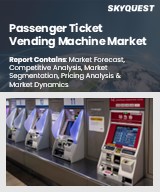
Passenger Ticket Vending Machine Market
Report ID: SQMIG20I2515
Report ID: SQMIG20I2515
[email protected]
USA +1 351-333-4748
Report ID:
SQMIG20I2515 |
Region:
Global |
Published Date: January, 2026
Pages:
191
|Tables:
115
|Figures:
69


Global Passenger Ticket Vending Machine Market size was valued at USD 4.49 Billion in 2024 and is poised to grow from USD 4.8 Billion in 2025 to USD 8.19 Billion by 2033, growing at a CAGR of 6.9% during the forecast period (2026–2033).
Market growth is fueled by widespread public transport modernization efforts and the global push towards smart city infrastructure, where automated ticketing is a priority concern for managing passenger flow and enhancing operational efficiency. Implementations incorporating contactless payment integration, multi-lingual support, and increased accessibility are experiencing robust growth within transit systems, providing improved service levels for heterogeneous commuter needs. Transit agency uptake is necessary due to the need for efficient management of high passenger loads, involving automated, secure fare collection systems that avoid queues and reduce manual handling. Urban transit operators utilize specialty TVMs integrated with real-time data and MaaS platforms to provide seamless journey planning and payment reliability. Geographically, Asia Pacific spearheaded once again in 2024 by virtue of humongous city commuter traffic and mandatory digital ticketing, followed by North America by virtue of gigantic transit system overhauls, and third was Europe backed by massive metro automation initiatives. The demand for sophisticated software features, such as AI-based predictive maintenance, customized user interfaces, and improved security mechanisms, is ushering in the next generation of TVM functionality. Despite disruption brought about by the high initial investment and growing competition from solely mobile ticketing platforms, the industry should continue to evolve in a phased fashion, e.g., continued reliance on TVMs as a means of offering accessibility, fairness, and business sustainability within public transportation networks.
How is AI Making Ticket Vending Machines Predictive, Personal, and Accessible?
Artificial Intelligence is revolutionizing passenger ticket vending machines (TVMs) from mere points of transaction into smart transit centers integral to the global passenger ticket vending machine market strategies. AI software optimizes performance through predictive maintenance, analyzing real-time streams of sensors to foresee component failure like printer jamming or screen failure long before it occurs, lowering machine downtime and service fees drastically. Aside from maintenance, AI makes the user experience more personalized; systems learn about behavior and history of passengers to provide optimal routes or dynamic pricing, thus more convenient. By 2024, integration with artificial intelligence was commonplace with the trends being sophisticated interfaces making it simpler with sophisticated voice command integration and entering biometric log in for added security. AI enhances security systems by tracking transactions to identify potential fraud in real-time. Analytics powered by AI aid transit agencies' passenger flow management with recommendations for alternate kiosks during rush hours, resource optimization allocation, and converting passive hardware to active network management solutions.
Market snapshot - 2026-2033
Global Market Size
USD 4.2 billion
Largest Segment
Telemedicine
Fastest Growth
mHealth
Growth Rate
6.9% CAGR
To get more insights on this market click here to Request a Free Sample Report
Global Passenger Ticket Vending Machine Market is segmented by Functionality, Technology, End Use, Installation Type and region. Based on Functionality, the market is segmented into Standard Ticketing, Smart Ticketing, Mobile Ticketing and Reservation Systems. Based on Technology, the market is segmented into Cash Payment, Card Payment, Contactless Payment and Mobile Payment. Based on End Use, the market is segmented into Public Transport, Railways, Airports and Event Venues. Based on Installation Type, the market is segmented into Standalone and Integrated Systems. Based on region, the market is segmented into North America, Europe, Asia Pacific, Latin America and Middle East & Africa.
Which Product Type Segment Dominates the Market?
Smart-Card Machines enjoys market leadership. This is a result of the ubiquitous and deeply embedded legacy infrastructure for mass transit subway and bus systems in major metropolitan cities worldwide. The machines are the proven workhorses reloading closed-loop transit passes, which are the preferred fare medium of tens of millions of daily mass transit passengers using weekly or monthly passes. Its gigantic, existing user base and the stability of the closed-loop system guarantee its market leadership.
The NFC/Contactless Machines segment is the fastest-growing. This is because open-loop payments are the growing trend all over the world where passengers can "tap-to-pay" with their existing bank card or smartphone wallet. This eliminates the proprietary transit card, which is a tremendous convenience advantage. Transit agencies quickly respond to this technology as they try to minimize operational drag, minimize wait time, and attract tech-friendly passengers.
Which Application Segment Leads the Market?
Urban Transit Authorities, such as subway and railroad stations, hold the largest market share. This is purely a result of the large number of daily commuters in higher density urban metropolitan cities requiring a massive, robust, and effective network of ticket vending machines. The requirements of high-capacity and dependability of these busy networks render TVMs an expected component of city transit infrastructure, and this segment's top share is assured.
This same Urban Transit Agencies segment is also the fastest-growing. The growth is propelled by two key factors: massive public infrastructure investment in developing nations, particularly in Asia-Pacific, to build new metro systems, and the concurrent modernization cycle in developed regions. Rapid urbanization and government-led smart city initiatives are fueling the construction of new subway lines that all require new, advanced TVM installations from the ground up.
To get detailed segments analysis, Request a Free Sample Report
What Makes Asia Pacific the Fastest-Growing Hub for Transit Technology?
According to the global passenger ticket vending machine regional forecast, Asia Pacific holds the largest market share and exhibits the fastest growth rate. This dynamism is being driven by heavy government investment in new public transport infrastructure, focusing on metro rail schemes within fast-growing economies such as China and India. A technologically advanced and populous population is easily adopting mobile payment technology (QR codes), driving demand for TVMs that accommodate these native customs alongside incumbent smart card systems, and hence the region is emerging as a leader in new transit solutions.
Passenger Ticket Vending Machine Market in Japan
According to the global passenger ticket vending machine regional outlook, Japan's market is controlled by powerful and highly advanced TVMs that support omnipresent IC cards such as Suica and PASMO. They provide multi-language support and standardized integration with the Shinkansen system. The ongoing trends include improvements in foreign credit card and cellular payment system compatibility for confronting the increasing tourism industry and general convenience for users.
Passenger Ticket Vending Machine Market in South Korea
As per the global passenger ticket vending machine regional analysis, South Korea utilizes its sophisticated technology infrastructure to plan public transport ticketing with heavy reliance on integrated smart card systems such as T-money. Subway, bus, and rail system integration is the focus with speedy processing. Further improvement is observed in 2024 with mobile application integration with TVMs as well as investigating biometric options for future systems.
How is North America Balancing Modernization with Existing Infrastructure?
According to the global passenger ticket vending machine market forecast, North America is a substantial and primary market with mass-scale efforts for modernization in primary urban centers. Although traditionally more dependent on individual automobiles, primary transit agencies invest heavily to modernize current TVM fleets with open-loop contactless payment capabilities and enhance the passengers' experience. The region is focused intensely upon integrating ticketing across transit modes under new MaaS schemes, creating travel links for passengers in diverse urban environments.
Passenger Ticket Vending Machine Market in United States
According to the global passenger ticket vending machine market outlook, the US market involves substantial upgrade cycles in big cities such as New York (OMNY) and Chicago (Ventra), shifting towards open-loop contactless solutions. This will require a major investment in new TVMs taking bank cards and mobile wallets in addition to traditional transit cards, generating strong demand across its fragmented public transportation network despite the growth in mobile ticketing.
Passenger Ticket Vending Machine Market in Canada
As per the global passenger ticket vending machine market analysis, Canada's market activity is concentrated in major urban centers such as Toronto (Presto), Montreal, and Vancouver. Transit agencies want to improve reliability, make user interfaces on current machines more straightforward, and introduce open-loop payment functionality incrementally. The emphasis is on providing a seamless experience across integrated regional transport networks for commuters.
Why is Europe a Leader in Integrated and Open Payment Ticketing?
According to the global passenger ticket vending machine industry analysis, Europe has an established, highly developed market with extensive, highly integrated inter-country public transport networks. The continent is a leader in the uptake of open-loop payment schemes and promotion of EU-wide interoperability standards. Robust regulatory endorsement of MaaS and urban evolution means ongoing demand for developed TVMs that enable simple multi-modal mobility, enhance passenger convenience through novel payments, and promote region-wide accessibility features.
Passenger Ticket Vending Machine Market in Germany
As per the global passenger ticket vending machine market trends, Germany has optimally aligned transport associations and high levels of investment in digitalization. TVMs are fundamental to complementing the national "Deutschlandticket" and enabling convenient travel on local and national rail services (DB). The focus is on reliability, choice of accessibility, and bringing live information together to optimize the passenger experience journey.
Passenger Ticket Vending Machine Market in United Kingdom
As per the global passenger ticket vending machine industry trends, the UK, London through Transport for London (TfL), is a world pioneer in large-scale open-loop contactless payment deployment. While "tap-and-go" is on the rise, TVMs continue to be needed to buy longer-term passes, to top up Oyster cards, and to assist non-contactless customers. Efforts at modernization are focused on extending functionalities and ensuring resilient network performance.
Passenger Ticket Vending Machine Market in France
According to the global passenger ticket vending machine industry, France is entirely revamping its metropolitan and inter-regional public transport ticketing network, entirely contactless and mobile payment-enabled. TVMs are being replaced to offer national initiatives such as combined regional passes (e.g., Paris's Navigo) and enhancing multi-language capabilities in order to accommodate tourist exposure. Capital spending is aimed at enhancing user experience and global security.
To know more about the market opportunities by region and country, click here to
Buy The Complete Report
Passenger Ticket Vending Machine Market Drivers
Increasing Urbanization and Public Transport Growth
Shift Towards Contactless Payments
Passenger Ticket Vending Machine Market Restraints
High Upfront Investment and Maintenance Costs
Introduction of Mobile Ticketing Apps
Request Free Customization of this report to help us to meet your business objectives.
The 2024 global passenger ticket vending machine market statistics describes a dynamic blend of mature world companies and new technology players emphasizing bundled transit solutions. Market leadership continues to rest with players such as Cubic Corporation, Conduent, Siemens Mobility, and Scheidt & Bachmann that bank on deep hardware bases, old-world contact with transit agencies, and high R&D investments across such horizontals as open-loop payments and system interoperability. Competitive differentiation is founded on system reliability, premium payment acceptance (NFC, mobile wallets), effortless integration into greater Mobility-as-a-Service (MaaS) ecosystems, and value-added software capabilities like remote diagnostics and predictive maintenance analytics. Strong hardware supports it, but strategic emphasis increasingly falls on end-to-end, long-term service deals and advanced, adaptable software platforms. Local players intensely compete on solution-based offerings and low prices, especially in emerging markets. Constant need for efficient, secure, and hassle-free ticketing necessitates constant innovation, subverting orthodoxies to agile software-driven disruptors leading digitalization and automation waves across the enterprise.
SkyQuest’s ABIRAW (Advanced Business Intelligence, Research & Analysis Wing) is our Business Information Services team that Collects, Collates, Correlates, and Analyses the Data collected by means of Primary Exploratory Research backed by robust Secondary Desk research.
As per SkyQuest analysis, the passenger ticket vending machine industry is experiencing a core evolution more than being confronted with looming obsolescence through mobile ticketing trends. As convenient as smartphone apps may be for others, TVMs are still of paramount importance for convenience and fairness, for passengers without smartphones, electronic means of payment, or for passengers who simply prefer paper tickets. They are also other sources of trustworthiness in case of network breakdown or phone battery problems. There are a number of large operators who are successfully transforming by integrating TVMs into far more comprehensive Mobility-as-a-Service (MaaS) solutions, greatly diversifying their function from simple ticketing machines. New technologies more and more include open-loop payments, trip planning in real time, and multi-modal data, solidifying themselves as omnipresent, interactive components of the multi-channel global transit systems of today, promoting the movement towards inclusivity and operational ruggedness. The market's future is based on this hybrid idea, setting traditional physical infrastructure against digital innovation.
| Report Metric | Details |
|---|---|
| Market size value in 2024 | USD 4.49 Billion |
| Market size value in 2033 | USD 8.19 Billion |
| Growth Rate | 6.9% |
| Base year | 2024 |
| Forecast period | 2026-2033 |
| Forecast Unit (Value) | USD Billion |
| Segments covered |
|
| Regions covered | North America (US, Canada), Europe (Germany, France, United Kingdom, Italy, Spain, Rest of Europe), Asia Pacific (China, India, Japan, Rest of Asia-Pacific), Latin America (Brazil, Rest of Latin America), Middle East & Africa (South Africa, GCC Countries, Rest of MEA) |
| Companies covered |
|
| Customization scope | Free report customization with purchase. Customization includes:-
|
To get a free trial access to our platform which is a one stop solution for all your data requirements for quicker decision making. This platform allows you to compare markets, competitors who are prominent in the market, and mega trends that are influencing the dynamics in the market. Also, get access to detailed SkyQuest exclusive matrix.
Table Of Content
Executive Summary
Market overview
Parent Market Analysis
Market overview
Market size
KEY MARKET INSIGHTS
COVID IMPACT
MARKET DYNAMICS & OUTLOOK
Market Size by Region
KEY COMPANY PROFILES
Methodology
For the Passenger Ticket Vending Machine Market, our research methodology involved a mixture of primary and secondary data sources. Key steps involved in the research process are listed below:
1. Information Procurement: This stage involved the procurement of Market data or related information via primary and secondary sources. The various secondary sources used included various company websites, annual reports, trade databases, and paid databases such as Hoover's, Bloomberg Business, Factiva, and Avention. Our team did 45 primary interactions Globally which included several stakeholders such as manufacturers, customers, key opinion leaders, etc. Overall, information procurement was one of the most extensive stages in our research process.
2. Information Analysis: This step involved triangulation of data through bottom-up and top-down approaches to estimate and validate the total size and future estimate of the Passenger Ticket Vending Machine Market.
3. Report Formulation: The final step entailed the placement of data points in appropriate Market spaces in an attempt to deduce viable conclusions.
4. Validation & Publishing: Validation is the most important step in the process. Validation & re-validation via an intricately designed process helped us finalize data points to be used for final calculations. The final Market estimates and forecasts were then aligned and sent to our panel of industry experts for validation of data. Once the validation was done the report was sent to our Quality Assurance team to ensure adherence to style guides, consistency & design.
Analyst Support
Customization Options
With the given market data, our dedicated team of analysts can offer you the following customization options are available for the Passenger Ticket Vending Machine Market:
Product Analysis: Product matrix, which offers a detailed comparison of the product portfolio of companies.
Regional Analysis: Further analysis of the Passenger Ticket Vending Machine Market for additional countries.
Competitive Analysis: Detailed analysis and profiling of additional Market players & comparative analysis of competitive products.
Go to Market Strategy: Find the high-growth channels to invest your marketing efforts and increase your customer base.
Innovation Mapping: Identify racial solutions and innovation, connected to deep ecosystems of innovators, start-ups, academics, and strategic partners.
Category Intelligence: Customized intelligence that is relevant to their supply Markets will enable them to make smarter sourcing decisions and improve their category management.
Public Company Transcript Analysis: To improve the investment performance by generating new alpha and making better-informed decisions.
Social Media Listening: To analyze the conversations and trends happening not just around your brand, but around your industry as a whole, and use those insights to make better Marketing decisions.
REQUEST FOR SAMPLE
 REQUEST FREE CUSTOMIZATION


Want to customize this report? This report can be personalized according to your needs. Our analysts and industry experts will work directly with you to understand your requirements and provide you with customized data in a short amount of time. We offer $1000 worth of FREE customization at the time of purchase.
Feedback From Our Clients


 USA (+1) 351-333-4748

