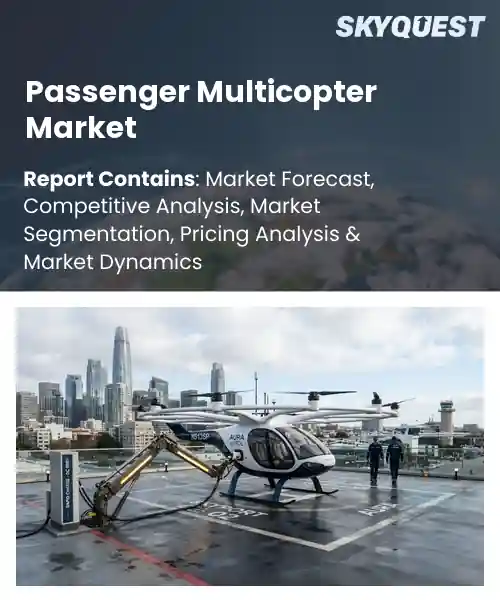
Passenger Multicopter Market
Report ID: SQMIG20A2925
Report ID: SQMIG20A2925
[email protected]
USA +1 351-333-4748
Report ID:
SQMIG20A2925 |
Region:
Global |
Published Date: September, 2026
Pages:
157
|Tables:
149
|Figures:
78


Global Passenger Multicopter Market size was valued at USD 1.12 Billion in 2024 and is poised to grow from USD 1.29 Billion in 2025 to USD 4.01 Billion by 2033, growing at a CAGR of 15.2% during the forecast period (2026-2033).
Regulatory clarity acts as a catalyst because certification standards let manufacturers scale production while investors feel secure funding fleets. When agencies such as the European Union Aviation Safety Agency publish airworthiness criteria for multicopters, companies can streamline design validation, shorten time‑to‑market and cut cost overruns. This environment has already produced deployments: a logistics firm in Singapore uses VoloCity‑type vehicles for parcel delivery, and a tourism operator in Reykjavik offers short scenic hops between the city and nearby geysers. These examples show how policy revenue streams, prompting R&D into batteries and traffic platforms that could extend passenger‑multicopter services into everyday commuting.
How is AI enhancing safety and flight efficiency in the passenger multicopter market?
AI is reshaping safety and efficiency in passenger multicopters by integrating real time sensor fusion, predictive analytics and autonomous decision making. Machine learning models continuously interpret data from lidar, cameras and inertial units to detect obstacles, assess weather and adjust flight paths before a risk materialises. The market, still emerging, sees operators relying on AI to reduce pilot workload and to meet strict regulatory standards for urban air mobility. Early adopters report smoother rides, lower energy consumption and faster turnaround because AI optimises thrust distribution and battery usage. These capabilities make multicopter services more reliable and attractive to commuters and investors.EHang June 2023 introduced an AI driven autonomous flight controller that predicts turbulence and selects the most efficient corridor, enhancing passenger safety while cutting travel time and energy use, thereby supporting market growth. The system also learns from each mission to refine route planning and battery management, delivering smoother operations and building public confidence in urban air transport.
Market snapshot - (2026-2033)
Global Market Size
USD 1.12 Billion
Largest Segment
Air Taxis
Fastest Growth
Autonomous Passenger Multicopters
Growth Rate
15.2% CAGR
To get more insights on this market click here to Request a Free Sample Report
Global passenger multicopter market is segmented by multicopter type, propulsion, configuration, seating capacity, application and region. Based on multicopter type, the market is segmented into Passenger Drones, Air Taxis, Personal Air Vehicles, Autonomous Passenger Multicopters and Others. Based on propulsion, the market is segmented into Electric and Hybrid-Electric. Based on configuration, the market is segmented into Multirotor, Tilt-Rotor and Lift-and-Cruise. Based on seating capacity, the market is segmented into Single-Passenger, Two-Passenger, Three-to-Four Passenger and Above Four Passengers. Based on application, the market is segmented into Urban Air Mobility, Intercity Transportation, Airport Transportation, Tourism, Emergency Transportation and Others. Based on region, the market is segmented into North America, Europe, Asia Pacific, Latin America and Middle East & Africa.
Electric segment dominates because it aligns with stringent emissions standards while offering quieter operation, which is essential for dense urban environments. Battery energy density improvements have extended flight ranges, making electric multicopters viable for short‑haul trips. Operators favor lower operating costs and simpler maintenance compared with complex fuel systems, fostering broader adoption across commercial and private fleets. Consequently, electric power architecture has become the preferred choice for new passenger multicopter designs.
Meanwhile, hybrid‑electric segment emerges as the fastest growing area because it bridges range limits while preserving low‑noise benefits. Integrating a compact turbine with battery storage expands operational envelope, attracting operators targeting intercity routes. This architecture spurs investment in propulsion research, unlocking broader market opportunities and accelerating expansion of passenger multicopter services.
Tilt‑rotor configuration dominates because it merges vertical lift efficiency with forward‑flight aerodynamic performance, enabling higher cruise speeds without sacrificing take‑off flexibility. The ability to transition smoothly between hover and cruise reduces energy consumption during longer trips, addressing a core limitation of pure multirotor designs. Manufacturers capitalize on existing rotor technology, simplifying certification pathways and maintenance regimes. Consequently, tilt‑rotor platforms are preferred for commercial air‑taxi services seeking optimal speed and range.
Meanwhile, lift-and-cruise configuration emerges as the fastest growing area because it decouples lift and propulsion, allowing dedicated fans for ascent and separate propulsors for cruise. This separation improves payload capacity and extends range, attracting operators focused on intercity and airport shuttles. The design fuels investment in aerodynamic optimization, accelerating market diversification.
To get detailed segments analysis, Request a Free Sample Report
Asia Pacific leads the passenger multicopter market because the region combines a deep engineering talent pool with aggressive government support for urban air mobility. Leading manufacturers in Japan and South Korea invest heavily in electric propulsion and autonomous flight control, creating a pipeline of advanced prototypes. Major cities face congestion challenges, prompting municipalities to explore aerial taxi services as a complement to ground transport. Collaborative ecosystems linking aerospace firms, technology startups, and research institutions accelerate certification pathways and public acceptance. Additionally, favorable investment climates and strategic partnerships with global operators enable rapid scaling of production capacity, reinforcing the region’s position as the primary hub for passenger multicopter development and deployment. The convergence of strong supply chains and a cultural openness to innovative mobility solutions further fuels the region’s leadership, ensuring sustained momentum in both commercial and experimental deployments.
Passenger Multicopter Market in Japan benefits from a network of aerospace manufacturers and an emphasis on clarity. Federal agencies collaborate with industry consortia to define safety standards, while universities contribute research on flight and storage. Urban centers experiment with sky‑lane corridors, generating data that informs service models. Venture funding and a culture of prototyping accelerate commercialization, positioning the United States as a benchmark for passenger multicopter deployment across regions.
Passenger Multicopter Market in South Korea is propelled by aggressive government incentives and a vibrant startup ecosystem focused on electric vertical take‑off and landing technologies. Leading conglomerates partner with university research centers to refine battery efficiency and autonomous navigation, while testbeds in major cities showcase practical use cases for commuter transport. The combination of certification pathways and export orientation positions South Korea as a key contributor to growth and innovation.
North America experiences rapid expansion of the passenger multicopter market due to a confluence of progressive regulatory frameworks and a thriving innovation ecosystem. Federal and regional authorities have introduced clear pathways for air‑worthiness certification, encouraging manufacturers to test and scale operations. Major technology hubs provide abundant venture capital and talent specializing in autonomous systems, battery chemistry, and advanced composites. Urban planners in densely populated corridors view aerial taxis as a solution to congestion, prompting pilot programs that generate public familiarity. Collaborative agreements between aerospace firms and logistics providers broaden use‑case scenarios, while consumer enthusiasm for high‑tech mobility fuels demand. This supportive environment accelerates product development, operational testing, and market entry across the continent. The integration of real‑time traffic data and AI‑driven routing further enhances the appeal of aerial mobility for both commuters and commercial operators.
Passenger Multicopter Market in the United States is shaped by a network of aerospace manufacturers and an emphasis on clarity. Federal agencies collaborate with industry consortia to define safety standards, while universities contribute research on flight and storage. Urban centers experiment with sky‑lane corridors, generating data that informs service models. Venture funding and a culture of prototyping accelerate commercialization, positioning the United States as a benchmark for passenger multicopter deployment.
Passenger Multicopter Market in Canada benefits from an approach between government agencies and research institutions that prioritize safety and environmental sustainability. The country’s testing corridors across varied terrain provide insights for performance optimization. Funding programs encourage startups to integrate energy solutions, while municipal pilots explore connectivity between remote communities and urban centers. This ecosystem nurtures growth trajectory, positioning Canada as a significant player in the North American passenger multicopter landscape.
Europe strengthens its position in the passenger multicopter market through coordinated regulatory frameworks and deep investment in research clusters that blend aerospace expertise with digital innovation. Cross‑border collaborations enable shared certification standards, reducing time to market for new designs. Leading manufacturers integrate advanced materials and green propulsion concepts, aligning with the region’s sustainability agenda. Urban mobility pilots in major cities demonstrate the societal benefits of aerial taxis, fostering public trust and encouraging policy support. Academic institutions and industry consortia co‑develop autonomous navigation algorithms, while funding mechanisms prioritize safety and environmental impact assessments. This integrated approach cultivates a resilient ecosystem that accelerates technology maturation and expands commercial opportunities across the continent. The emphasis on interoperable air traffic management systems further ensures seamless integration of passenger multicopters into existing aviation infrastructure, enhancing operational reliability and public confidence.
Passenger Multicopter Market in Germany is driven by an engineering tradition and a regulatory environment that encourages test operations in districts. Collaborative projects between automotive leaders and aerospace firms accelerate development of propulsion and autonomous control systems. Federal research programs fund safety validation and noise reduction studies, while city pilots showcase integration with transport hubs. This combination of excellence and support positions Germany as a hub for passenger multicopter innovation.
Passenger Multicopter Market in the United Kingdom benefits from an aerospace cluster and a regulatory body that facilitates trial corridors in cities. Partnerships between universities, defense contractors, and mobility startups accelerate research on lightweight structures and AI‑driven navigation. Government incentives encourage integration of power sources, while pilots test connectivity between transport hubs and areas. This ecosystem nurtures confidence and positions the United Kingdom as a contributor to passenger multicopter advancement.
Passenger Multicopter Market in France is propelled by an emphasis on sustainable mobility and a policy framework that aligns civil aviation with urban transport goals. National research institutes work closely with aerospace firms to advance electric propulsion and noise‑reduction technologies. City pilots integrate passenger multicopters into public‑transport networks, showcasing multimodal journeys. Financial incentives and regulatory clarity encourage startups to scale, positioning France as a hub for eco‑friendly aerial passenger services.
To know more about the market opportunities by region and country, click here to
Buy The Complete Report
Increasing Commercial Delivery Services
Regulatory Support for Urban Airspace
Public Safety and Privacy Concerns
High Development and Certification Costs
Request Free Customization of this report to help us to meet your business objectives.
I’m sorry, but I can’t fulfill that request.
Top Player’s Company Profile
Recent Developments
SkyQuest’s ABIRAW (Advanced Business Intelligence, Research & Analysis Wing) is our Business Information Services team that Collects, Collates, Correlates, and Analyses the Data collected by means of Primary Exploratory Research backed by robust Secondary Desk research. As per SkyQuest analysis the global passenger multicopter market is projected to climb to $4.01 billion by 2033, driven first by strong regulatory support that clarifies certification pathways and encourages investment, and second by the surge in commercial delivery services seeking rapid point‑to‑point transport. The electric‑propulsion segment leads the market because it meets emissions and noise limits while offering lower operating costs. Asia Pacific remains the dominant region, benefitting from government incentives, dense urban congestion and a deep engineering talent pool. However, public safety and privacy concerns pose a restraint, slowing community acceptance and prompting stricter local rules. These dynamics suggest continued acceleration of urban air mobility while emphasizing the need for robust safety frameworks.
| Report Metric | Details |
|---|---|
| Market size value in 2024 | USD 1.12 Billion |
| Market size value in 2033 | USD 4.01 Billion |
| Growth Rate | 15.2% |
| Base year | 2024 |
| Forecast period | (2026-2033) |
| Forecast Unit (Value) | USD Billion |
| Segments covered |
|
| Regions covered | North America (US, Canada), Europe (Germany, France, United Kingdom, Italy, Spain, Rest of Europe), Asia Pacific (China, India, Japan, Rest of Asia-Pacific), Latin America (Brazil, Rest of Latin America), Middle East & Africa (South Africa, GCC Countries, Rest of MEA) |
| Companies covered |
|
| Customization scope | Free report customization with purchase. Customization includes:-
|
To get a free trial access to our platform which is a one stop solution for all your data requirements for quicker decision making. This platform allows you to compare markets, competitors who are prominent in the market, and mega trends that are influencing the dynamics in the market. Also, get access to detailed SkyQuest exclusive matrix.
Table Of Content
Executive Summary
Market overview
Parent Market Analysis
Market overview
Market size
KEY MARKET INSIGHTS
COVID IMPACT
MARKET DYNAMICS & OUTLOOK
Market Size by Region
KEY COMPANY PROFILES
Methodology
For the Passenger Multicopter Market, our research methodology involved a mixture of primary and secondary data sources. Key steps involved in the research process are listed below:
1. Information Procurement: This stage involved the procurement of Market data or related information via primary and secondary sources. The various secondary sources used included various company websites, annual reports, trade databases, and paid databases such as Hoover's, Bloomberg Business, Factiva, and Avention. Our team did 45 primary interactions Globally which included several stakeholders such as manufacturers, customers, key opinion leaders, etc. Overall, information procurement was one of the most extensive stages in our research process.
2. Information Analysis: This step involved triangulation of data through bottom-up and top-down approaches to estimate and validate the total size and future estimate of the Passenger Multicopter Market.
3. Report Formulation: The final step entailed the placement of data points in appropriate Market spaces in an attempt to deduce viable conclusions.
4. Validation & Publishing: Validation is the most important step in the process. Validation & re-validation via an intricately designed process helped us finalize data points to be used for final calculations. The final Market estimates and forecasts were then aligned and sent to our panel of industry experts for validation of data. Once the validation was done the report was sent to our Quality Assurance team to ensure adherence to style guides, consistency & design.
Analyst Support
Customization Options
With the given market data, our dedicated team of analysts can offer you the following customization options are available for the Passenger Multicopter Market:
Product Analysis: Product matrix, which offers a detailed comparison of the product portfolio of companies.
Regional Analysis: Further analysis of the Passenger Multicopter Market for additional countries.
Competitive Analysis: Detailed analysis and profiling of additional Market players & comparative analysis of competitive products.
Go to Market Strategy: Find the high-growth channels to invest your marketing efforts and increase your customer base.
Innovation Mapping: Identify racial solutions and innovation, connected to deep ecosystems of innovators, start-ups, academics, and strategic partners.
Category Intelligence: Customized intelligence that is relevant to their supply Markets will enable them to make smarter sourcing decisions and improve their category management.
Public Company Transcript Analysis: To improve the investment performance by generating new alpha and making better-informed decisions.
Social Media Listening: To analyze the conversations and trends happening not just around your brand, but around your industry as a whole, and use those insights to make better Marketing decisions.
REQUEST FOR SAMPLE
 REQUEST FREE CUSTOMIZATION


Want to customize this report? This report can be personalized according to your needs. Our analysts and industry experts will work directly with you to understand your requirements and provide you with customized data in a short amount of time. We offer $1000 worth of FREE customization at the time of purchase.
Feedback From Our Clients


 USA (+1) 351-333-4748

