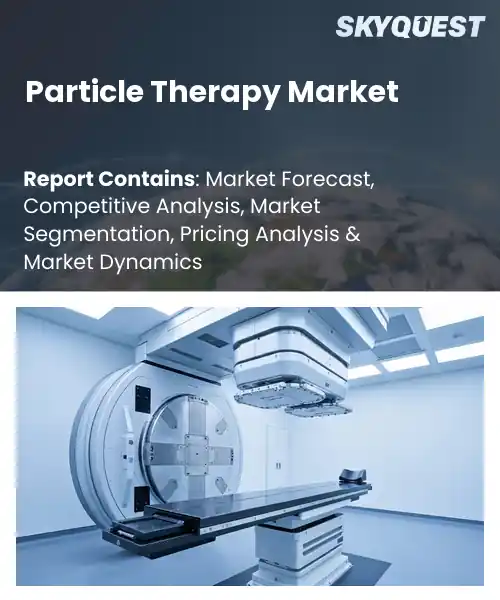
Particle Therapy Market
Report ID: SQMIG35D2388
Report ID: SQMIG35D2388
[email protected]
USA +1 351-333-4748
Report ID:
SQMIG35D2388 |
Region:
Global |
Published Date: February, 2026
Pages:
174
|Tables:
92
|Figures:
71


Global Particle Therapy Market size was valued at USD 1.2 Billion in 2024 and is poised to grow from USD 1.29 Billion in 2025 to USD 2.38 Billion by 2033, growing at a CAGR of 7.9% during the forecast period (2026-2033).
As cancer cases are rising throughout the world due to the aging population and lifestyle changes, the improvements in diagnostic rates are putting pressure on the health care systems to provide effective r healthcare therapies and survivorship activities. In the past, many of the treatments used to control the disease, such as traditional photon-based radiotherapy, have resulted in high doses of radiation being absorbed by healthy tissues, resulting in a high level of long-term side effects, including being at risk for developing a secondary cancer. As a result, the clinical limitations of traditional photon-based radiotherapy have made oncologists demand greater levels of tumor control with more minimal complications using particle therapy.
Early particle therapy facilities required massive cyclotrons, custom buildings, and multibillion-dollar investments, restricting adoption to a few specialized centers. Continuous technological innovation is now reversing this constraint. Compact proton systems, modular gantries, automation, and AI-assisted treatment planning reduce space, staffing, and operating requirements. The resulting effect is a broader range of hospitals—especially private cancer centers and regional oncology hubs—considering particle therapy as a viable investment, steadily expanding the global market footprint beyond highly developed economies.
How does AI Reduce Dependence on Highly Specialized Staff?
AI directly reshapes particle therapy by transforming how treatments are planned, delivered, and optimized. Manual contouring, dose calculation, and plan validation are both time consuming and requires a highly specialized skill set, which limits patient throughput. AI enabled auto-segmentation, dose prediction, and plan optimization to reduce the time to create treatment plans while increasing the accuracy and consistency of those plans. Faster, more reliable treatment workflows result in increased patient capacity at each center; lower operational costs; and greater clinical confidence in treating complex tumors. Indirectly, adaptive therapy using AI and real-time imaging analytics decrease both range of uncertainties and toxicity risks, thereby improving clinical outcomes and accelerating investments into next-generation particle therapy systems.
At the ASTRO 2025 conference, RaySearch Laboratories AB introduced new artificial intelligence enhancements for their RayStation® treatment planning software. These new features include enhanced capabilities for automated image segmentation, fast, adaptive re-planning capabilities, and automated treatment planning processes. These enhancements will increase the speed and accuracy of planning for particle therapy and will allow oncology facilities to quickly optimize and personalize their plans with less human input.
Market snapshot - 2026-2033
Global Market Size
USD 1.50 Billion
Largest Segment
Proton Therapy
Fastest Growth
Carbon Ion Therapy
Growth Rate
7.4% CAGR
To get more insights on this market click here to Request a Free Sample Report
Global Particle Therapy Market is segmented by Particle Therapy Types, Application Areas, End-User Segments, Technology Providers, Market Dynamics and region. Based on Particle Therapy Types, the market is segmented into Proton Therapy and Heavy Ion Therapy. Based on Application Areas, the market is segmented into Oncology Treatments and Non-oncology Treatments. Based on End-User Segments, the market is segmented into Hospitals and Research Institutions. Based on Technology Providers, the market is segmented into Equipment Manufacturers and Software Solution Providers. Based on Market Dynamics, the market is segmented into Drivers and Restraints. Based on region, the market is segmented into North America, Europe, Asia Pacific, Latin America and Middle East & Africa.
Proton therapy innovation is centered on compact system design, pencil beam scanning, adaptive planning, and AI-assisted workflows, enabling faster, more precise, and cost-efficient treatments. Its usage is expanding across pediatric, CNS, and complex tumors where tissue sparing is critical. Among the different types of particle therapy, Proton Therapy is leading the market. Proton Therapy provides the most balanced combination of clinical effectiveness, technological maturity, regulatory acceptance, and economic feasibility compared to Carbon Ion Therapies, which helps to increase the global penetration and investment level in Proton Therapy.
Carbon ion therapy is poised for fastest growth because it delivers higher biological effectiveness against radio-resistant tumors and tighter dose conformity, improving outcomes where protons are limited. With increasing clinical evidence and reducing facility costs, there will be a rise in the demand for advanced oncology facilities to enable a faster rate of worldwide adoption compared to other particle modalities.
Oncology applications drive particle therapy innovation through precision targeting, adaptive planning, and combining immunotherapy, expanding use in complex cancers like pediatric, head & neck, and radio-resistant tumors. The clinical data supporting improved local control and lower side effects is leading to faster acceptance and uptake of particle therapy. An increasing number of investments in and usage of particle therapy for cancer treatment is supported by particle therapy's advantages of greater precision in treating the tumor volume and greater biological effectiveness compared with conventional methods of delivering radiation.
Cardiology is emerging as the fastest-growing application as particle therapy is increasingly explored for non-invasive cardiac ablation, particularly in treating refractory ventricular tachycardia. The cause is the need for precise, catheter-free interventions in high-risk cardiac patients. The effect is rising clinical research, early adoption, and expanding interest beyond oncology, accelerating growth.
To get detailed segments analysis, Request a Free Sample Report
North America represents a mature and technology-driven region in the global particle therapy market trends, supported by advanced healthcare infrastructure, strong reimbursement mechanisms, and early adoption of precision oncology. The growing number of young patients has prompted a major push for new proton therapy centers to enlarge our growing base of philanthropic corporate sponsors with proven relationships in academic medicine. Education, research partnerships, and improving treatment via artificial intelligence will perpetually enhance our regional standing.
The United States is the primary growth engine of North America’s particle therapy market growth, driven by the world’s largest installed base of proton therapy centers, strong reimbursement pathways, and high oncology spending. High rates of cancer incidences, strong clinical trial activity, and vendor development efforts all contribute to the United States' leading position in the adoption and commercialization of innovative healthcare technology.
Canada contributes through targeted, research-led adoption rather than large-scale deployment. Canada puts a strong emphasis on cross border referrals of patients, sharing clinical collaboration, and evaluating cost-benefit of particle therapy through public healthcare. Although the number of facilities will remain relatively low, but trends in demand and continued discussions about policy changes indicate long-term growth in Canada’s participation.
Asia Pacific is the fastest-growing region in the global particle therapy market share, driven by rising cancer incidence, large patient populations, and increasing government investment in advanced oncology infrastructure. To meet the demand for proton and heavy-ion therapies, more countries in this area are investing in the development of new facilities capable of providing these types of therapy. The increasing prevalence of compact systems, new reimbursement policies, and high levels of research activity also contribute significantly to the further expansion of the regional marketplace.
Japan is a global pioneer in particle therapy, particularly in proton and carbon ion technologies, supported by decades of clinical research and strong government funding. Japan has early-approval status for regulatory agencies, a reimbursement structure that supports ongoing innovation in accelerators and treatment planning technologies and thus is a recognized technology and evidence leader in the Asia Pacific Region.
South Korea’s contribution is driven by rapid healthcare modernization, strong public–private investment, and the expansion of proton therapy centers within major academic hospitals. Increasing cancer incidence and the development of a robust government-assisted component of South Korea's infrastructure have also enabled it to become a rapidly growing and strategically important participant in the particle therapy marketplace within the Asia-Pacific region due to its vibrant medical tourism industry.
Europe’s particle therapy market regional outlook is expanding steadily, anchored by early adopters in Germany, Italy, and France, where public healthcare supports proton and carbon ion centers. Strong clinical research networks and EU initiatives, as well as CrossBorder referrals, have been critical drivers in the process. Compact systems and collaborative trials provide greater access to patient data and increase the number of studies conducted. The increased number of patients diagnosed with cancer and the positive reimbursement policies that many countries in Western Europe have made this region an important part of the Growth in Particle Therapy.
Germany is a leading contributor to Europe’s particle therapy market regional forecast, due to its strong public healthcare funding, early adoption of proton and carbon ion therapy, and concentration of advanced oncology centers. The country's high incidence of cancer, coupled with regulated reimbursement paths, and collaboration with manufacturers of medical devices, support ongoing investments in the use of this technology for clinical purposes.
France plays a strategic role through state-backed investments and centralized cancer care planning. Proton therapy adoption is driven by national oncology programs focused on pediatric and complex cancers. Collaboration amongst hospitals, research institutions and technology organisations will enable treatment planning/clinical protocols to be developed innovatively. The French governmental agency also supports the development of evidence-based expansion through its funding and support of evidence-based initiatives to grow the French particle therapy ecosystem on a long-term sustained basis.
The UK contributes through carefully planned, NHS-supported proton therapy deployment aimed at reducing overseas patient referrals. The national centres in the UK focus on certain 'high impact' tumour types - specifically, paediatric, brain and spinal tumours. Centralised procurement, combined with integration of clinical research and the training of the clinical workforce, improve operational efficiencies. As a controlled method of expansion takes place, increasing patient demand in the UK and long-term commitments to cancer strategies in the UK are results of the UK’s emerging role in the European particle therapy market.
To know more about the market opportunities by region and country, click here to
Buy The Complete Report
Rising Demand for Precision and Organ-Sparing Cancer Treatments
Expansion of Advanced Oncology Infrastructure and Public Funding
High Capital Investment and Operational Complexity
Limited Reimbursement and Uneven Clinical Evidence
Request Free Customization of this report to help us to meet your business objectives.
Global particle therapy’s competitive landscape features established device makers and hospital networks, Varian (Siemens/Varian), IBA, Hitachi, Mitsubishi, and Mevion, competing with new entrants offering compact systems and software. Vendors are pursuing vertical integration, service contracts, and AI-enabled planning partnerships as means of differentiating themselves from competitors: IBA is seeking to broaden its clinical services; Hitachi is concentrating on developing scalable heavy-ion platforms; and Mevion is emphasizing the development of compact, lower-cost proton units in order to foster increased adoption of proton therapy in regional hospitals. Varian is additionally expanding by offering software products and installation services.
The startup landscape in the global particle therapy market penetration is shaped by the need to overcome cost, size, and accessibility barriers. New entrants focus on compact system design, upright treatment concepts, and AI-driven software rather than full-scale accelerators. This cause reducing capital and operational constraints, creates the effect of broader hospital adoption, faster installations, and complementary innovation alongside established particle therapy vendors.
SkyQuest’s ABIRAW (Advanced Business Intelligence, Research & Analysis Wing) is our Business Information Services team that Collects, Collates, Correlates, and Analyses the Data collected by means of Primary Exploratory Research backed by robust Secondary Desk research.
As per SkyQuest analysis, the global particle therapy market statistics is transitioning from a niche, capital-intensive modality to a more accessible and strategically essential component of modern oncology care. An increase in cancer cases, the demand for organ-sparing therapies and advances in compact systems integrated with artificial intelligence are driving adoption growth through combined factors of clinical maturity supporting the dominant market position of proton therapy whilst generating new opportunities from high-growth markets associated with carbon ion32 therapy for complex cancers.
The growth of regional markets in North America, Europe, and Asia-Pacific can be attributed to the improvement of infrastructure, increasing support through government policies, and collaborative research. Along with the continued challenges to high costs and reimbursement, new innovations in particle therapy, the development of new technologies and a recent increase in the establishment of startups will bring with them the prospect of a new economy. Particle therapy is set for continued global growth due to the increased emphasis on precision medicine.
| Report Metric | Details |
|---|---|
| Market size value in 2024 | USD 1.2 Billion |
| Market size value in 2033 | USD 2.38 Billion |
| Growth Rate | 7.9% |
| Base year | 2024 |
| Forecast period | 2026-2033 |
| Forecast Unit (Value) | USD Billion |
| Segments covered |
|
| Regions covered | North America (US, Canada), Europe (Germany, France, United Kingdom, Italy, Spain, Rest of Europe), Asia Pacific (China, India, Japan, Rest of Asia-Pacific), Latin America (Brazil, Rest of Latin America), Middle East & Africa (South Africa, GCC Countries, Rest of MEA) |
| Companies covered |
|
| Customization scope | Free report customization with purchase. Customization includes:-
|
To get a free trial access to our platform which is a one stop solution for all your data requirements for quicker decision making. This platform allows you to compare markets, competitors who are prominent in the market, and mega trends that are influencing the dynamics in the market. Also, get access to detailed SkyQuest exclusive matrix.
Table Of Content
Executive Summary
Market overview
Parent Market Analysis
Market overview
Market size
KEY MARKET INSIGHTS
COVID IMPACT
MARKET DYNAMICS & OUTLOOK
Market Size by Region
KEY COMPANY PROFILES
Methodology
For the Particle Therapy Market, our research methodology involved a mixture of primary and secondary data sources. Key steps involved in the research process are listed below:
1. Information Procurement: This stage involved the procurement of Market data or related information via primary and secondary sources. The various secondary sources used included various company websites, annual reports, trade databases, and paid databases such as Hoover's, Bloomberg Business, Factiva, and Avention. Our team did 45 primary interactions Globally which included several stakeholders such as manufacturers, customers, key opinion leaders, etc. Overall, information procurement was one of the most extensive stages in our research process.
2. Information Analysis: This step involved triangulation of data through bottom-up and top-down approaches to estimate and validate the total size and future estimate of the Particle Therapy Market.
3. Report Formulation: The final step entailed the placement of data points in appropriate Market spaces in an attempt to deduce viable conclusions.
4. Validation & Publishing: Validation is the most important step in the process. Validation & re-validation via an intricately designed process helped us finalize data points to be used for final calculations. The final Market estimates and forecasts were then aligned and sent to our panel of industry experts for validation of data. Once the validation was done the report was sent to our Quality Assurance team to ensure adherence to style guides, consistency & design.
Analyst Support
Customization Options
With the given market data, our dedicated team of analysts can offer you the following customization options are available for the Particle Therapy Market:
Product Analysis: Product matrix, which offers a detailed comparison of the product portfolio of companies.
Regional Analysis: Further analysis of the Particle Therapy Market for additional countries.
Competitive Analysis: Detailed analysis and profiling of additional Market players & comparative analysis of competitive products.
Go to Market Strategy: Find the high-growth channels to invest your marketing efforts and increase your customer base.
Innovation Mapping: Identify racial solutions and innovation, connected to deep ecosystems of innovators, start-ups, academics, and strategic partners.
Category Intelligence: Customized intelligence that is relevant to their supply Markets will enable them to make smarter sourcing decisions and improve their category management.
Public Company Transcript Analysis: To improve the investment performance by generating new alpha and making better-informed decisions.
Social Media Listening: To analyze the conversations and trends happening not just around your brand, but around your industry as a whole, and use those insights to make better Marketing decisions.
REQUEST FOR SAMPLE
 REQUEST FREE CUSTOMIZATION
Global Particle Therapy Market size was valued at USD 1.50 Billion in 2025 and is expected to grow from USD 1.61 Billion in 2026 to USD 2.66 Billion by 2033, growing at a CAGR of 7.4% in the forecast period (2026-2033).
Global particle therapy’s competitive landscape features established device makers and hospital networks, Varian (Siemens/Varian), IBA, Hitachi, Mitsubishi, and Mevion, competing with new entrants offering compact systems and software. Vendors are pursuing vertical integration, service contracts, and AI-enabled planning partnerships as means of differentiating themselves from competitors: IBA is seeking to broaden its clinical services; Hitachi is concentrating on developing scalable heavy-ion platforms; and Mevion is emphasizing the development of compact, lower-cost proton units in order to foster increased adoption of proton therapy in regional hospitals. Varian is additionally expanding by offering software products and installation services. 'Ion Beam Applications (IBA) (Belgium)', 'Varian Medical Systems (USA)', 'Hitachi Ltd. (Japan)', 'Mitsubishi Electric Corporation (Japan)', 'Sumitomo Heavy Industries (Japan)', 'Mevion Medical Systems (USA)', 'ProTom International (USA)', 'Advanced Oncotherapy (United Kingdom)', 'RaySearch Laboratories (Sweden)', 'Elekta AB (Sweden)', 'Shimadzu Corporation (Japan)', 'ProNova Solutions (Norway)', 'Leo Cancer Care (United Kingdom)', 'Optivus Proton Therapy (USA)', 'Toshiba Energy Systems & Solutions (Japan)'
The increased occurrence of cancer and the modernization of expectations for survival have created a need for therapy options that do not harm healthy tissue. The fine control of the dose provided by particle therapy provides the ability to precisely target tumors, particularly in a pediatric or complex situation. This advantage will promote the growth of hospitals investing in and referring patients to this technology and will continue to contribute to the long-term development of the therapy across sophisticated oncology markets.
Expansion of Heavy-Ion for Radio-Resistant Cancers: Healthcare systems are increasing investment in carbon ion therapy to address tumors less responsive to conventional radiation. Strong clinical outcomes and growing evidence drive this trend. The rise in installation of these heavy-ion centers (especially throughout Asia and Europe) has led to increasing demand for High Energy Particle Therapy applications due to rapid advancement in this technology.
How does the Rise in Pediatric Cases Influence New Center Development in North America?


Want to customize this report? This report can be personalized according to your needs. Our analysts and industry experts will work directly with you to understand your requirements and provide you with customized data in a short amount of time. We offer $1000 worth of FREE customization at the time of purchase.
Feedback From Our Clients


 USA (+1) 351-333-4748

