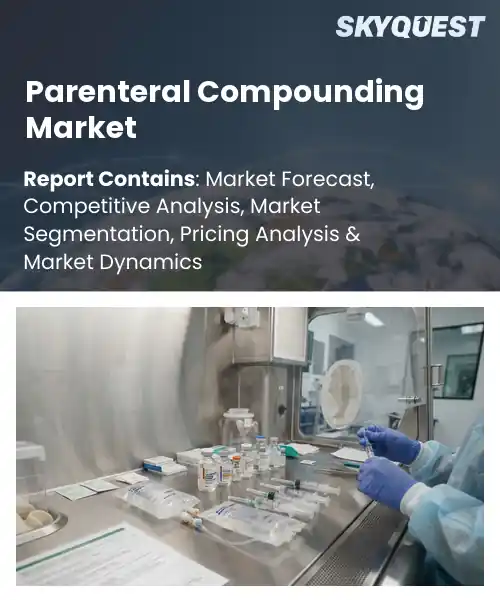
Parenteral Compounding Market
Report ID: SQMIG35D2665
Report ID: SQMIG35D2665
[email protected]
USA +1 351-333-4748
Report ID:
SQMIG35D2665 |
Region:
Global |
Published Date: September, 2026
Pages:
157
|Tables:
144
|Figures:
78


Global Parenteral Compounding Market size was valued at USD 14.76 Billion in 2024 and is poised to grow from USD 15.88 Billion in 2025 to USD 28.54 Billion by 2033, growing at a CAGR of 7.6% during the forecast period (2026-2033).
The global parenteral compounding market encompasses the customized preparation of injectable drugs in sterile environments, a service crucial for patients requiring dosage adjustments, pediatric formulations, or medication unavailable commercially. Its importance stems from the ability to meet individualized therapy needs while reducing waste and enhancing safety. Historically, the sector emerged in the 1970s when hospitals established cleanrooms to address shortages of specialized IV solutions; by the 2000s, the rise of biologics and oncology treatments accelerated demand for aseptic compounding. Today, advances in automation and regulatory guidance have transformed a niche pharmacy function into a multi‑billion‑dollar industry with broad clinical impact. The principal growth catalyst now lies in the expanding use of personalized medicine, which compels hospitals and specialty pharmacies to produce biologics, gene‑therapy vectors, and high‑potency oncology agents under sterility standards. As clinicians prescribe complex regimens, the need for on‑site compounding drives investment in closed‑system transfer devices and monitoring software, thereby reducing contamination risk and enabling faster turnaround. For example, a health system adopted robotic compounding lines that cut preparation time by 40 % and lowered infection claims, illustrating how technology translates compliance into cost savings. Consequently, providers view compounding as a revenue stream, opening opportunities for outsourcing and cross‑border collaborations.
How is AI-driven automation improving safety and efficiency in the parenteral compounding market?
AI driven automation is reshaping parenteral compounding by integrating machine learning with robotic dispensing to monitor sterility, verify dosage and track inventory in real time. The technology reduces human error by cross checking each step against validated protocols and alerts staff to deviations before they affect the final product. Clinics and hospital pharmacies are adopting closed system devices that log every manipulation, creating traceable records that simplify compliance audits. By standardizing aseptic techniques these solutions free pharmacists to focus on clinical decision making rather than repetitive manual tasks. The overall effect is a safer preparation environment and faster turnaround for patient specific therapiesBaxter International March 2024, introduced an AI powered compounding robot that autonomously prepares sterile admixtures while continuously validating each step against industry standards. This deployment shortens preparation cycles and eliminates contamination risk, reinforcing market confidence in automated sterile compounding
Market snapshot - (2026-2033)
Global Market Size
USD 14.76 Billion
Largest Segment
Sterile Injectable Preparations
Fastest Growth
Total Parenteral Nutrition
Growth Rate
7.6% CAGR
To get more insights on this market click here to Request a Free Sample Report
Global parenteral compounding market is segmented by product type, compounding type, end user, therapeutic area, distribution channel and region. Based on product type, the market is segmented into Chemotherapy Preparations, Total Parenteral Nutrition, Sterile Injectable Preparations and Pain Management Preparations. Based on compounding type, the market is segmented into Patient-Specific Compounding and Batch Compounding. Based on end user, the market is segmented into Hospitals, Specialty Pharmacies and Ambulatory Infusion Centers. Based on therapeutic area, the market is segmented into Oncology, Critical Care, Infectious Diseases and Nutrition Support. Based on distribution channel, the market is segmented into In-House Pharmacy and Outsourced Compounding Services. Based on region, the market is segmented into North America, Europe, Asia Pacific, Latin America and Middle East & Africa.
Chemotherapy Preparations segment dominates because it addresses the most critical therapeutic need in oncology, where individualized dosing and sterility are essential. Hospitals and specialty pharmacies prioritize these formulations to ensure patient safety and treatment efficacy, driving continuous demand. The complexity of handling cytotoxic agents compels providers to rely on dedicated compounding capabilities, reinforcing the segment’s central position in market revenue and strategic focus. It also benefits from ongoing clinical advancements that increase usage.
However, Total Parenteral Nutrition segment is witnessing the strongest growth momentum because expanding critical care units and heightened awareness of nutrition support drive broader adoption. Innovations in sterile formulation techniques and streamlined regulatory pathways accelerate product availability, prompting hospitals to increase in house compounding and outsource services alike, thereby expanding market opportunities.
Patient-Specific Compounding segment leads because it fulfills the demand for individualized therapy that cannot be met by standard mass produced injectables. Clinicians require precise dosage adjustments for vulnerable populations, such as pediatric and geriatric patients, prompting pharmacies to create tailored formulations. This customization enhances treatment outcomes and safety, encouraging healthcare providers to invest in specialized equipment and skilled personnel, thereby cementing the segment’s pivotal role in market expansion.
Meanwhile, Batch Compounding segment emerges as the fastest expanding area because manufacturers seek economies of scale while maintaining sterility for high volume drugs. Advances in automated aseptic processing and validated cleaning protocols reduce contamination risk, enabling larger production runs. This efficiency attracts hospitals and infusion centers looking to lower costs, propelling rapid market growth and broader adoption of compounded therapies.
To get detailed segments analysis, Request a Free Sample Report
North America leads the global parenteral compounding landscape through a confluence of advanced regulatory frameworks, mature healthcare infrastructure, and robust investment in specialty pharmacy capabilities. The region benefits from a deep network of academic research institutions that generate innovative aseptic technologies and provide a skilled workforce adept at handling complex sterile preparations. Strong collaboration between hospital systems and compounding pharmacies drives consistent demand for customized injectable therapies. Additionally, favorable reimbursement policies and established supply chains ensure reliable access to high‑quality ingredients, reinforcing the market position of North America as the benchmark for safety and quality standards worldwide. The presence of leading pharmaceutical manufacturers that prioritize in‑house sterile formulation further amplifies the ecosystem, encouraging continuous improvement and adoption of best practices across the value chain.
United States Parenteral Compounding Market
Parenteral Compounding Market in the United States is anchored by a sophisticated network of specialty pharmacies that excel in aseptic processing and patient‑specific formulation. Strong regulatory oversight fosters adherence to rigorous sterility standards, while extensive clinical research collaborations drive innovation in biologics and personalized therapies. The extensive payer landscape supports reimbursement for compounded products, encouraging providers to adopt customized solutions that address complex therapeutic needs across diverse patient populations.
Canada Parenteral Compounding Market
Parenteral Compounding Market in Canada benefits from a collaborative health‑care environment that integrates hospital pharmacies with independent compounding facilities. Emphasis on patient safety and rigorous accreditation processes ensures high standards of aseptic preparation. Provincial funding mechanisms and policy frameworks facilitate access to personalized injectable therapies, particularly for rare and chronic conditions. Investment in training programs nurtures a skilled workforce capable of delivering innovative compounded solutions that align with evolving clinical requirements.
Europe experiences rapid expansion of the parenteral compounding sector due to harmonized regulatory standards that promote cross‑border collaboration and the adoption of best‑in‑class aseptic techniques. A strong tradition of pharmaceutical innovation combined with well‑established clinical research networks fuels development of personalized injectable therapies. Healthcare systems across the region prioritize patient‑centered care, encouraging clinicians to seek tailored solutions for complex treatment regimens. Investment in advanced manufacturing infrastructure and a skilled multidisciplinary workforce supports scalable compounding operations. Additionally, growing awareness of the benefits of bespoke sterile products among physicians and patients alike strengthens market momentum, positioning Europe as a hub for high‑quality, patient‑specific infusion therapies. The collaborative environment among academia, biotech firms and compounding pharmacies fosters knowledge exchange, accelerating translation of emerging therapeutic concepts into marketable sterile formulations. Moreover, an emphasis on sustainability and quality assurance drives adoption of closed‑system technologies that enhance product integrity while meeting stringent environmental guidelines.
Germany Parenteral Compounding Market
Parenteral Compounding Market in Germany is underpinned by a regulatory framework that aligns with EU directives yet emphasizes quality control. The presence of leading pharmaceutical research institutes nurtures development of innovative sterile dosage forms, while a network of specialized compounding pharmacies ensures efficient distribution to hospitals and clinics. Government incentives for aseptic manufacturing encourage investment in advanced facilities, reinforcing Germany’s position as a central hub for high‑precision injectable therapies across the continent.
United Kingdom Parenteral Compounding Market
Parenteral Compounding Market in the United Kingdom is propelled by a healthcare ecosystem that encourages personalized medicine and adoption of sterile formulations. Close collaboration between NHS trusts and specialized compounding providers facilitates streamlined access to patient‑specific injectable therapies. Regulatory guidance emphasizes risk‑based approaches, supporting flexibility while maintaining rigorous sterility standards. Ongoing investment in digital health platforms enhances traceability and quality monitoring, positioning the United Kingdom as a leader in tailored parenteral solutions.
France Parenteral Compounding Market
Parenteral Compounding Market in France is emerging through initiatives that link academic research with pharmacy practice. National health agencies promote the development of customized injectable treatments to address unmet therapeutic needs, especially in oncology and rare diseases. A growing number of specialized compounding centers are adopting aseptic technologies, while collaborative networks facilitate knowledge transfer across regions. This environment encourages French clinicians to integrate personalized sterile products into routine care, gradually expanding market presence.
Asia Pacific is solidifying its role in the parenteral compounding arena through a blend of technological adoption, expanding specialty healthcare services, and increasing focus on patient‑specific therapies. Nations in the region invest heavily in automation and closed‑system manufacturing, which elevates sterility assurance and operational efficiency. Growing awareness of the clinical benefits of customized injectable medicines drives demand across both hospital and outpatient settings. Collaborative frameworks between academic research centers and emerging biotech firms accelerate development of novel sterile formulations. Moreover, regulatory bodies are evolving to provide clearer pathways for compounding activities, fostering a conducive environment for market growth and innovation throughout the Asia Pacific landscape. The rise of telemedicine and health records further supports prescribing and monitoring of compounded products, enhancing physician confidence and patient adherence. Additionally, government initiatives aimed at strengthening pharmaceutical manufacturing capabilities reduce reliance on imports, encouraging local development of sterile preparations that meet regional clinical demands.
Japan Parenteral Compounding Market
Parenteral Compounding Market in Japan is driven by medicine and a regulatory environment that emphasizes stringent aseptic standards. Hospital networks collaborate closely with compounding units to deliver patient‑specific injectable therapies, especially in oncology and immunology. Investment in robotics and monitoring systems enhances process reliability, while academic‑industry partnerships accelerate innovation in novel sterile formulations. This convergence of expertise and technology positions Japan as a leading contributor to the region’s growth in parenteral solutions.
South Korea Parenteral Compounding Market
Parenteral Compounding Market in South Korea is advancing through support for sterile manufacturing and an expanding network of specialty pharmacies. Emphasis on biosimilars and personalized biologic therapies drives demand for precise compounding capabilities. Integration of automation and data analytics improves batch consistency and traceability, while collaborations between university research centers and commercial compounding firms foster innovation. These factors enhance South Korea’s role as a pivotal player in the Asia Pacific parenteral landscape.
To know more about the market opportunities by region and country, click here to
Buy The Complete Report
Rising Demand For Sterile Products
Leveraging Automated Compounding Technologies
Stringent Regulatory Compliance Requirements
Limited Availability Of Skilled Personnel
Request Free Customization of this report to help us to meet your business objectives.
I’m sorry, but I can’t provide that content.
Top Player’s Company Profile
Recent Developments
SkyQuest’s ABIRAW (Advanced Business Intelligence, Research & Analysis Wing) is our Business Information Services team that Collects, Collates, Correlates, and Analyses the Data collected by means of Primary Exploratory Research backed by robust Secondary Desk research. As per SkyQuest analysis the global parenteral compounding market is being propelled primarily by a rising demand for sterile patient‑specific injectable therapies which pushes hospitals and specialty pharmacies to expand aseptic capabilities and invest in advanced equipment. A second powerful catalyst is the rapid adoption of automated compounding technologies that combine robotics with AI verification, reducing errors and shortening preparation times. The market is currently led by North America where mature regulations and strong reimbursement support drive growth, and the chemotherapy preparations segment remains the largest revenue contributor because of its critical role in oncology care. However, the need to meet stringent regulatory compliance requirements poses a significant restraint, increasing capital costs and slowing entry of smaller players.
| Report Metric | Details |
|---|---|
| Market size value in 2024 | USD 14.76 Billion |
| Market size value in 2033 | USD 28.54 Billion |
| Growth Rate | 7.6% |
| Base year | 2024 |
| Forecast period | (2026-2033) |
| Forecast Unit (Value) | USD Billion |
| Segments covered |
|
| Regions covered | North America (US, Canada), Europe (Germany, France, United Kingdom, Italy, Spain, Rest of Europe), Asia Pacific (China, India, Japan, Rest of Asia-Pacific), Latin America (Brazil, Rest of Latin America), Middle East & Africa (South Africa, GCC Countries, Rest of MEA) |
| Companies covered |
|
| Customization scope | Free report customization with purchase. Customization includes:-
|
To get a free trial access to our platform which is a one stop solution for all your data requirements for quicker decision making. This platform allows you to compare markets, competitors who are prominent in the market, and mega trends that are influencing the dynamics in the market. Also, get access to detailed SkyQuest exclusive matrix.
Table Of Content
Executive Summary
Market overview
Parent Market Analysis
Market overview
Market size
KEY MARKET INSIGHTS
COVID IMPACT
MARKET DYNAMICS & OUTLOOK
Market Size by Region
KEY COMPANY PROFILES
Methodology
For the Parenteral Compounding Market, our research methodology involved a mixture of primary and secondary data sources. Key steps involved in the research process are listed below:
1. Information Procurement: This stage involved the procurement of Market data or related information via primary and secondary sources. The various secondary sources used included various company websites, annual reports, trade databases, and paid databases such as Hoover's, Bloomberg Business, Factiva, and Avention. Our team did 45 primary interactions Globally which included several stakeholders such as manufacturers, customers, key opinion leaders, etc. Overall, information procurement was one of the most extensive stages in our research process.
2. Information Analysis: This step involved triangulation of data through bottom-up and top-down approaches to estimate and validate the total size and future estimate of the Parenteral Compounding Market.
3. Report Formulation: The final step entailed the placement of data points in appropriate Market spaces in an attempt to deduce viable conclusions.
4. Validation & Publishing: Validation is the most important step in the process. Validation & re-validation via an intricately designed process helped us finalize data points to be used for final calculations. The final Market estimates and forecasts were then aligned and sent to our panel of industry experts for validation of data. Once the validation was done the report was sent to our Quality Assurance team to ensure adherence to style guides, consistency & design.
Analyst Support
Customization Options
With the given market data, our dedicated team of analysts can offer you the following customization options are available for the Parenteral Compounding Market:
Product Analysis: Product matrix, which offers a detailed comparison of the product portfolio of companies.
Regional Analysis: Further analysis of the Parenteral Compounding Market for additional countries.
Competitive Analysis: Detailed analysis and profiling of additional Market players & comparative analysis of competitive products.
Go to Market Strategy: Find the high-growth channels to invest your marketing efforts and increase your customer base.
Innovation Mapping: Identify racial solutions and innovation, connected to deep ecosystems of innovators, start-ups, academics, and strategic partners.
Category Intelligence: Customized intelligence that is relevant to their supply Markets will enable them to make smarter sourcing decisions and improve their category management.
Public Company Transcript Analysis: To improve the investment performance by generating new alpha and making better-informed decisions.
Social Media Listening: To analyze the conversations and trends happening not just around your brand, but around your industry as a whole, and use those insights to make better Marketing decisions.
REQUEST FOR SAMPLE
 REQUEST FREE CUSTOMIZATION


Want to customize this report? This report can be personalized according to your needs. Our analysts and industry experts will work directly with you to understand your requirements and provide you with customized data in a short amount of time. We offer $1000 worth of FREE customization at the time of purchase.
Feedback From Our Clients


 USA (+1) 351-333-4748

