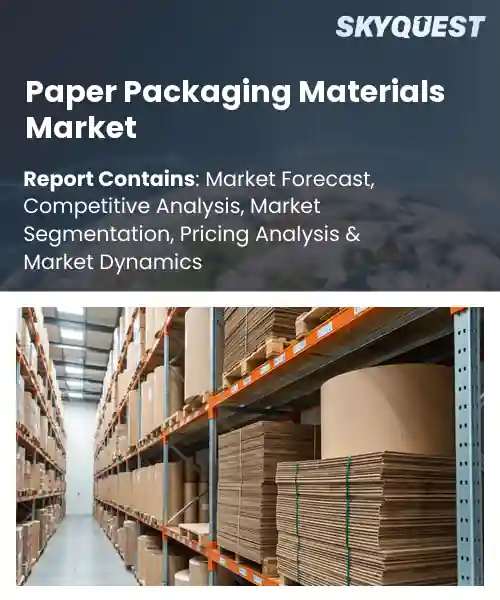
Paper Packaging Materials Market
Report ID: SQMIG15H2196
Report ID: SQMIG15H2196
[email protected]
USA +1 351-333-4748
Report ID:
SQMIG15H2196 |
Region:
Global |
Published Date: May, 2026
Pages:
157
|Tables:
183
|Figures:
79


Global Paper Packaging Materials Market size was valued at USD 392.8 Billion in 2024 and is poised to grow from USD 418.33 Billion in 2025 to USD 692.34 Billion by 2033, growing at a CAGR of 6.5% during the forecast period (2026-2033).
The primary driver of the paper packaging materials market is pressure from sustainability imperatives and shifting consumption patterns, which reshape supply chains and product design. Paper packaging includes corrugated board, paperboard cartons, sacks and films used in ecommerce, food and beauty, and it matters because it supports recyclability, reduces reliance on plastics from fossil fuels and enables circularity commitments. Over two decades the market moved from heavy industrial cartons toward lighter consumer facing formats as barrier coatings, fiber substitution and automated converting improved. For example, ecommerce growth boosted corrugated demand and motivated retailers to replace plastic wraps with paper alternatives.
Building on demand driven by sustainability, key factor shaping paper packaging is fiber supply and pulp price volatility, influencing costs and design choices. When virgin pulp costs rise or recovered fiber availability tightens, converters invest in lightweighting, coatings compatible with recycling and recycling capacity to protect margins and meet targets. For example, food brands shifted to higher recycled content board, prompting mills to install deinking lines and test agricultural fiber blends cut wood pulp dependence. Those shifts create opportunities for suppliers of certified recycled fibers, recyclable coatings and circular procurement partnerships that stabilize supply, improve traceability and lower lifecycle costs.
How is AI improving sustainability in the paper packaging materials market?
AI is improving sustainability in the paper packaging materials market by making design and production more efficient and supply chains more transparent. Key aspects include automated design tools that reduce material use, machine vision for quality control that lowers rejects, predictive maintenance that keeps equipment efficient and AI enabled sourcing that supports renewable fiber choices. The market context is a shift toward recyclable and compostable packaging driven by brand and regulatory expectations. Firms are applying AI across lifecycle planning and operations to cut raw material loss and extend circularity while preserving functional performance.
Globant and CMPC April 2026, launched an AI based supply chain traceability solution that strengthens responsible fiber sourcing and regulatory compliance while speeding audits and turning supply chain data into operational choices that reduce waste and support growth.
Market snapshot - (2026-2033)
Global Market Size
USD 392.8 Billion
Largest Segment
Corrugated Paper
Fastest Growth
Corrugated Paper
Growth Rate
6.5% CAGR
To get more insights on this market click here to Request a Free Sample Report
Global paper packaging materials market is segmented by material type, product type, layer type, application, end user, distribution channel and region. Based on material type, the market is segmented into Kraft Paper, Corrugated Paper, Paperboard, Specialty Paper and Others. Based on product type, the market is segmented into Boxes & Cartons, Bags & Sacks, Wraps & Pouches, Cups & Trays, Labels & Inserts and Others. Based on layer type, the market is segmented into Single Wall, Double Wall, Triple Wall and Others. Based on application, the market is segmented into Food & Beverage Packaging, E-Commerce Packaging, Consumer Goods Packaging, Healthcare Packaging, Industrial Packaging and Others. Based on end user, the market is segmented into Food & Beverage Industry, Retail & E-Commerce, Healthcare Industry, Electronics Industry, Industrial Manufacturing and Others. Based on distribution channel, the market is segmented into Direct Sales, Distributors & Wholesalers and Online Sales. Based on region, the market is segmented into North America, Europe, Asia Pacific, Latin America and Middle East & Africa.
Kraft Paper segment dominates because its high-tenacity fibers and recyclability align with core industry needs for durable yet environmentally responsible packaging. The material’s mechanical strength supports lighter constructs that still protect goods, reducing damage and return rates, while its compatibility with printing and coatings aids brand requirements. Widespread manufacturing familiarity and low cost production encourage stable procurement, prompting supplier investment and sustained adoption across product categories.
However, Specialty Paper segment is witnessing the strongest growth momentum as barrier treated and compostable grades expand into premium and technical packaging. Functional coatings and novel fiber blends enable improved shelf life and moisture resistance for food and medical uses. Regulatory momentum for compostable materials and brand demand for differentiated finishes are accelerating adoption and supplier innovation.
Direct Sales segment dominates because major buyers favor direct manufacturer relationships to secure customized paper formulations and large volume supply. Close collaboration enables precise specification control, tailored coatings and print finishing, and synchronized logistics that reduce lead times and ensure consistent quality for critical applications. Long term contracts with technical service commitments incentivize supplier capacity expansion and research and development, reinforcing supplier-buyer ties and sustaining market leadership.
However, Online Sales segment is witnessing the strongest growth momentum as digital platforms simplify procurement for small and medium buyers and enable rapid access to diverse paper grades and customization options. Digital catalogs, instant quoting and logistics integration shorten procurement cycles, while data analytics and marketplace competition accelerate innovation, expanding reach for niche suppliers and creating new market opportunities.
To get detailed segments analysis, Request a Free Sample Report
Asia Pacific leads due to a dense manufacturing ecosystem that connects raw material suppliers, converters and global brands. Large consumer markets and strong export orientation create steady demand for paper based packaging, while established pulp and paper capacity supports consistent supply. Regional cost efficiencies and localized innovation enable a broad range of product formats from lightweight cartons to specialty barrier papers. Policy emphasis on circularity and recycling, plus rapid expansion of e commerce and modern retail channels, reinforce adoption of sustainable fiber based solutions. Close collaboration between mills and converters accelerates customization for brand owners, and robust logistics networks ensure timely delivery across diverse national markets, sustaining Asia Pacific position at the center of global paper packaging value chains. Investment in upgraded mills and sustainable sourcing further strengthens regional competitiveness and market depth.
Paper Packaging Materials Market in Japan is characterized by premium quality standards, strong demand for functional and lightweight solutions and food safety requirements. Domestic mills and converters prioritize innovation in barrier papers and coated boards to meet consumer needs. Collaboration between material producers and packaging designers fosters advanced formats and efficient recycling pathways. Regulatory emphasis on material recovery and consumer preference for sustainable packaging sustain momentum across application segments broadly.
Paper Packaging Materials Market in South Korea is shaped by dynamic converter networks focusing on high performance flexible paper formats. Domestic suppliers emphasize functional coatings, barrier enhancements and design integration to meet demanding brand and export requirements. Adaptation to e commerce fulfillment models and compact retail formats drives specialized packaging solutions. Policy measures encouraging material recovery and partnerships between mills and converters support innovation and transition toward circular fiber packaging.
North America expansion is driven by converging pressures from brands, retailers and consumers seeking more sustainable packaging formats. Corporate commitments to reduce plastic and increase recycled content create sustained demand for fiber based solutions, while advancements in recycling infrastructure and collection systems improve feedstock availability. Investment by converters and mills in modernization enables production of high performance papers and boards suited to food safety and e commerce logistics. Innovation in coatings and barrier technologies addresses functional gaps without compromising recyclability. Supply chain reconfiguration, focus on local sourcing and strong collaboration between packaging designers, material producers and waste management stakeholders accelerate commercialization of new formats, positioning North America as a rapidly evolving market for paper packaging materials. Supportive regulatory frameworks and brand led pilot programs for recyclable formats further stimulate demand and guide investment toward lightweighting and material efficiency.
Paper Packaging Materials Market in United States is led by large converters and strong retail and e commerce demand, aligned with corporate sustainability commitments. Mill upgrades and investments in recycling increase recycled fiber availability for packaging grades. Development of barrier coatings and adaptable board formats supports food and protective packaging. Coordination between brands, converters and waste management stakeholders fosters pilot programs and standardization that influence product specifications and procurement decisions.
Paper Packaging Materials Market in Canada draws on forest based fiber supply and regional mills serving domestic cross border demand. Emphasis on recycled content and supply chain transparency steers development toward recyclable and processed packaging grades. Converters and brand owners collaborate on material specification and lightweighting to meet retail and food industry needs. Public private initiatives improving collection and recycling infrastructure support circularity and wider adoption of fiber packaging solutions.
Europe is consolidating strength through policy driven circularity measures, mature recycling systems and a well established pulp and paper industry that emphasizes sustainable sourcing and certified fiber. Extended producer responsibility frameworks and packaging waste legislation push brand owners toward recyclable, mono material and easy to sort formats, accelerating demand for paper based alternatives. Technical innovation in barrier technologies and coating chemistries helps reconcile food safety and shelf life with recyclability requirements. Close alignment among mills, converters, retailers and waste managers fosters standardized specifications and collection practices. Investments in mill upgrades and collaborative pilot programs for reusable and recyclable systems further integrate paper packaging into wider sustainability agendas, reinforcing Europe role as a leader in responsible packaging solutions. Market actors emphasize design for recycling, material transparency and cross border collaboration to scale uptake.
Paper Packaging Materials Market in Germany is anchored by a strong industrial base, advanced recycling infrastructure and alignment between manufacturers and brand owners. Emphasis on material quality and functional performance drives development of high grade boards and papers suitable for food applications. Collaboration with chemical and processing suppliers enables barrier and coating innovations that balance product protection with recyclability. Standardized collection systems and logistics support circularity across packaging supply chains.
Paper Packaging Materials Market in United Kingdom is driven by retailer and consumer demand for recyclable packaging and initiatives that promote reuse and reduction. Converters focus on boards and coating systems that combine protection with recyclability for food and consumer goods. Collaboration among brands, waste managers and policymakers supports collection and sorting improvements. Pilot projects and targets encourage adoption of fiber alternatives nationally across retail, e commerce and packaging segments.
Paper Packaging Materials Market in France is characterized by emphasis on design, brand and sustainable sourcing, especially within food and luxury segments. Converters develop boards and printed solutions that combine aesthetics with functional barrier properties. National recycling and collection systems, complemented by policy measures, encourage use of recyclable and compostable fiber based options. Collaboration among designers, mills and retailers supports innovation in material specification and circular business models across packaging applications.
To know more about the market opportunities by region and country, click here to
Buy The Complete Report
Rising Preference For Recyclable Materials
Expansion Of Ecommerce Packaging Needs
High Cost Of Specialized Coatings
Limited Availability Of High Grade Pulp
Request Free Customization of this report to help us to meet your business objectives.
Competition in the global paper packaging materials market is intensifying as sustainability mandates drive rivals to pursue consolidation, strategic alliances and material innovation to secure retail and CPG contracts. Notable concrete moves include Amcor's acquisition of Bemis and the BillerudKorsnäs and Alpla joint venture Paboco for paper bottles, while firms commercialize barrier coatings and recyclable paper technologies to meet retailer specifications.
SkyQuest’s ABIRAW (Advanced Business Intelligence, Research & Analysis Wing) is our Business Information Services team that Collects, Collates, Correlates, and Analyses the Data collected by means of Primary Exploratory Research backed by robust Secondary Desk research.
As per SkyQuest analysis, the global paper packaging materials market is being propelled by sustainability imperatives that push brands to replace plastics with recyclable fiber solutions, while rapid ecommerce expansion serves as a second major driver by increasing demand for protective, lightweight shipping formats. A notable restraint remains the high cost of specialized barrier coatings which can complicate adoption for some converters and brands. Asia Pacific currently dominates the market thanks to its integrated pulp and converting ecosystems and large consumer base, and kraft paper stands out as the dominating segment due to its strength, recyclability and cost efficiency, with momentum favoring circularity and material innovation.
| Report Metric | Details |
|---|---|
| Market size value in 2024 | USD 392.8 Billion |
| Market size value in 2033 | USD 692.34 Billion |
| Growth Rate | 6.5% |
| Base year | 2024 |
| Forecast period | (2026-2033) |
| Forecast Unit (Value) | USD Billion |
| Segments covered |
|
| Regions covered | North America (US, Canada), Europe (Germany, France, United Kingdom, Italy, Spain, Rest of Europe), Asia Pacific (China, India, Japan, Rest of Asia-Pacific), Latin America (Brazil, Rest of Latin America), Middle East & Africa (South Africa, GCC Countries, Rest of MEA) |
| Companies covered |
|
| Customization scope | Free report customization with purchase. Customization includes:-
|
To get a free trial access to our platform which is a one stop solution for all your data requirements for quicker decision making. This platform allows you to compare markets, competitors who are prominent in the market, and mega trends that are influencing the dynamics in the market. Also, get access to detailed SkyQuest exclusive matrix.
Table Of Content
Executive Summary
Market overview
Parent Market Analysis
Market overview
Market size
KEY MARKET INSIGHTS
COVID IMPACT
MARKET DYNAMICS & OUTLOOK
Market Size by Region
KEY COMPANY PROFILES
Methodology
For the Paper Packaging Materials Market, our research methodology involved a mixture of primary and secondary data sources. Key steps involved in the research process are listed below:
1. Information Procurement: This stage involved the procurement of Market data or related information via primary and secondary sources. The various secondary sources used included various company websites, annual reports, trade databases, and paid databases such as Hoover's, Bloomberg Business, Factiva, and Avention. Our team did 45 primary interactions Globally which included several stakeholders such as manufacturers, customers, key opinion leaders, etc. Overall, information procurement was one of the most extensive stages in our research process.
2. Information Analysis: This step involved triangulation of data through bottom-up and top-down approaches to estimate and validate the total size and future estimate of the Paper Packaging Materials Market.
3. Report Formulation: The final step entailed the placement of data points in appropriate Market spaces in an attempt to deduce viable conclusions.
4. Validation & Publishing: Validation is the most important step in the process. Validation & re-validation via an intricately designed process helped us finalize data points to be used for final calculations. The final Market estimates and forecasts were then aligned and sent to our panel of industry experts for validation of data. Once the validation was done the report was sent to our Quality Assurance team to ensure adherence to style guides, consistency & design.
Analyst Support
Customization Options
With the given market data, our dedicated team of analysts can offer you the following customization options are available for the Paper Packaging Materials Market:
Product Analysis: Product matrix, which offers a detailed comparison of the product portfolio of companies.
Regional Analysis: Further analysis of the Paper Packaging Materials Market for additional countries.
Competitive Analysis: Detailed analysis and profiling of additional Market players & comparative analysis of competitive products.
Go to Market Strategy: Find the high-growth channels to invest your marketing efforts and increase your customer base.
Innovation Mapping: Identify racial solutions and innovation, connected to deep ecosystems of innovators, start-ups, academics, and strategic partners.
Category Intelligence: Customized intelligence that is relevant to their supply Markets will enable them to make smarter sourcing decisions and improve their category management.
Public Company Transcript Analysis: To improve the investment performance by generating new alpha and making better-informed decisions.
Social Media Listening: To analyze the conversations and trends happening not just around your brand, but around your industry as a whole, and use those insights to make better Marketing decisions.
REQUEST FOR SAMPLE
 REQUEST FREE CUSTOMIZATION
Global Paper Packaging Materials Market size was valued at USD 392.8 Billion in 2024 and is poised to grow from USD 418.33 Billion in 2025 to USD 692.34 Billion by 2033, growing at a CAGR of 6.5% during the forecast period (2026-2033).
Competition in the global paper packaging materials market is intensifying as sustainability mandates drive rivals to pursue consolidation, strategic alliances and material innovation to secure retail and CPG contracts. Notable concrete moves include Amcor's acquisition of Bemis and the BillerudKorsnäs and Alpla joint venture Paboco for paper bottles, while firms commercialize barrier coatings and recyclable paper technologies to meet retailer specifications. 'International Paper Company', 'WestRock Company', 'Smurfit Westrock plc', 'DS Smith Plc', 'Mondi plc', 'Stora Enso Oyj', 'UPM-Kymmene Corporation', 'Nine Dragons Paper Holdings Limited', 'Oji Holdings Corporation', 'Nippon Paper Industries Co., Ltd.', 'Packaging Corporation of America', 'Sappi Limited', 'Georgia-Pacific LLC', 'Cascades Inc.', 'Mayr-Melnhof Karton AG', 'Sonoco Products Company', 'Pratt Industries, Inc.', 'Metsa Board Corporation', 'Graphic Packaging International, LLC', 'Klabin S.A.'
The growing consumer preference for recyclable and biodegradable packaging drives demand for paper based materials by encouraging manufacturers and retailers to prioritize sustainable options, resulting in increased adoption across product categories. As brand owners seek to align with environmental commitments and meet consumer expectations, investment in fiber based solutions rises, stimulating innovation in paper formulations and coatings. This shift supports market expansion by creating consistent commercial incentives for suppliers to scale production, refine supply chains, and develop diverse paper packaging formats that replace less sustainable alternatives.
Circularity And Recycling Focus: Industry participants are prioritizing closed-loop systems and recycled fiber streams to reduce environmental footprints and meet stakeholder expectations. Design-for-recycling principles and mono-material formats are being emphasized to improve end-of-life recovery and compatibilize collection infrastructure. Collaboration among brands, converters, and waste managers is accelerating innovations in sorting, cleaning, and repulping processes. Regulatory impetus and consumer preference for circular packaging are driving investments in scalable recycling initiatives and supply chain traceability, enhancing brand credibility while supporting resource efficiency and long-term material availability.
Why does Asia Pacific Dominate the Global Paper Packaging Materials Market? |@12


Want to customize this report? This report can be personalized according to your needs. Our analysts and industry experts will work directly with you to understand your requirements and provide you with customized data in a short amount of time. We offer $1000 worth of FREE customization at the time of purchase.
Feedback From Our Clients


 USA (+1) 351-333-4748

