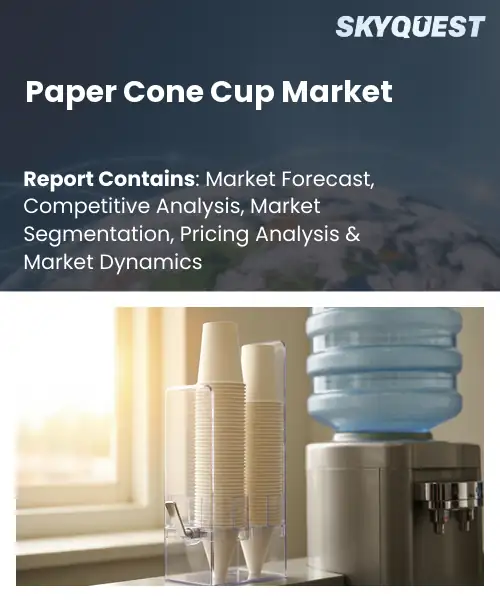
Paper Cone Cup Market
Report ID: SQMIG25H2071
Report ID: SQMIG25H2071
[email protected]
USA +1 351-333-4748
Report ID:
SQMIG25H2071 |
Region:
Global |
Published Date: April, 2026
Pages:
157
|Tables:
146
|Figures:
78


Global Paper Cone Cup Market size was valued at USD 416.0 Million in 2024 and is poised to grow from USD 433.47 Million in 2025 to USD 602.42 Million by 2033, growing at a CAGR of 4.2% during the forecast period (2026-2033).
An accelerating primary driver of the paper cone cup market is the global shift toward single-use plastic reduction driven by public policy, corporate sustainability commitments, and changing consumer preferences. The market comprises lightweight, often biodegradable conical paper vessels used for dispensing drinking water, coffee samplings, and consumption at events and points, and it matters because it substitutes high-polluting plastics while offering cost and advantages to institutions such as hospitals and stadiums. Over the past decade adoption expanded from suppliers to mainstream purchasing through municipal bans on plastic disposables, EU directives and major foodservice brands transitioning to paper-based formats as examples.One key factor shaping global growth is technological innovation in fibers and barrier treatments that reduces leaks and expands usable applications, and that effect cascades into procurement and consumer acceptance. When manufacturers adopt compostable PLA or water-based dispersion coatings, cups can safely hold hot beverages and sauces, which causes institutional buyers such as airlines, hospitals and event organizers to replace plastic options. Volume production and automation then lower unit costs, creating price parity with plastic and enabling wider rollouts at festivals and workplace water dispensers. These dynamics unlock partnership opportunities with recycling firms and branded packaging initiatives that drive sales.
How is automation improving production efficiency in the paper cone cup market?
Automation is streamlining paper cone cup production by linking forming, barrier coating, and inspection into continuous lines. Key aspects are automated cup forming, inline coating, robotic handling and vision based quality control. The current state shows manufacturers replacing manual touch points with modular equipment that shortens changeovers and raises line availability. This shift matters because demand for recyclable and compostable cups is growing and labor is tighter. For example established cup forming machine builders supply high speed, reliable equipment that improves consistency. Modular automation packages let regional producers scale output with smaller crews while cutting waste and rework.Huhtamaki July 2025, introduced new compostable paper cups and highlighted automated production methods that increase throughput and consistency, strengthening the market by making sustainable cup formats easier to scale.
Market snapshot - (2026-2033)
Global Market Size
USD 416.0 Million
Largest Segment
Medium Size
Fastest Growth
Small Size
Growth Rate
4.2% CAGR
To get more insights on this market click here to Request a Free Sample Report
Global paper cone cup market is segmented by cup size, end user, coating type, material type, distribution channel and region. Based on cup size, the market is segmented into Small Size, Medium Size and Large Size. Based on end user, the market is segmented into Food Service Industry, Retail Outlets, Events and Catering and Educational Institutions. Based on coating type, the market is segmented into Polyethylene Coated, PLA Coated and Biodegradable Coatings. Based on material type, the market is segmented into Single-Wall Cups, Double-Wall Cups and Ripple-Wall Cups. Based on distribution channel, the market is segmented into Online Retail, Direct Sales, Wholesale Distribution and Supermarkets and Hypermarkets. Based on region, the market is segmented into North America, Europe, Asia Pacific, Latin America and Middle East & Africa.
Polyethylene Coated segment dominates because its reliable moisture and grease barrier delivers consistent liquid containment and operational simplicity for manufacturers and buyers. Established coating processes and material availability reduce production complexity and support predictable product performance, which encourages widespread adoption in routine beverage and snack service. This persistent preference for dependable barrier performance drives supplier investment and maintains polyethylene coated cups as the market mainstay across conventional applications.
However, PLA Coated segment is witnessing the strongest growth momentum because buyer demand for compostable barriers and brand sustainability drives adoption. Improvements in PLA performance and compatibility with composting systems attract manufacturer investment, enabling premium positioning and new use cases that fuel rapid expansion and create fresh commercial opportunities.
Double-Wall Cups segment leads because its integrated insulating construction lowers surface temperature while preserving a slim profile, meeting operator goals for safe hot beverage service without extra accessories. The inherent thermal protection enhances consumer comfort and simplifies handling, prompting food service buyers to specify double-wall designs for premium offerings. This buyer preference steers manufacturers toward performance-led production and cements double-wall cups as the preferred choice for hot beverage applications.
However, Ripple-Wall Cups segment is emerging as the key high growth area as textured walls provide ergonomic grip and perceived insulation while allowing lighter material use. Consumer appetite for tactile design and brands seeking distinctive aesthetics fuels innovation and customization, expanding applications in on the go retail and event settings and unlocking new commercialization paths.
To get detailed segments analysis, Request a Free Sample Report
Asia Pacific dominance is rooted in a convergence of market scale, manufacturing capability, and proactive sustainability adoption. Dense urban populations and extensive foodservice networks create steady demand, while well established paper packaging industries supply efficient production and customization. Regional manufacturers emphasize material innovation and compostable substrates, aligning with regulatory encouragement for single use alternatives and supply chain resilience. Export oriented production hubs and integrated raw material sourcing lower lead times and support competitive pricing. Consumer preference for convenient, on the go beverage solutions and strong retailer partnerships accelerate category penetration, while collaborations among converters, brand owners, and waste management stakeholders reinforce circularity and market depth across key markets.
Paper Cone Cup Market in Japan reflects strong consumer emphasis on convenience and environmental responsibility, increasingly driving adoption of compostable cone cups across urban foodservice and vending channels. Domestic manufacturers prioritize high quality printing, lightweight structures, and hygienic liners to meet stringent retail and institutional standards. Collaboration with waste management initiatives supports closed loop ambitions, while premiumized design and limited releases create differentiation in a sophisticated, design conscious market landscape.
Paper Cone Cup Market in South Korea is shaped by a dynamic foodservice culture and consumer uptake of sustainable alternatives, encouraging innovation in barrier coatings and lightweight paper substrates. Local converters focus on high speed production, bespoke designs, and hygiene standards suited to urban takeout and street food. Partnerships between brands and municipal waste initiatives aim to improve end of life pathways, while collaborations with designers elevate beverage offerings.
North America expansion is propelled by heightened consumer demand for convenient, single serve beverage solutions and an accelerating focus on sustainable alternatives within foodservice and retail channels. Major quick service and specialty coffee chains are fostering category uptake through standardized procurement and brand collaborations that prioritize compostable and recyclable substrates. Regional manufacturers and converters are investing in flexible production to meet diverse customization needs and to shorten lead times for retailers. Procurement policies at institutional and corporate levels increasingly favor suppliers with clear environmental credentials, while partnerships across supply chain stakeholders enhance collection and end of life management. Investment in material science and certification alignment helps brands communicate performance and disposal pathways, reducing consumer friction and supporting broader adoption.
Paper Cone Cup Market in United States is characterized by strong influence from major coffee chains and convenience retailers that shape demand through standardized packaging specifications and sustainability commitments. Manufacturers emphasize customization, barrier technologies for hot beverages, and material sourcing to meet retailer procurement requirements. Collaboration with certification bodies and waste management organizations aids in clarifying end of life options, while label growth and trends drive product differentiation and premiumization.
Paper Cone Cup Market in Canada is influenced by retailer and municipal commitments to reduce single use plastics and adopt compostable alternatives across broader foodservice procurement. Converters prioritize certified fiber sourcing, barrier performance for hot and cold beverages, and transparent supply chains to meet procurement standards. Coordination with municipal organics programs and industry groups supports disposal solutions, while collaborations with craft beverage operators enable niche product differentiation and premium positioning.
Europe is reinforcing its role through a combination of regulatory emphasis on circularity, strong retail and foodservice commitments to sustainable packaging, and concentrated innovation around compostable and recyclable substrates. Regional converters are advancing barrier chemistries compatible with industrial composting systems and are aligning product specifications with harmonized disposal standards to reduce consumer uncertainty. Collaboration among manufacturers, certification bodies, and municipal waste operators enhances end of life infrastructure. Brand owners are employing design driven differentiation and strategic sourcing of certified fibers to meet discerning consumer expectations, while pan European trade networks facilitate technology transfer and scale efficiencies that bolster regional competitiveness and category resilience. Investment in flexible manufacturing, sustainable inks, and biobased coatings enables rapid adaptation to emerging consumer preferences, while collaboration with hospitality chains and retailer initiatives supports widespread adoption; consumer education campaigns and labelling clarity further reduce friction and enhance trust across markets.
Paper Cone Cup Market in Germany benefits from advanced manufacturing capabilities, engineering of barrier solutions, and a regulatory environment that encourages recyclable and compostable alternatives. Converters prioritize material performance under quality audits, and partnerships with retailers emphasize consistent supply and traceability. Municipal collection systems and industry sorting initiatives support end of life management, while collaborations with hospitality operators foster adoption and product innovation that highlights sustainability credentials across regional markets.
Paper Cone Cup Market in United Kingdom is driven by café culture and retailer sustainability commitments that increase demand for certified compostable and recyclable cups. Converters and brand owners focus on printing, barrier technologies, and packaging formats suited to urban takeaway consumption. Municipal composting infrastructure and industry collection pilots are influencing disposal practices, while collaborations with local foodservice operators raise consumer awareness and encourage premium and eco labeled product choices.
Paper Cone Cup Market in France combines a strong cafe culture with an emphasis on design and material quality, encouraging adoption of stylish, sustainable cone cups among cafes and patisseries. Converters balance barrier functionality with printed aesthetics to match beverage presentations. Coordination with municipal composting schemes and industry certification helps clarify disposal options, while collaborations between brands and artisanal operators create differentiated offerings that align environmental messaging with culinary experiences.
To know more about the market opportunities by region and country, click here to
Buy The Complete Report
Rising Environmental Awareness
Advancements In Barrier Coatings
Higher Production Costs
Limited Recycling Infrastructure
Request Free Customization of this report to help us to meet your business objectives.
Competitive landscape in the global paper cone cup market is driven by material innovation and consolidation, with major packaging firms pursuing acquisitions and partnerships to secure compostable barrier technologies, while mid-sized converters scale production to meet foodservice demand; examples include Huhtamaki's investments in bio based cup coatings and Stora Enso's aqueous dispersion barrier commercialization, intensifying supplier competition.
Top Player’s Company Profile
Recent Developments
SkyQuest’s ABIRAW (Advanced Business Intelligence, Research & Analysis Wing) is our Business Information Services team that Collects, Collates, Correlates, and Analyses the Data collected by means of Primary Exploratory Research backed by robust Secondary Desk research. As per SkyQuest analysis, the global paper cone cup market is buoyed by a key driver, rising environmental awareness and policies reducing single-use plastics, while a second driver is technological progress in barrier coatings and automation that expand applications and lower unit costs. A notable restraint is higher production costs associated with premium paper substrates and specialized coatings, which can slow adoption in price-sensitive channels. Asia Pacific remains the dominating region due to scale, manufacturing capability and dense foodservice networks, and the polyethylene coated segment continues to dominate because its reliable moisture and grease barriers meet widespread operational needs.
| Report Metric | Details |
|---|---|
| Market size value in 2024 | USD 416.0 Million |
| Market size value in 2033 | USD 602.42 Million |
| Growth Rate | 4.2% |
| Base year | 2024 |
| Forecast period | (2026-2033) |
| Forecast Unit (Value) | USD Million |
| Segments covered |
|
| Regions covered | North America (US, Canada), Europe (Germany, France, United Kingdom, Italy, Spain, Rest of Europe), Asia Pacific (China, India, Japan, Rest of Asia-Pacific), Latin America (Brazil, Rest of Latin America), Middle East & Africa (South Africa, GCC Countries, Rest of MEA) |
| Companies covered |
|
| Customization scope | Free report customization with purchase. Customization includes:-
|
To get a free trial access to our platform which is a one stop solution for all your data requirements for quicker decision making. This platform allows you to compare markets, competitors who are prominent in the market, and mega trends that are influencing the dynamics in the market. Also, get access to detailed SkyQuest exclusive matrix.
Table Of Content
Executive Summary
Market overview
Parent Market Analysis
Market overview
Market size
KEY MARKET INSIGHTS
COVID IMPACT
MARKET DYNAMICS & OUTLOOK
Market Size by Region
KEY COMPANY PROFILES
Methodology
For the Paper Cone Cup Market, our research methodology involved a mixture of primary and secondary data sources. Key steps involved in the research process are listed below:
1. Information Procurement: This stage involved the procurement of Market data or related information via primary and secondary sources. The various secondary sources used included various company websites, annual reports, trade databases, and paid databases such as Hoover's, Bloomberg Business, Factiva, and Avention. Our team did 45 primary interactions Globally which included several stakeholders such as manufacturers, customers, key opinion leaders, etc. Overall, information procurement was one of the most extensive stages in our research process.
2. Information Analysis: This step involved triangulation of data through bottom-up and top-down approaches to estimate and validate the total size and future estimate of the Paper Cone Cup Market.
3. Report Formulation: The final step entailed the placement of data points in appropriate Market spaces in an attempt to deduce viable conclusions.
4. Validation & Publishing: Validation is the most important step in the process. Validation & re-validation via an intricately designed process helped us finalize data points to be used for final calculations. The final Market estimates and forecasts were then aligned and sent to our panel of industry experts for validation of data. Once the validation was done the report was sent to our Quality Assurance team to ensure adherence to style guides, consistency & design.
Analyst Support
Customization Options
With the given market data, our dedicated team of analysts can offer you the following customization options are available for the Paper Cone Cup Market:
Product Analysis: Product matrix, which offers a detailed comparison of the product portfolio of companies.
Regional Analysis: Further analysis of the Paper Cone Cup Market for additional countries.
Competitive Analysis: Detailed analysis and profiling of additional Market players & comparative analysis of competitive products.
Go to Market Strategy: Find the high-growth channels to invest your marketing efforts and increase your customer base.
Innovation Mapping: Identify racial solutions and innovation, connected to deep ecosystems of innovators, start-ups, academics, and strategic partners.
Category Intelligence: Customized intelligence that is relevant to their supply Markets will enable them to make smarter sourcing decisions and improve their category management.
Public Company Transcript Analysis: To improve the investment performance by generating new alpha and making better-informed decisions.
Social Media Listening: To analyze the conversations and trends happening not just around your brand, but around your industry as a whole, and use those insights to make better Marketing decisions.
REQUEST FOR SAMPLE
 REQUEST FREE CUSTOMIZATION


Want to customize this report? This report can be personalized according to your needs. Our analysts and industry experts will work directly with you to understand your requirements and provide you with customized data in a short amount of time. We offer $1000 worth of FREE customization at the time of purchase.
Feedback From Our Clients


 USA (+1) 351-333-4748

