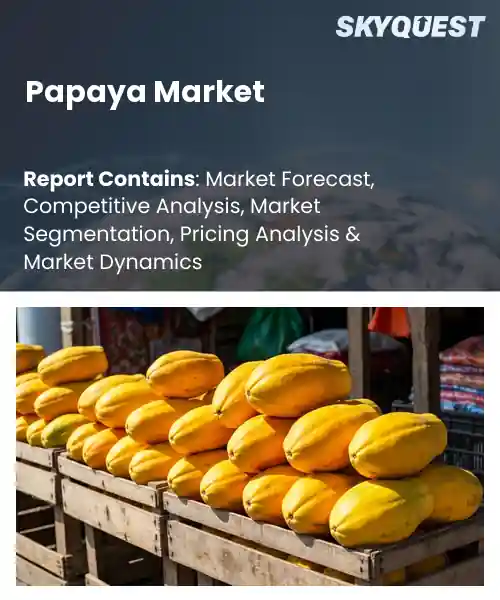
Papaya Market
Report ID: SQMIG30C2191
Report ID: SQMIG30C2191
[email protected]
USA +1 351-333-4748
Report ID:
SQMIG30C2191 |
Region:
Global |
Published Date: February, 2026
Pages:
157
|Tables:
171
|Figures:
79


Global Papaya Market size was valued at USD 14.2 Billion in 2024 and is poised to grow from USD 14.94 Billion in 2025 to USD 22.41 Billion by 2033, growing at a CAGR of 5.2% during the forecast period (2026-2033).
The primary driver of the papaya market is rising global demand for nutritious, convenient fruit coupled with expanded production capacity and improved logistics. The market covers fresh fruit trade, industrial papain extraction and processed items such as purees and ready-to-eat packs, and it matters because papaya provides vitamins, digestive enzymes and diversified income for tropical producers. Over time the sector moved beyond local consumption toward integrated export systems as major producers increased productivity through hybrid cultivars and better agronomy, while supermarkets and cold chains extended reach and shelf life; for example, Mexico significantly expanded exports to the United States.
Building on export and logistics gains, a central factor shaping the global papaya market share is investment in postharvest infrastructure and integration, because reduced losses and consistent quality directly enable new commercial applications and expansion. When cold storage, modified atmosphere packaging and transport lower spoilage rates, exporters can meet retailer specifications and enter distant markets leading processors to scale pureeing and freeze-drying. As a result of this, buyers including smoothie companies, baby food producers and cosmetic ingredient producers require confidence in volume delivery and consistency between fermented enzyme extracts; which are an incentive to contract grow and transfer technology; creating a virtuous cycle that will subsequently increase exports and lead to increased innovation in agriculture.
AI optimizes supply chain forecasting in the papaya market by combining demand sensing, remote sensing, and real time cold chain data into predictive models. Key aspects include satellite and drone imagery for estimating fruit set, weather and soil inputs to flag climate risk, and sensor data from packing houses and trucks to track ripening and quality. The current state shows producers and distributors using these signals to plan harvest windows, schedule shipments, and fine tune ripening capacity, so retail supply is steadier and waste is lower. Practical examples range from AI yield models to image based sorting and smarter routing that make papaya supply more reliable for buyers and sellers.
Calavo Growers, January 2026, announced a strategic transaction with Mission Produce that expands sourcing and packing reach. That consolidation lets the combined group pool historical and real time data to feed AI forecasting, improve ripening schedules, optimize logistics, and cut spoilage which supports stronger market efficiency and growth.
Market snapshot - 2026-2033
Global Market Size
USD 14.2 Billion
Largest Segment
Large-Fruited (Mexican/Maradol)
Fastest Growth
Hybrid Varieties
Growth Rate
5.2% CAGR
To get more insights on this market click here to Request a Free Sample Report
Global papaya market is segmented by variety, product form, end use industry, maturity stage, distribution channel, production method and region. Based on variety, the market is segmented into solo type (hawaiian), large-fruited (mexican/maradol) and hybrid varieties. Based on product form, the market is segmented into fresh fruit, processed and papain extracts. Based on end use industry, the market is segmented into food & beverage, pharmaceuticals & healthcare, cosmetics & personal care, textile & leather and others. Based on maturity stage, the market is segmented into green (unripe) and ripe. Based on distribution channel, the market is segmented into direct sales (B2B) and indirect sales (B2C). Based on production method, the market is segmented into conventional, organic and genetically modified (GMO). Based on region, the market is segmented into North America, Europe, Asia Pacific, Latin America and Middle East & Africa.
Based on the global papaya market forecast, solo hawaiian segment dominates because its small fruit size, sweet flavor, and thin skin align with consumer demand for ready to eat papaya. The characteristics of this variety will decrease the amount of labor needed to peel and the variation of ripeness from one piece to the other; therefore, there will be less waste at retail and better presentation on the shelf. The supply chain for this variety is preferred by retailers and handlers; therefore, there is a reliable demand for the fruit grown, encouraging growers and distributors to make it a priority in production and postharvest logistics.
Solo Hawaiian segment contributes to market growth by expanding fresh consumption occasions and simplifying retail integration. Because of the manner in which it handles product quality and provides store owners with the flexibility to handle products, it reduces the barriers related to gaining greater distribution and will create opportunities for increased marketing and supply chain expansion. The growing consumer demand for these products will promote a wide variety of new items based on value-added fresh products and an increase in opportunity to source from a more consistent supply chain.
Papain Extracts segment leads because papain serves as a high value bioactive with multiple pharmaceutical applications that command specialized processing and regulatory pathways. The extract's functional versatility for digestive therapies, wound care, and formulation aids creates predictable industrial demand that motivates investment in extraction infrastructure and quality assurance. Producers that develop scalable standardized extraction capabilities capture premium buyers and integrate with downstream manufacturers, reinforcing the extract role as a value driver within the papaya value chain.
Market expansion is achieved by creating downstream opportunities for the use of papain, which has a high value-added opportunity as a food ingredient. Standardized extraction will increase the demand for raw papaya input in industry, which could stimulate partnerships with manufacturers, resulting in increased investment in processing capacity and research and development. The effort to create value through the papain extraction process will help create more opportunities for the market while strengthening the link between primary production and pharmaceutical supply chains.
To get detailed segments analysis, Request a Free Sample Report
As per the global papaya market analysis, Asia Pacific dominance in the industry is rooted in a combination of favorable climatic conditions, long-standing cultivation expertise, and integrated supply chain networks that support year-round availability. Producing in the region helps agriculture producers have financially stable agricultural systems because they have developed standard farming methods and varied types of farm crops, as well as consumers being able to purchase farm crops easily. Investment in postharvest handling, cold chain improvements, and logistics has raised fruit quality and reduced waste, while proximal manufacturing hubs feed processed papaya product development. Trade relationships within the region and with other markets allow producers to scale exports with relative agility. Policy frameworks designed to help modernize the agricultural sector and the growth of retail channels and foodservices create regional leadership opportunities to align production capabilities with changing consumer preferences for fresh and convenient Papaya products.
Papaya Market in Japan is characterized by premium positioning, emphasis on quality assurance, and consumer demand for specialized varieties and value-added formats. Supply consistency, traceability, and presentation are priorities for retail and food service channels and drive to develop both imported and niche domestic grown products. Industry stakeholders concentrate on preserving cold chain integrity while being able to provide certification(s) and innovative processed products matching trends toward health & convenience. A partner-based collaboration between growers distributors and retailers drive both Premiumization strategies (i.e., higher-quality) and the ability to quickly respond to the marketplace.
Papaya Market in South Korea sees growth driven by urban consumer interest in exotic fruits, strong retail chain penetration, and innovation in ready-to-eat and ready-to-cook offerings. Established import is supported by targeted domestic trialing of protected cultivation methods. Freshness is highlighted as a marketing tool, along with convenience and the story behind the product; processors develop differentiated snacks as well as ingredient solutions for food manufacturers. Public and private collaboration supports quality control and supply chain refinement initiatives.
Rapid expansion of the papaya market in North America is propelled by evolving consumer preferences toward tropical and health-oriented fruits, expansion of modern retail formats, and greater availability through diversified import channels. Retailers and foodservice operators increasingly feature papaya in fresh produce assortments, prepared meals, and ingredient applications, creating broader daily consumption occasions. Investment in distribution infrastructure and marketing has improved year-round assortment reliability and consumer awareness. Product innovation in minimally processed, packaged, and convenience segments appeals to time-constrained shoppers. Establishing regulatory agreement on phytosanitary (e.g., plant health) and quality standards aids in achieving more efficient trade and integration into various markets. Developing new channels will include direct-to-consumer mechanisms and food service relationships, which will increase product exposure/visibility and encourage people to try them.
Papaya Market in United States benefits from wide consumer familiarity, extensive retail and foodservice channels, and established importers that maintain year-round availability. Quality control along with cold chain practices are heavily emphasised by all distributors to ensure shelf life and appearance. Innovation in products primarily focuses on convenience and multi-use applications (e.g., smoothie, salads and meal kit applications). Retailers’ use health messages and culinary messages to promote papaya; as well; partnerships within the supply chain enhance traceability, reliable sourcing and innovation initiatives.
Papaya Market in Canada is shaped by increasing consumer demand for tropical fruit, a concentrated retail landscape, and specialized importers curating premium assortments. Traceability and certification through retail programs give discerning buyers an extra level of assurance. Controlled environment growing projects within the U.S. are also emerging. Processors continue developing value-added snack and ingredient applications for food manufacturers. Better coordination among distributors, retailers, and regulators is necessary to help producers gain market access and achieve consistency throughout their respective supply chains as well as resilience.
Europe is strengthening its position in the papaya market by enhancing import sourcing strategies, improving retail assortment sophistication, and developing value-added product lines that align with regional taste profiles and sustainability expectations. Importers and distributors place emphasis on quality verification, certification, and supplier relationships that ensure consistent arrivals and minimize logistical risks. Innovations in retail include many target-based innovations (targeted merchandising), convenience formats, and adding a private label to allow expanded access for consumers. Processors have begun developing premium ingredient offerings for both functional foods and culinary usage to further develop an industrial market for these products. Food safety, traceability, and commitments to sustainability from retailers all prompt increased supplier expectations and encourage investment in production and handling methods that will meet compliance specifications across all countries where product is sourced.
Papaya Market in Germany is defined by discerning consumers, strong emphasis on certification and sustainability, and retailers requiring clear product provenance and quality standards. To adhere to consumer-specific requirements, importers implement substantial cold chain and inspection protocols and systems, while processors are conducting extensive research on the uses of various ingredients in both functional foods as well as food preparation. Promotion of the uses of these products focuses on the health benefits and the versatility in culinary applications to help promote wider usage.
Papaya Market in United Kingdom benefits from retail innovation, active foodservice adoption, and consumer interest in healthful and ethnic flavors. Retailers partner with importers to deliver products of uniform quality to consumers. In marketing, the emphasis is on convenience, in addition to promoting recipe use. The availability of pre-packaged, ready-to-eat formats and mixed package ingredients supports the broader market for prepared foods. Retailers’ sustainability initiatives influence buying/ingredient usage criteria and compel suppliers to provide evidence of traceability and social responsibility.
Papaya Market in France is influenced by culinary tradition, gastronomy-driven demand, and a sophisticated retail landscape that favors high-quality imports. Retail chain and specialty shops showcase certain papaya varieties, while food and beverage service businesses are beginning to use papaya in fusions or healthy food items. Marketing campaigns focused on provenance, taste profile, and food pairing help attract culinary-minded customers. French processors are investigating using premium ingredients in new ways within the patisserie sector, as well as incorporating new ingredients into savory foods.
To know more about the market opportunities by region and country, click here to
Buy The Complete Report
With a growing global demand for healthy diets and preventive nutrition has also led to an increased demand for papaya fruit to use as a source of natural digestive enzymes, vitamins, and fiber, leading to increased inclusion of papaya in regular daily consumption patterns along with the inclusion of papaya on retail assortments. This global papaya market growth will drive retailers to provide and promote a wider variety of papaya-based products while developing convenient formats that are more conducive to busy/time challenged consumers; hence providing additional opportunities for papaya consumption.
Expansion of processing capacity and development of value-added papaya products such as purees, concentrates, dried pieces, and infant foods is enabling producers to extend shelf life and access new distribution channels, thereby stimulating demand beyond fresh markets. Processors often use low-quality or excess fruit to produce shelf-stable ingredients thereby minimizing wastage of the fruit and also creating a source of supply for the manufacture and export of finished goods year round. The resulting diversification of product forms provides an incentive for investment in both production and processing infrastructure to increase the growth and strength of the overall market as opposed to relying solely on fresh fruit sales.
High perishability and significant postharvest losses constrain market expansion by limiting the time window for transport and sale, increasing costs for cold chains and logistics, and discouraging entry into distant markets. Producers and traders face pressure to sell quickly or accept quality downgrades, which reduces margins and investment appetite. Rapid handling, strategic storage, and careful harvesting processes create barriers for smallholder farmers and slow the speed of scaling. These barriers affect the ability to scale production and meet the increased demand in both domestic and export markets as quickly as possible.
Papaya crops are extremely sensitive to viral diseases like papaya ringspot viruses and pests such as fruit flies, which can devastate yields. Furthermore, alterations in climate patterns, changing rainfall patterns and extreme temperatures cause interruptions to be fruiting production leading to production instability which will discourage investment in larger-scale commercial growing operations.
Request Free Customization of this report to help us to meet your business objectives.
The global papaya market outlook showcases consolidation among large distributors and vertically integrated growers while trade access and retailer sourcing agreements drive competition. Recent M&A and strategic sourcing reshape supply security, for example Mission Produce announced acquisition of Calavo which adds papaya and value-addedlines. Retail partnerships such as Carrefour with Del Monte and country level exporter competition further push firms into technology-led traceability and postharvest innovation.
Sustainable Supply Chain: Producers, retailers and processors are opting into more sustainable ways of growing food and sourcing products that put a high priority on soil health, efficient use of water and biodiversity. There has been an increased focus on regenerative practices, supplier relationships, and transparent traceability to increase market access and create more value. With the increase of retailer sustainability commitments and changing consumer demands, there is an expectation that suppliers will reduce their use of chemical fertilizers, follow ethical labor practices, promote supplier development and invest in collective certification programs and digital traceability tools. These types of investments can enhance the strength of trade relationships and create different types of products available through the value chain.
Premium Processed Offers: As per the global papaya industry analysis, manufacturers are expanding value-added papaya portfolios to meet consumer demand for convenience, natural ingredients and differentiated flavors. New product developments such as pre-made purees, dried fruit snacks and functional extracts as well as clean label ingredient combinations are providing processors with an opportunity to expand their market presence into retail and food service areas. The establishment of collaborative relationships between processors, agriculture producers and co-packers has provided processors with the underpinning resources to ensure consistent product quality, traceability, and compliance with private label requirements.
SkyQuest’s ABIRAW (Advanced Business Intelligence, Research & Analysis Wing) is our Business Information Services team that Collects, Collates, Correlates, and Analyses the Data collected by means of Primary Exploratory Research backed by robust Secondary Desk research.
As per SkyQuest analysis, a key trend driving the global papaya sector is the rising consumer demand for nutritious, convenient fruit, and a second driver is investment in postharvest infrastructure and integration that reduces spoilage and enables larger-scale processing and exports. A major restraint is high perishability and postharvest losses, which raise cold chain and logistics costs and limit distant market access. The dominating region is Asia Pacific, supported by favorable climate, established production and integrated supply chains, while the dominating segment for fresh consumption is the Solo Hawaiian variety thanks to its small size, sweet flavor and retailer-friendly handling, together promoting wider retail adoption and value-added product development.
| Report Metric | Details |
|---|---|
| Market size value in 2024 | USD 14.2 Billion |
| Market size value in 2033 | USD 22.41 Billion |
| Growth Rate | 5.2% |
| Base year | 2024 |
| Forecast period | 2026-2033 |
| Forecast Unit (Value) | USD Billion |
| Segments covered |
|
| Regions covered | North America (US, Canada), Europe (Germany, France, United Kingdom, Italy, Spain, Rest of Europe), Asia Pacific (China, India, Japan, Rest of Asia-Pacific), Latin America (Brazil, Rest of Latin America), Middle East & Africa (South Africa, GCC Countries, Rest of MEA) |
| Companies covered |
|
| Customization scope | Free report customization with purchase. Customization includes:-
|
To get a free trial access to our platform which is a one stop solution for all your data requirements for quicker decision making. This platform allows you to compare markets, competitors who are prominent in the market, and mega trends that are influencing the dynamics in the market. Also, get access to detailed SkyQuest exclusive matrix.
Table Of Content
Executive Summary
Market overview
Parent Market Analysis
Market overview
Market size
KEY MARKET INSIGHTS
COVID IMPACT
MARKET DYNAMICS & OUTLOOK
Market Size by Region
KEY COMPANY PROFILES
Methodology
For the Papaya Market, our research methodology involved a mixture of primary and secondary data sources. Key steps involved in the research process are listed below:
1. Information Procurement: This stage involved the procurement of Market data or related information via primary and secondary sources. The various secondary sources used included various company websites, annual reports, trade databases, and paid databases such as Hoover's, Bloomberg Business, Factiva, and Avention. Our team did 45 primary interactions Globally which included several stakeholders such as manufacturers, customers, key opinion leaders, etc. Overall, information procurement was one of the most extensive stages in our research process.
2. Information Analysis: This step involved triangulation of data through bottom-up and top-down approaches to estimate and validate the total size and future estimate of the Papaya Market.
3. Report Formulation: The final step entailed the placement of data points in appropriate Market spaces in an attempt to deduce viable conclusions.
4. Validation & Publishing: Validation is the most important step in the process. Validation & re-validation via an intricately designed process helped us finalize data points to be used for final calculations. The final Market estimates and forecasts were then aligned and sent to our panel of industry experts for validation of data. Once the validation was done the report was sent to our Quality Assurance team to ensure adherence to style guides, consistency & design.
Analyst Support
Customization Options
With the given market data, our dedicated team of analysts can offer you the following customization options are available for the Papaya Market:
Product Analysis: Product matrix, which offers a detailed comparison of the product portfolio of companies.
Regional Analysis: Further analysis of the Papaya Market for additional countries.
Competitive Analysis: Detailed analysis and profiling of additional Market players & comparative analysis of competitive products.
Go to Market Strategy: Find the high-growth channels to invest your marketing efforts and increase your customer base.
Innovation Mapping: Identify racial solutions and innovation, connected to deep ecosystems of innovators, start-ups, academics, and strategic partners.
Category Intelligence: Customized intelligence that is relevant to their supply Markets will enable them to make smarter sourcing decisions and improve their category management.
Public Company Transcript Analysis: To improve the investment performance by generating new alpha and making better-informed decisions.
Social Media Listening: To analyze the conversations and trends happening not just around your brand, but around your industry as a whole, and use those insights to make better Marketing decisions.
REQUEST FOR SAMPLE
 REQUEST FREE CUSTOMIZATION
Global Papaya Market size was valued at USD 14.2 Billion in 2024 and is poised to grow from USD 14.94 Billion in 2025 to USD 22.41 Billion by 2033, growing at a CAGR of 5.2% during the forecast period (2026-2033).
Global papaya competitive landscape shows consolidation among large distributors and vertically integrated growers while trade access and retailer sourcing agreements drive competition. Recent M&A and strategic sourcing reshape supply security, for example Mission Produce announced acquisition of Calavo which adds papaya and value added lines. Retail partnerships such as Carrefour with Del Monte and country level exporter competition further push firms into technology led traceability and postharvest innovation. 'Dole Food Company, Inc.', 'Fresh Del Monte Produce Inc.', 'Calavo Growers, Inc.', 'Brooks Tropicals, LLC', 'Agromod', 'J S Fruit s.r.o.', 'Caliman Agricola S.A.', 'Robinson Fresh', 'HLB Tropical Food GmbH', 'Zumosol', 'Greenyard', 'Frutex SA de CV', 'Kedia Organic Agro Farms', 'Golden Hills Farms', 'Exotic Fruit Co.', 'Green Paradise Produce', 'Sunshine Fruits Ltd.', 'Island Fresh Produce', 'Fresh Traders Co., Ltd', 'Harvest Green'
Rising public focus on healthy diets and preventive nutrition has increased interest in fruits like papaya for natural digestive enzymes, vitamins, and fiber, encouraging greater inclusion in daily diets and retail assortment. This shift prompts retailers and processors to promote papaya-based offerings and develop convenient formats that attract time-poor consumers, expanding consumption occasions. As demand for nutrient-dense fresh and minimally processed options grows, producers respond by scaling production and adopting practices that increase availability, thereby reinforcing market expansion. This supports wider market penetration.
As per the global papaya market analysis, Asia Pacific dominance in the industry is rooted in a combination of favorable climatic conditions, long-standing cultivation expertise, and integrated supply chain networks that support year-round availability.


Want to customize this report? This report can be personalized according to your needs. Our analysts and industry experts will work directly with you to understand your requirements and provide you with customized data in a short amount of time. We offer $1000 worth of FREE customization at the time of purchase.
Feedback From Our Clients


 USA (+1) 351-333-4748

