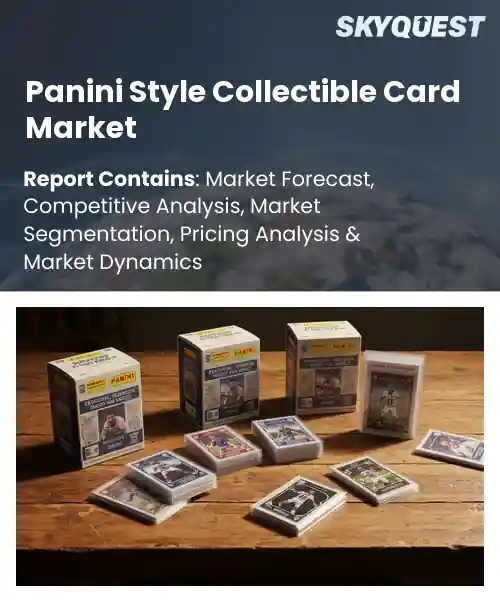
Panini Style Collectible Card Market
Report ID: SQMIG45J2571
Report ID: SQMIG45J2571
[email protected]
USA +1 351-333-4748
Report ID:
SQMIG45J2571 |
Region:
Global |
Published Date: June, 2026
Pages:
157
|Tables:
177
|Figures:
79


Global Panini Style Collectible Card Market size was valued at USD 3.9 Billion in 2024 and is poised to grow from USD 4.24 Billion in 2025 to USD 8.2 Billion by 2033, growing at a CAGR of 8.6% during the forecast period (2026-2033).
The Panini style collectible card market is founded on basketball trading cards that were stamped with foil in the early 1990’s. The psychological need for scarcity and the cultural cachet of sports idols are what drive both hobbyist enthusiasm and speculative investment. The hobby, once a niche schoolyard swap, exploded after a 1996-97 set centered around Michael Jordan went for record-breaking prices at auction. Collectors saw cards as alternative assets. Digital platforms, grading services and global licensing deals increased visibility and turned casual fans into high-stakes players that impact pricing dynamics over the next 20 years.
And on top of that the next growth lever for the market is to combine technology authentication with secondary liquidity, creating a feedback loop that increases demand. Auction houses report when third-party grading companies assign grades, and investors are encouraged to invest money, pushing prices up. By 2021, a LeBron James rookie foil card was selling for more than $300,000, and a buying frenzy for rookie cards took off across multiple sports. The chain of cause and effect is limited edition inserts from manufacturers and retailers, and extending distribution through social-media hype, creating revenue streams for producers and collectors.
How is blockchain affecting authentication and resale in the Panini collectible card market?
Blockchain is revolutionizing how Panini cards are authenticated and traded. Buyers can check a card’s provenance without the need for third party grading services by stamping a digital ledger on each card’s serial number. This immutable record reduces condition and rarity talk and makes secondary platform resale easier. Smart contract platforms take away the friction in the transaction process by automating payments after the authenticity is verified. The added trust from blockchain helps keep collector interest in the face of licensing upheaval roiling the Panini market, and it also helps facilitate a smoother transfer of cards among hobbyists and dealers. The physical card is also supported by portable digital certificates that can aid collectors in proving ownership across borders.
Fanatics (May 2026) launched a blockchain-based verification platform for its new line of Panini-type cards that enable instant authentication and easier resale. Each card has a unique token in the system used to track changes in ownership . This helps prevent fraud and encourages collectors to trade more freely which is good for the health of the market.
Market snapshot - (2026-2033)
Global Market Size
USD 3.9 Billion
Largest Segment
Fastest Growth
Growth Rate
8.6% CAGR
To get more insights on this market click here to Request a Free Sample Report
Global panini style collectible card market is segmented by product type, card format, packaging type, distribution channel, licensing category, end user and region. Based on product type, no specific sub-segments were identified. Based on card format, no specific sub-segments were identified. Based on packaging type, no specific sub-segments were identified. Based on distribution channel, no specific sub-segments were identified. Based on licensing category, no specific sub-segments were identified. Based on end user, no specific sub-segments were identified. Based on region, the market is segmented into North America, Europe, Asia Pacific, Latin America and Middle East & Africa.
Entertainment-themed cards segment dominates because fans seek narrative depth and iconic artwork that extends beloved franchises beyond screen. Panini leverages exclusive licensing agreements, delivering fresh story driven inserts that captivate collectors yearning for immersive experiences. This emotional connection fuels repeat purchases and community driven trading, reinforcing brand loyalty. The synergy between pop culture relevance and collectible mechanics creates a loop that solidifies its leading market position.
However, sports-themed cards segment emerges as the most rapidly expanding area as live athlete performance data fuels real time collectible releases. Integration with digital stats and fantasy platforms draws new enthusiast cohorts, prompting frequent updated print runs. This convergence of physical and interactive experiences accelerates market breadth and opens fresh revenue streams.
Standard size format segment dominates because it aligns with traditional collecting habits and fits easily into established storage solutions. Collectors value the tactile familiarity and visual clarity that full card artwork provides, reinforcing long term engagement. Retailers favor this format for its consistent shelf presence, while secondary markets thrive on its recognized grading standards. These intertwined preferences sustain its preeminence across the Panini style ecosystem.
Meanwhile, mini format segment experiences the strongest growth as casual gamers seek affordable entry points and portable collectibility. Smaller dimensions lower production costs and enable themed bundles that appeal to younger audiences. This ease of handling encourages impulsive purchases and social sharing, expanding the consumer base beyond collectors. The momentum drives broader market diffusion and new partnership opportunities.
To get detailed segments analysis, Request a Free Sample Report
Global panini style collectible card market is segmented by product type, card format, packaging type, distribution channel, licensing category, end user and region. Based on product type, no specific sub-segments were identified. Based on card format, no specific sub-segments were identified. Based on packaging type, no specific sub-segments were identified. Based on distribution channel, no specific sub-segments were identified. Based on licensing category, no specific sub-segments were identified. Based on end user, no specific sub-segments were identified. Based on region, the market is segmented into North America, Europe, Asia Pacific, Latin America and Middle East & Africa.
Entertainment-themed cards segment dominates because fans seek narrative depth and iconic artwork that extends beloved franchises beyond screen. Panini leverages exclusive licensing agreements, delivering fresh story driven inserts that captivate collectors yearning for immersive experiences. This emotional connection fuels repeat purchases and community driven trading, reinforcing brand loyalty. The synergy between pop culture relevance and collectible mechanics creates a loop that solidifies its leading market position.
However, sports-themed cards segment emerges as the most rapidly expanding area as live athlete performance data fuels real time collectible releases. Integration with digital stats and fantasy platforms draws new enthusiast cohorts, prompting frequent updated print runs. This convergence of physical and interactive experiences accelerates market breadth and opens fresh revenue streams.
Standard size format segment dominates because it aligns with traditional collecting habits and fits easily into established storage solutions. Collectors value the tactile familiarity and visual clarity that full card artwork provides, reinforcing long term engagement. Retailers favor this format for its consistent shelf presence, while secondary markets thrive on its recognized grading standards. These intertwined preferences sustain its preeminence across the Panini style ecosystem.
Meanwhile, mini format segment experiences the strongest growth as casual gamers seek affordable entry points and portable collectibility. Smaller dimensions lower production costs and enable themed bundles that appeal to younger audiences. This ease of handling encourages impulsive purchases and social sharing, expanding the consumer base beyond collectors. The momentum drives broader market diffusion and new partnership opportunities.
Europe’s dominance stems from a deep cultural affinity for collectible hobbies, a robust network of specialty retailers, and a legacy of high‑quality printing craftsmanship. Long‑standing relationships between Panini and European licensors ensure exclusive access to popular sport and entertainment properties, reinforcing brand prestige. Consumer enthusiasm is amplified by avid fan communities that organize events, trade exchanges, and digital platforms, creating a vibrant ecosystem that supports both casual collectors and serious investors. Additionally, strong distribution channels across the region facilitate rapid product rollout, while regulatory environments favor intellectual‑property protection and consumer confidence, further solidifying Europe’s leading position.
Panini Style Collectible Card Market in Germany benefits from a meticulous collector culture that values precision and rarity. Retail outlets ranging from hobby shops to major department stores provide extensive shelf space, while dedicated conventions attract enthusiasts who exchange insights and foster brand loyalty. Partnerships with local sports leagues and entertainment franchises enhance relevance, and a well‑established logistics infrastructure ensures timely delivery of new releases to avid fans across the country.
Panini Style Collectible Card Market in the United Kingdom thrives on a rich tradition of trading card hobbyists and a vibrant community of collectors. Specialist retailers and online platforms cater to a diverse audience, while collaborations with prominent football clubs and media franchises heighten appeal. Regular collector meet‑ups and tournament events encourage social interaction, reinforcing brand attachment and driving sustained demand throughout the market.
Panini Style Collectible Card Market in France is propelled by a passionate fan base that embraces both sport and pop‑culture themes. Boutique hobby shops and mainstream outlets alike showcase a wide array of products, supported by strong promotional campaigns linked to popular French athletes and entertainment icons. Collector clubs organize swap sessions and themed gatherings, fostering a sense of community that sustains interest and encourages repeat purchases.
In North America, the expansion is fueled by a convergence of mainstream pop‑culture integration, innovative digital engagement, and a growing collector demographic that spans casual hobbyists to serious investors. The market benefits from strategic alliances with major sports leagues and entertainment studios, delivering exclusive content that resonates with a broad audience. Emerging online marketplaces and social media communities amplify visibility, while experiential events such as trade shows and pop‑up experiences deepen brand interaction. Retail partnerships across both specialty channels and mass‑market outlets ensure wide accessibility, and an emphasis on sustainable, high‑quality production reinforces consumer trust, all contributing to a dynamic growth trajectory.
Panini Style Collectible Card Market in the United States thrives on a diverse collector base energized by major league sports and popular entertainment franchises. A blend of brick‑and‑mortar hobby stores and robust e‑commerce platforms offers extensive product reach, while nationwide conventions and community events foster active engagement. Collaborative releases with prominent athletes and media properties generate excitement, and the integration of digital tools for cataloguing and trading enhances the overall collector experience throughout the market.
Panini Style Collectible Card Market in Canada is supported by enthusiastic fan communities that value both traditional sports and contemporary pop‑culture themes. Specialty retailers and online distributors provide comprehensive access to new series, while regional collector gatherings encourage networking and knowledge sharing. Partnerships with national sports associations and entertainment partners create locally resonant offerings, and a focus on environmentally responsible production aligns with consumer expectations, sustaining momentum within the Canadian market.
Asia Pacific is strengthening its position through a synthesis of cultural enthusiasm for storytelling, rapid adoption of digital interaction, and strategic collaborations with regional entertainment powerhouses. The market leverages deep‑rooted fan devotion to anime, manga, and sports, translating into high demand for themed collectibles. Innovative cross‑media initiatives, such as augmented reality integrations and mobile app experiences, enhance collector engagement and broaden appeal. Localized product designs that reflect regional aesthetics, coupled with a dense network of specialty retailers and vibrant collector conventions, drive sustained interest. Moreover, a commitment to quality and authenticity reinforces brand credibility, positioning the region as an emerging hub for Panini Style Collectible Cards.
Panini Style Collectible Card Market in Japan capitalizes on a passionate audience enamored with anime, manga, and professional sports. Dedicated hobby shops and expansive online platforms provide extensive distribution, while collaborations with iconic Japanese franchises yield exclusive, culturally resonant releases. Collector clubs host regular meet‑ups and trading events, fostering a tightly knit community that sustains enthusiasm and encourages continual participation in the market.
Panini Style Collectible Card Market in South Korea benefits from a tech‑savvy collector demographic that embraces both physical and digital experiences. Partnerships with popular K‑pop groups and e‑sports organizations generate high‑visibility product launches, while specialty retailers and vibrant online marketplaces ensure broad accessibility. Community gatherings and themed conventions reinforce loyalty, and the integration of interactive technologies enhances the overall appeal of Panini Style Collectible Cards within the Korean market.
To know more about the market opportunities by region and country, click here to
Buy The Complete Report
Digital Integration Fuels Collector Engagement
Brand Partnerships Expand Audience Reach
Supply Constraints Limit Card Availability
Intellectual Property Issues Impede Expansion
Request Free Customization of this report to help us to meet your business objectives.
The Panini‑style collectible card market is intensely competitive, with firms racing to capture collector attention through high‑profile athlete collaborations, tournament‑driven releases, and digital‑first initiatives. Companies are leveraging M&A to add tech capabilities, forging partnerships with grading services, and deploying AI‑driven pricing tools to differentiate their platforms, all aimed at accelerating sales during major sports events and card‑season competitions.
SkyQuest’s ABIRAW (Advanced Business Intelligence, Research & Analysis Wing) is our Business Information Services team that Collects, Collates, Correlates, and Analyses the Data collected by means of Primary Exploratory Research backed by robust Secondary Desk research. As per SkyQuest analysis the Panini‑style collectible card market is projected to nearly double by 2033, driven primarily by digital integration that lets fans view, trade and authenticate cards through mobile apps, creating continuous engagement and repeat purchases. A second important driver is the surge in brand partnerships with major sports leagues and entertainment franchises, which broaden appeal and generate limited‑time drops that heighten urgency. Europe remains the dominating region, benefiting from a strong hobby culture, premium printing and extensive retailer networks. The standard‑size card format continues to dominate the segment landscape because it fits established storage solutions and grading standards, while supply constraints on premium releases act as a key restraint that can dampen new‑collector enthusiasm.
| Report Metric | Details |
|---|---|
| Market size value in 2024 | USD 3.9 Billion |
| Market size value in 2033 | USD 8.2 Billion |
| Growth Rate | 8.6% |
| Base year | 2024 |
| Forecast period | (2026-2033) |
| Forecast Unit (Value) | USD Billion |
| Segments covered |
|
| Regions covered | North America (US, Canada), Europe (Germany, France, United Kingdom, Italy, Spain, Rest of Europe), Asia Pacific (China, India, Japan, Rest of Asia-Pacific), Latin America (Brazil, Rest of Latin America), Middle East & Africa (South Africa, GCC Countries, Rest of MEA) |
| Companies covered |
|
| Customization scope | Free report customization with purchase. Customization includes:-
|
To get a free trial access to our platform which is a one stop solution for all your data requirements for quicker decision making. This platform allows you to compare markets, competitors who are prominent in the market, and mega trends that are influencing the dynamics in the market. Also, get access to detailed SkyQuest exclusive matrix.
Table Of Content
Executive Summary
Market overview
Parent Market Analysis
Market overview
Market size
KEY MARKET INSIGHTS
COVID IMPACT
MARKET DYNAMICS & OUTLOOK
Market Size by Region
KEY COMPANY PROFILES
Methodology
For the Panini Style Collectible Card Market, our research methodology involved a mixture of primary and secondary data sources. Key steps involved in the research process are listed below:
1. Information Procurement: This stage involved the procurement of Market data or related information via primary and secondary sources. The various secondary sources used included various company websites, annual reports, trade databases, and paid databases such as Hoover's, Bloomberg Business, Factiva, and Avention. Our team did 45 primary interactions Globally which included several stakeholders such as manufacturers, customers, key opinion leaders, etc. Overall, information procurement was one of the most extensive stages in our research process.
2. Information Analysis: This step involved triangulation of data through bottom-up and top-down approaches to estimate and validate the total size and future estimate of the Panini Style Collectible Card Market.
3. Report Formulation: The final step entailed the placement of data points in appropriate Market spaces in an attempt to deduce viable conclusions.
4. Validation & Publishing: Validation is the most important step in the process. Validation & re-validation via an intricately designed process helped us finalize data points to be used for final calculations. The final Market estimates and forecasts were then aligned and sent to our panel of industry experts for validation of data. Once the validation was done the report was sent to our Quality Assurance team to ensure adherence to style guides, consistency & design.
Analyst Support
Customization Options
With the given market data, our dedicated team of analysts can offer you the following customization options are available for the Panini Style Collectible Card Market:
Product Analysis: Product matrix, which offers a detailed comparison of the product portfolio of companies.
Regional Analysis: Further analysis of the Panini Style Collectible Card Market for additional countries.
Competitive Analysis: Detailed analysis and profiling of additional Market players & comparative analysis of competitive products.
Go to Market Strategy: Find the high-growth channels to invest your marketing efforts and increase your customer base.
Innovation Mapping: Identify racial solutions and innovation, connected to deep ecosystems of innovators, start-ups, academics, and strategic partners.
Category Intelligence: Customized intelligence that is relevant to their supply Markets will enable them to make smarter sourcing decisions and improve their category management.
Public Company Transcript Analysis: To improve the investment performance by generating new alpha and making better-informed decisions.
Social Media Listening: To analyze the conversations and trends happening not just around your brand, but around your industry as a whole, and use those insights to make better Marketing decisions.
REQUEST FOR SAMPLE
 REQUEST FREE CUSTOMIZATION
Global Panini Style Collectible Card Market size was valued at USD 3.9 Billion in 2024 and is poised to grow from USD 4.24 Billion in 2025 to USD 8.2 Billion by 2033, growing at a CAGR of 8.6% during the forecast period (2026-2033).
The Panini‑style collectible card market is intensely competitive, with firms racing to capture collector attention through high‑profile athlete collaborations, tournament‑driven releases, and digital‑first initiatives. Companies are leveraging M&A to add tech capabilities, forging partnerships with grading services, and deploying AI‑driven pricing tools to differentiate their platforms, all aimed at accelerating sales during major sports events and card‑season competitions. 'Panini S.p.A.', 'The Topps Company, Inc.', 'Upper Deck Company, LLC', 'Leaf Trading Cards LLC', 'Futera Limited', 'Cardsmiths LLC', 'Press Pass Collectibles', 'Rittenhouse Archives Ltd.', 'SAGE Collectibles, Inc.', 'Historic Autographs LLC', 'Dynamite Entertainment Collectibles', 'Cryptozoic Entertainment LLC', 'ONIT Athlete, Inc.', 'Wild Card Trading Cards', 'Arena Club Holdings, Inc.', 'Fanatics Collectibles', 'TCGplayer, Inc.', 'Beckett Media LLC', 'Sportscard Guaranty Corporation', 'Professional Sports Authenticator'
Digital platforms let fans view, trade, and authenticate Panini cards via mobile apps, creating interaction beyond physical collections. This experience appeals to younger audiences used to online engagement and offers collectors instant rarity verification and community forums. Consequently, hobbyists feel more connected, prompting repeat purchases and stronger brand loyalty, which together support market growth. The introduction of augmented reality overlays adds a visual dimension to card reveals, encouraging users to share videos on social platforms, which amplifies organic promotion and draws additional collectors into the ecosystem.
Digital Integration Driving New Value: Collectors increasingly expect seamless digital experiences, prompting manufacturers to embed QR codes, augmented‑reality triggers, and companion apps directly into Panini‑style packs. This convergence transforms a static hobby into an interactive ecosystem where fans can instantly verify authenticity, unlock exclusive animations, and trade virtual equivalents alongside physical cards. Brands leverage these tools to cultivate ongoing engagement, personalize content, and gather consumer insights, thereby extending the product lifecycle and creating new monetization pathways beyond traditional print releases for future collector communities worldwide.
Why does Europe Dominate the Global Panini Style Collectible Card Market? |@12


Want to customize this report? This report can be personalized according to your needs. Our analysts and industry experts will work directly with you to understand your requirements and provide you with customized data in a short amount of time. We offer $1000 worth of FREE customization at the time of purchase.
Feedback From Our Clients


 USA (+1) 351-333-4748

