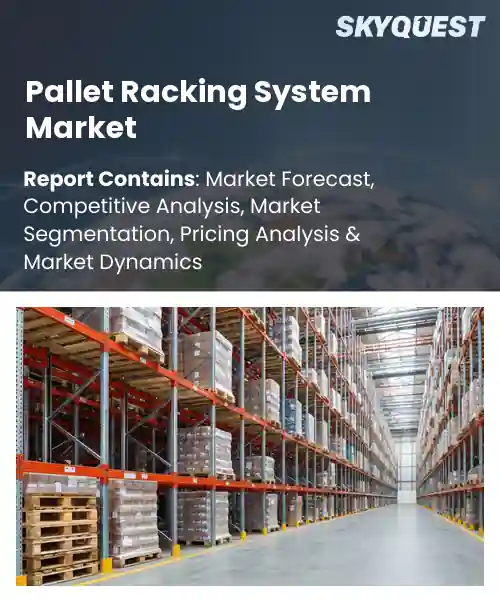
Pallet Racking System Market
Report ID: SQMIG20I3118
Report ID: SQMIG20I3118
[email protected]
USA +1 351-333-4748
Report ID:
SQMIG20I3118 |
Region:
Global |
Published Date: June, 2026
Pages:
157
|Tables:
119
|Figures:
77


Global Pallet Racking System Market size was valued at USD 14.52 Billion in 2024 and is poised to grow from USD 15.48 Billion in 2025 to USD 25.85 Billion by 2033, growing at a CAGR of 6.62% during the forecast period (2026-2033).
The global pallet racking system market growth is mostly being powered by the quick expansion of global commerce , e commerce, and these modern warehousing operations that everyone’s talking about. Basically, as companies deal with bigger inventory lots and a wider assortment of stock keeping units (SKUs), there’s been a big uptick in the need for effective storage methods that can squeeze more use out of warehouse space. Pallet racking systems help with orderly inventory control, support quicker pick and ship routines and even raise day to day efficiency, so they become much a must have for distribution hubs and logistics sites.
On top of that, more and more automation is rolling in, like Automated Storage and Retrieval Systems (AS/RS), shuttle setups, and smarter warehouse arrangements. This acceleration is making it easier for buyers to install advanced pallet racking infrastructure, not just basic frames. At the same time, rising labor costs and workforce shortages are nudging warehouse managers toward denser storage layouts and automated facilities. The goal is to cut down on manual handling and lift output, which sounds simple, but it’s actually a major driver. In addition, there is the ongoing expansion of third-party logistics (3PL) services, cold-chain processing centers , and these urban fulfillment hubs, all of which are pulling demand for racking solutions that are both adaptable and scalable.
Automation is improving efficiency in this pallet racking system sector by teaming up smart machinery with software, to streamline storage and retrieval. The core pieces usually include automated storage and retrieval machines, pallet shuttle systems, autonomous mobile robots, and integrated warehouse management software. Right now the market leans toward setups that boost throughput and squeeze the footprint, mostly because customers want faster order cycles and layouts that can adapt. By cutting travel time and limiting manual handling, automation helps accuracy rise and also boosts asset utilization. In practice, examples like shuttle racking and mobile high bay systems illustrate how adaptable racking designs and data-driven controls can optimize material flow, and also make capacity upgrades more cost effective.
Market snapshot - (2026-2033)
Global Market Size
USD 14.52 Billion
Largest Segment
Selective Pallet Racking
Fastest Growth
Pallet Flow Racking
Growth Rate
6.62% CAGR
To get more insights on this market click here to Request a Free Sample Report
The global pallet racking system market is segmented based on type, material, end-use industry, distribution channel, and region. By type, the market is categorized into Selective Pallet Racking, Drive-In/Drive-Through Racking, Push Back Racking, Pallet Flow Racking, and Double Deep Racking. Based on material, the market is divided into Steel and Aluminum pallet racking systems. By end-use industry, the market is segmented into E-Commerce & Retail, Food & Beverage, Pharmaceuticals, and Manufacturing. Based on distribution channel, the market is classified into Direct Sales, Distributors, and Online channels. Geographically, the market is analyzed across North America, Europe, Asia Pacific, Latin America, and the Middle East & Africa.
As per the pallet racking system market analysis, the Selective Pallet Racking segment takes the lead because it gives immediate access to every pallet bay, so it feels inherently adaptable for different SKU mixtures and shifting order rhythms that are typical in present day warehousing. Its simple layout means fewer moving steps, and it fits in pretty smoothly with standard forklift routines, which can lower daily operational friction, and make inventory control more straightforward. The ability to reconfigure later, plus the fact it works well with incremental automation investments, keeps operators leaning this way, and that maintains steady demand across the Pallet Racking System Market.
At the same time, Push Back Racking is showing up as the fastest growing choice, mostly because it raises usable storage density, while still allowing effective picking and retrieval for high velocity distribution flows. More adoption is happening as operators want space optimization without having to rely on complicated automation. Also, upgrades in carriage and rail design reduce upkeep requirements, and they make installation less of a hassle, so it opens doors for tighter, denser warehouse setups.
According to the pallet racking system market forecast, the online segment stands out because digital channels help streamline specification, quoting, and procurement of pallet racking solutions. That shortens the overall journey from design to purchase for buyers, sometimes drastically. With better product visualization, configurators, and smoother integration with inventory management tools, spec mistakes drop, and procurement delays get fewer. As a result manufacturers tend to expand their digital catalog offerings. This reduction in friction helps broader adoption, improves how much variety buyers can see, and also enables more agile service models within the Pallet Racking System Market.
Meanwhile, Distributors are becoming the fastest expanding channel too. They do this by bundling technical advisory, installation work, and aftermarket support , which is exactly what buyers expect when projects get complex. Their local inventory positioning, project coordination, and integration capabilities let manufacturers reach bigger commercial opportunities. It also creates recurring service revenue, so manufacturers can scale through reliable partner networks and capture the rising demand across a wider set of customer profiles.
To get detailed segments analysis, Request a Free Sample Report
As per the pallet racking system market regional forecast, Asia Pacific leads the market, mostly because manufacturing is clustered there, logistics routes are big and growing, and retail plus manufacturing keep asking for more space solutions, fast. In the region, producers usually mix larger scale with more localized engineering so they can offer storage options that are flexible and still cost effective, which helps them cover a lot of different warehouse setups. Also, fast urbanization and industrial zoning make companies push for higher density storage plus systems that are ready for automation. On top of that, money going into port and transport infrastructure boosts distribution reach and supports businesses that depend on import export trade. System suppliers, integrators and end users working together makes it easier to customize product details, and that partnership style speeds up implementation. Finally, regulations that encourage warehousing modernization , plus a competitive supplier scene, keeps reinforcing why the region is a top source for both innovation and large volume pallet racking solutions.
Japan Pallet Racking System Market
The Pallet racking system industry in Japan benefits from a solid industrial supply chain, high expectations for precision engineering, and a logistics sector that already wants compact, high density storage. Local manufacturers tend to concentrate on quality and also how well the system links with automation tech. Meanwhile outside integrators often show up with more end to end services. Demand is coming from advanced manufacturing, electronics and retail distribution centers, where they need dependable racking that saves space, plus ongoing lifecycle support, quick after sale responsiveness, and training.
South Korea Pallet Racking System Market
The Pallet racking system market in South Korea stands on a manufacturing backbone, more advanced logistics operations, and increasing automation adoption in warehousing. This combination drives interest in configurable throughput racking solutions. Suppliers usually stress compatibility with material handling equipment and how to use tight floor space in a smarter way. When system designers coordinate with distribution operators, they can shape custom layouts and installations that actually fit real workflows. Service providers then add installation, upkeep, and retrofitting , so the operation stays resilient and can adjust as supply chain needs keep shifting.
Rapid pallet racking system market penetration in North America is tied to a logistics environment that keeps changing, where omnichannel retail plus outsourced distribution makes operators try to improve both storage density and throughput. The momentum is also shaped by the push for strategic operational efficiency, workplace safety, and better integration with automated material handling systems. Older warehouses are being renovated , and specialized solutions, like cold storage and setups for high turnover inventory, expand the types of demand they see. Equipment makers, engineering firms, and logistics providers working closely together helps speed up tailored system design and project delivery. There’s also an ongoing emphasis on lifecycle support, safety compliance , building regulations, and the availability of professional installation along with inspection services. All of this supports adoption and keeps the region positioned as a leading market for pallet racking solutions that are both innovative and service centered.
United States Pallet Racking System Market
The Pallet racking system market outlook in the United States is shaped by large distribution networks, broad warehouse automation adoption, and a mature supplier base that supports modular engineered solutions. Buyers include retail, manufacturing, and outsourced logistics providers, and they usually prioritize throughput plus inventory optimization. Because safety rules and building codes get scrutinized, there’s strong demand for professional engineering, inspection, and verification. Service packages , like installation, maintenance, and selective retrofits, also help keep systems performing well and help protect operational resilience.
Canada Pallet Racking System Market
The Pallet racking system market in Canada is pushed by modernization of distribution centers, a strong preference for efficient warehouse space use, and the need for solutions that work smoothly with automated material handling. Local integrators team up with equipment manufacturers to deliver customized layouts and installations, while trying to reduce disruption to day to day operations. Safety compliance and maintenance attention encourages more uptake of inspection routines and lifecycle service offerings. Retrofits, plus tailored storage systems, help meet needs across retail, food handling, and industrial operations too.
Europe is slowly but surely tightening its grip in the pallet racking system market , mostly due to more regulatory push on safety and sustainability, plus a broad modernization of logistics infrastructure, and the usual growing appetite for automated storage that is also space efficient. Regional suppliers tend to lean on solid engineering know how and the habit of following harmonized standards, so their systems can actually talk to each other across borders. On top of that, there’s a noticeable shift toward circular procurement and lifecycle services , which makes their offers feel more valuable rather than just “boxes and beams”. Existing warehouses are getting upgraded, and there’s also extra interest in specialized racking for food and pharmaceutical supply chains, so the market opens up for engineered, compliant products. Designers, integrators and end users are collaborating more, which speeds up rollout of tailored setups , and the insistence on professional installation plus ongoing inspection helps the whole thing look more mature and dependable. And, companies are investing in digital warehouse management while pushing flexible modular systems, so they can adapt when supply chain patterns change. Add in cross border logistics hubs and broader external logistics networks, and offer more consistent racking specifications , along with more service oriented business models.
Germany Pallet Racking System Market
The Pallet Racking System Market in Germany shows a strong industrial pull , with strict engineering expectations and a clear preference for high quality storage solutions that work well with automation. Suppliers highlight engineered racking, load related thinking and integration with material handling systems. End users , like those in manufacturing and automotive supply chains, usually want durability, compliance first ,and they also expect lifecycle service support. Local integrators propose tailored layouts , handle installation plus inspection services , and keep everything aligned with safety rules and building regulation standards, so operations can keep running without surprises.
United Kingdom Pallet Racking System Market
The Pallet Racking System Market in United Kingdom is being pushed by ecommerce logistics growth, the shift toward urban warehousing solutions and the need for adaptive dense storage setups. Suppliers and integrators concentrate on fast deployment, modular rack systems and connecting them with warehouse management technologies. Safety codes and professional installation are a big part of why inspection and maintenance services are getting picked up more often. Activity also includes retrofitting older sites and rolling out purpose built solutions for retail, pharmaceutical and cold chain distribution networks , where the requirements are never simple.
France Pallet Racking System Market
The Pallet Racking System Market in France is defined by ongoing modernization of logistics parks , a strong focus on compliance, and steady demand for bespoke racking that fits each industry’s real needs. Suppliers blend engineering capability with service delivery , offering installation, inspection and maintenance packages. Retail and manufacturing are the main drivers here , because they want space efficient storage that still stays compliant. Integration is also trending toward automated material handling, sustainable material selections and circular lifecycle practices, and that affects how products are designed and how procurement decisions are made.
To know more about the market opportunities by region and country, click here to
Buy The Complete Report
Ecommerce Expansion Boosting Demand
Automation Integration Enhancing Efficiency
High Initial Capital Requirements
Regulatory And Safety Compliance Challenges
Request Free Customization of this report to help us to meet your business objectives.
The competitive landscape in the global pallet racking systems market is getting more intense, like, as older racking makers, intralogistics integrators and even fresh robotics entrants chase specific strategies such as targeted acquisitions strategic partnerships and pallet shuttle innovations to grab more automated, high density projects. Some of the most visible moves show up as a strategic majority acquisition of a robotics firm, OEM launches of roaming pallet shuttles and brand new shuttle-focused robotics brands pushing expanded system+software offerings too.
Top Player’s Company Profile
Recent Developments in the Pallet Racking System Market
SkyQuest’s ABIRAW (Advanced Business Intelligence, Research & Analysis Wing) is our Business Information Services team that Collects, Collates, Correlates, and Analyses the Data collected by means of Primary Exploratory Research backed by robust Secondary Desk research.
As per SkyQuest analysis, the global pallet racking system market is being driven mainly by ecommerce expansion, which boosts the need for high density , flexible storage, and a second driver is the integration of automation and robotics that improves throughput and reduces labor dependence. A notable restraint stays the high upfront capital requirements, which can delay purchasing for smaller operators. Asia Pacific currently leads the market due to manufacturing concentration, infrastructure investment, and competitive supplier ecosystems, and selective pallet racking remains the leading segment because it offers versatility, plus direct pallet access for shifting SKU mixes. Overall, suppliers that focus on automation ready , service oriented solutions and sustainability themes should be best positioned to capture growth opportunities.
| Report Metric | Details |
|---|---|
| Market size value in 2024 | USD 14.52 Billion |
| Market size value in 2033 | USD 25.85 Billion |
| Growth Rate | 6.62% |
| Base year | 2024 |
| Forecast period | (2026-2033) |
| Forecast Unit (Value) | USD Billion |
| Segments covered |
|
| Regions covered | North America (US, Canada), Europe (Germany, France, United Kingdom, Italy, Spain, Rest of Europe), Asia Pacific (China, India, Japan, Rest of Asia-Pacific), Latin America (Brazil, Rest of Latin America), Middle East & Africa (South Africa, GCC Countries, Rest of MEA) |
| Companies covered |
|
| Customization scope | Free report customization with purchase. Customization includes:-
|
To get a free trial access to our platform which is a one stop solution for all your data requirements for quicker decision making. This platform allows you to compare markets, competitors who are prominent in the market, and mega trends that are influencing the dynamics in the market. Also, get access to detailed SkyQuest exclusive matrix.
Table Of Content
Executive Summary
Market overview
Parent Market Analysis
Market overview
Market size
KEY MARKET INSIGHTS
COVID IMPACT
MARKET DYNAMICS & OUTLOOK
Market Size by Region
KEY COMPANY PROFILES
Methodology
For the Pallet Racking System Market, our research methodology involved a mixture of primary and secondary data sources. Key steps involved in the research process are listed below:
1. Information Procurement: This stage involved the procurement of Market data or related information via primary and secondary sources. The various secondary sources used included various company websites, annual reports, trade databases, and paid databases such as Hoover's, Bloomberg Business, Factiva, and Avention. Our team did 45 primary interactions Globally which included several stakeholders such as manufacturers, customers, key opinion leaders, etc. Overall, information procurement was one of the most extensive stages in our research process.
2. Information Analysis: This step involved triangulation of data through bottom-up and top-down approaches to estimate and validate the total size and future estimate of the Pallet Racking System Market.
3. Report Formulation: The final step entailed the placement of data points in appropriate Market spaces in an attempt to deduce viable conclusions.
4. Validation & Publishing: Validation is the most important step in the process. Validation & re-validation via an intricately designed process helped us finalize data points to be used for final calculations. The final Market estimates and forecasts were then aligned and sent to our panel of industry experts for validation of data. Once the validation was done the report was sent to our Quality Assurance team to ensure adherence to style guides, consistency & design.
Analyst Support
Customization Options
With the given market data, our dedicated team of analysts can offer you the following customization options are available for the Pallet Racking System Market:
Product Analysis: Product matrix, which offers a detailed comparison of the product portfolio of companies.
Regional Analysis: Further analysis of the Pallet Racking System Market for additional countries.
Competitive Analysis: Detailed analysis and profiling of additional Market players & comparative analysis of competitive products.
Go to Market Strategy: Find the high-growth channels to invest your marketing efforts and increase your customer base.
Innovation Mapping: Identify racial solutions and innovation, connected to deep ecosystems of innovators, start-ups, academics, and strategic partners.
Category Intelligence: Customized intelligence that is relevant to their supply Markets will enable them to make smarter sourcing decisions and improve their category management.
Public Company Transcript Analysis: To improve the investment performance by generating new alpha and making better-informed decisions.
Social Media Listening: To analyze the conversations and trends happening not just around your brand, but around your industry as a whole, and use those insights to make better Marketing decisions.
REQUEST FOR SAMPLE
 REQUEST FREE CUSTOMIZATION
Global Pallet Racking System Market size was valued at USD 14.52 Billion in 2024 and is poised to grow from USD 15.48 Billion in 2025 to USD 25.85 Billion by 2033, growing at a CAGR of 6.62% during the forecast period (2026-2033).
Competitive landscape in the global pallet racking systems market is sharpening as legacy racking manufacturers, intralogistics integrators and robotics newcomers pursue concrete strategies such as targeted acquisitions, strategic partnerships and pallet shuttle innovations to capture automated, high-density projects; notable moves include a strategic majority acquisition of a robotics firm, OEM launches of roaming pallet shuttles and new shuttle-focused robotics brands expanding system+software offerings. 'Mecalux SA', 'SSI SCHÄFER', 'Jungheinrich AG', 'Kardex AG', 'Daifuku Co. Ltd.', 'Dematic (KION Group)', 'Swisslog (KUKA)', 'Interroll Group', 'Advance Storage Products', 'Unarco Material Handling', 'Steel King Industries', 'Ridg-U-Rak', 'Jarke Corporation', 'Lyon LLC', 'Equipto', 'Konstant (Konstant Industrial)', 'Wireway/Husky', 'Hannibal Industries', 'Frazier Industrial', 'Craftsman Storage'
Ecommerce expansion has increased demand for high density, flexible storage solutions in distribution environments, and pallet racking systems provide scalable and reconfigurable layouts that optimize vertical space and support rapid inventory turnover. Their compatibility with diverse load types and integration with material handling equipment enables operators to improve throughput while maintaining organization, which encourages investment in modern racking. As fulfillment operations seek space efficiency and operational agility, decision makers prefer pallet racking as a core infrastructure element, driving sustained procurement across logistics and retail sectors.
Warehouse Automation Integration: Adoption of pallet racking systems increasingly aligns with automated material handling platforms, enabling higher throughput and smoother robotic navigation. Designers focus on modular layouts that accommodate conveyors, automated guided vehicles, and pick-to-light systems while maintaining adjustable clearances and load resilience. Collaboration between racking manufacturers and automation integrators emphasizes predictable aisle geometries, sensor-friendly attachments, and installation processes that minimize downtime. This trend enhances operational flexibility, supports scale up of automation initiatives, and creates new specification demands from logistics and fulfillment operators.
Why does Asia Pacific Dominate the Global Pallet Racking System Market? |@12


Want to customize this report? This report can be personalized according to your needs. Our analysts and industry experts will work directly with you to understand your requirements and provide you with customized data in a short amount of time. We offer $1000 worth of FREE customization at the time of purchase.
Feedback From Our Clients


 USA (+1) 351-333-4748

