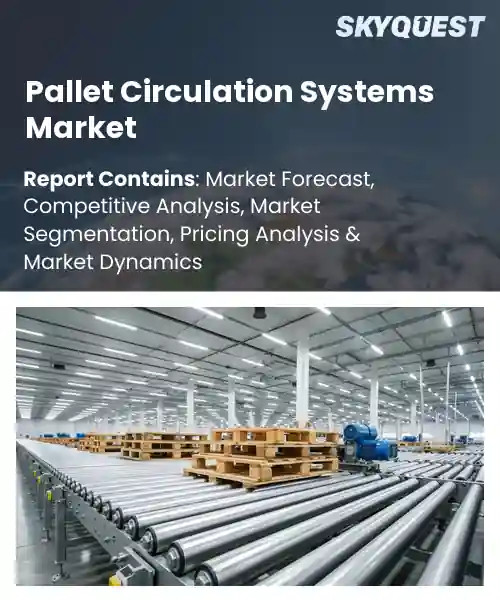
Pallet Circulation Systems Market
Report ID: SQMIG20I3358
Report ID: SQMIG20I3358
[email protected]
USA +1 351-333-4748
Report ID:
SQMIG20I3358 |
Region:
Global |
Published Date: July, 2026
Pages:
157
|Tables:
146
|Figures:
78


Global Pallet Circulation Systems Market size was valued at USD 69.84 Billion in 2024 and is poised to grow from USD 77.35 Billion in 2025 to USD 175.21 Billion by 2033, growing at a CAGR of 10.76% during the forecast period (2026-2033).
The global pallet circulation systems market consists of technologies and services that enable the automated tracking, transportation and reuse of pallets within supply chains. This is important, because pallets add cost to logistics and circulation reduces waste, labor and carbon emissions.
The use of data analytics to transform tracking signals into actionable insights that cut costs and advance sustainability goals is also driving growth in the pallet circulation systems market growth. Businesses that leverage data analytics can anticipate demand for pallets, reallocate stock between regions and trigger warnings when pallets are close to end-of-life – boosting utilization rates by as much as 20%. Another U.S.-based automotive parts supplier reduced outbound freight by 12% and lowered its carbon footprint by using predictive models in conjunction with its RFID network. These results raise investor interest, encourage regulators to back circular economy projects, and provide more and more opportunities to software and service providers.
AI plus IoT automation is quietly turning pallet circulation systems into smarter, intelligent networks, that can foresee demand, reduce manual handling, and help make better use of the assets. In practice pallets get sensors that keep sending position and condition signals in real time up to cloud platforms and machine-learning models, which then anticipate congestion and suggest the best way through it all. With that connection in place pallet life tends to last longer and downtime gets cut down ,so operators can oversee inventory across warehouses and distribution hubs, without needing to do those physical checks, each time. Investment in smarter infrastructure and more resilient and flexible supply chains to changing e-commerce volumes is being driven by the move to digital twins and predictive maintenance.
Market snapshot - (2026-2033)
Global Market Size
USD 69.84 Billion
Largest Segment
Continuous Conveyors
Fastest Growth
Buffer Elevators
Growth Rate
10.76% CAGR
To get more insights on this market click here to Request a Free Sample Report
The global pallet circulation systems market is segmented by system mechanism, load configuration, pallet base material, application environment, sales channel and region. Based on system mechanism, the market is segmented into Continuous Conveyors, Intermittent Indexing, Transversal Transfers and Buffer Elevators. Based on load configuration, the market is segmented into Light Duty and Heavy Duty. Based on pallet base material, the market is segmented into Machined Steel, Rigid Plastics, Laminated Wood and Aluminum Alloys. Based on application environment, the market is segmented into Powertrain Assembly, Electronics Pick, Pharmaceutical Packaging, Cleanroom Assembly and Battery Cells. Based on sales channel, the market is segmented into Direct Plant and System Integrators. Based on region, the market is segmented into North America, Europe, Asia Pacific, Latin America and Middle East & Africa.
As per the pallet circulation systems market analysis, the Continuous Conveyors sector is leading because of the continuous flow it offers in line with the high throughput manufacturing principles. This reduces idle time and simplifies the control logic. It is best suited for large assembly lines, where not much handling and consistency are required. It can handle a variety of load sizes, without too many stops. Engineers like this mechanism because it is reliable, it needs less maintenance, it can be easily integrated with automated warehousing systems, and it has the potential to develop operational scalability capabilities in the future.
However, the intermittent indexing category is the fastest-growing alternative. Manufacturers that want a lot of flexibility also like its precise stop-go motion, and that feature helps teams set up customized workspaces without to much headache, plus it supports a good mix of product combinations. Lately the whole smart factory movement, along with modularly designed lines, is gaining momentum, where firms can quickly reconfigure layouts and, in the end, raise throughput for mixed mode production capacity . That adaptability is what’s pushing demand forward.
According to the pallet circulation systems market forecast, the Machined Steel Segment is the ideal choice for heavy duty pallet circulation installations because of its superior resistance to heavy loads and difficult industrial conditions. The predictable deformation characteristics of the material enable accurate alignment and prolonged service life, thus minimizing replacement downtime. It can be customized with unique features to improve load stability in tough production lines and operational efficiency, and it is compatible with high temperatures, which manufacturers love.
On the other hand, rigid plastics are experiencing the highest growth momentum owing to their light weight durability, less energy consumption and easy handling under different conditions. The need for corrosion-free solutions in cleanroom and pharmaceutical facilities and the use of sustainable materials are driving its use, opening up possibilities for system designs and faster deployment cycles.
To get detailed segments analysis, Request a Free Sample Report
As per the pallet circulation systems market regional forecast, North America's industry leader with its advanced supply chain networks and early adoption of automation technologies. The area has a tightly integrated logistics infrastructure that supports lean manufacturing techniques and high throughput distribution centers. Investment in sophisticated pallet circulation technologies has been driven by the need to reduce handling costs and customer demand for quick delivery. This is further aided by a culture of continuous improvement and a large presence of original equipment manufacturers. Regulatory focus on industrial safety and sustainability further consolidates the region’s dominance, creating a setting where effective pallet handling becomes a cost-effective and compliance tool.
US Pallet Circulation Systems Market
The US pallet circulation systems industry is characterized by its extensive use in large production facilities and distribution centers, where reliability and speed are essential. Advanced tracking and automatic return loops are driven by the focus on lean operations and the quest for operational excellence. - It is crucial for local manufacturers to offer tailor-made solutions to the specific needs of mass volume industries. The market penetration is also being driven by the huge importance placed on reducing manual labor and making workers safe.
Canada Pallet Circulation Systems Market
The Canadian pallet circulation systems sector is a testament to the increasing commitment of the nation to sustainable logistics and efficient cold chain management. The country’s wide network of cross-border commerce channels means that pallet handling needs to be efficient to reduce product waste and speed up turnaround times. End users and equipment manufacturers work together to provide solutions that address the unique challenges of temperature sensitive products. The focus on safety regulations and the objective to boost the productivity of regional distribution centers will aid the market.
The European pallet circulation systems market penetration is growing due to strict environmental legislations and a general move towards a circular economy. Manufacturers across the continent are employing pallet circulation to reduce waste and expand the reuse of materials, and regulatory incentives are pushing the resource efficiency envelope. Industry 4.0 technologies allow for data-driven optimization and real-time monitoring, a reflection of the region’s strong advanced manufacturing base. Demand is being driven by the strong automotive, pharmaceutical and food industries and the need for reliable and sanitary pallet handling. European unions are working together on standards to enable interoperability and market growth, with a focus on ergonomic design and worker safety.
German Pallet Circulation Systems Market
Germany’s strong engineering heritage and well-organized industrial environment support the Pallet Circulation Systems Market. Precision handling and modular system design are essential for leading automakers and machinery manufacturers, enabling quick reconfiguration to meet changing production volumes. Germany is in a strong position and is leading on continuous innovation and performance benchmarks for the wider European market due to its focus on high reliability and integration with digital manufacturing platforms.
UK Pallet Circulation Systems Market
The UK pallet circulation systems market is growing rapidly due to heavy investments in warehouse automation, and the boom in e-commerce activity. Businesses want pallet solutions that are flexible enough to accommodate fluctuating order volumes and a range of product lines. The business also benefits from occupational health regulations and increased awareness of the financial benefits of automated return loops. All these factors combined are turning the UK into a fast-growing hub for the adoption of pallet circulation.
France Pallet Circulation Systems Market
In France, modern food and beverage logistics and increasing demands for sustainability certifications are driving the growth of the market for pallet circulation systems. Operators are implementing smart tracking capabilities to enhance traceability and reduce material loss. The increasing demand for more environmentally friendly supply chains and the use of cooperative platforms are leading a number of distribution channels to adopt reusable pallet solutions. This renewed interest puts France in a key position to help push the overall momentum of the market across the continent.
Asia Pacific is boosting its market position through affordable automation and greater industrialization. The growth in e-commerce and international trade has created a need for more effective pallet handling solutions which reduce stay times and improve warehouse density. With the government’s push for smart manufacturing and the integration of Internet of Things technologies, real-time pallet tracking and predictive maintenance have become commonplace. Furthermore, the region’s emphasis on compact, scalable solutions that accommodate the geographical constraints of densely populated metropolitan logistics hubs underscores its increasing importance on the global stage.
Japan Pallet Circulation Systems Market
The Japanese pallet circulation systems market is characterized by its high precision handling and integration with the latest industrial execution systems. Seamless pallet flows are required to achieve just-in-time production schedules for the automotive and high-tech electronics industries. The market is about resource optimization and operational excellence, with a focus on energy efficiency and small footprints.
South Korea Pallet Circulation Systems Market
South Korea’s pallet circulation systems market is driven by aggressive automation deployment in logistics hubs and a strong export-oriented electronics industry. Government support for a smart factory is driving the adoption of smart pallet solutions that can increase throughput and save floor space. Emphasis is put on fast changeover capabilities and modular designs in order to meet the dynamic needs of the fast moving consumer products industry.
To know more about the market opportunities by region and country, click here to
Buy The Complete Report
Increasing Warehouse Automation
With the use of automated storage and retrieval systems in modern warehouses, the demand for pallet circulation solutions is high. Dependable pallet movement is critical to throughput for automated conveyors, robotic pickers and integrated control software. Pallet circulation systems will provide automated handling, reducing cycle times and physical labor. They enable efficient movement of goods by operating at high speed, thereby helping to meet the scalability goals of warehouse automation and increasing the demand for advanced pallet handling technology in various distribution networks.
Sustainability and Circular Economy
With increasing concern of customers and businesses on environmental responsibility, businesses are using techniques of circular supply chain. Pallet circulation systems facilitate the reuse of pallets and reduce the amount of waste and disposable packaging used. The solutions allow tracking and refurbishment processes that support the recovery of materials and the reduction of carbon footprints in pallet production.” This functionality allows businesses to achieve sustainability objectives, boost brand awareness and conform to new green procurement rules, creating a favorable market atmosphere for pallet circulation solutions.
High Initial Capital Investment
The investment in large pallet circulation infrastructure is typically associated with significant capital outlay for equipment, software integration and facility reconfiguration. For small and medium-sized enterprises with little capital reserves the financial commitment is often too high. So, these companies might prefer to stay with older manual approaches rather than putting money into more refined pallet handling systems. The high cost barrier then slows everything down, it limits how much those advanced circulation systems can actually spread around, so their use in the wider logistics sector gets held back a bit . And that, in turn, delays the possible efficiency gains that people were hoping for.
Regulatory and Safety Compliance
Material handling equipment is subject to strict safety standards and regulatory requirements. Consequently, pallet circulation systems have additional design and operational constraints. Manufacturers’ requirements to introduce safety features, conduct exhaustive risk assessments and obtain certifications may increase the development durations and production costs. In addition, installed systems must be maintained in accordance with occupational safety regulations, such as staff training and periodic inspections. In countries with a weak legal system, these compliance requirements generate operational difficulties that could hamper the speed of market entry.
Request Free Customization of this report to help us to meet your business objectives.
There’s a lot of competition, including M&A, and smart partnerships with big-box retailers, plus rapid tech innovation like AI enabled pallet tracking. Like for instance, a logistics major teamed up with a robotics supplier to form this joint venture to automate pallet circulation, which should boost competitiveness, and speed up industry consolidation, a bit. Also two European pallet pooling companies recently merged so they can offer better cross-border services, which feels important too.
Top Player’s Company Profile
Recent Developments in the Pallet Circulation Systems Market
SkyQuest’s ABIRAW (Advanced Business Intelligence, Research & Analysis Wing) is our Business Information Services team that Collects, Collates, Correlates, and Analyses the Data collected by means of Primary Exploratory Research backed by robust Secondary Desk research.
As per SkyQuest analysis, the global pallet circulation systems market is driven by the increasing automation of warehouses which requires reliable high throughput pallet movement to keep pace with robotic pickers and fast-lane conveyors. Another big element is the drive for sustainability and circular economy methods, pushing companies to reuse pallets and reduce their carbon footprints. North America holds a significant share in the market owing to high demand due to early adoption of technology and complex logistics networks. The segment landscape captures continuous conveyors for simple integration and continuous flow for large-scale production lines. However, the significant up-front capital costs for full-scale deployment, particularly for smaller operators, still inhibit broader uptake.
| Report Metric | Details |
|---|---|
| Market size value in 2024 | USD 69.84 Billion |
| Market size value in 2033 | USD 175.21 Billion |
| Growth Rate | 10.76% |
| Base year | 2024 |
| Forecast period | (2026-2033) |
| Forecast Unit (Value) | USD Billion |
| Segments covered |
|
| Regions covered | North America (US, Canada), Europe (Germany, France, United Kingdom, Italy, Spain, Rest of Europe), Asia Pacific (China, India, Japan, Rest of Asia-Pacific), Latin America (Brazil, Rest of Latin America), Middle East & Africa (South Africa, GCC Countries, Rest of MEA) |
| Companies covered |
|
| Customization scope | Free report customization with purchase. Customization includes:-
|
To get a free trial access to our platform which is a one stop solution for all your data requirements for quicker decision making. This platform allows you to compare markets, competitors who are prominent in the market, and mega trends that are influencing the dynamics in the market. Also, get access to detailed SkyQuest exclusive matrix.
Table Of Content
Executive Summary
Market overview
Parent Market Analysis
Market overview
Market size
KEY MARKET INSIGHTS
COVID IMPACT
MARKET DYNAMICS & OUTLOOK
Market Size by Region
KEY COMPANY PROFILES
Methodology
For the Pallet Circulation Systems Market, our research methodology involved a mixture of primary and secondary data sources. Key steps involved in the research process are listed below:
1. Information Procurement: This stage involved the procurement of Market data or related information via primary and secondary sources. The various secondary sources used included various company websites, annual reports, trade databases, and paid databases such as Hoover's, Bloomberg Business, Factiva, and Avention. Our team did 45 primary interactions Globally which included several stakeholders such as manufacturers, customers, key opinion leaders, etc. Overall, information procurement was one of the most extensive stages in our research process.
2. Information Analysis: This step involved triangulation of data through bottom-up and top-down approaches to estimate and validate the total size and future estimate of the Pallet Circulation Systems Market.
3. Report Formulation: The final step entailed the placement of data points in appropriate Market spaces in an attempt to deduce viable conclusions.
4. Validation & Publishing: Validation is the most important step in the process. Validation & re-validation via an intricately designed process helped us finalize data points to be used for final calculations. The final Market estimates and forecasts were then aligned and sent to our panel of industry experts for validation of data. Once the validation was done the report was sent to our Quality Assurance team to ensure adherence to style guides, consistency & design.
Analyst Support
Customization Options
With the given market data, our dedicated team of analysts can offer you the following customization options are available for the Pallet Circulation Systems Market:
Product Analysis: Product matrix, which offers a detailed comparison of the product portfolio of companies.
Regional Analysis: Further analysis of the Pallet Circulation Systems Market for additional countries.
Competitive Analysis: Detailed analysis and profiling of additional Market players & comparative analysis of competitive products.
Go to Market Strategy: Find the high-growth channels to invest your marketing efforts and increase your customer base.
Innovation Mapping: Identify racial solutions and innovation, connected to deep ecosystems of innovators, start-ups, academics, and strategic partners.
Category Intelligence: Customized intelligence that is relevant to their supply Markets will enable them to make smarter sourcing decisions and improve their category management.
Public Company Transcript Analysis: To improve the investment performance by generating new alpha and making better-informed decisions.
Social Media Listening: To analyze the conversations and trends happening not just around your brand, but around your industry as a whole, and use those insights to make better Marketing decisions.
REQUEST FOR SAMPLE
 REQUEST FREE CUSTOMIZATION
Global Pallet Circulation Systems Market size was valued at USD 69.84 Billion in 2024 and is poised to grow from USD 77.35 Billion in 2025 to USD 175.21 Billion by 2033, growing at a CAGR of 10.76% during the forecast period (2026-2033).
The competitive landscape is shaped by aggressive M&A activity, strategic partnerships with major retailers, and rapid tech innovation such as AI‑driven pallet tracking; recent examples include a merger between two European pallet‑pooling firms to expand cross‑border services and a joint venture between a logistics giant and a robotics supplier to automate pallet circulation, intensifying rivalry and accelerating market consolidation. 'Vollert Anlagenbau GmbH', 'Prilhofer Consulting GmbH & Co KG', 'Ebawe Anlagentechnik GmbH', 'Progress Group', 'Sommer Anlagentechnik GmbH', 'Weckenmann Anlagentechnik GmbH & Co KG', 'Avermann Maschinenfabrik GmbH & Co KG', 'Ratec GmbH', 'Reymann Technik GmbH', 'Elematic Oyj', 'Nordimpianti System SRL', 'Technocom Commercial', 'Concrete Technologies Worldwide Inc', 'Besser Company', 'Masa GmbH', 'Quadra SA', 'Topwerk GmbH', 'Hess Group', 'Prinzing Pfeiffer GmbH', 'KraussMaffei Group GmbH'
The adoption of automated storage and retrieval systems in modern warehouses creates a strong need for efficient pallet circulation solutions. Automated conveyors, robotic pickers, and integrated control software rely on reliable pallet movement to maintain throughput. Pallet circulation systems provide the necessary mechanized handling, reducing manual labor and cycle times. By enabling seamless flow of goods through high‑speed operations, these systems support the scalability objectives of warehouse automation, thereby driving demand for advanced pallet handling technologies across diverse distribution networks.
Automated Guided Vehicles Integration: The adoption of automated guided vehicles (AGVs) is reshaping pallet circulation by delivering continuous, hands‑free movement across warehouses and distribution centers. Companies are deploying AGVs to synchronize with warehouse management systems, reducing human labor and minimizing handling errors. This shift enhances throughput, improves inventory visibility, and supports lean operations. As technology matures, integration costs decline, encouraging mid‑size operators to invest, while leading firms use data analytics from AGVs to refine layout and staffing strategies and drive sustainable cost efficiencies globally.
Why does North America Dominate the Global Pallet Circulation Systems Market? |@12


Want to customize this report? This report can be personalized according to your needs. Our analysts and industry experts will work directly with you to understand your requirements and provide you with customized data in a short amount of time. We offer $1000 worth of FREE customization at the time of purchase.
Feedback From Our Clients


 USA (+1) 351-333-4748

