Paint and Varnish Market
Report ID: SQMIG15E3381
Report ID: SQMIG15E3381
[email protected]
USA +1 351-333-4748
Report ID:
SQMIG15E3381 |
Region:
Global |
Published Date: March, 2026
Pages:
157
|Tables:
121
|Figures:
77


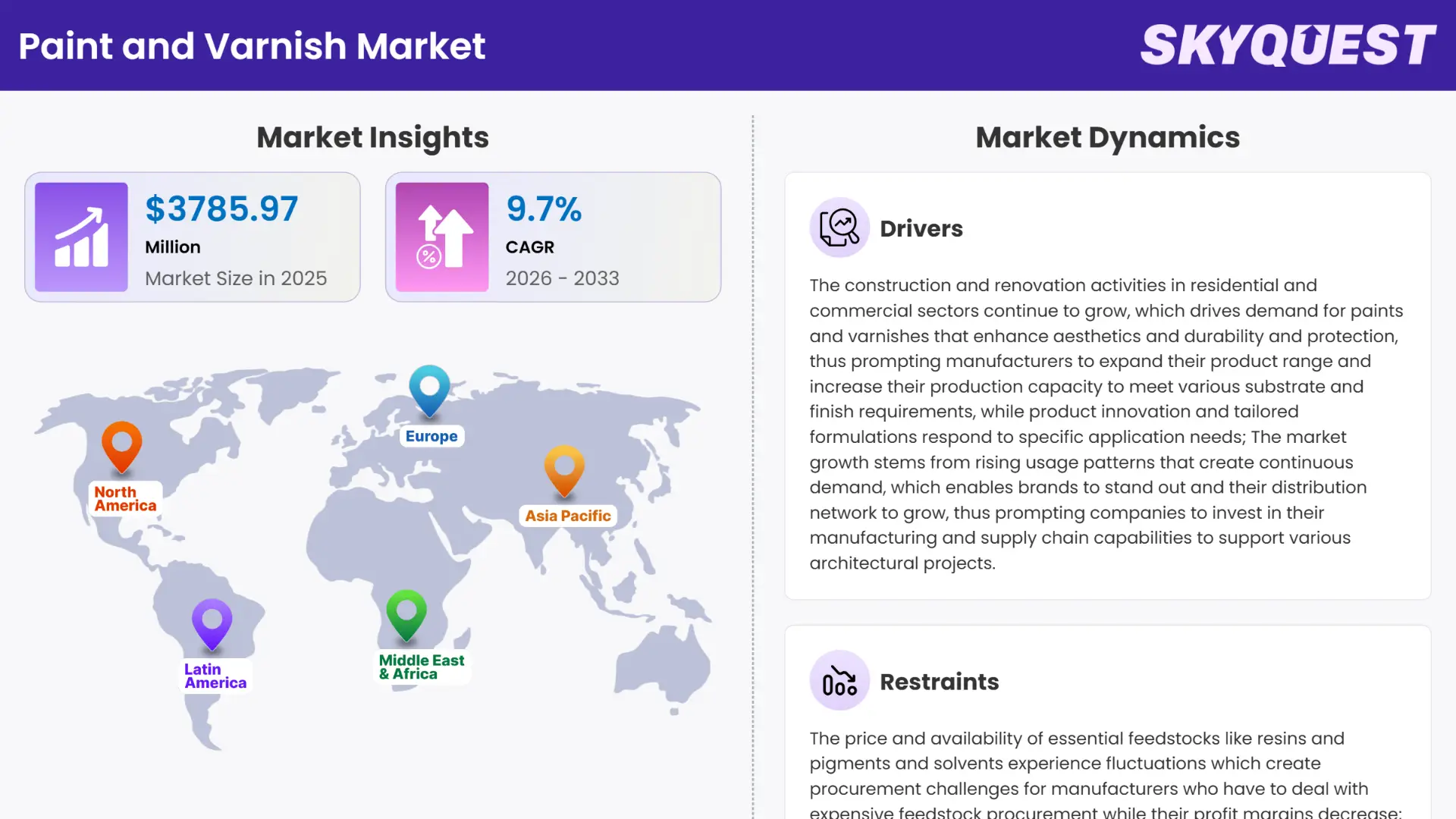
Global Paint and Varnish Market size was valued at USD 3451.20 Million in 2024 and is poised to grow from USD 3785.97 Million in 2025 to USD 7940.17 Million by 2033, growing at a CAGR of 9.7% during the forecast period (2026-2033).
Key Takeaways: Market Trends & Insights
The global paint and varnish market growth is maintained through constant construction and renovation work, which creates a commercial spaces and industrial facilities. The industry produces architectural paints and industrial coatings and wood varnishes and specialty formulations that improve product appearance and safeguard materials and enhance product durability. The building industry depends on coatings because they provide protection against corrosion and reduce maintenance costs throughout a building's lifespan while simultaneously improving energy efficiency and infrastructure.
Moreover, the global paint and varnish market outlook has transitioned from lead and oil-based paints and high-performance systems during this period because regulatory requirements became more stringent and materials science developed across Europe and Asia. The global market experiences its primary growth driver through regulatory requirements that mandate lower emissions because stricter VOC limits force manufacturers to develop waterborne powder products and biobased chemistries that achieve compliance while enhancing performance.
The companies enhance by directing resources toward reformulation and production upgrades to secure contracts from automotive OEMs, and infrastructure projects which need durable aesthetic solutions that protect against corrosion. Powder coatings achieved VOC reductions in automotive assembly lines while healthcare facilities adopted antimicrobial finishes for their use. The market now provides opportunities for premium functional coatings, digital color services, and which enable companies to increase their profit margins and capture a larger paint and varnish market share.
How is AI Optimizing Formulation and Color Matching in the Paint and Varnish Market?
The development combines spectral measurement with materials data and predictive models to create AI-based systems that transform paint formulation and color matching processes for paints and varnishes. The system combines three essential components which include spectrophotometer color capture systems, machine learning algorithms to predict pigment interactions, and generative systems to create different color palette combinations. The market implements AI at present to shorten testing periods while increasing product consistency between batches and enabling businesses to produce custom colors at industrial scale.
Companies need to streamline their processes because customers now expect quicker delivery of customized products and they must follow stricter environmental sustainability standards. Designers can use automated tinting systems and cloud-based color visualizers to create their original design specifications for real-world applications.
PPG, in March 2025, launched an automotive coatings color creation studio in Tianjin with advanced measurement tools that operate together with AI-based software. The development enables companies to complete color approval processes faster because it uses predictive technology to determine formulas and more accurately match colors, which results in better operational efficiency for both OEM and refinish businesses.
To get more insights on this market click here to Request a Free Sample Report
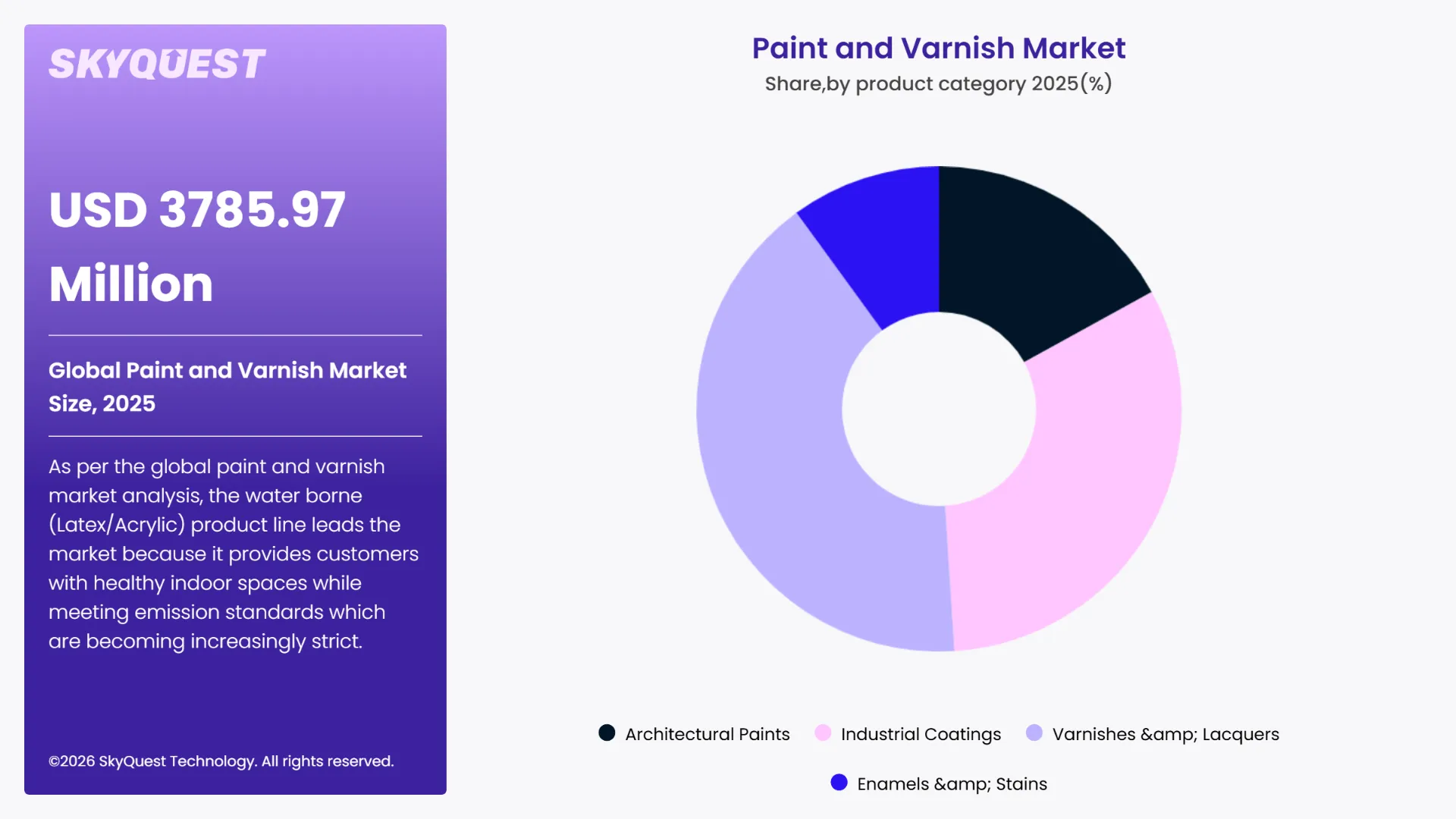
The global paint and varnish market is segmented based on product category, formulation technology, material resin type, application vertical, and region. By product category, the market includes architectural paints, industrial coatings, varnishes and lacquers, as well as enamels and stains. In terms of formulation technology, it is categorized into water-borne (latex or acrylic), solvent-borne (oil-based), powder coatings, and UV-cured coatings. Based on material resin type, the market is divided into acrylic, alkyd, epoxy, and polyurethane (PU). By application vertical, the market covers residential construction, commercial and infrastructure, automotive and transportation, and wood and furniture manufacturing. Regionally, the market is analyzed across North America, Europe, Asia Pacific, Latin America, and the Middle East & Africa.
As per the global paint and varnish market analysis, the water borne (Latex/Acrylic) product line leads the market because it provides customers with healthy indoor spaces while meeting emission standards which are becoming increasingly strict. Manufacturers can achieve their production goals through the solvent-free profile of this product, which allows them to create durable products with high color retention and easy application methods, which will decrease the need for maintenance work during the product's lifespan. Contractors and OEMs choose to specify products based on their performance and sustainability benefits, which create a pipeline of supply chain investments and demand for products.
However, the UV cured coatings segment experiences rapid growth because its products provide immediate curing and exceptional surface capabilities, which fulfill the production demands of high-throughput OEM manufacturing environments. The low solvent profiles of this product make it suitable for use with digital decorating, which allows it to be applied in specialty furniture production, electronics manufacturing, and industrial parts production, leading to changes in specification requirements and investments in high-speed finishing lines and new application equipment.
According to the global paint and varnish market forecast, the wood & furniture manufacturing segment exhibits a unique market position because the need to meet aesthetic expectations and durability standards results in the development of new coating chemistries that evolve from clear lacquers to conversion varnishes and specialized stains. The demand for scratch resistance and color fidelity and pleasant tactile finishes leads manufacturers to select multi-coat systems with premium resins, which creates a need for product development in formulation and curing technology and application equipment.
Whereas the automotive & transportation sector experiences strong growth at present because OEMs need multifunctional coatings, which provide both corrosion resistance and lightweight substrate adhesion and complex visual effects and fast curing times. The development of special chemistries together with long-lasting coating systems occurs because performance requirements and regulatory standards spur companies to improve their operational capabilities, which results in new business prospects for suppliers in both repair work and OEM tasks.
To get detailed segments analysis, Request a Free Sample Report
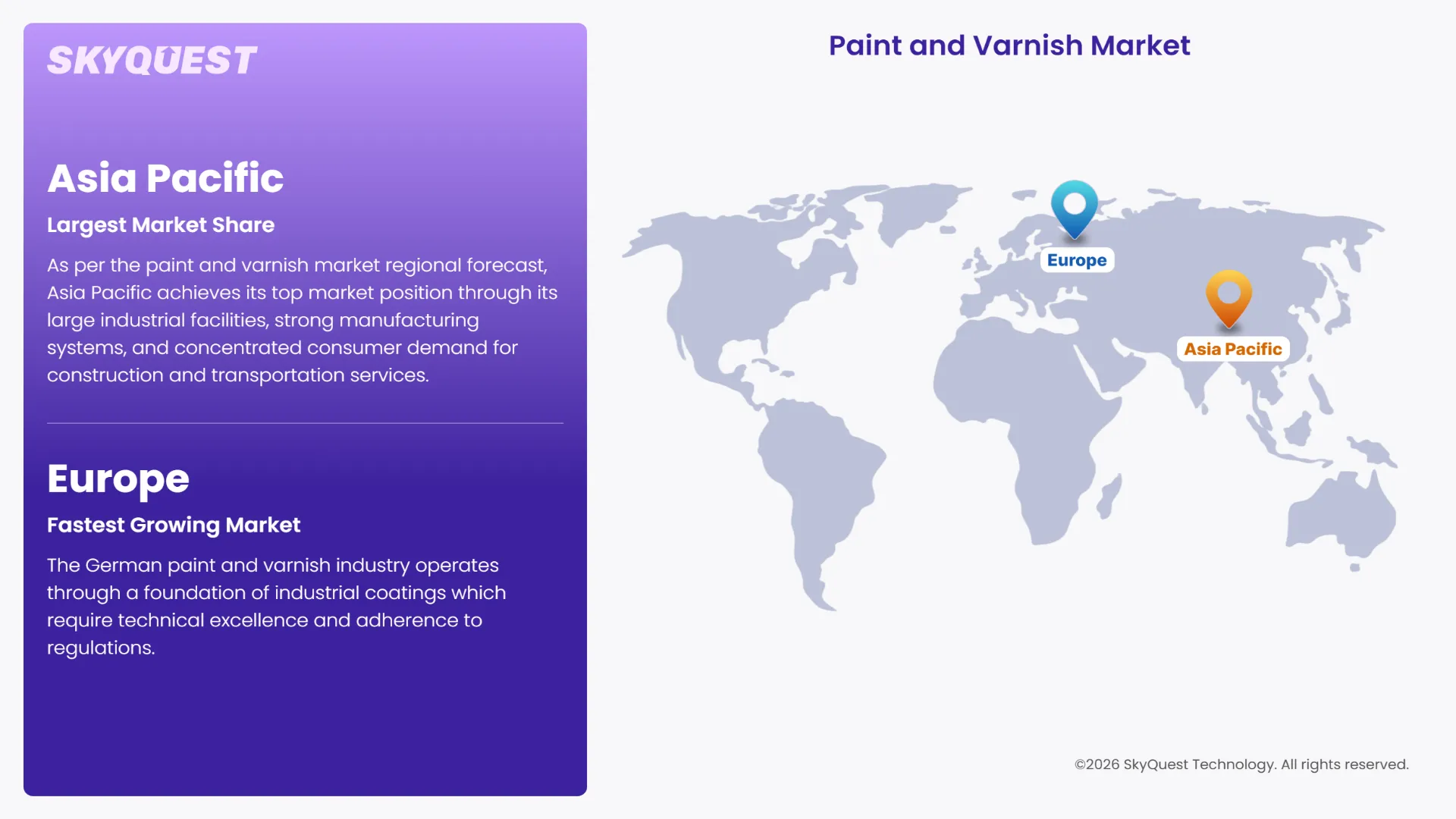
As per the paint and varnish market regional forecast, Asia Pacific achieves its top market position through its large industrial facilities, strong manufacturing systems, and concentrated consumer demand for construction and transportation services. The region achieves its market power through supply chain networks which connect pigment and resin and additive manufacturers with local formulators to deliver cost advantages and quick production expansion.
The automotive and consumer electronics sectors create strong demand for both high-performance coatings and specialty coatings through their established original equipment manufacturer partnerships. Advanced research facilities together with specialized technical professionals support ongoing development of low-emission and waterborne system alternatives through innovation and product reformulation efforts. Active export channels along with favorable production economics enable businesses to expand their market presence as infrastructure development and urban growth maintain continuous demand for decorative coatings.
In Japan the paint and varnish market features advanced formulation capabilities which create high-performance specialty coatings for automotive and electronics and industrial applications. The combination of technical innovation and original equipment manufacturer partnerships drives the development of premium products which customers select for use. The regulatory requirement to develop long-lasting solutions with low emissions has made waterborne and solvent-reduction technologies the primary focus for reformulation efforts. The market exists to meet established domestic supplier requirements and sophisticated application standards through products which deliver high-quality and long-lasting performance and technical product diversity.
The South Korean paint and varnish sector depends on domestic manufacturing operations which supply specialized coatings and functional coatings to export-oriented coating manufacturers who produce these products. The shipbuilding and automotive and electronics industries drive industrial demand for advanced surface treatments and high-performance finishes and corrosion protection systems. Companies invest in research and development together with process improvement activities to achieve quick implementation of environmentally friendly solutions. The market combines innovative solutions with pricing advantages by using local raw material connections together with technical partnerships to provide services to international and domestic markets.
The European paint and varnish market trends grow because construction activities and new environmental regulations and consumer demand for high-quality environmentally friendly products create a bundle of development opportunities. New product research and development activities have increased because companies need to develop waterborne products which can meet environmental regulations while creating marketable product line distinctions. The automotive and industrial coatings market provides stable demand through its structural strength while urban development activities and residential upgrades based on aesthetic preferences fuel decorative segment growth.
Distribution networks and technical service capabilities receive enhancements from market consolidation and established companies making particular operational investments. Certified high-performance infrastructure and protective coatings systems create additional market opportunities for specialized suppliers who meet these requirements. European companies can compete in regional and global markets through their advanced products which achieve both quality standards and sustainability certifications while standards across borders allow them to expand their business.
The German paint and varnish industry operates through a foundation of industrial coatings which require technical excellence and adherence to regulations. The market focuses on creating high-performance systems that provide durability for automotive and machinery and infrastructure applications through its relationship with original equipment manufacturers. The suppliers of sustainable chemistries and process efficiency innovations focus their resources on delivering product reliability through their product development efforts. The distribution network structure together with consumer demand for superior products leads suppliers to deliver complete application support and technical assistance to their customers.
The United Kingdom paint and varnish market experiences fast growth because home renovation projects increase and people want environmentally friendly decorative products that match their modern lifestyle. The market momentum develops through active specification channels which promote both consumer and professional investments in premium products that emit low emissions. The independent contractors and professional applicators want systems which provide both easy application and environmental certification. The market benefits from agile suppliers who provide technical service and local supply solutions while they adapt to changing regulatory requirements and customer preferences.
The paint and varnish market in France grows as eco-friendly formulations become more popular and design-driven decorative trends emerge. Product selection for sustainable building materials focuses on low-emission products and natural-looking coatings because building materials support indoor air quality. The industrial sector requires manufacturers to apply higher performance protective systems because they need to protect their products from industrial use while complying with environmental regulations. The market prefers design collaborations between designers and architects and suppliers because these partnerships create precise product specifications for specialized finishes which help niche brands create their own unique market presence.
North America strengthens its market position through investments in sustainable technology development and supply chain resilience and specialty product creation. Companies have adopted low-VOC and waterborne alternatives as their focus which has led to raw material suppliers and formulators establishing new partnerships through their reformulation work. The region possesses advanced distribution systems which enable renovation and maintenance operations to continue through its strong aftermarket support.
Manufacturers combine their operations through consolidation which enhances their capacity to provide both technical service and scale operations while specific research and development work produces specialized coatings for industrial and protective purposes. Digital commerce and private-label expansion enable producers to access various end-users through new customer purchasing methods which transform how customers buy products. Environmental priorities and technical innovation along with commercial channels work together to create strategic alignment which strengthens North Americas position in the global paint and varnish industry.
The United States paint and varnish market exhibit strong demand because decorative renovation and industrial maintenance sectors both benefit from advanced formulation technology and wide distribution networks. Suppliers provide waterborne and low-emission systems together with special coatings which protect infrastructure and machinery while they promote sustainability and performance. The market participants develop their technical service and application training programs to fulfill the complex specification demands which exist in the market. The new procurement methods combined with digital sales channels enable businesses to reach more customers while providing customized supply solutions for distinct market areas.
The Canadian paint and varnish market focus on producing climate-adapted coatings which last long and on developing environmentally friendly products. The region requires protective systems and finishes which provide exceptional durability and environmental sustainability because its climatic conditions. Local suppliers and distributors focus their operations on providing technical assistance while ensuring dependable local supply, which they combine with their work to develop products that meet building and infrastructure specifications. The market needs advanced chemical technologies which match regulatory standards and practitioner preferences to achieve gradual market acceptance.
To know more about the market opportunities by region and country, click here to
Buy The Complete Report
Growth In Architectural Applications
Demand For Environmentally Friendly Coatings
Volatility In Raw Material Supply
High Compliance and Production Costs
Request Free Customization of this report to help us to meet your business objectives.
Market competition in the global paint and varnish industry experiences increased pressure because regulations demand products with low VOC emissions and bio-based materials which lead companies to make specific acquisition and partnership choices that help them obtain specialty binders and digital formulation technology. The major coatings companies collaborate with industrial technology partners through joint development pacts while making strategic acquisitions and alliances that boost their powder and UV cure capabilities.
SkyQuest’s ABIRAW (Advanced Business Intelligence, Research & Analysis Wing) is our Business Information Services team that Collects, Collates, Correlates, and Analyses the Data collected by means of Primary Exploratory Research backed by robust Secondary Desk research.
As per SkyQuest analysis, the construction and renovation activities continue to drive up demand for protective and decorative coatings while raw material supply disruptions create production challenges through their cost increases. Asia Pacific serves as the leading manufacturing hub because it features extensive manufacturing facilities and unified supply chains and strong OEM demands. The market now prefers water-borne coatings because they meet new environmental regulations and people want better indoor air quality. The second driver results from environmental laws which demand low-VOC production and the creation of sustainable products and biobased products which have high value and functionality.
| Report Metric | Details |
|---|---|
| Market size value in 2024 | USD 3451.20 Million |
| Market size value in 2033 | USD 7940.17 Million |
| Growth Rate | 9.7% |
| Base year | 2024 |
| Forecast period | 2026-2033 |
| Forecast Unit (Value) | USD Million |
| Segments covered |
|
| Regions covered | North America (US, Canada), Europe (Germany, France, United Kingdom, Italy, Spain, Rest of Europe), Asia Pacific (China, India, Japan, Rest of Asia-Pacific), Latin America (Brazil, Rest of Latin America), Middle East & Africa (South Africa, GCC Countries, Rest of MEA) |
| Companies covered |
|
| Customization scope | Free report customization with purchase. Customization includes:-
|
To get a free trial access to our platform which is a one stop solution for all your data requirements for quicker decision making. This platform allows you to compare markets, competitors who are prominent in the market, and mega trends that are influencing the dynamics in the market. Also, get access to detailed SkyQuest exclusive matrix.
Table Of Content
Executive Summary
Market overview
Parent Market Analysis
Market overview
Market size
KEY MARKET INSIGHTS
COVID IMPACT
MARKET DYNAMICS & OUTLOOK
Market Size by Region
KEY COMPANY PROFILES
Methodology
For the Paint and Varnish Market, our research methodology involved a mixture of primary and secondary data sources. Key steps involved in the research process are listed below:
1. Information Procurement: This stage involved the procurement of Market data or related information via primary and secondary sources. The various secondary sources used included various company websites, annual reports, trade databases, and paid databases such as Hoover's, Bloomberg Business, Factiva, and Avention. Our team did 45 primary interactions Globally which included several stakeholders such as manufacturers, customers, key opinion leaders, etc. Overall, information procurement was one of the most extensive stages in our research process.
2. Information Analysis: This step involved triangulation of data through bottom-up and top-down approaches to estimate and validate the total size and future estimate of the Paint and Varnish Market.
3. Report Formulation: The final step entailed the placement of data points in appropriate Market spaces in an attempt to deduce viable conclusions.
4. Validation & Publishing: Validation is the most important step in the process. Validation & re-validation via an intricately designed process helped us finalize data points to be used for final calculations. The final Market estimates and forecasts were then aligned and sent to our panel of industry experts for validation of data. Once the validation was done the report was sent to our Quality Assurance team to ensure adherence to style guides, consistency & design.
Analyst Support
Customization Options
With the given market data, our dedicated team of analysts can offer you the following customization options are available for the Paint and Varnish Market:
Product Analysis: Product matrix, which offers a detailed comparison of the product portfolio of companies.
Regional Analysis: Further analysis of the Paint and Varnish Market for additional countries.
Competitive Analysis: Detailed analysis and profiling of additional Market players & comparative analysis of competitive products.
Go to Market Strategy: Find the high-growth channels to invest your marketing efforts and increase your customer base.
Innovation Mapping: Identify racial solutions and innovation, connected to deep ecosystems of innovators, start-ups, academics, and strategic partners.
Category Intelligence: Customized intelligence that is relevant to their supply Markets will enable them to make smarter sourcing decisions and improve their category management.
Public Company Transcript Analysis: To improve the investment performance by generating new alpha and making better-informed decisions.
Social Media Listening: To analyze the conversations and trends happening not just around your brand, but around your industry as a whole, and use those insights to make better Marketing decisions.
REQUEST FOR SAMPLE
 REQUEST FREE CUSTOMIZATION
Global Paint And Varnish Market size was valued at USD 5.0 Billion in 2024 and is poised to grow from USD 5.48 Billion in 2025 to USD 11.41 Billion by 2033, growing at a CAGR of 9.6% during the forecast period (2026-2033).
Competitive intensity in the global paint and varnish market is driven by regulatory pressure for low VOC and bio based solutions, prompting incumbents to pursue targeted M&A and industrial partnerships to secure specialty binders and digital formulation tech. Examples include strategic acquisitions and alliances that accelerate powder and UV cure capabilities and joint development pacts between major coatings firms and industrial technology partners. 'AkzoNobel', 'Sherwin-Williams', 'PPG Industries', 'Nippon Paint', 'BASF SE', 'Kansai Paint', 'RPM International', 'Axalta Coating Systems', 'Asian Paints', 'Jotun', 'Hempel', 'Masco Corporation (Behr)', 'Tnemec', 'Sika AG', 'Diamond Vogel', 'DAW SE', 'Berger Paints', 'Kelly-Moore', 'Dunn-Edwards', 'Benjamin Moore'
The steady expansion of construction and renovation activities in residential and commercial sectors stimulates demand for paints and varnishes that enhance aesthetics, durability, and protection, encouraging manufacturers to broaden product lines and increase production capacity to meet diverse substrate and finish requirements, while product innovation and tailored formulations respond to specific application needs; this rising usage supports market growth by creating sustained consumption patterns, enabling brand differentiation and distribution expansion, and motivating investment in manufacturing and supply chain capabilities to serve varied architectural projects.
Bio-Based Low-Voc Formulations: Manufacturers are shifting toward bio-based, low‑VOC formulations that meet growing preference for environmentally conscious products and reduced indoor emissions. This trend emphasizes renewable feedstocks, readily biodegradable resins, and safer additive packages that enhance shelf life and performance without sacrificing application properties. Collaboration across chemical suppliers and paint producers accelerates commercialization, while marketing narratives increasingly highlight cradle to application benefits. Adoption in architectural and niche industrial segments supports premium positioning and long-term brand differentiation driven by consumer preferences and specification decisions.
Asia Pacific Dominate the Global Paint and Varnish Market?


Want to customize this report? This report can be personalized according to your needs. Our analysts and industry experts will work directly with you to understand your requirements and provide you with customized data in a short amount of time. We offer $1000 worth of FREE customization at the time of purchase.
Feedback From Our Clients


 USA (+1) 351-333-4748

