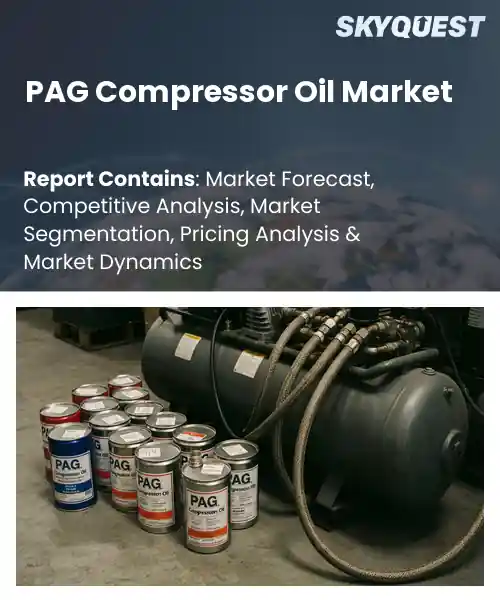
PAG Compressor Oil Market
Report ID: SQMIG15E3729
Report ID: SQMIG15E3729
[email protected]
USA +1 351-333-4748
Report ID:
SQMIG15E3729 |
Region:
Global |
Published Date: June, 2026
Pages:
157
|Tables:
91
|Figures:
76


Global Pag Compressor Oil Market size was valued at USD 1.4 Billion in 2024 and is poised to grow from USD 1.5 Billion in 2025 to USD 2.57 Billion by 2033, growing at a CAGR of 7.0% during the forecast period (2026-2033).
The primary driver of the polyalkylene glycol (PAG) compressor oil market is the accelerating demand for high-performance lubricants in industrial refrigeration and gas compression systems, where reduced flammability and superior thermal stability prolong equipment life and lower maintenance costs. PAG compressor oil markets encompass formulated synthetic lubricants designed for screw, reciprocating, and centrifugal compressors used across petrochemical, LNG, and logistics sectors; their importance has grown as stricter safety and environmental standards pushed operators away from mineral oils. Adoption rose after technological advances in additive chemistry and material compatibility testing enabled wider use, as in ammonia plants and offshore gas facilities.
Building on that momentum, the key factor shaping the PAG compressor oil market is regulatory-driven equipment upgrades that prompt end-users to adopt compatible lubricants, thereby accelerating supplier innovation and scale economies. As operators replace legacy compressors to meet safety and low-GWP mandates, manufacturers specify PAG oils to ensure compatibility with synthetic refrigerants and elastomers, creating predictable demand that justifies greater R&D; the resulting cycle lowers unit costs and expands formulations for extreme temperature and high-pressure use. Examples include LNG terminals standardizing PAG oils for mixed-refrigerant cycles and cold-storage operators reducing downtime, which demonstrates commercial opportunities for formulators and service providers.
How is IoT-enabled predictive maintenance impacting demand in the PAG compressor oil market?
IoT enabled predictive maintenance uses onboard sensors to track oil condition vibration and temperature and then applies analytics to predict service needs. For the PAG compressor oil market this drives demand toward premium synthetic PAG grades that offer thermal stability low varnish risk and predictable drain behavior. The current situation sees OEMs and service teams pairing remote monitoring with specification of higher performance lubricants so maintenance windows can be planned and unplanned downtime reduced. Real world examples and market studies report growing preference for PAG formulations where condition based strategies are adopted.
LIQUI MOLY February 2026, released a PAG air conditioning oil aimed at modern refrigerants which highlights OEM and aftermarket focus on oils compatible with sensor based monitoring. That launch shows how IoT enabled condition monitoring increases demand for high quality PAG oils by linking lubricant choice to measurable asset health.
Market snapshot - (2026-2033)
Global Market Size
USD 1.4 Billion
Largest Segment
Water-Insoluble PAG
Fastest Growth
Water-Soluble PAG
Growth Rate
7.0% CAGR
To get more insights on this market click here to Request a Free Sample Report
Global pag compressor oil market is segmented by product type, viscosity grade, end-use industry and region. Based on product type, the market is segmented into Water-Soluble PAG and Water-Insoluble PAG. Based on viscosity grade, the market is segmented into ISO VG 46, ISO VG 100, ISO VG 150 and Others. Based on end-use industry, the market is segmented into Automotive, Industrial Manufacturing, Chemical and Petrochemical and Others. Based on region, the market is segmented into North America, Europe, Asia Pacific, Latin America and Middle East & Africa.
Water-Soluble PAG segment dominates because its miscibility with condensate and refrigerant streams enables consistent moisture handling inside compressors, preventing phase separation and reducing corrosion risks that compromise seals and internal components. This compatibility encourages OEM and maintenance preference for formulations that simplify fluid management and acidic byproduct control, prompting suppliers to optimize additive chemistry for enhanced corrosion inhibition and sustained lubrication under moisture-prone operating conditions.
However, Water-Insoluble PAG is witnessing rapid growth as formulators create hydrophobic chemistries for oil-flooded compressors and retrofit programs, driven by demand for extended oil life and lower oil-refrigerant interaction. Improved additive solubility and seal compatibility broaden usable applications, accelerating adoption in industries focusing on leak containment and simplified oil recovery.
ISO VG 46 segment leads because its balanced viscosity delivers an effective compromise between film formation and pumpability, providing sufficient lubricating film under shear while remaining serviceable across typical compressor temperature ranges. That balance reduces wear and energy loss, aligns with common OEM recommendations, and stabilizes additive performance, encouraging widespread selection by manufacturers and maintenance teams for diverse rotary and reciprocating compressor applications.
However, ISO VG 100 is growing rapidly as industrial systems demand thicker films for heavy duty compressors, enabling longer drain intervals and improved wear margins. Advances in shear stability additives and formulation techniques let higher viscosity oils maintain film strength while addressing durability needs in heavy duty applications.
To get detailed segments analysis, Request a Free Sample Report
Asia Pacific dominates the global PAG compressor oil market due to a concentrated combination of manufacturing scale, technological expertise and integrated supply chains that support rapid product development and deployment. Large compressor and equipment manufacturing clusters create close collaboration between OEMs and lubricant formulators, enabling tailored PAG solutions optimized for regional operating conditions and refrigerant profiles. Robust research and development capabilities in countries such as Japan and South Korea drive formulation advances, while local blending and distribution networks ensure timely availability across diverse industrial and refrigeration segments. Strong aftermarket ecosystems, technical service providers and export oriented production hubs further reinforce the region leadership, allowing suppliers to scale specialized offerings and maintain close field support for complex compressor applications. This ecosystem fosters continuous improvement in product reliability and cross border collaboration.
PAG Compressor Oil Market in Japan is driven by advanced manufacturing, close collaboration between OEMs and lubricant developers, and a high emphasis on performance and reliability. Strong industrial engineering capabilities support tailored formulations for specialized compressors, while established testing infrastructure and stringent quality regimes foster supplier innovation. Domestic supplier networks and export oriented production further reinforce Japan position in premium lubricant segments and technical aftermarket services, and long term partnerships.
PAG Compressor Oil Market in South Korea benefits from strong electronics and automotive ecosystems, enabling close integration of lubricant specification with compressor design. Local suppliers emphasize thermal stability, compatibility and performance under compact operating conditions, while engineering services support rapid prototyping and validation. Strategic collaborations between manufacturers and material scientists accelerate innovation, and growing aftermarket networks ensure availability of specialized fluids and technical support across industrial and refrigeration segments nationwide.
Rapid expansion of the PAG compressor oil market in North America is driven by converging industrial modernization, widespread HVACR upgrade cycles and a strong aftermarket culture that prioritizes reliable, high performance lubricants. Suppliers benefit from sophisticated distribution channels and close engagement with equipment manufacturers that translate application needs into specified PAG formulations. Emphasis on operational efficiency and lower lifecycle costs encourages adoption of tailored fluids, while robust service networks facilitate retrofit and maintenance activities. Investment in local blending, technical support and validation laboratories supports quicker market response. Regulatory alignment and industry certifications lend confidence to specification decisions, while supplier training programs and field technical services strengthen adoption in complex installations.
PAG Compressor Oil Market in United States reflects a large installed base of compressors requiring efficient, reliable lubrication. Strong OEM ties and advanced distribution channels facilitate specification of tailored PAG formulations. Emphasis on energy efficiency and retrofit activity sustains aftermarket demand, while extensive technical support and localized blending enable suppliers to address diverse commercial and industrial applications with high performance fluids and responsive field services across large service networks nationwide.
PAG Compressor Oil Market in Canada is shaped by diversified industrial activity and a dispersed service footprint that favors dependable lubricant supply and technical support. Domestic distributors and formulators emphasize compatibility with varied refrigerants and robust thermal performance for remote operations. Collaborative relationships with equipment manufacturers and service providers support specification clarity, while aftermarket channels and testing capabilities enable response to maintenance needs in commercial refrigeration and industrial compressor applications.
Europe is strengthening its position in PAG compressor oil market through a combination of technical leadership, regulatory alignment and strong industrial partnerships. Traditional manufacturing hubs provide deep expertise in lubricant chemistry and precision engineering, enabling development of formulations that address evolving refrigerant compatibility and performance requirements. Collaborative frameworks between OEMs, testing laboratories and specialty chemical suppliers accelerate validation and commercialization of tailored fluids. Cross border distribution networks and aftermarket service providers ensure reliable supply and field support, while focused investments in testing infrastructure and sustainability oriented product design enhance supplier credibility. Market participants leverage longstanding relationships with equipment manufacturers to influence lubricant specifications, positioning Europe as a center for high quality, certified PAG solutions adapted to diverse commercial and industrial compressor applications.
PAG Compressor Oil Market in Germany is anchored by deep industrial expertise, precision engineering and close ties between lubricant developers and compressor manufacturers. Emphasis on durability, thermal resilience and compatibility with advanced refrigerants leads to rigorous testing and bespoke formulations. Strong laboratory capabilities and certification frameworks support supplier credibility, while a mature aftermarket and service ecosystem enable reliable supply chains and field support across industrial, automotive and refrigeration applications nationwide.
PAG Compressor Oil Market in United Kingdom benefits from a strong services and maintenance sector, close collaboration between equipment specialists and lubricant formulators, and flexible supply chains that address varied application needs. Focus on efficiency and compatibility with emerging refrigerants drives targeted product development, while testing facilities and technical consultancies enable rapid validation. Robust aftermarket channels and skilled field technicians support reliable lubrication practices across commercial and industrial compressor installations.
PAG Compressor Oil Market in France demonstrates strong integration between chemical formulators and compressor OEMs, with emphasis on fluid performance under varied operational conditions. Suppliers prioritize compatibility, low volatility and thermal stability to meet industrial and refrigeration requirements. Established testing centers and collaborative development programs support tailored formulations, while concentrated distribution and technical service networks ensure consistent supply and expert field support for maintenance and retrofit activities across industrial clusters.
To know more about the market opportunities by region and country, click here to
Buy The Complete Report
Increasing Automotive Refrigeration Demand
Compatibility With New Refrigerants
High Formulation And Compliance Costs
Limited Supply Of Specialized Additives
Request Free Customization of this report to help us to meet your business objectives.
Competitive dynamics in the global PAG compressor oil market center on technology differentiation and sustainability credentials, with incumbents executing M&A and portfolio reshaping, for example Lubrizol's purchase of Croda refrigeration assets, alongside chemical majors partnering to commercialize bio based PAGs and renewable base stocks; new entrants supply novel base oils and biomanufactured feedstocks to gain formulators seeking low environmental impact and refrigerant compatibility.
SkyQuest’s ABIRAW (Advanced Business Intelligence, Research & Analysis Wing) is our Business Information Services team that Collects, Collates, Correlates, and Analyses the Data collected by means of Primary Exploratory Research backed by robust Secondary Desk research.
As per SkyQuest analysis, the global PAG compressor oil market is driven by accelerating demand for high-performance lubricants in industrial refrigeration and gas compression systems and by regulatory-driven equipment upgrades that push operators to adopt compatible PAG formulations. However, high formulation and compliance costs constrain wider adoption. Asia Pacific dominates the market due to manufacturing scale, integrated supply chains and strong R&D, while water-soluble PAG leads as the dominant segment because its miscibility with condensate simplifies moisture management and improves reliability. Suppliers emphasizing refrigerant compatibility, sustainability and IoT-enabled condition monitoring are best positioned to capture growth as OEMs and end users prioritize safety and lifecycle efficiency.
| Report Metric | Details |
|---|---|
| Market size value in 2024 | USD 1.4 Billion |
| Market size value in 2033 | USD 2.57 Billion |
| Growth Rate | 7.0% |
| Base year | 2024 |
| Forecast period | (2026-2033) |
| Forecast Unit (Value) | USD Billion |
| Segments covered |
|
| Regions covered | North America (US, Canada), Europe (Germany, France, United Kingdom, Italy, Spain, Rest of Europe), Asia Pacific (China, India, Japan, Rest of Asia-Pacific), Latin America (Brazil, Rest of Latin America), Middle East & Africa (South Africa, GCC Countries, Rest of MEA) |
| Companies covered |
|
| Customization scope | Free report customization with purchase. Customization includes:-
|
To get a free trial access to our platform which is a one stop solution for all your data requirements for quicker decision making. This platform allows you to compare markets, competitors who are prominent in the market, and mega trends that are influencing the dynamics in the market. Also, get access to detailed SkyQuest exclusive matrix.
Table Of Content
Executive Summary
Market overview
Parent Market Analysis
Market overview
Market size
KEY MARKET INSIGHTS
COVID IMPACT
MARKET DYNAMICS & OUTLOOK
Market Size by Region
KEY COMPANY PROFILES
Methodology
For the PAG Compressor Oil Market, our research methodology involved a mixture of primary and secondary data sources. Key steps involved in the research process are listed below:
1. Information Procurement: This stage involved the procurement of Market data or related information via primary and secondary sources. The various secondary sources used included various company websites, annual reports, trade databases, and paid databases such as Hoover's, Bloomberg Business, Factiva, and Avention. Our team did 45 primary interactions Globally which included several stakeholders such as manufacturers, customers, key opinion leaders, etc. Overall, information procurement was one of the most extensive stages in our research process.
2. Information Analysis: This step involved triangulation of data through bottom-up and top-down approaches to estimate and validate the total size and future estimate of the PAG Compressor Oil Market.
3. Report Formulation: The final step entailed the placement of data points in appropriate Market spaces in an attempt to deduce viable conclusions.
4. Validation & Publishing: Validation is the most important step in the process. Validation & re-validation via an intricately designed process helped us finalize data points to be used for final calculations. The final Market estimates and forecasts were then aligned and sent to our panel of industry experts for validation of data. Once the validation was done the report was sent to our Quality Assurance team to ensure adherence to style guides, consistency & design.
Analyst Support
Customization Options
With the given market data, our dedicated team of analysts can offer you the following customization options are available for the PAG Compressor Oil Market:
Product Analysis: Product matrix, which offers a detailed comparison of the product portfolio of companies.
Regional Analysis: Further analysis of the PAG Compressor Oil Market for additional countries.
Competitive Analysis: Detailed analysis and profiling of additional Market players & comparative analysis of competitive products.
Go to Market Strategy: Find the high-growth channels to invest your marketing efforts and increase your customer base.
Innovation Mapping: Identify racial solutions and innovation, connected to deep ecosystems of innovators, start-ups, academics, and strategic partners.
Category Intelligence: Customized intelligence that is relevant to their supply Markets will enable them to make smarter sourcing decisions and improve their category management.
Public Company Transcript Analysis: To improve the investment performance by generating new alpha and making better-informed decisions.
Social Media Listening: To analyze the conversations and trends happening not just around your brand, but around your industry as a whole, and use those insights to make better Marketing decisions.
REQUEST FOR SAMPLE
 REQUEST FREE CUSTOMIZATION
Global Pag Compressor Oil Market size was valued at USD 1.4 Billion in 2024 and is poised to grow from USD 1.5 Billion in 2025 to USD 2.57 Billion by 2033, growing at a CAGR of 7.0% during the forecast period (2026-2033).
Competitive dynamics in the global PAG compressor oil market center on technology differentiation and sustainability credentials, with incumbents executing M&A and portfolio reshaping, for example Lubrizol's purchase of Croda refrigeration assets, alongside chemical majors partnering to commercialize bio based PAGs and renewable base stocks; new entrants supply novel base oils and biomanufactured feedstocks to gain formulators seeking low environmental impact and refrigerant compatibility. 'Shell', 'ExxonMobil', 'Chevron', 'BP', 'TotalEnergies', 'BASF', 'Idemitsu Kosan', 'Sinopec Group', 'ENEOS Holdings', 'Fuchs Group', 'Valvoline', 'Sasol', 'Lubrizol Corporation', 'Lukoil', 'Quaker Houghton', 'Kluber Lubrication', 'Indian Oil Corporation', 'Petronas', 'Petro-Canada', 'Phillips 66'
Increasing adoption of advanced air conditioning systems in passenger vehicles and commercial fleets drives demand for high performance PAG compressor oils that provide reliable lubrication, thermal stability, and compatibility with modern refrigerants. Automakers and suppliers prioritize components that extend compressor life and maintain efficiency under varied operating conditions, which elevates procurement of specialized lubricants engineered for these systems. As vehicle comfort expectations and regulatory standards for cabin cooling intensify, suppliers and OEMs seek lubricant solutions that ensure long term system durability, supporting broader market expansion for PAG compressor oils.
Sustainability And Circularity Focus: Market participants are increasingly prioritizing product life cycle considerations, driving demand for recyclable PAG formulations and reclaimable lubrication solutions that support closed loop servicing. Original equipment manufacturers and service networks are seeking transparent environmental claims, robust chain of custody traceability, and collaboration with waste management partners to enable oil recovery and reuse. This shift encourages investment in compatible additives and processing technologies, fosters supplier partnerships around sustainable sourcing, and elevates stewardship expectations across aftermarket service providers.
Why does Asia Pacific Dominate the Global PAG Compressor Oil Market? |@12


Want to customize this report? This report can be personalized according to your needs. Our analysts and industry experts will work directly with you to understand your requirements and provide you with customized data in a short amount of time. We offer $1000 worth of FREE customization at the time of purchase.
Feedback From Our Clients


 USA (+1) 351-333-4748

