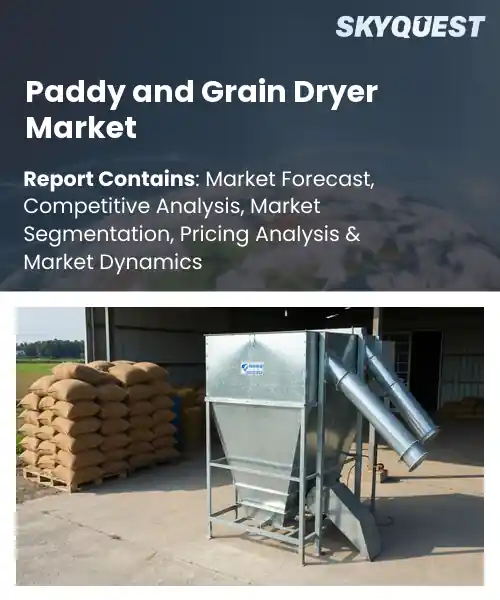
Paddy and Grain Dryer Market
Report ID: SQMIG20H2115
Report ID: SQMIG20H2115
[email protected]
USA +1 351-333-4748
Report ID:
SQMIG20H2115 |
Region:
Global |
Published Date: July, 2026
Pages:
157
|Tables:
146
|Figures:
78


Global Paddy And Grain Dryer Market size was valued at USD 1.94 Billion in 2024 and is poised to grow from USD 2.05 Billion in 2025 to USD 3.22 Billion by 2033, growing at a CAGR of 5.8% during the forecast period (2026-2033).
The global paddy and grain dryer market encompasses equipment and services that reduce moisture content in harvested rice, wheat, maize and other cereals to safe storage levels. Its relevance stems from the need to prevent spoilage, mycotoxin formation and post‑harvest losses that can exceed 30 % in humid regions. Historically the market was dominated by simple batch dryers; however, the introduction of high‑efficiency convective and solar‑assisted systems in the early 2000s accelerated adoption in Southeast Asia and South America. Rising farm incomes and government incentives for food‑security have since converted dryer procurement from a cost‑center to a revenue‑protecting investment for growers. Energy efficiency and automation represent the next pivotal driver, because lower operating costs directly improve farm profitability while reducing carbon footprints. Modern dryers equipped with variable‑frequency drives and IoT sensors can adjust temperature and airflow in real time, cutting electricity consumption by up to 35 % compared with legacy units. This capability encourages producers in India and Brazil to replace old equipment, creating a surge in demand for retrofitting services and smart‑control software. Consequently, manufacturers that bundle hardware with data‑analytics platforms gain access to recurring revenue streams, while policymakers promote subsidies that accelerate diffusion of these greener solutions across emerging markets.
How is AI-driven automation improving efficiency in the paddy and grain dryer market?
AI‑driven automation is reshaping the paddy and grain dryer market by turning traditional batch processes into intelligent operations. Sensors now capture moisture levels, temperature and airflow in real time, feeding data to machine‑learning models that predict the optimal drying curve for each load. The system automatically adjusts heat and fan speed, reducing energy waste and shortening drying cycles. Operators can monitor performance from a mobile dashboard, freeing labor for other tasks and lowering the risk of human error. Consistent drying profiles also protect grain quality, leading to higher market value and fewer post‑harvest losses. These capabilities are becoming standard as growers seek faster, greener and more reliable solutions.In June 2024, a leading equipment maker introduced an AI‑controlled batch dryer that fine‑tunes temperature in real time, cutting drying time and boosting throughput while conserving energy.
Market snapshot - (2026-2033)
Global Market Size
USD 1.94 Billion
Largest Segment
Batch Dryers
Fastest Growth
Continuous Flow Dryers
Growth Rate
5.8% CAGR
To get more insights on this market click here to Request a Free Sample Report
Global paddy and grain dryer market is segmented by dryer type, heat source, application, capacity, end user and region. Based on dryer type, the market is segmented into Batch Dryers, Continuous Flow Dryers and Recirculating Batch Dryers. Based on heat source, the market is segmented into Biomass, Diesel, LPG/Natural Gas and Electric. Based on application, the market is segmented into Paddy, Wheat, Maize and Other Grains. Based on capacity, the market is segmented into Small Capacity, Medium Capacity and Large Capacity. Based on end user, the market is segmented into Farms, Grain Processing Facilities and Cooperatives. Based on region, the market is segmented into North America, Europe, Asia Pacific, Latin America and Middle East & Africa.
Continuous flow dryer segment dominates because it provides uninterrupted processing, reducing moisture variance and labor intensity. Its ability to handle large volumes continuously aligns with the scale of modern grain handling, delivering consistent product quality while minimizing downtime. Operators favor this technology for its throughput advantage and lower operational complexity, which drives its market leadership. The continuous flow design also integrates well with automated handling systems, enhancing overall plant efficiency and supporting higher production targets.
However, biomass heat source segment is witnessing the strongest growth momentum because renewable incentives and lower fuel costs encourage growers to adopt cleaner drying solutions. Improved combustion efficiency makes biomass attractive for medium scale operations, expanding market reach and generating new opportunities for eco friendly drying.
Paddy application segment dominates because the moisture content of harvested rice requires precise drying to prevent spoilage and maintain grain quality. The high sensitivity of paddy to moisture loss drives demand for specialized dryers that can control temperature and airflow, ensuring consistent output and protecting farmer profitability, cementing its market leadership. These dryers often incorporate advanced sensors and automated controls, which further enhance reliability and reduce labor requirements, making them indispensable for rice producers seeking efficiency and product integrity.
Meanwhile, maize application segment is emerging as the key high growth area because expanding corn production and increasing demand for feed and biofuel are driving the need for efficient drying solutions. Innovations in dryer design tailored to maize kernels improve energy use and throughput, attracting processors and encouraging broader market adoption.
To get detailed segments analysis, Request a Free Sample Report
Asia Pacific dominates due to a combination of extensive rice cultivation, advanced manufacturing capabilities, and strong governmental support for agricultural modernization. The region’s diverse climates create a persistent need for efficient drying solutions that preserve grain quality and reduce post‑harvest losses. Leading equipment producers leverage cutting‑edge sensor technology and automation to meet the high throughput demands of large‑scale farms. Collaborative ecosystems linking research institutes, agribusinesses, and policy makers accelerate innovation, while export‑driven markets reinforce the region’s position as a hub for both production and technology leadership.
Japan Paddy and Grain Dryer Market
Paddy and Grain Dryer Market in Japan benefits from a highly mechanized agricultural sector that emphasizes efficiency and product quality. Strong research institutions drive continuous innovation in drying technology, while government policies encourage adoption of energy‑saving equipment. The country’s focus on export‑oriented rice varieties creates demand for reliable post‑harvest solutions. Collaborative networks between equipment manufacturers and large‑scale growers further reinforce market depth and resilience. Through strategic partnerships and training programs.
South Korea Paddy and Grain Dryer Market
Paddy and Grain Dryer Market in South Korea is propelled by a robust focus on high‑value rice production and advanced post‑harvest handling. Government incentives prioritize modern drying solutions that reduce losses and improve grain quality. Domestic manufacturers leverage cutting‑edge sensor technology to deliver precise moisture control, while strong export demand for Korean rice varieties sustains continuous equipment upgrades. Industry clusters foster collaboration between research institutes and agribusinesses, enhancing overall market dynamism.
Europe’s rapid expansion is driven by stringent food safety regulations, a strong emphasis on sustainability, and increasing consumer demand for high‑quality grain products. Policies promoting energy efficiency and carbon reduction incentivize the adoption of modern drying systems equipped with digital monitoring and automation. Collaborative research across the continent accelerates the development of low‑emission technologies, while well‑established supply chains support swift market penetration. The region’s diverse agricultural landscape encourages tailored solutions, positioning Europe as a leader in innovative, environmentally responsible drying practices.
Germany Paddy and Grain Dryer Market
Paddy and Grain Dryer Market in Germany is anchored by a strong engineering tradition and a commitment to sustainable agriculture. Precision drying equipment is widely adopted to meet stringent quality standards for both domestic consumption and export. Federal programs support energy‑efficient technologies, encouraging manufacturers to integrate digital monitoring and automation. Close cooperation between research universities and equipment producers drives continuous improvement, reinforcing Germany leadership in the sector. For global markets.
United Kingdom Paddy and Grain Dryer Market
Paddy and Grain Dryer Market in the United Kingdom is experiencing rapid adoption driven by heightened focus on food security and climate‑responsive farming practices. Incentive schemes promote low‑carbon drying solutions, prompting growers to replace older equipment with smart, energy‑efficient models. Collaborative research initiatives between universities and agritech firms accelerate the development of sensor‑based control systems. Market participants benefit from a supportive regulatory environment that encourages innovation and export significant potential.
France Paddy and Grain Dryer Market
Paddy and Grain Dryer Market is emerging as growers adopt modern drying technologies to enhance grain quality and reduce post‑harvest losses. National agricultural policies emphasize sustainability, encouraging the shift toward energy‑saving dryers with integrated monitoring. Partnerships between regional cooperatives and equipment manufacturers facilitate knowledge transfer and customized solutions for diverse cropping systems. Growing consumer demand for premium grain products further motivates investment in advanced drying infrastructure across the country.
North America strengthens its position through large‑scale grain production, a culture of technological adoption, and supportive research initiatives that drive efficiency improvements. Federal and regional programs fund the development of high‑performance dryers that incorporate real‑time data analytics and low‑emission designs. Major agribusinesses invest in scalable solutions to meet both domestic consumption and export standards, fostering a competitive environment for equipment manufacturers. Integrated networks of universities, extension services, and industry groups accelerate knowledge sharing, ensuring that innovative drying practices are rapidly disseminated across diverse farming regions.
United States Paddy and Grain Dryer Market
United States Paddy and Grain Dryer Market is reinforced by extensive grain production zones and a culture of technological adoption. Federal research programs support the development of high‑efficiency dryers that integrate IoT connectivity for real‑time moisture management. Large agribusinesses invest in scalable drying solutions to meet both domestic demand and export standards. Collaborative networks among equipment suppliers, universities, and extension services accelerate best‑practice dissemination across diverse farming regions and innovation.
Canada Paddy and Grain Dryer Market
Canada Paddy and Grain Dryer Market benefits from a climate that demands efficient post‑harvest drying across vast wheat and barley regions. Government incentives promote the adoption of low‑emission drying equipment, encouraging manufacturers to embed advanced control algorithms. Strong collaboration between agricultural colleges and equipment firms drives research on energy‑optimized processes. The emphasis on sustainability and export quality positions Canada as a proactive participant in the global drying technology landscape today.
To know more about the market opportunities by region and country, click here to
Buy The Complete Report
Increasing Demand for Processed Grains
Energy Efficient Dryer Technologies Emerging
High Initial Capital Expenditure
Limited Technical Expertise in Rural Areas
Request Free Customization of this report to help us to meet your business objectives.
The competitive landscape in the paddy and grain dryer market is shaped by manufacturers accelerating technology adoption and forming strategic alliances to meet rising efficiency demands. Companies are pursuing M&A to broaden product portfolios, while partnerships with agribusiness firms enable integrated drying solutions. Recent tech innovation includes the rollout of IoT‑enabled dryer controls, enhancing real‑time monitoring and energy optimization across the sector.
Top Player’s Company Profile
Recent Developments
SkyQuest’s ABIRAW (Advanced Business Intelligence, Research & Analysis Wing) is our Business Information Services team that Collects, Collates, Correlates, and Analyses the Data collected by means of Primary Exploratory Research backed by robust Secondary Desk research. As per SkyQuest analysis the global paddy and grain dryer market is being propelled primarily by rising demand for processed grains, which pushes growers to adopt drying equipment that secures quality and reduces post‑harvest loss. A second strong catalyst is the rollout of energy‑efficient technologies such as variable‑speed fans and heat‑recovery systems that lower operating costs and meet sustainability goals. The market is led by Asia Pacific, where extensive rice cultivation and supportive policies drive adoption, and the continuous‑flow dryer segment holds the largest share because it offers uninterrupted processing and higher throughput. However, high upfront capital costs remain a significant restraint, especially for small‑holder farmers.
| Report Metric | Details |
|---|---|
| Market size value in 2024 | USD 1.94 Billion |
| Market size value in 2033 | USD 3.22 Billion |
| Growth Rate | 5.8% |
| Base year | 2024 |
| Forecast period | (2026-2033) |
| Forecast Unit (Value) | USD Billion |
| Segments covered |
|
| Regions covered | North America (US, Canada), Europe (Germany, France, United Kingdom, Italy, Spain, Rest of Europe), Asia Pacific (China, India, Japan, Rest of Asia-Pacific), Latin America (Brazil, Rest of Latin America), Middle East & Africa (South Africa, GCC Countries, Rest of MEA) |
| Companies covered |
|
| Customization scope | Free report customization with purchase. Customization includes:-
|
To get a free trial access to our platform which is a one stop solution for all your data requirements for quicker decision making. This platform allows you to compare markets, competitors who are prominent in the market, and mega trends that are influencing the dynamics in the market. Also, get access to detailed SkyQuest exclusive matrix.
Table Of Content
Executive Summary
Market overview
Parent Market Analysis
Market overview
Market size
KEY MARKET INSIGHTS
COVID IMPACT
MARKET DYNAMICS & OUTLOOK
Market Size by Region
KEY COMPANY PROFILES
Methodology
For the Paddy and Grain Dryer Market, our research methodology involved a mixture of primary and secondary data sources. Key steps involved in the research process are listed below:
1. Information Procurement: This stage involved the procurement of Market data or related information via primary and secondary sources. The various secondary sources used included various company websites, annual reports, trade databases, and paid databases such as Hoover's, Bloomberg Business, Factiva, and Avention. Our team did 45 primary interactions Globally which included several stakeholders such as manufacturers, customers, key opinion leaders, etc. Overall, information procurement was one of the most extensive stages in our research process.
2. Information Analysis: This step involved triangulation of data through bottom-up and top-down approaches to estimate and validate the total size and future estimate of the Paddy and Grain Dryer Market.
3. Report Formulation: The final step entailed the placement of data points in appropriate Market spaces in an attempt to deduce viable conclusions.
4. Validation & Publishing: Validation is the most important step in the process. Validation & re-validation via an intricately designed process helped us finalize data points to be used for final calculations. The final Market estimates and forecasts were then aligned and sent to our panel of industry experts for validation of data. Once the validation was done the report was sent to our Quality Assurance team to ensure adherence to style guides, consistency & design.
Analyst Support
Customization Options
With the given market data, our dedicated team of analysts can offer you the following customization options are available for the Paddy and Grain Dryer Market:
Product Analysis: Product matrix, which offers a detailed comparison of the product portfolio of companies.
Regional Analysis: Further analysis of the Paddy and Grain Dryer Market for additional countries.
Competitive Analysis: Detailed analysis and profiling of additional Market players & comparative analysis of competitive products.
Go to Market Strategy: Find the high-growth channels to invest your marketing efforts and increase your customer base.
Innovation Mapping: Identify racial solutions and innovation, connected to deep ecosystems of innovators, start-ups, academics, and strategic partners.
Category Intelligence: Customized intelligence that is relevant to their supply Markets will enable them to make smarter sourcing decisions and improve their category management.
Public Company Transcript Analysis: To improve the investment performance by generating new alpha and making better-informed decisions.
Social Media Listening: To analyze the conversations and trends happening not just around your brand, but around your industry as a whole, and use those insights to make better Marketing decisions.
REQUEST FOR SAMPLE
 REQUEST FREE CUSTOMIZATION


Want to customize this report? This report can be personalized according to your needs. Our analysts and industry experts will work directly with you to understand your requirements and provide you with customized data in a short amount of time. We offer $1000 worth of FREE customization at the time of purchase.
Feedback From Our Clients


 USA (+1) 351-333-4748

