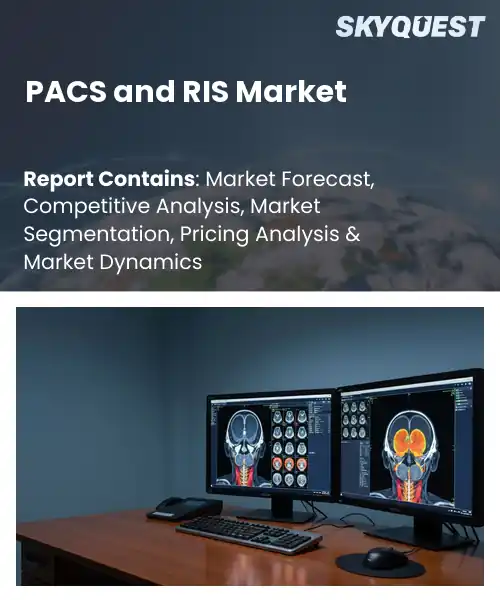
PACS and RIS Market
Report ID: SQMIG35G2506
Report ID: SQMIG35G2506
[email protected]
USA +1 351-333-4748
Report ID:
SQMIG35G2506 |
Region:
Global |
Published Date: July, 2026
Pages:
157
|Tables:
147
|Figures:
78


Global Pacs And Ris Market size was valued at USD 2.45 Billion in 2024 and is poised to grow from USD 2.63 Billion in 2025 to USD 4.57 Billion by 2033, growing at a CAGR of 7.18% during the forecast period (2026-2033).
Building on the efficiency gains from digital imaging, the decisive factor shaping the global PACS and RIS market is the integration of AI analytics that turn stored images into actionable insights. AI modules embedded in PACS can flag abnormal findings, prioritize urgent cases, and suggest reports, which in turn shortens turnaround times and improves patient outcomes. Hospitals that have deployed AI‑enhanced PACS report up to a 20 % reduction in radiologist workload and faster stroke‑code activation. This boost fuels demand for cloud‑based platforms that support AI workloads, especially in emerging economies where PACS solutions enable remote diagnostics and expand market reach.
How is AI-driven automation influencing the PACS and RIS market adoption rates?
AI driven automation is reshaping how radiology departments manage imaging data. It streamlines the capture, storage and retrieval processes in PACS while linking directly to RIS for scheduling and reporting. By using algorithms that prioritize studies, suggest protocols and flag abnormalities, hospitals reduce manual handling and accelerate diagnosis. The current market sees vendors embedding AI modules into existing platforms, allowing seamless upgrades without replacing legacy hardware. Early adopters report smoother workflow, faster turnaround and better resource allocation. This momentum is encouraging more institutions to transition from manual archives to intelligent, cloud enabled solutions, driving broader market uptake.Siemens Healthineers February 2024, introduced an AI powered imaging workflow that automatically routes studies from PACS to RIS and generates preliminary findings. The tool cuts routine tasks, frees radiologists for complex cases and showcases how AI driven automation can accelerate adoption by delivering measurable efficiency gains.
Market snapshot - (2026-2033)
Global Market Size
USD 2.45 Billion
Largest Segment
Picture Archiving and Communication Systems
Fastest Growth
Radiology Information Systems
Growth Rate
7.18% CAGR
To get more insights on this market click here to Request a Free Sample Report
Global pacs and ris market is segmented by product type, component, deployment mode, medical specialty application, end user and region. Based on product type, the market is segmented into Picture Archiving and Communication Systems and Radiology Information Systems. Based on component, the market is segmented into Hardware, Software and Services. Based on deployment mode, the market is segmented into Web-Based, Cloud-Based and On-Premises. Based on medical specialty application, the market is segmented into Cardiology, Orthopedics, Dental, Oncology and General Radiology. Based on end user, the market is segmented into Hospitals, Diagnostic Centers, Research Institutes, Academic Institutes and Ambulatory Surgical Centers. Based on region, the market is segmented into North America, Europe, Asia Pacific, Latin America and Middle East & Africa.
Picture Archiving and Communication Systems segment dominates because it centralizes image storage, retrieval, and distribution, eliminating archives and streamlining radiology workflows. By integrating with imaging modalities, it reduces manual handling, shortens diagnosis time, and enhances collaboration among clinicians. The ability to support multimodal imaging and provide secure, scalable access drives widespread adoption across facilities, positioning it as the foundational technology that underpins efficient data management and patient care within the PACS and RIS Market.
However, Radiology Information Systems segment is witnessing the strongest growth momentum as hospitals seek integrated workflow solutions that combine scheduling, reporting, and billing. Advances in interoperability and AI driven analytics are expanding its role, prompting facilities to upgrade legacy platforms and creating fresh opportunities for vendors to capture emerging demand.
On Premises segment dominates because many institutions prioritize direct control over sensitive imaging data, opting for internal servers that meet strict compliance standards. This approach ensures predictable performance, simplifies integration with legacy systems, and offers customized security configurations. The perceived assurance of localized storage sustains strong demand, especially among large hospitals that require rigorous governance and reliable uptime for critical diagnostic operations within the PACS and RIS Market.
Meanwhile, Cloud based segment is emerging as the key high growth area as providers adopt subscription driven models that lower capital spend. Seamless remote access, automatic updates and scalable infrastructure attract midsize facilities and diagnostic centers, speeding adoption and prompting vendors to broaden service portfolios. This momentum expands market and creates space for innovative analytics and collaborative care solutions.
To get detailed segments analysis, Request a Free Sample Report
North America enjoys a confluence of advanced healthcare delivery models and a deep pool of technology expertise that fuels dominance in the PACS and RIS arena. The region benefits from extensive integration of digital imaging into clinical workflows, supported by sophisticated hospital information systems and strong interoperability standards. Robust reimbursement frameworks encourage investment in cutting‑edge solutions, while a culture of innovation drives continuous improvement and early adoption of artificial intelligence enhancements. Leading technology firms maintain strategic research and development centers, fostering close collaboration with major health systems. Regulatory bodies promote standards that ensure data security and patient privacy, reinforcing confidence among providers. This combination of mature infrastructure, financial incentives, and a proactive regulatory environment sustains a leadership position that shapes global market dynamics.
United States PACS and RIS Market
PACS and RIS Market in the United States is characterized by a highly mature ecosystem where large health networks and academic centers drive sophisticated imaging workflows. Vendor collaborations focus on seamless integration with electronic health records and the incorporation of advanced analytics to improve diagnostic efficiency. Emphasis on patient‑centric solutions and value‑based care models encourages continuous refinement of system scalability and user experience. Strong academic research contributions propel innovations that quickly transition from prototype to clinical deployment, reinforcing market depth and breadth.
Canada PACS and RIS Market
PACS and RIS Market in Canada reflects a balanced approach that blends public health priorities with emerging technology adoption. Health authorities prioritize interoperable platforms that support collaborative care across provincial boundaries, fostering consistent imaging standards. Emphasis on cost‑effective solutions drives interest in cloud‑based architectures and shared services that optimize resource utilization. Partnerships between clinical institutions and technology providers focus on enhancing diagnostic speed while maintaining rigorous data governance, aligning with national health objectives and patient safety mandates.
Europe’s expansion is propelled by a harmonized regulatory landscape that encourages cross‑border collaboration and standard adoption across member states. Strong governmental commitment to digital health transformation underpins investment in modern imaging infrastructure, while funding mechanisms support research into artificial intelligence and predictive analytics. Health systems increasingly value integrated workflows that connect imaging data with broader clinical information, enhancing diagnostic accuracy and patient pathways. Collaborative networks among hospitals, research institutions, and technology firms accelerate knowledge sharing and promote interoperability. Moreover, a focus on patient outcomes and efficiency drives adoption of scalable solutions that can be tailored to diverse market needs, positioning Europe as a hub of progressive imaging technology deployment.
Germany PACS and RIS Market
PACS and RIS Market in Germany benefits from a robust healthcare framework that emphasizes precision and efficiency. Leading hospitals integrate advanced imaging platforms with extensive laboratory and pathology systems, fostering comprehensive diagnostic ecosystems. Continuous investment in research institutions nurtures innovation, particularly in AI‑enabled image analysis, which is rapidly incorporated into clinical practice. Strong emphasis on data protection and standards compliance supports trustworthy information exchange across regional networks, reinforcing market confidence and sustained growth.
United Kingdom PACS and RIS Market
PACS and RIS Market in the United Kingdom is marked by swift adoption driven by national health service initiatives aimed at digital transformation. Emphasis on interoperability ensures that imaging data seamlessly flows between primary, secondary, and tertiary care settings, enhancing care coordination. Collaborative projects between academic centers and industry accelerate the rollout of AI‑augmented diagnostic tools, improving workflow efficiency. Policy focus on patient‑centred services encourages the development of user‑friendly interfaces and remote access capabilities, positioning the United Kingdom as a leading growth engine within the European landscape.
France PACS and RIS Market
PACS and RIS Market in France reflects an emerging trajectory supported by strategic health reforms that prioritize modernization of imaging services. Public and private providers alike explore cloud‑based solutions to address scalability and cost constraints, while fostering collaborative research into machine learning applications. Commitment to standardization facilitates smoother data exchange across hospitals and specialty clinics, enhancing diagnostic continuity. The growing emphasis on outpatient imaging and tele‑radiology creates demand for adaptable platforms that support flexible service delivery models.
Asia Pacific is advancing its role through a combination of expanding healthcare infrastructure and proactive governmental policies that champion digital health. Nations across the region are investing heavily in modernizing hospital networks, with a particular focus on integrating imaging solutions that support burgeoning outpatient services. Cultural emphasis on technological adoption fuels interest in AI‑driven image interpretation and real‑time analytics, enhancing diagnostic confidence. Collaborative partnerships between local technology firms and global vendors accelerate knowledge transfer and tailor solutions to regional clinical needs. Concurrently, rising chronic disease prevalence and an aging demographic increase demand for efficient imaging workflows, prompting health systems to adopt scalable, interoperable platforms that improve patient outcomes and operational agility.
Japan PACS and RIS Market
PACS and RIS Market in Japan is distinguished by a sophisticated approach that blends precision medicine with high‑technology integration. Leading medical centers adopt comprehensive imaging suites that interface tightly with electronic health records, supporting seamless data flow across specialties. Strong emphasis on research collaboration drives the incorporation of cutting‑edge AI algorithms for image analysis, enhancing diagnostic speed and accuracy. Commitment to stringent data security standards ensures robust patient confidentiality while fostering trust in digital imaging solutions throughout the healthcare continuum.
South Korea PACS and RIS Market
PACS and RIS Market in South Korea is characterized by rapid digital adoption supported by forward‑looking health policies and a vibrant tech ecosystem. Health institutions prioritize cloud‑enabled platforms that provide flexible access to imaging data, facilitating tele‑radiology and remote consultation services. Close cooperation between medical centers and innovative startups accelerates the deployment of AI‑based diagnostic tools, improving workflow efficiency. Emphasis on interoperability and standardized protocols enables smooth integration across a diverse range of clinical settings, reinforcing South Korea’s emerging leadership in advanced imaging solutions.
To know more about the market opportunities by region and country, click here to
Buy The Complete Report
Increasing Demand For Digital Imaging
Adoption Of Cloud Based Solutions
High Initial Capital Investment
Regulatory Compliance Complexity
Request Free Customization of this report to help us to meet your business objectives.
The competitive landscape of the global PACS and RIS market is shaped by intense rivalry among established imaging vendors and emerging technology firms, driving rapid adoption of cloud‑based platforms, AI‑enhanced image analysis, and integrated workflow solutions. Recent M&A activity, such as a leading radiology software provider acquiring a cloud‑PACS specialist, and strategic partnerships linking RIS systems with electronic health record platforms, illustrate how companies are leveraging consolidation and collaboration to expand functionality, improve interoperability, and capture market share.
Top Player’s Company Profile
Recent Developments
SkyQuest’s ABIRAW (Advanced Business Intelligence, Research & Analysis Wing) is our Business Information Services team that Collects, Collates, Correlates, and Analyses the Data collected by means of Primary Exploratory Research backed by robust Secondary Desk research. As per SkyQuest analysis the global PACS and RIS market is propelled primarily by the rising demand for digital imaging, which drives hospitals to adopt comprehensive image management solutions, while the high initial capital investment remains a notable restraint limiting uptake in smaller facilities. Cloud‑based deployments serve as a second driver, offering scalable, cost‑effective platforms that enhance remote access and AI integration. North America continues to dominate the market thanks to its mature healthcare infrastructure and strong reimbursement models, and the Picture Archiving and Communication Systems segment leads in workflow efficiency, cementing its position as the core technology underpinning radiology operations.
| Report Metric | Details |
|---|---|
| Market size value in 2024 | USD 2.45 Billion |
| Market size value in 2033 | USD 4.57 Billion |
| Growth Rate | 7.18% |
| Base year | 2024 |
| Forecast period | (2026-2033) |
| Forecast Unit (Value) | USD Billion |
| Segments covered |
|
| Regions covered | North America (US, Canada), Europe (Germany, France, United Kingdom, Italy, Spain, Rest of Europe), Asia Pacific (China, India, Japan, Rest of Asia-Pacific), Latin America (Brazil, Rest of Latin America), Middle East & Africa (South Africa, GCC Countries, Rest of MEA) |
| Companies covered |
|
| Customization scope | Free report customization with purchase. Customization includes:-
|
To get a free trial access to our platform which is a one stop solution for all your data requirements for quicker decision making. This platform allows you to compare markets, competitors who are prominent in the market, and mega trends that are influencing the dynamics in the market. Also, get access to detailed SkyQuest exclusive matrix.
Table Of Content
Executive Summary
Market overview
Parent Market Analysis
Market overview
Market size
KEY MARKET INSIGHTS
COVID IMPACT
MARKET DYNAMICS & OUTLOOK
Market Size by Region
KEY COMPANY PROFILES
Methodology
For the PACS and RIS Market, our research methodology involved a mixture of primary and secondary data sources. Key steps involved in the research process are listed below:
1. Information Procurement: This stage involved the procurement of Market data or related information via primary and secondary sources. The various secondary sources used included various company websites, annual reports, trade databases, and paid databases such as Hoover's, Bloomberg Business, Factiva, and Avention. Our team did 45 primary interactions Globally which included several stakeholders such as manufacturers, customers, key opinion leaders, etc. Overall, information procurement was one of the most extensive stages in our research process.
2. Information Analysis: This step involved triangulation of data through bottom-up and top-down approaches to estimate and validate the total size and future estimate of the PACS and RIS Market.
3. Report Formulation: The final step entailed the placement of data points in appropriate Market spaces in an attempt to deduce viable conclusions.
4. Validation & Publishing: Validation is the most important step in the process. Validation & re-validation via an intricately designed process helped us finalize data points to be used for final calculations. The final Market estimates and forecasts were then aligned and sent to our panel of industry experts for validation of data. Once the validation was done the report was sent to our Quality Assurance team to ensure adherence to style guides, consistency & design.
Analyst Support
Customization Options
With the given market data, our dedicated team of analysts can offer you the following customization options are available for the PACS and RIS Market:
Product Analysis: Product matrix, which offers a detailed comparison of the product portfolio of companies.
Regional Analysis: Further analysis of the PACS and RIS Market for additional countries.
Competitive Analysis: Detailed analysis and profiling of additional Market players & comparative analysis of competitive products.
Go to Market Strategy: Find the high-growth channels to invest your marketing efforts and increase your customer base.
Innovation Mapping: Identify racial solutions and innovation, connected to deep ecosystems of innovators, start-ups, academics, and strategic partners.
Category Intelligence: Customized intelligence that is relevant to their supply Markets will enable them to make smarter sourcing decisions and improve their category management.
Public Company Transcript Analysis: To improve the investment performance by generating new alpha and making better-informed decisions.
Social Media Listening: To analyze the conversations and trends happening not just around your brand, but around your industry as a whole, and use those insights to make better Marketing decisions.
REQUEST FOR SAMPLE
 REQUEST FREE CUSTOMIZATION


Want to customize this report? This report can be personalized according to your needs. Our analysts and industry experts will work directly with you to understand your requirements and provide you with customized data in a short amount of time. We offer $1000 worth of FREE customization at the time of purchase.
Feedback From Our Clients


 USA (+1) 351-333-4748

