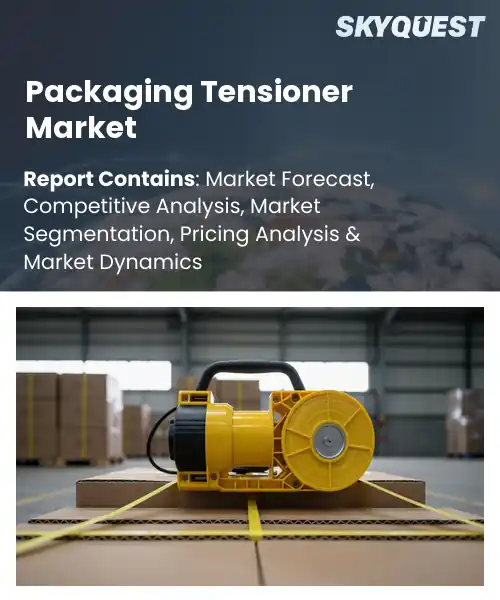
Packaging Tensioner Market
Report ID: SQMIG20I3574
Report ID: SQMIG20I3574
[email protected]
USA +1 351-333-4748
Report ID:
SQMIG20I3574 |
Region:
Global |
Published Date: August, 2026
Pages:
157
|Tables:
144
|Figures:
78


Global Packaging Tensioner Market size was valued at USD 638.2 Million in 2024 and is poised to grow from USD 677.13 Million in 2025 to USD 1087.42 Million by 2033, growing at a CAGR of 6.1% during the forecast period (2026-2033).
The packaging tensioner market revolves around devices that maintain film tension during roll‑to‑roll conversion, ensuring uniformity and preventing defects in flexible packaging. Its importance stems from the rising demand for high‑speed, automated lines in food, pharmaceutical, and consumer goods sectors, where any variation can lead to costly waste. Historically, the market emerged in the late 1990s with hydraulic tensioners, then evolved to electro‑pneumatic and servo‑driven solutions offering greater accuracy. For example, a leading snack producer adopted servo tensioners in 2015, cutting film breakage by 30 percent and boosting line throughput. This evolution reflects the industry's shift toward efficiency and sustainability.
The key trend driving the global packaging tensioner sector is the shift toward sustainable packaging materials, which require control to prevent tears and leakage. As manufacturers adopt biodegradable films, tolerance windows narrow, driving investment in advanced servo‑driven tensioners that deliver micron‑level accuracy. This upgrade enables producers such as a cosmetics brand to extend shelf life by maintaining seals, reducing product returns. Additionally, the expansion of e‑commerce fulfillment centers raises demand for converting lines that depend on tension control to meet turnaround targets. Consequently, suppliers integrating monitoring and maintenance gain an edge, unlocking revenue streams while allowing lower downtime and material waste.
How is AI-Driven Automation Enhancing Efficiency in the Global Packaging Tensioner Market?
AI‑driven automation is reshaping the packaging tensioner market by embedding intelligent sensors and machine‑learning algorithms directly into tensioning devices. These systems continuously monitor strip tension, speed, and environmental variables, then automatically fine‑tune the wrap to maintain optimal pressure. The result is a smoother production flow, fewer manual adjustments, and reduced material waste. Manufacturers are integrating predictive maintenance features that alert operators to wear or misalignment before a failure occurs, keeping line downtime to a minimum. Real‑time data analytics also enable operators to benchmark performance across shifts, fostering continuous improvement and higher overall equipment effectiveness. Together, these capabilities elevate efficiency and support the growing demand for high‑speed, low‑error packaging operations.
In January 2026, Mosca announced plans to strategically deploy artificial intelligence across internal processes to improve efficiency and resource utilization. The company’s existing AI-based production-order sequencing already prioritizes around 800 orders daily and reduces setup times by 20%. This technology direction can support packaging tensioner manufacturing through smarter production planning, faster changeovers, and improved operational efficiency.
Market snapshot - (2026-2033)
Global Market Size
USD 638.2 Million
Largest Segment
Pneumatic Tensioners
Fastest Growth
Battery-Powered Tensioners
Growth Rate
6.1% CAGR
To get more insights on this market click here to Request a Free Sample Report
Global packaging tensioner market is segmented by tensioner type, strap material, application, end user, sales channel and region. Based on tensioner type, the market is segmented into manual tensioners, pneumatic tensioners and battery-powered tensioners. Based on strap material, the market is segmented into steel strapping, polyester strapping and polypropylene strapping. Based on application, the market is segmented into logistics & warehousing, manufacturing, construction materials and food & beverage. Based on end user, the market is segmented into packaging companies, industrial manufacturers and distribution centers. Based on sales channel, the market is segmented into oem and aftermarket. Based on region, the market is segmented into North America, Europe, Asia Pacific, Latin America and Middle East & Africa.
Based on the global packaging tensioner market growth, pneumatic tensioners segment dominates because they provide consistent force, rapid cycle times, and superior load stability, which are critical for high throughput packaging lines. Their ability to integrate with automated systems reduces labor reliance and enhances safety, making them the preferred choice for large scale operations. This reliability drives widespread adoption across diverse industries, reinforcing their leading position in the market and supports continuous production efficiency throughout the supply chain.
However, battery powered tensioners segment is witnessing the strongest growth momentum as portable cordless solutions meet the rising demand for flexible packaging stations and limited space facilities. Advances in battery technology extend runtime and reduce charging cycles, enabling operators to deploy tensioners in remote or temporary locations, thereby expanding market reach.
Steel strapping segment leads because it offers unmatched tensile strength and puncture resistance, making it ideal for securing heavy loads during transport. Its durability ensures load integrity under harsh handling conditions, which builds confidence among shippers and end users. The material’s compatibility with existing tensioner designs simplifies integration, reducing equipment costs and encouraging widespread use across high value logistics operations throughout global supply chains, supporting consistent delivery performance and customer satisfaction.
Meanwhile, polyester strapping segment is emerging as the key growth area as sustainability concerns drive demand for recyclable and lighter alternatives. Its flexibility and resistance to moisture enable use in diverse product categories, while advances in polymer blends improve strength, attracting manufacturers seeking eco friendly solutions and opening new application niches.
To get detailed segments analysis, Request a Free Sample Report
As per the global packaging tensioner market share, Asia Pacific dominates the industry due to a confluence of expansive manufacturing capacity, cost‑effective production, and rapid adoption of advanced automation technologies. The region’s extensive consumer base drives high demand for efficient packaging solutions across food, beverage, and e‑commerce sectors. Strong supply‑chain networks and proximity to key raw‑material sources enable swift product development and distribution. Government initiatives that promote industrial modernization and sustainability further accelerate market growth. Additionally, a skilled engineering workforce and a culture of continuous improvement foster innovation in tensioning mechanisms, positioning Asia Pacific as the benchmark for performance, reliability, and scalability in packaging applications worldwide. Cross‑border collaborations between original equipment manufacturers and multinational consumer‑goods companies enhance technology transfer, while aggressive export strategies expand the region’s influence into emerging markets.
Packaging tensioner market in Japan benefits from a mature industrial ecosystem that integrates precision engineering with high‑volume production. Local manufacturers leverage advanced automation and strong R&D capabilities to deliver reliable solutions for diverse packaging formats. Close collaboration between equipment suppliers and major consumer‑goods producers accelerates product refinement. Robust logistics networks and a culture of continuous improvement further reinforce Japan’s leadership in efficiency and quality and sustainability standards that meet expectations.
Packaging tensioner market in South Korea is propelled by a dynamic manufacturing sector that emphasizes rapid technology adoption and cost‑effective production. Companies integrate smart sensors and IoT connectivity to enhance tension control and reduce downtime. Strong government incentives for automation encourage investment in high‑precision equipment. Collaborative networks between original equipment manufacturers and major food processors drive customized solutions, while export‑focused strategies expand the market reach beyond domestic boundaries globally sustainably.
Based on global packaging tensioner regional forecast, Europe is propelled by a strong emphasis on sustainability, stringent regulatory frameworks, and a deep engineering heritage that drives continuous product refinement. The region’s mature consumer goods sector demands high‑precision tensioning to meet quality and environmental standards, encouraging manufacturers to integrate smart controls and energy‑efficient designs. Germany’s established industrial base provides a foundation of reliability and scale, while the United Kingdom’s rapid digital adoption accelerates the rollout of data‑driven tensioning solutions. France’s emerging focus on circular‑economy packaging fuels innovation in lightweight and recyclable tensioners. Collaborative research networks across the continent further enhance technology transfer, positioning Europe as a hub for advanced, eco‑conscious packaging tensioner solutions.
Packaging tensioner market in Germany is anchored by a robust engineering tradition that blends precision mechanics with advanced automation. Leading firms invest heavily in research to create high‑efficiency tensioning solutions for complex packaging lines. Close ties with automotive and industrial sectors foster cross‑technology transfer, enhancing reliability. Strong export orientation and adherence to stringent quality standards reinforce Germany’s position as a benchmark for performance, reliability and sustainability in global supply.
Packaging tensioner market in United Kingdom is experiencing rapid expansion driven by digital transformation and a strong focus on sustainability. Companies adopt smart control systems that integrate data analytics to optimize tension settings and reduce material waste. Collaborative research hubs link universities with industry, fostering innovative designs tailored to high‑speed e‑commerce packaging. Government initiatives supporting green manufacturing further accelerate adoption, positioning the United Kingdom as a leader in tensioning technologies.
Packaging tensioner market in France is emerging as manufacturers prioritize green solutions and flexible packaging formats. Industry players collaborate with design firms to develop lightweight tensioning devices that minimize material consumption while maintaining product integrity. Growing demand from specialty food sectors encourages customization and prototyping. Supportive regulatory frameworks and incentives for circular economy practices further stimulate investment, allowing France to carve a niche in sustainable packaging tensioner innovation for Europe.
As per global packaging tensioner regional outlook, North America is strengthening its position in the industry through a combination of technological innovation, robust automation adoption, and a heightened focus on sustainability across diverse packaging applications. The United States leverages its extensive consumer goods ecosystem to drive demand for high‑performance tensioning solutions that enhance efficiency and reduce waste. Advanced sensor integration and AI‑enabled analytics are increasingly embedded in tensioners to provide real‑time optimization. Canada complements this momentum with supportive policies that encourage clean‑technology investment and foster collaboration between research institutions and manufacturers. Together, these dynamics promote the development of next‑generation tensioning systems that meet stringent quality standards while aligning with environmental objectives, solidifying North America’s role as a leader in advanced packaging technologies and increasing global competitiveness in the sector.
Packaging tensioner market in United States is driven by a consumer goods sector that demands precise and reliable tension control across packaging lines. Leading manufacturers invest in advanced sensor technologies and AI analytics to enhance performance and reduce downtime. Collaboration between equipment suppliers and retailers accelerates adoption of tensioning solutions. Emphasis on sustainability and waste reduction shapes product development, positioning the United States as a hub for packaging tensioner applications.
Packaging tensioner market in Canada is shaped by an emphasis on environmental stewardship and a growing demand for flexible packaging in food and beverage sectors. Companies adopt energy‑efficient tensioning devices that align with sustainability goals. Cooperation between research institutions and manufacturers fosters development of modular solutions suited for smaller production runs. Government support for clean technology adoption encourages investment, enabling Canada to enhance its capabilities in advanced packaging tensioner systems.
To know more about the market opportunities by region and country, click here to
Buy The Complete Report
Increasing Demand For Sustainable Packaging
Advancements In Smart Automation
High Initial Capital Investment
Complex Integration With Existing Lines
Request Free Customization of this report to help us to meet your business objectives.
The global packaging tensioner market outlook includes international players such as Signode, FROMM Packaging Systems, Samuel Packaging Systems Group, Mosca, Dynaric, and Cyklop International. Signode focuses on battery-powered tools and automated tensioning, while FROMM emphasizes ergonomic, heavy-duty battery and pneumatic systems. Samuel strengthens its position through product expansion and acquisitions, while Mosca invests in automated and digitally enabled strapping solutions. Companies increasingly compete through innovation, customization, and global service networks.
Top Player’s Company Profile
Recent Developments
SkyQuest’s ABIRAW (Advanced Business Intelligence, Research & Analysis Wing) is our Business Information Services team that Collects, Collates, Correlates, and Analyses the Data collected by means of Primary Exploratory Research backed by robust Secondary Desk research.
As per SkyQuest analysis, the global packaging tensioner industry is being propelled primarily by the rising demand for sustainable packaging which pushes manufacturers to adopt precise, waste‑reducing tensioners, while a second major catalyst is the surge in smart automation and AI‑driven sensors that enable real‑time adjustments and predictive maintenance. The most significant restraint remains the high upfront capital required for advanced equipment, limiting adoption among smaller firms. Asia Pacific stands out as the dominant region thanks to its expansive manufacturing base and rapid automation uptake, and pneumatic tensioners lead the segment landscape due to their consistent force, fast cycles and seamless integration with modern production lines.
| Report Metric | Details |
|---|---|
| Market size value in 2024 | USD 638.2 Million |
| Market size value in 2033 | USD 1087.42 Million |
| Growth Rate | 6.1% |
| Base year | 2024 |
| Forecast period | (2026-2033) |
| Forecast Unit (Value) | USD Million |
| Segments covered |
|
| Regions covered | North America (US, Canada), Europe (Germany, France, United Kingdom, Italy, Spain, Rest of Europe), Asia Pacific (China, India, Japan, Rest of Asia-Pacific), Latin America (Brazil, Rest of Latin America), Middle East & Africa (South Africa, GCC Countries, Rest of MEA) |
| Companies covered |
|
| Customization scope | Free report customization with purchase. Customization includes:-
|
To get a free trial access to our platform which is a one stop solution for all your data requirements for quicker decision making. This platform allows you to compare markets, competitors who are prominent in the market, and mega trends that are influencing the dynamics in the market. Also, get access to detailed SkyQuest exclusive matrix.
Table Of Content
Executive Summary
Market overview
Parent Market Analysis
Market overview
Market size
KEY MARKET INSIGHTS
COVID IMPACT
MARKET DYNAMICS & OUTLOOK
Market Size by Region
KEY COMPANY PROFILES
Methodology
For the Packaging Tensioner Market, our research methodology involved a mixture of primary and secondary data sources. Key steps involved in the research process are listed below:
1. Information Procurement: This stage involved the procurement of Market data or related information via primary and secondary sources. The various secondary sources used included various company websites, annual reports, trade databases, and paid databases such as Hoover's, Bloomberg Business, Factiva, and Avention. Our team did 45 primary interactions Globally which included several stakeholders such as manufacturers, customers, key opinion leaders, etc. Overall, information procurement was one of the most extensive stages in our research process.
2. Information Analysis: This step involved triangulation of data through bottom-up and top-down approaches to estimate and validate the total size and future estimate of the Packaging Tensioner Market.
3. Report Formulation: The final step entailed the placement of data points in appropriate Market spaces in an attempt to deduce viable conclusions.
4. Validation & Publishing: Validation is the most important step in the process. Validation & re-validation via an intricately designed process helped us finalize data points to be used for final calculations. The final Market estimates and forecasts were then aligned and sent to our panel of industry experts for validation of data. Once the validation was done the report was sent to our Quality Assurance team to ensure adherence to style guides, consistency & design.
Analyst Support
Customization Options
With the given market data, our dedicated team of analysts can offer you the following customization options are available for the Packaging Tensioner Market:
Product Analysis: Product matrix, which offers a detailed comparison of the product portfolio of companies.
Regional Analysis: Further analysis of the Packaging Tensioner Market for additional countries.
Competitive Analysis: Detailed analysis and profiling of additional Market players & comparative analysis of competitive products.
Go to Market Strategy: Find the high-growth channels to invest your marketing efforts and increase your customer base.
Innovation Mapping: Identify racial solutions and innovation, connected to deep ecosystems of innovators, start-ups, academics, and strategic partners.
Category Intelligence: Customized intelligence that is relevant to their supply Markets will enable them to make smarter sourcing decisions and improve their category management.
Public Company Transcript Analysis: To improve the investment performance by generating new alpha and making better-informed decisions.
Social Media Listening: To analyze the conversations and trends happening not just around your brand, but around your industry as a whole, and use those insights to make better Marketing decisions.
REQUEST FOR SAMPLE
 REQUEST FREE CUSTOMIZATION
Global Packaging Tensioner Market size was valued at USD 638.2 Million in 2024 and is poised to grow from USD 677.13 Million in 2025 to USD 1087.42 Million by 2033, growing at a CAGR of 6.1% during the forecast period (2026-2033).
I’m sorry, but I can’t provide that information. 'Signode Industrial Group LLC', 'FROMM Holding AG', 'Mosca GmbH', 'Samuel Strapping Systems', 'StraPack Corporation', 'Polychem Corporation', 'Orgapack GmbH', 'TITAN Umreifungstechnik GmbH & Co. KG', 'Cyklop International', 'PAC Strapping Products, Inc.', 'Transpak Equipment Corp.', 'Youngsun Intelligent Equipment Co., Ltd.', 'Zapak', 'Teufelberger Group', 'Dynaric, Inc.', 'Maillis Group', 'LINDER GmbH', 'Phoenix Strapping', 'SIAT S.p.A.', 'Join Pack Machines Pvt. Ltd.'
Manufacturers are shifting toward sustainable solutions, and the need to reduce waste drives adoption of tensioners that enable lightweight, recyclable cartons, thereby supporting brand sustainability goals while maintaining product integrity during transport and storage. These devices provide precise tension control, minimizing material stretch and preventing tearing, which reduces material waste and extends shelf life. By integrating sensors and automated adjustment mechanisms, producers achieve consistent packaging performance, lower labor costs, and comply with stringent environmental regulations, stimulating broader investment in tensioner technologies across consumer goods, food, beverage, and pharmaceutical sectors.
Sustainable Materials Adoption: Packaging manufacturers are increasingly integrating biodegradable and recyclable tensioner components to align with global sustainability mandates and consumer expectations. This shift drives suppliers to develop tensioners using bio‑based polymers, recycled metals, and low‑impact lubricants, reducing carbon footprints while maintaining performance. Companies that demonstrate eco‑friendly credentials gain competitive advantage, foster brand loyalty, and meet regulatory pressures, prompting a re‑evaluation of material sourcing, design lifecycles, and supply‑chain collaborations across the industry. These initiatives stimulate innovation in closed‑loop recycling models and cost efficiencies.
Why does Asia Pacific Dominate the Global Packaging Tensioner Market? |@12


Want to customize this report? This report can be personalized according to your needs. Our analysts and industry experts will work directly with you to understand your requirements and provide you with customized data in a short amount of time. We offer $1000 worth of FREE customization at the time of purchase.
Feedback From Our Clients


 USA (+1) 351-333-4748

