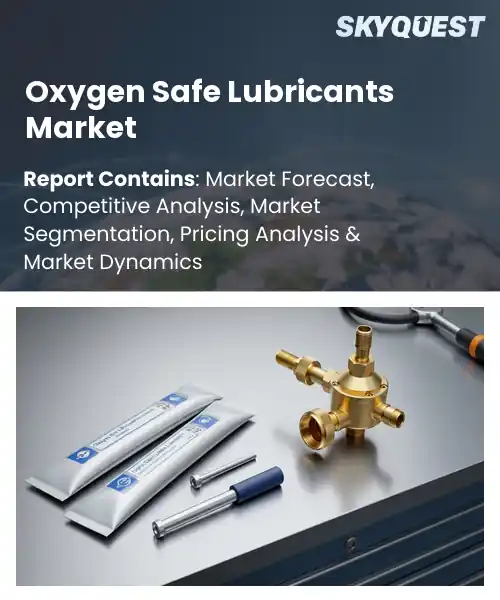
Oxygen Safe Lubricants Market
Report ID: SQMIG15E3295
Report ID: SQMIG15E3295
[email protected]
USA +1 351-333-4748
Report ID:
SQMIG15E3295 |
Region:
Global |
Published Date: February, 2026
Pages:
157
|Tables:
116
|Figures:
77


Global Oxygen Safe Lubricants Market size was valued at USD 1.2 Billion in 2024 and is poised to grow from USD 1.30 Billion in 2025 to USD 2.50 Billion by 2033, growing at a CAGR of 8.5% during the forecast period (2026-2033).
Oxygen safe lubricants market growth is driven by the critical need for ignition prevention and the reliability of oxygen systems and has increased due to the expansion of medical, aerospace, and industrial oxygen systems. Oxygen safe lubricants represent a relatively new category of specialized formulations that are designed to prevent combustion, limit outgassing, and provide performance stability when used with high partial pressures of oxygen; therefore, it is very important to have an oxygen-safe lubricant to reduce the risk of catastrophic fire and regulatory action, as one lubricant failure can result in catastrophic failure, regulatory action, or both.
The growth of the global oxygen proper lubricants industry is being driven by the growth of oxygen dependent systems; this drives the need for safe, certified low-reactivity lubricants and causes formulators to prioritize safety and performance testing. As hospitals, manufacturing plants and aerospace manufacturers are implementing more oxygen systems, the OEMs are setting high expectations for the lubricants supplied; this has resulted in an increased investment by suppliers in R&D, increased time for regulatory approval, strengthening of supplier OEM partnerships.
How is Automation Enhancing Safety and Compliance in the Oxygen-safe Lubricants Market?
In the oxygen safe lubricants market, automation is improving safety and compliance by helping to standardize selection, handling, application, and record keeping systems. Engineers have designed dispensing systems to eliminate contamination using sensors to monitor conditions and detect hot spots, as well as providing automated traceability that connects batches to quality information and production steps taken by operators. Presently, many suppliers and end-users of lubricants utilize closed systems, which minimize human contact with potentially hazardous substances and diminish the possibility of ignition. Automated dispensing, cleanroom-compatible packaging, and coordinated procedures for each step of the process help to ensure complete compliance with regulations for oxygen compatibility, thereby allowing manufacturers to provide consistency in terms of performance in sensitive applications.
Market snapshot - 2026-2033
Global Market Size
USD 0.3 Billion
Largest Segment
Oils
Fastest Growth
Greases
Growth Rate
5.5% CAGR
To get more insights on this market click here to Request a Free Sample Report
Global oxygen safe lubricants market is segmented into product type, formulation type, application, end user industry and region. Based on product type, the market is segmented into greases, oils and sprays. Based on formulation type, the market is segmented into synthetic and natural. Based on application, the market is segmented into machinery, automotive and medical devices. Based on end user industry, the market is segmented into aerospace, food processing, and healthcare. Based on region, the market is segmented into North America, Europe, Asia Pacific, Latin America and Middle East & Africa.
As per oxygen safe lubricants market outlook, the grease segment has a commanding lead because of the ability to form thick, adhesive lubricant films that give continuous separation and protection from metal-to-metal contact over short distances in oxygen-laden environments. Greases also have a low volatility, making them less likely to evaporate, and their resistance to be washed off makes them available for use with minimal disruption created by pressure and vibration that can lead to longer periods between maintenance. Furthermore, the fact that greases are compatible with seals and can withstand a broad spectrum of pressures makes them suitable for use with equipment that is required to work reliably and efficiently in industrial applications, particularly in heavy-duty and safety-critical applications where the impact of oxygen stability and persistence of the lubricant are essential. As per oxygen safe lubricants market analysis, oils have become the fastest growing product category within the oxygen safe lubricant market as a result of recent advances in formulation that have provided better performance based upon purity and less residue. Additionally, oils have been found to be easy to apply using metered lubrication systems, which has encouraged rapid acceptance of oils within precision manufacturing and regulated markets and has opened up new entry and aftermarket opportunities within this segment of the lubricant industry.
As per oxygen safe lubricants market forecast, medical devices segment dominates because stringent sterilization protocols and biocompatibility demand force manufacturers to select lubricants that remain inert and stable in oxygen rich sterilization and operational conditions. The reliability expected from implants and diagnostic instruments is also causing manufacturers to require lubricants that exhibit low levels of outgassing, limited residue, and a very specific viscosity so as not to interfere with the operation of sensors. Therefore, the need for safety has established the use of specialized oxygen safe products as the expected standard for manufacturers when designing and assembling their medical devices.
The automotive segment is experiencing the greatest growth opportunity in the oxygen safe lubricants market primarily due to the increased number of oxygen-sensitive components being integrated into vehicle platforms, and the need for vehicle lubricants to be free of contaminants to accommodate the fuel cell and emissions-control technologies now being developed. The introduction of improved lubricant chemistries that can accommodate a greater range of temperature variations, as well as more robust automated processes for the application of lubricants during not only the assembly process, but during maintenance will help drive new opportunities for OEMs and in the aftermarket of the automotive industry.
To get detailed segments analysis, Request a Free Sample Report
As per oxygen safe lubricants market regional outlook, North America has a unique combination of developed industries, safety focus, and suppliers that make it an ideal location to develop oxygen compatible lubricants. Industries including aerospace, medical, petrochemicals, and specialty manufacturers all drive the demand for lubricant formulations that are certifiable and tested per application. As a result, suppliers continue to invest in developing lubricant formulations and implementing quality assurance processes.
The oxygen safe lubricants market in the United States is driven by significant demand for certification and testing of lubricant formulations by aerospace, medical device, and heavy industrial manufacturers. The market consists of specialized lubricant manufacturers, independent testing laboratories, and equipment manufacturers working together to create customized product solutions while facilitating the rapid qualification of products for mission critical applications.
The oxygen safe lubricants market in Canada is driven by energy demands and climate related operational challenges associated with working in a cold environment, as well as significant emphasis on employee safety and complying with applicable legislation. Locally based distributors and specialty suppliers support end-users by developing and supplying lubricant formulations based on each company's specific maintenance requirements and work environment. Verified product availability is enhanced by cross-border supply partnerships with adjacent lubricant markets, while regional infrastructures for product testing and industry training provide adequate support for adopting and implementing safe practices throughout multiple high-risk settings.
The growth of the European market for products manufactured under standardized, approved conditions of safety allows companies in the region to develop a unified approach to their production processes, thus creating synergies within the value chain, while simultaneously increasing consumer awareness and understanding of the safety hazards posed by non-compatible lubricants. The automotive, aerospace, chemical, and health industries require both performance and certification of product performance through various independent certification agencies and universities that are engaged in research and development. Both national and regional companies that are champions in the respective fields and smaller, specialized companies that supply products all have a vested interest in developing formulations that have been tested within the specified environment prior to commercializing them. Additionally, maintenance providers and contractors require the use of tested products during the upgrade of existing facilities as well as new construction. The establishment of multinational supply chains and aftermarket support systems enables faster entry into markets where compliance and risk mitigation are important factors.
The oxygen safe lubricants market in Germany is supported by a strong manufacturing infrastructure, based on accurate, certified solutions, sharing of technologies and technical proficiency. Heavy industrial, automotive suppliers and aerospace industries require lubricants that meet specific requirements; thereby creating a need for local producers/ laboratories to offer validated products. Engineering companies and lubricant manufacturers have developed long-lasting relationships which enable customized formulations to satisfy customers' needs and ensure that the products are qualified rigorously; positioning this end-user as one of the best users of optimum safety and high-grade supply chains in all types of industry.
The market in the UK has developed due to a surge of maintenance and retrofitting within the energy, shipping and manufacturing industries. As the number of service provider companies continues to increase, they are primarily focused on purchasing certified lubricants and will seek certification programs or technical configuration assistance to assist them in making those purchases.
The oxygen safe lubricants market in France has rapidly expanded due to investments made into aerospace, healthcare technologies and customized manufacturing. Research universities and industrial clusters are regularly working with lubricant manufacturers to validate product formulations, thus providing processes for further testing. The continued growth of the France oxygen safe lubricant market is also attributed to large scale manufacturers proactively procuring for their certified and standard compliant lubricant needs; as well as through the growth of a larger distribution and technical support network supporting the evolution of these products and ensuring compliance with the expectations of the end-user regarding safety.
The Asia-Pacific region is committing to an expanding capacity to manufacture products that are safe to use with oxygen; increasing their technical expertise; and collaborating more closely with global suppliers to provide solutions that safely meet oxygen as the demand for oxygen safe solutions rises. Manufacturers in the Asia-Pacific region are developing formulations and improving quality control so their products can meet the customer requirements of the electronics, automotive, aerospace and petrochemical industries, which have stringent application requirements.
As per oxygen safe lubricants market regional forecast, Japan demonstrates an emphasis on precision engineering, high quality control and close working relationships with OEMs (original equipment manufacturers). National chemical manufacturers and testing laboratories are creating validated formulation safety and performance criteria that exceed the explicit application requirements of aerospace and precision manufacturing. In addition, strong collaborative relationships between suppliers and end-users are helping create customized solutions that require a detailed qualification process; thus, reinforcing a culture of reliability, traceability and technical excellence in the market.
As per oxygen safe lubricants industry analysis, South Korea is supported by strong, value-adding industrial sectors such as shipbuilding, electronics and petrochemicals, which create strong demand for widely accepted validated lubricants. Local suppliers are expanding their product/service capabilities through partnership arrangements with manufacturers/other suppliers and by significantly improving their testing services to provide suitable lubricating solutions for a wide variety of applications. An emphasis on safety, performance and supplier responsiveness will further increase the use of oxygen safe lubricants among maintenance and engineering personnel in the region, while local suppliers with the regional export focus will increasingly align their products to meet and exceed the international certification standards and best practices for handling oxygen safe lubricants.
To know more about the market opportunities by region and country, click here to
Buy The Complete Report
Stricter Safety Regulations
The introduction of more stringent safety regulations and industry standards are causing both manufacturers and end users of lubricant products to move towards the use of oxygen safe lubricants due to the reduced risk of fire and decomposition associated with using lubricants in oxygen enriched environments. The increased compliance requirements result in the procurement of specialized lubricant products and encourage lubricant suppliers to supply only certified oxygen safe lubricants and/or reformulating their lubricant product offerings to ensure their products comply with oxygen safe standards and certifications and to help create and promote an oxygen safe environment by creating and fostering a heightened awareness of the need for oxygen safe lubricants in all segments of the economy where oxygen is used or handled.
Increased Use of Industrial Oxygen
Oxygen is being used in an increasingly larger number of industrial applications, thereby increasing the demand for lubricants that can operate safely in oxygen-rich environments, therefore causing end users to specify the use of oxygen safe lubricant formulations when performing maintenance and whenever reliability is a consideration when applying lubricants to any equipment. As the use of oxygen as a process gas becomes more widely utilized in many industrial processes, the need for products that will minimize the risk of ignition and the contamination of either equipment or processes has been determined to be of utmost importance to facility managers and maintenance personnel.
High Certification and Compliance Costs
The certification processes and compliance obligations associated with oxygen-safe lubricants can require extensive resources for manufacturers and suppliers to fulfill. Obtaining oxygen-safe lubricant certification necessitates specially designed lubricant testing, as well as sourcing the proper materials and completing extensive documentation. Each of these requirements presents challenges to the manufacturers and suppliers that create longer lead times for product development. These challenges typically result in increasing the complexity of operations to produce oxygen-safe lubricants and often restrict the ability of smaller or newer entrants who lack the technical knowledge or testing resources to successfully enter the marketplace. In addition to limiting competition in the market, the emphasis placed on meeting rigorous compliance standards also reduces the diversity of products available in the market.
Limited End User Awareness
End users are often unaware of the requirements for using oxygen-safe lubricants and therefore do not understand the benefits of using the specially designed lubricants. When end users' maintenance practices are based on using legacy products, they often do not look for oxygen-compatible lubricants, resulting in the selection of standard or general-purpose lubricants. As a result, it is very difficult to generate demand for certified products in the marketplace due to the lack of end-user awareness and interest, which creates a disincentive for suppliers to develop and expand their customer base.
Request Free Customization of this report to help us to meet your business objectives.
The oxygen safe lubricants market refers to a specialized segment of lubricants engineered to be chemically inert, non-flammable, and safe in oxygen-rich environments where conventional mineral or typical synthetic oils pose ignition or explosion risk. Typical mineral or synthetic oils may have the potential to ignite or explode if they come into contact with oxygen. Oxygen-Safe Lubricants are used in aerospace oxygen systems, industrial gas handling, medical oxygen delivery or distribution systems, cryogenic equipment, valves/pumps/compressors, and fittings.
Safety-Driven Product Innovation: Manufacturers have a goal of producing lubricants that are designed to work well in environments that contain high levels of oxygen. These lubricants need to be made from materials that will not react with each other, have high levels of thermal stability, and can perform well with many kinds of materials, all factors that help to keep ignition from happening. The research and development of these products is centered upon developing new additive packages and new carrier fluids, specifically for using high levels of oxygen, without leaving behind significant amounts of residue or vaporizing.
Expansion of Cross-sector Applications: The demand for these products is expanding beyond traditional industrial oxygen uses into specialized industries such as aerospace services and the maintenance of medical devices and precision manufacturing processes, resulting in a need for suppliers to modify or redesign their formulations and service models. Technical support and application specific testing will help different types of customers get started using these types of products by providing a straightforward means for them to get started. Through partnerships with system integrators and aftermarket service providers, suppliers can transition into the market faster and share knowledge with the customer regarding safe handling of the product and compatibility with existing systems.
SkyQuest’s ABIRAW (Advanced Business Intelligence, Research & Analysis Wing) is our Business Information Services team that Collects, Collates, Correlates, and Analyses the Data collected by means of Primary Exploratory Research backed by robust Secondary Desk research.
As per SkyQuest analysis, the oxygen safe lubricants market worldwide is driven by the essential requirement to prevent fire in oxygen-fueled machines, and this is compounded by increasing industrial and medical applications of oxygen which increases the demand for lubrication across aerospace, health care and manufacturing. High certification and compliance expenses serve as limitations by lengthening development timelines and thus impeding entry for new businesses. The leading area of the world for this product is North America, primarily because of the high-end usages and extremely rigorous regulations in place, while the leading segment in this sector is greases because they provide superior durability in areas where there is an abundance of oxygen due to their adhesive films and low volatility. Overall, the market is trending towards higher value, validated chemistry, and automated methods of ensuring safe work practices. The market is dominated by established specialty chemical manufacturers, with fluorinated lubricant producers holding the largest oxygen safe lubricants market share due to their strong certification portfolio and global distribution presence. The oxygen safe lubricants market trend is witnessing steady growth driven by rising demand from aerospace, medical oxygen systems, industrial gas processing, and cryogenic applications.
| Report Metric | Details |
|---|---|
| Market size value in 2024 | USD 1.2 Billion |
| Market size value in 2033 | USD 2.50 Billion |
| Growth Rate | 8.5% |
| Base year | 2024 |
| Forecast period | 2026-2033 |
| Forecast Unit (Value) | USD Billion |
| Segments covered |
|
| Regions covered | North America (US, Canada), Europe (Germany, France, United Kingdom, Italy, Spain, Rest of Europe), Asia Pacific (China, India, Japan, Rest of Asia-Pacific), Latin America (Brazil, Rest of Latin America), Middle East & Africa (South Africa, GCC Countries, Rest of MEA) |
| Companies covered |
|
| Customization scope | Free report customization with purchase. Customization includes:-
|
To get a free trial access to our platform which is a one stop solution for all your data requirements for quicker decision making. This platform allows you to compare markets, competitors who are prominent in the market, and mega trends that are influencing the dynamics in the market. Also, get access to detailed SkyQuest exclusive matrix.
Table Of Content
Executive Summary
Market overview
Parent Market Analysis
Market overview
Market size
KEY MARKET INSIGHTS
COVID IMPACT
MARKET DYNAMICS & OUTLOOK
Market Size by Region
KEY COMPANY PROFILES
Methodology
For the Oxygen Safe Lubricants Market, our research methodology involved a mixture of primary and secondary data sources. Key steps involved in the research process are listed below:
1. Information Procurement: This stage involved the procurement of Market data or related information via primary and secondary sources. The various secondary sources used included various company websites, annual reports, trade databases, and paid databases such as Hoover's, Bloomberg Business, Factiva, and Avention. Our team did 45 primary interactions Globally which included several stakeholders such as manufacturers, customers, key opinion leaders, etc. Overall, information procurement was one of the most extensive stages in our research process.
2. Information Analysis: This step involved triangulation of data through bottom-up and top-down approaches to estimate and validate the total size and future estimate of the Oxygen Safe Lubricants Market.
3. Report Formulation: The final step entailed the placement of data points in appropriate Market spaces in an attempt to deduce viable conclusions.
4. Validation & Publishing: Validation is the most important step in the process. Validation & re-validation via an intricately designed process helped us finalize data points to be used for final calculations. The final Market estimates and forecasts were then aligned and sent to our panel of industry experts for validation of data. Once the validation was done the report was sent to our Quality Assurance team to ensure adherence to style guides, consistency & design.
Analyst Support
Customization Options
With the given market data, our dedicated team of analysts can offer you the following customization options are available for the Oxygen Safe Lubricants Market:
Product Analysis: Product matrix, which offers a detailed comparison of the product portfolio of companies.
Regional Analysis: Further analysis of the Oxygen Safe Lubricants Market for additional countries.
Competitive Analysis: Detailed analysis and profiling of additional Market players & comparative analysis of competitive products.
Go to Market Strategy: Find the high-growth channels to invest your marketing efforts and increase your customer base.
Innovation Mapping: Identify racial solutions and innovation, connected to deep ecosystems of innovators, start-ups, academics, and strategic partners.
Category Intelligence: Customized intelligence that is relevant to their supply Markets will enable them to make smarter sourcing decisions and improve their category management.
Public Company Transcript Analysis: To improve the investment performance by generating new alpha and making better-informed decisions.
Social Media Listening: To analyze the conversations and trends happening not just around your brand, but around your industry as a whole, and use those insights to make better Marketing decisions.
REQUEST FOR SAMPLE
 REQUEST FREE CUSTOMIZATION
Global Oxygen Safe Lubricants Market size was valued at USD 0.3 Billion in 2024 and is poised to grow from USD 0.32 Billion in 2025 to USD 0.49 Billion by 2033, growing at a CAGR of 5.5% during the forecast period (2026-2033).
The competitive landscape for global oxygen safe lubricants is concentrated among specialty chemical leaders, with competition driven by capacity expansions, M&A to secure PFPE supply, and OEM qualification partnerships for medical and semiconductor applications. Firms are also pursuing formulation innovation and PFAS reduction to meet stricter approvals, exemplified by recent capacity and product moves from Chemours, Solvay and Daikin. Search summary: I reviewed recent market reports, supplier technical notes and industry analyses and did not identify any verified startups founded in 2019 or later that publicly offer certified oxygen service lubricants; the segment continues to be supplied by established PFPE and fluorinated fluid manufacturers and is limited by certification and raw material barriers. 'Klüber Lubrication', 'Fuchs Petrolub SE', 'Mobil Industrial', 'Castrol', 'TotalEnergies', 'Shell Lubricants', 'Chevron', 'ExxonMobil Chemical', 'ITW Performance Polymers', 'WD-40 Company', 'CRC Industries', 'DuPont', 'Dow Chemical Company', 'Chemours', 'Houghton International', 'NYE Lubricants', 'Inox Lubricants', 'Rocol', 'SOGELUB', 'Afton Chemical Corporation'
Stricter safety regulations and industry standards have compelled manufacturers and end users to shift toward oxygen safe lubricants to reduce fire and decomposition risks in oxygen enriched environments. Compliance requirements increase procurement of specialized products, encourage suppliers to certify and reformulate offerings, and raise awareness across sectors that handle oxygen. As organizations prioritize workplace safety and operational continuity, procurement policies and supplier selection increasingly favor certified oxygen compatible lubricants; this regulatory driven preference supports market expansion by creating sustained demand for compliant products and certified suppliers.
Safety-Driven Product Innovation: Manufacturers are prioritizing lubricants engineered specifically for oxygen-rich environments, emphasizing non-reactive chemistries, improved thermal stability, and enhanced material compatibility to reduce ignition risk. Research and development investments focus on novel additive packages and carrier fluids that maintain performance under elevated oxygen exposure while minimizing residue and volatilization. Collaboration with end users and safety bodies guides iterative improvements and ensures formulations integrate with existing equipment. This trend fosters differentiation through validated performance claims and targeted product lines tailored to high-safety sectors.
As per oxygen safe lubricants market regional outlook, North America has a unique combination of developed industries, safety focus, and suppliers that make it an ideal location to develop oxygen compatible lubricants.


Want to customize this report? This report can be personalized according to your needs. Our analysts and industry experts will work directly with you to understand your requirements and provide you with customized data in a short amount of time. We offer $1000 worth of FREE customization at the time of purchase.
Feedback From Our Clients


 USA (+1) 351-333-4748

