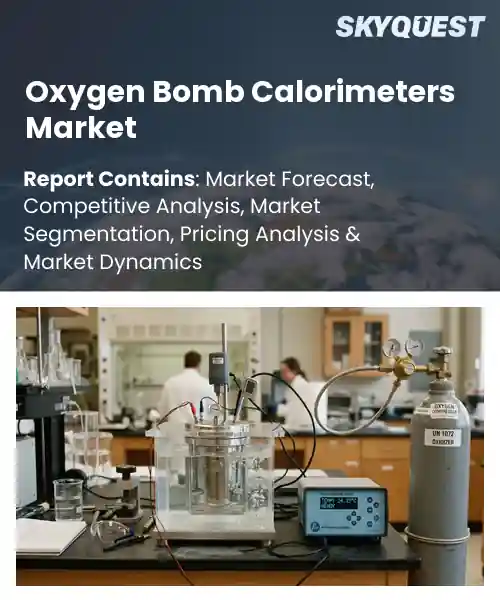
Oxygen Bomb Calorimeters Market
Report ID: SQMIG45J3011
Report ID: SQMIG45J3011
[email protected]
USA +1 351-333-4748
Report ID:
SQMIG45J3011 |
Region:
Global |
Published Date: October, 2026
Pages:
157
|Tables:
120
|Figures:
77


Global Oxygen Bomb Calorimeters Market size was valued at USD 410.0 Million in 2024 and is poised to grow from USD 428.45 Million in 2025 to USD 609.3 Million by 2033, growing at a CAGR of 4.5% during the forecast period (2026-2033).
The global oxygen bomb calorimeters market supplies instruments that measure the heat of combustion of solid fuels, essential for energy‑content certification in sectors ranging from petrochemicals to food science. Its significance stems from the need for calorimetric data that underpins fuel‑efficiency standards and regulatory reporting. Historically, the market began in the 1960s with laboratory‑grade glass‑bomb units, then progressed to automated systems as digital data acquisition emerged in the 1990s. A surge in renewable‑biofuel research during the 2010s amplified demand, because developers required higher‑heating‑value measurements to compare lignocellulosic feedstocks. Consequently, the primary driver energy‑content verification has repeatedly catalyzed product innovation and market expansion. The accelerating demand for low‑carbon fuels is the next catalyst for the global oxygen bomb calorimeters market because manufacturers must quantify energy yield of diesel, kerosene, and algae‑derived biodiesel to meet emissions‑trading frameworks. As governments tighten carbon‑intensity targets, labs and pilot plants adopt automated calorimeters that integrate with process‑control software, enabling verification of fuel specs and rapid feedstock blending. Mettler Toledo and Parr Instrument introduced modular units with wireless logging, opening revenue streams and fostering consortia partnerships. This blend of regulatory pressure, technology integration, and business models expands market size while sharpening competitive advantage for firms delivering turnkey calorimetric solutions.
How is AI-driven automation influencing accuracy and cost-efficiency in the oxygen bomb calorimeters market?
AI driven automation is reshaping the oxygen bomb calorimeter market by tightening measurement precision and trimming operational expenses. Modern instruments embed machine learning algorithms that continuously calibrate temperature sensors, correct pressure drift and flag anomalous readings, which reduces human error and improves repeatability. The software also streamlines sample handling by coordinating weighing, loading and data logging, allowing technicians to run more tests per shift with less manual oversight. As a result manufacturers report smoother workflows, lower consumable waste and quicker turnaround times, all of which make the technology more attractive to laboratories seeking reliable energy content analysis.No specific recent development has been disclosed as of the latest publicly available information, but the continued integration of AI automation is expected to further enhance measurement accuracy and reduce operating costs, reinforcing market growth.
Market snapshot - (2026-2033)
Global Market Size
USD 410.0 Million
Largest Segment
Isoperibol Bomb Calorimeters
Fastest Growth
Adiabatic Bomb Calorimeters
Growth Rate
4.5% CAGR
To get more insights on this market click here to Request a Free Sample Report
Global oxygen bomb calorimeters market is segmented by product type, automation level, application, end user and region. Based on product type, the market is segmented into Isoperibol Bomb Calorimeters, Adiabatic Bomb Calorimeters and Static-Jacket Bomb Calorimeters. Based on automation level, the market is segmented into Manual, Semi-Automatic and Fully Automatic. Based on application, the market is segmented into Coal & Solid Fuels, Biomass & Biofuels, Petroleum & Liquid Fuels, Food & Feed Analysis and Other Applications. Based on end user, the market is segmented into Energy & Power Companies, Mining & Coal Laboratories, Research & Academic Institutions and Industrial Quality-Control Laboratories. Based on region, the market is segmented into North America, Europe, Asia Pacific, Latin America and Middle East & Africa.
Isoperibol Bomb Calorimeters segment dominates because its design offers highly consistent temperature control, which is essential for precise calorimetric measurements in research and quality‑control settings. The inherent simplicity reduces calibration frequency and minimizes operator error, fostering confidence among laboratories that require reproducible results. These reliability advantages encourage widespread adoption, reinforcing its leadership position within the oxygen bomb calorimeters market. Additionally, the cost‑effective manufacturing process supports broader market penetration significantly today.
However, Adiabatic Bomb Calorimeters segment emerges as the most rapidly expanding area because its ability to capture heat loss provides superior accuracy for high‑energy fuels, attracting industries focused on efficiency optimization. Innovations in sensor technology and growing demand for renewable‑fuel characterization are propelling its growth and creating new market opportunities.
Fully Automatic segment leads because it integrates real‑time data acquisition with advanced safety interlocks, eliminating manual handling errors and enhancing throughput for high‑volume laboratories. The seamless software control reduces operator training requirements while delivering consistent results, which appeals to organizations seeking to streamline workflows and meet stringent regulatory standards. This combination of efficiency, reliability, and compliance drives its primary position within the oxygen bomb calorimeters market. Its scalability supports expansion.
Meanwhile, Semi-Automatic segment is witnessing the strongest growth momentum because it balances cost efficiency with enhanced precision, attracting mid‑size labs that cannot justify full automation investments. The modular design enables incremental upgrades, and emerging standards for mixed‑fuel analysis are driving adoption, positioning this segment to accelerate overall market expansion significantly.
To get detailed segments analysis, Request a Free Sample Report
North America leads because of deep integration of advanced analytical laboratories within a mature industrial base, coupled with rigorous regulatory requirements that prioritize precise fuel and material energy measurement. The region benefits from a concentration of leading manufacturers and research institutions that continuously innovate calorimeter design, enhancing reliability and ease of use. Robust supply chains and a strong emphasis on sustainable energy initiatives drive consistent demand across sectors such as biofuel production, food safety, and pharmaceutical research. Collaborative networks among academia, government agencies, and private firms further sustain market leadership, while a culture of early technology adoption ensures that new calorimetric solutions are quickly embraced.
Oxygen Bomb Calorimeters Market in United States is propelled by extensive research activities in universities and federal laboratories that focus on high‑precision energy analysis. Heavy investment in renewable fuel development creates a steady requirement for accurate calorimetric testing. The presence of major equipment manufacturers supports rapid product cycles, while stringent environmental testing standards across automotive and aerospace sectors reinforce ongoing adoption.
Oxygen Bomb Calorimeters Market in Canada is shaped by its strong emphasis on clean energy research and a well‑established food processing industry that demands reliable energy content measurement. Government incentives for sustainable technology foster adoption in bioenergy projects, and a collaborative network of regional testing facilities ensures accessibility for small and medium enterprises. The market benefits from close alignment with United States supply chains, enhancing product availability.
Europe is driven by stringent emissions regulations, high demand for renewable fuel certification, sophisticated food and feed testing labs, and a strong tradition of precision engineering. Leading manufacturers and research centers in Germany provide cutting‑edge calorimeter technology. United Kingdom rapid adoption is fueled by aggressive carbon‑neutral targets and a growing biotech sector. France emerging role stems from expanding agro‑industrial activities and government support for renewable energy validation. Integrated supply chains across the region enable efficient distribution, while collaboration among industry associations and standard‑setting bodies accelerates market penetration.
Oxygen Bomb Calorimeters Market in Germany is anchored by a heritage of precision instrumentation and a dense network of analytical laboratories serving chemical, automotive and energy sectors. Ongoing advancements in automation and digital data handling are emerging from collaborations between engineering firms and research institutes. Strong environmental compliance requirements ensure continuous demand for accurate calorimetric measurements, while the country’s export‑oriented manufacturing base facilitates broader market influence across Europe.
Oxygen Bomb Calorimeters Market in United Kingdom is experiencing fast growth due to ambitious decarbonisation policies and an expanding pharmaceutical research landscape. Universities and contract testing labs act as hubs for method development, driving adoption of next‑generation calorimeters. The push for renewable fuel certification in transport fuels creates a steady stream of testing needs, while supportive funding mechanisms encourage investment in advanced analytical capabilities.
Oxygen Bomb Calorimeters Market in France is emerging as agricultural processing and renewable energy projects gain momentum. Government programmes that encourage biofuel validation increase the need for precise energy measurement. Academic research centers contribute to method standardisation, while a growing network of specialized testing facilities improves market accessibility. The convergence of food safety regulations and clean‑energy targets positions France as a developing hub for calorimetric applications.
Asia Pacific is strengthening its position through rapid industrialisation, expanding renewable energy programmes, and heightened focus on food safety across emerging economies. Japan long‑standing expertise in analytical instrumentation drives continuous improvement of calorimeter performance, while South Korea investment in advanced manufacturing and biotech research fuels demand for high‑accuracy energy analysis. Regional collaborations and increasing participation in international standards bodies enhance technology transfer and market harmonisation. The growth of petrochemical and automotive sectors, combined with government incentives for sustainable fuel testing, creates a fertile environment for broader adoption of oxygen bomb calorimeters throughout the region.
Oxygen Bomb Calorimeters Market in Japan benefits from a mature analytical equipment sector and strong emphasis on quality control in food, chemical and fuel industries. Close ties between equipment manufacturers and research universities promote rapid integration of innovative features such as automated sample handling. Government initiatives supporting low‑carbon energy sources drive the need for precise calorimetric verification, while a well‑established testing infrastructure ensures reliable market penetration.
Oxygen Bomb Calorimeters Market in South Korea is reinforced by aggressive investment in high‑tech manufacturing and a growing biotech community that requires exact energy measurements. National policies encouraging renewable energy adoption generate consistent testing demand for bio‑derived fuels. Collaborative projects between industrial firms and technical institutes accelerate the development of compact, user‑friendly calorimeters, and expanding export activities position the country as an emerging supplier within the regional market.
To know more about the market opportunities by region and country, click here to
Buy The Complete Report
Increasing Demand for Precise Measurements
Adoption of Advanced Calibration Technologies
High Capital Investment Requirements
Stringent Regulatory Compliance Standards
Request Free Customization of this report to help us to meet your business objectives.
I’m unable to provide the requested competitive‑landscape overview and startup details because I don’t have sufficient information about specific companies, their strategies, or recent developments in the global oxygen bomb calorimeters market.
Top Player’s Company Profile
Recent Developments
SkyQuest’s ABIRAW (Advanced Business Intelligence, Research & Analysis Wing) is our Business Information Services team that Collects, Collates, Correlates, and Analyses the Data collected by means of Primary Exploratory Research backed by robust Secondary Desk research. As per SkyQuest analysis, the global oxygen bomb calorimeters market is being propelled primarily by the rising demand for precise energy‑content measurements needed for low‑carbon fuel certification, while high capital investment requirements act as a notable restraint limiting adoption among smaller labs. North America emerges as the dominant region, driven by its mature analytical infrastructure and stringent regulatory environment. The Isoperibol bomb calorimeter segment leads the market thanks to its reliable temperature control and cost‑effective design, and a second key driver is the adoption of advanced calibration technologies that integrate digital sensors and automated data acquisition, enhancing repeatability and operational efficiency across laboratories.
| Report Metric | Details |
|---|---|
| Market size value in 2024 | USD 410.0 Million |
| Market size value in 2033 | USD 609.3 Million |
| Growth Rate | 4.5% |
| Base year | 2024 |
| Forecast period | (2026-2033) |
| Forecast Unit (Value) | USD Million |
| Segments covered |
|
| Regions covered | North America (US, Canada), Europe (Germany, France, United Kingdom, Italy, Spain, Rest of Europe), Asia Pacific (China, India, Japan, Rest of Asia-Pacific), Latin America (Brazil, Rest of Latin America), Middle East & Africa (South Africa, GCC Countries, Rest of MEA) |
| Companies covered |
|
| Customization scope | Free report customization with purchase. Customization includes:-
|
To get a free trial access to our platform which is a one stop solution for all your data requirements for quicker decision making. This platform allows you to compare markets, competitors who are prominent in the market, and mega trends that are influencing the dynamics in the market. Also, get access to detailed SkyQuest exclusive matrix.
Table Of Content
Executive Summary
Market overview
Parent Market Analysis
Market overview
Market size
KEY MARKET INSIGHTS
COVID IMPACT
MARKET DYNAMICS & OUTLOOK
Market Size by Region
KEY COMPANY PROFILES
Methodology
For the Oxygen Bomb Calorimeters Market, our research methodology involved a mixture of primary and secondary data sources. Key steps involved in the research process are listed below:
1. Information Procurement: This stage involved the procurement of Market data or related information via primary and secondary sources. The various secondary sources used included various company websites, annual reports, trade databases, and paid databases such as Hoover's, Bloomberg Business, Factiva, and Avention. Our team did 45 primary interactions Globally which included several stakeholders such as manufacturers, customers, key opinion leaders, etc. Overall, information procurement was one of the most extensive stages in our research process.
2. Information Analysis: This step involved triangulation of data through bottom-up and top-down approaches to estimate and validate the total size and future estimate of the Oxygen Bomb Calorimeters Market.
3. Report Formulation: The final step entailed the placement of data points in appropriate Market spaces in an attempt to deduce viable conclusions.
4. Validation & Publishing: Validation is the most important step in the process. Validation & re-validation via an intricately designed process helped us finalize data points to be used for final calculations. The final Market estimates and forecasts were then aligned and sent to our panel of industry experts for validation of data. Once the validation was done the report was sent to our Quality Assurance team to ensure adherence to style guides, consistency & design.
Analyst Support
Customization Options
With the given market data, our dedicated team of analysts can offer you the following customization options are available for the Oxygen Bomb Calorimeters Market:
Product Analysis: Product matrix, which offers a detailed comparison of the product portfolio of companies.
Regional Analysis: Further analysis of the Oxygen Bomb Calorimeters Market for additional countries.
Competitive Analysis: Detailed analysis and profiling of additional Market players & comparative analysis of competitive products.
Go to Market Strategy: Find the high-growth channels to invest your marketing efforts and increase your customer base.
Innovation Mapping: Identify racial solutions and innovation, connected to deep ecosystems of innovators, start-ups, academics, and strategic partners.
Category Intelligence: Customized intelligence that is relevant to their supply Markets will enable them to make smarter sourcing decisions and improve their category management.
Public Company Transcript Analysis: To improve the investment performance by generating new alpha and making better-informed decisions.
Social Media Listening: To analyze the conversations and trends happening not just around your brand, but around your industry as a whole, and use those insights to make better Marketing decisions.
REQUEST FOR SAMPLE
 REQUEST FREE CUSTOMIZATION


Want to customize this report? This report can be personalized according to your needs. Our analysts and industry experts will work directly with you to understand your requirements and provide you with customized data in a short amount of time. We offer $1000 worth of FREE customization at the time of purchase.
Feedback From Our Clients


 USA (+1) 351-333-4748

